
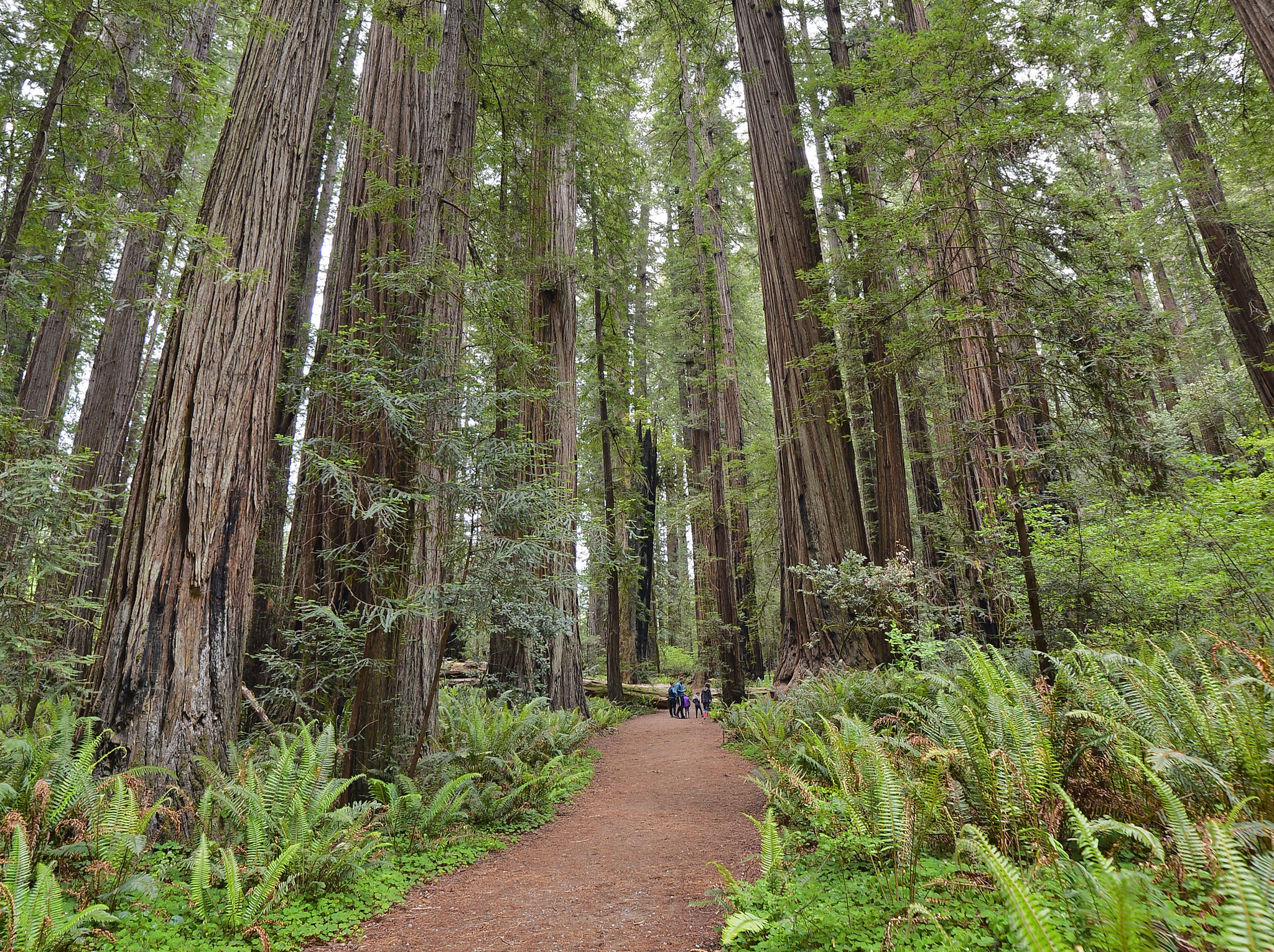
Stout Grove in Redwood National and State Parks. Credit: John Chao / NPS
Location: Humboldt and Del Norte Counties, California, United States
Size: 130,000+ acres of combined federal and state public lands
Established: October 2, 1968 (National Park); combined management with California State Parks in 1994
Overview:
Encompassing a magnificent strip of Northern California’s rugged coastline, Redwood National and State Parks (RNSP) protects some of the most awe-inspiring and unique landscapes on Earth. The parks serve as a sanctuary for the world’s tallest living trees, the coastal redwoods (Sequoia sempervirens). These magnificent trees rise like living skyscrapers amidst a mosaic of wild prairies, coastal oak woodlands, and pristine marine environments.
The land carries a rich human history stretching back more than 10,000 years. Indigenous peoples, including the Yurok and Tolowa, historically lived in harmony with these ecosystems, utilizing fallen redwoods to construct seaworthy canoes and traditional plank houses built over insulated underground pits. To these cultures, the redwoods were more than just natural resources. They were sacred Spirit Beings that taught humans to co-exist with the Earth and its creatures.
The push for modern preservation began after the 1850 gold rush, which brought an influx of Euro-American settlers, miners, and commercial loggers to the region. Driven by demand for durable lumber, timber operations rapidly decimated the ancient forests. Of the original two million acres of old-growth redwood forest, only a small fraction survived. Thanks to the conservation movement of the early 20th century, and the formation of groups like the Save the Redwoods League, key groves were systematically repurchased and preserved, culminating eventually in the establishment of the Redwood National Park in 1968. Today, RNSP stands as a designated UNESCO World Heritage Site, welcoming millions who seek to experience this landscape.
Giants of the Earth
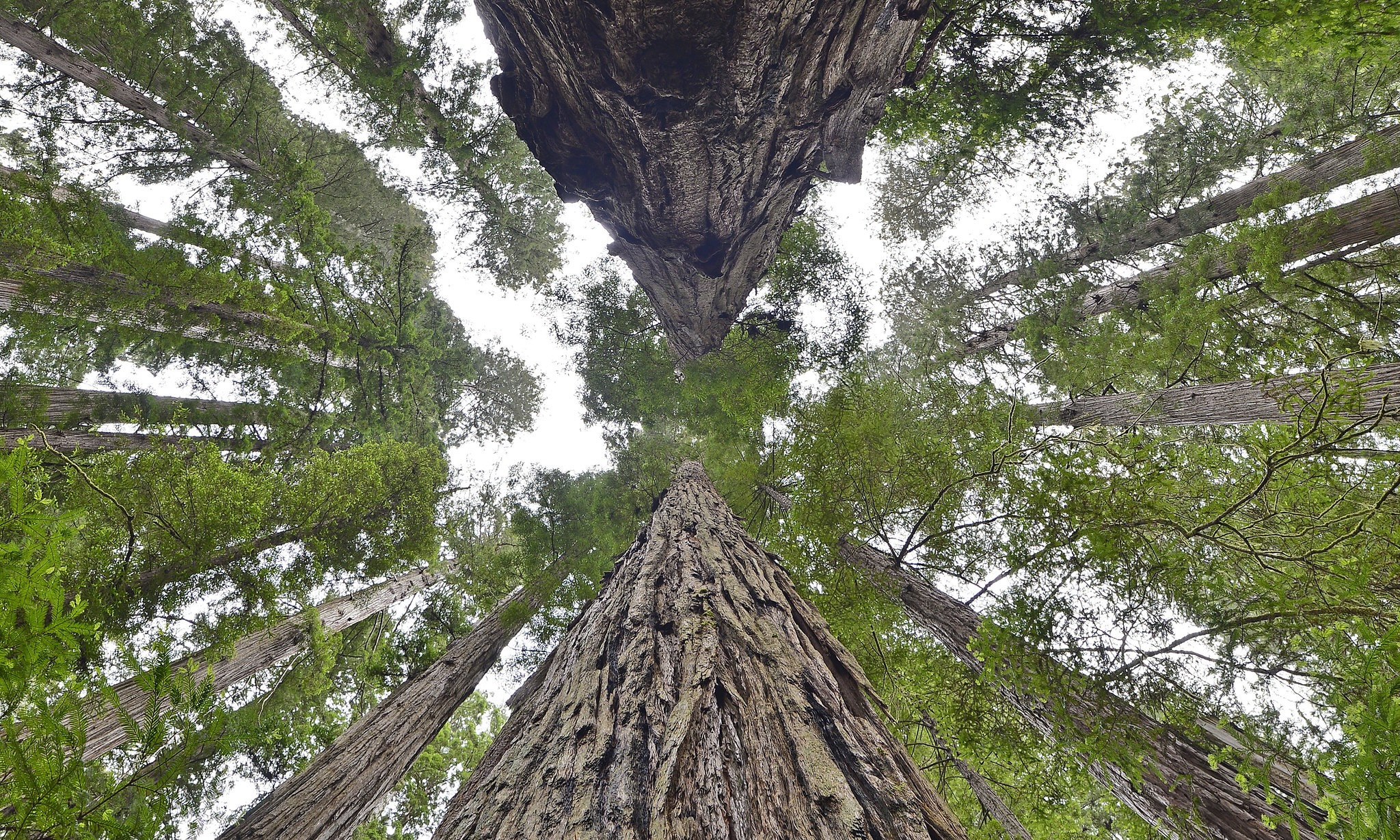
Looking up at redwoods in Redwood National and State Parks. Credit: John Chao / NPS
Redwoods are a biological wonder — living links to the Jurassic Era when relatives of these trees thrived alongside dinosaurs over 160 million years ago. The trees have evolved with unique properties that allow them to exist on an unparalleled scale:
- Staggering Dimensions: Redwood National and State Parks are home to the coastal redwood (Sequoia sempervirens), the largest of the three varieties of redwoods. Growing from a seed no larger than a tomato seed, a mature coastal redwood may reach a height of over 350 feet, with a base spanning more than 22 feet in diameter. Exactly why these giants grow so tall remains a scientific mystery. While new theories continue to develop, a definitive answer remains elusive.
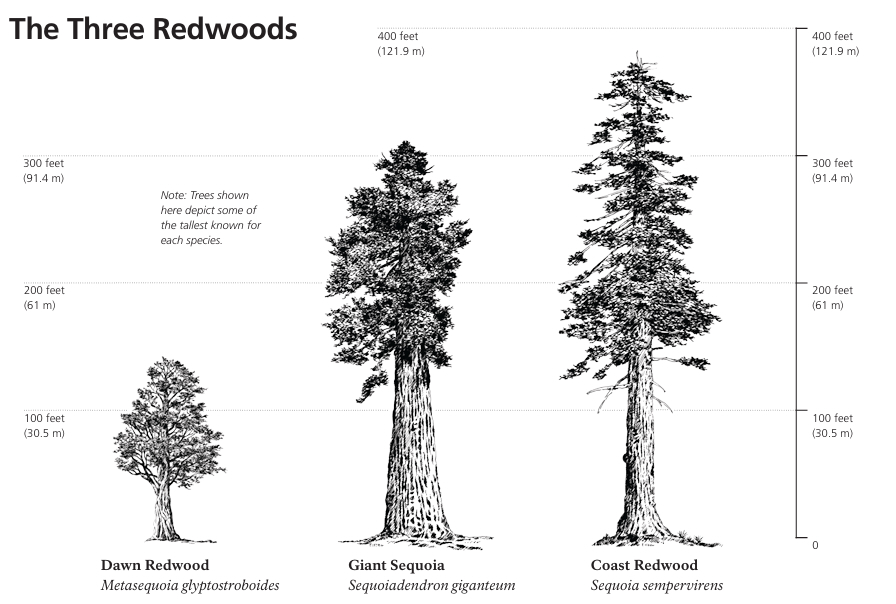
Comparison of redwood sizes. Credit: NPS
- Built-in Defenses: Coastal redwoods are practically immune to common tree diseases and insect damage. This is due to an extraordinarily high concentration of tannin in their wood, which acts as a natural pest deterrent and gives the wood its distinctive reddish-brown hue. Furthermore, their foliage develops high above the ground, allowing them to withstand all but the most intense forest fires. These resilient trees regularly reach 600 years of age, with the oldest individuals surviving for up to 2,000 years!
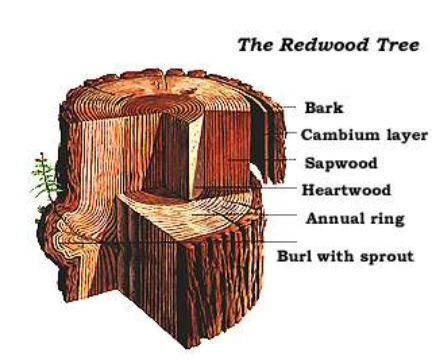
Cross-section of a redwood tree. Credit: NPS
- The Power of Cloning: While most trees rely on seeds to reproduce, coastal redwoods possess the uncanny ability to clone themselves. When a parent tree is damaged by fire, cutting, or toppling, dormant buds contained within hard, knotty growths called “basal burls” are activated. These basal burls allow new sprouts to emerge directly from the root system of a stump or downed tree as a clone. This unusual ability aids the redwoods in their survival as a species.
The Critical Role of Fog
Video from a Redwood Park ranger on the role that fog plays in the redwood groves:
Coastal redwoods need a specific combination of longitude, climate, and elevation in order to thrive. California’s North Coast provides the only environment in the world that can meet the extreme biological demands of these trees. A unique characteristic of this area, which is limited to a few hundred coastal miles, is the thick ocean fog that is essential to the redwoods’ survival.
During the hot, dry summer months when regional rainfall virtually stops, the high-pressure systems over the Pacific Ocean push a thick layer of cool marine fog inland. As the fog drifts through the forest, moisture condenses directly onto the redwood needles high up in the canopy. The water forms droplets and falls to the forest floor like a localized rain shower in a phenomenon known as “fog drip.” Scientists have determined that ocean fog accounts for roughly 40 percent of the redwoods’ annual moisture intake. Without this natural cooling and watering system, the upper canopies would dehydrate. Thus, marine fog may be considered the fundamental architect of the entire redwood range.
Return of the California Condor
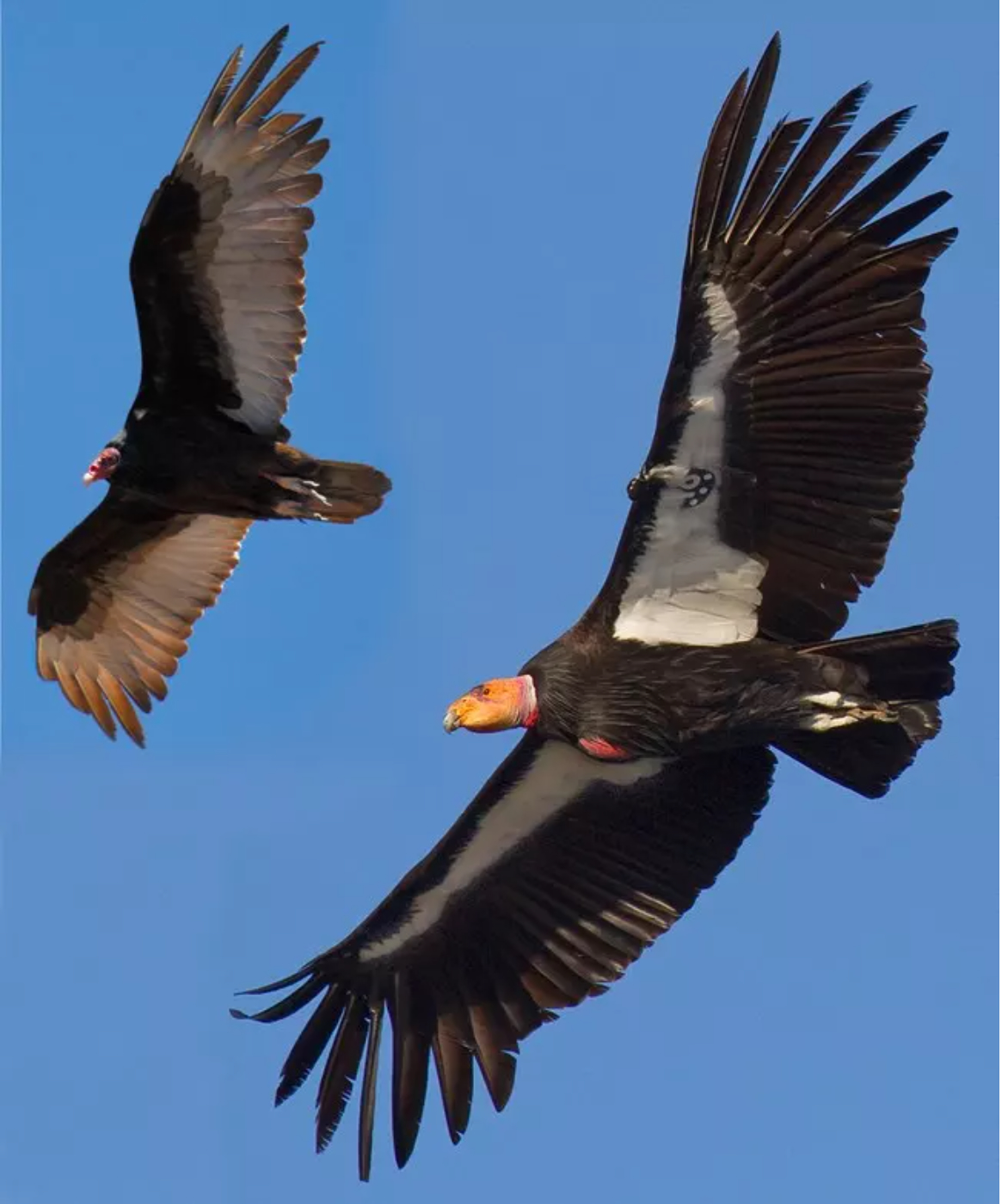
Comparison of a turkey vulture (left) and a California condor (right) in flight. Credit: Gavin Eammons / NPS
The return of the majestic California condor (Gymnogyps californianus) to Northern California represents one of the most profound cultural and environmental restoration milestones in modern conservation history. By 1982, the global population of these rare birds had plummeted to a catastrophic low of just twenty-two individuals left in the entire world. Following decades of intensive captive-breeding efforts by a coalition of tribal, federal, and private partners, the skies above the redwoods are once again home to North America’s largest land bird.
- Deep Cultural and Historical Roots: Historically, the coastal redwoods and the broader Pacific Northwest were part of the condor’s traditional home range. In 1805, the Lewis and Clark expedition explicitly documented condors spotted at the mouth of the Columbia River. The Yurok Nation, recognizing the bird’s vital ecological role and its sacred status, formally declared the restoration of the condor (known as “Prey-go-neesh” in the Yurok language) to its ancestral territory a top priority in 2003. Following extensive scientific habitat suitability assessments and public planning meetings, the Pacific Northwest flock was officially established in spring 2022 inside Redwood National and State Parks.
- The Power of Mentorship: Young, captive-bred condors are typically released into the wild when they are between two and four years old. To help shape their behavior and teach them how to navigate their environment safely, the Park’s release pen hosts a permanent mentor bird named Paaytoqin, which translates to “Come back” in the Nez Perce language. Paaytoqin, an older male hatched in 2014, remains in the enclosure to guide new, young condors. To honor their individuality and significance, the Yurok Condor Restoration Program gives each bird a unique traditional name reflecting its personality. An early cohort included A4 (“Cher-perhl So-nee-ne-pek,” meaning I feel strong), A5 (“Neee’n,” meaning The Watcher), A6 (“Me-new-kwek,” meaning I’m shy), and A7 (“He-we-chek,” meaning I am healthy / I get well).
- A New Beginning: For the first time in over a century, a pair of California condors in the Pacific Northwest are believed to have established a nest and laid an egg in the wild. This is a huge milestone for the flock and for the overall recovery program. Currently, 24 condors reside in the wild within Yurok ancestral territory, which includes Redwood National and State Parks.
Overcoming Threats to Survival
Despite their successful return, wild condors continue to face severe, human-caused challenges that conservation managers must actively mitigate:
- Lead Poisoning: This is the most significant threat to adult and juvenile condor survival in the wild. When hunters utilize traditional lead ammunition, the soft metal shatters into dozens of tiny fragments upon impact, scattering throughout an animal’s carcass. When condors scavenge these carcasses, they inadvertently ingest these toxic fragments, resulting in severe or fatal lead poisoning. Hunters are important conservation stewards. By using non-lead ammunition, they can carry on the proud tradition of protecting wildlife and ecosystems as a whole.
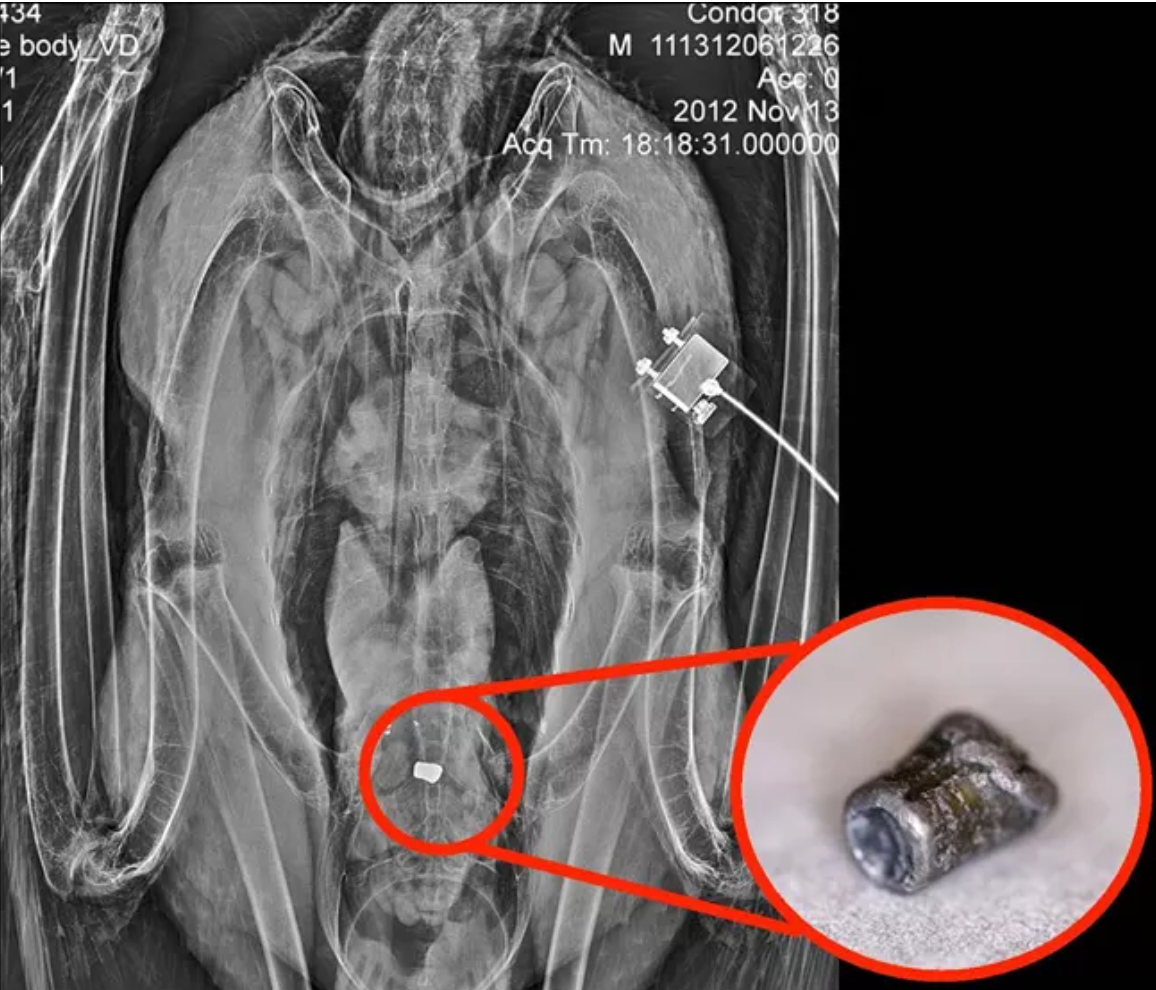
Radiograph of a condor that consumed lead ammunition; pullout photo is the actual fragment that was removed from the bird. Credit: Ventana Wildlife Society
- Microtrash Ingestion: This is the leading cause of death specifically for wild condor nestlings and chicks. Adult condors naturally look for small bone chips to feed their young as a source of essential calcium. However, condors often mistake small items of human litter (such as plastic bottle caps, pull tabs, glass, and small metal fragments) for bone chips and regurgitate them to their chicks. This indigestible microtrash builds up in the chick’s digestive system, leading to fatal impactions and starvation.
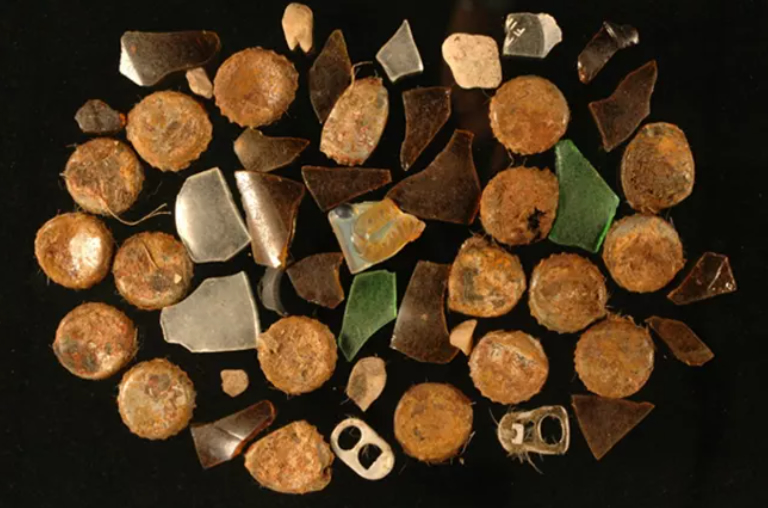
Bottle caps, tabs, and pieces of glass and metal were removed from the crop of a dead condor chick. Credit: Ventana Wildlife Society
- Utility Line Electrocution: Due to their massive wingspan, condors can easily touch two live power lines simultaneously, completing an electrical circuit that delivers a fatal shock. To prevent this, biologists developed an innovative “power pole aversion training” program to be implemented before the birds are released. In captive enclosures, young condors interact with a mock utility pole rigged to emit a harmless, mild shock if landed upon. The birds quickly learn this life-saving lesson from a single experience and, through social interaction, pass on the proper perching behavior to one another.
Sources: All images and data are public domain provided via the Redwood National Park NPS Site.
This piece comes to us from our nonprofit partner Post Pigeon EDU. With a mission to spark curiosity about the amazing nature in our public lands, Nature and Post Pigeon EDU are collaborating on a series of posts that will share the histories and stories of our National Parks and other public lands.
Inspiring the next generation of planetary stewards, Post Pigeon EDU is a nonprofit organization working to increase exposure and access to the outdoors by bringing public lands and leadership into K-12 classrooms by virtual means.