John Green on America’s Evangelicals Survey

Read political science professor John Green’s comments at the April 13, 2004 RELIGION & ETHICS NEWSWEEKLY press conference in Washington, DC to announce the results of a new national survey on America’s evangelicals:

This is a very sophisticated survey. It has a lot of detail; it has a lot of nuance. I think it would be in everyone’s interest to look carefully through the materials that are being presented here because this is a rare look into a very important religious community. Oftentimes in polling, we tend to look at religion in a very general way, the same way we’d look in a general way at other demographic characteristics like education or income or occupation. And this is one of those rare opportunities.

johngreen-commentary-post01

It’s been a long time since anybody has looked at the evangelical community in this much detail and with this much nuance. So I commend my colleagues for taking on this topic. In fact, you’d have to go among the pointy-headed crowd, myself included, among intellectuals, to get this degree of sophistication. And I think it comes at a very important time, when evangelicals have really become a prominent people in American politics and in American society at large.

It’s interesting, when your colleagues [in the media] from Europe call me — which they do from time to time — they have this impression that everybody in America is an evangelical Protestant, because that’s the image that they have because of the renewed prominence of this community.

This survey allows for a lot of nuance and detail when it comes to the evangelical community. … What we’ve chosen to emphasize today is the core of the evangelical community. But if we adopted other types of definitions — and if you all have questions about definitions, I’m the designated go-to guy on definitions — we can talk about that. But we wouldn’t see enormously big differences if we adopted other definitions.

Let me just hit upon what I see as a couple of highlights of the survey, picking up on what Bob [Abernethy] and Anna [Greenberg] have both talked about, but maybe looking at it from a little different point of view. One of the reasons that evangelicals are so important in American society today is because of their enormous energy. This is a community that is just extraordinarily active. Of course, many of us notice the relatively new activity in politics. But evangelicals are active in every other area. They’re active in the arts, they’re active in cultural things, they’re active in publishing and broadcasting and the news media. And then, of course, they’re very active in religious activities, which include a high level of volunteerism and participation in charitable and other types of parachurch activities. And the source of that energy is this powerful tension that Bob alluded to earlier. This is a group of people that in many ways feel very comfortable with American society; in many ways they feel like they are at the center of American society. But in other ways, they feel that they are still a people apart — that they really have to struggle to get their message out, that they are not respected the way that they ought to be respected.

We see that in the two questions that Bob highlighted, with really three quarters of white evangelicals thinking that they’re mainstream, but then three quarters believing that they have to struggle to get their message out. And you also see it in some of the things that Anna mentioned. They believe that they have influence with political leaders, with the Bush administration and in Congress. On the other hand, they also feel that they’re looked down upon, [that] there are certain institutions that really dislike them. And one of the findings, and I hope this doesn’t come as a big shock to all of you here, but they really don’t like the news media too much. They really feel that the news media is hostile to them. It’s not just that [the media] has a different point of view, but [it] is actually hostile to them, and I think that’s part of that.

Well, where does this tension come from? Well, I think it comes from two things. One is that this is a group with very distinctive religious beliefs and practices. When we look at survey data on religious behavior and we look at survey data on religious beliefs, we always have to be a little bit skeptical, because people tend to put the best face on their beliefs and practices. But even if you apply an appropriate discount to the self-report, these are deeply religious people. I mean, they really do behave and believe in distinctive ways, compared to the American public as a whole. And one part of that distinctiveness in belief and behavior is they build very strong communities. These people are very involved in their churches and in the organizations connected to their churches. And this is something of an exception in American society. I’m sure, as many of you know, we’ve had in the last several decades a dissolution of many communities, a decline in what scholars call social capital and sociability generally. Well, here’s a community that’s a countertrend, that builds these very strong communities and organizations. And they’re able to, in many respects, lead a different kind of life than many Americans do. So here we have a distinctive community that is nonetheless enmeshed in this broader, diverse, pluralistic society. And there’s just a lot of tension between those two things.

Evangelicals, because of their beliefs and their distinctive communities, do tend to put stress on traditional morality. As Anna indicated, perhaps not as strongly as the popular images, but they are distinct in that regard. They pay a lot of attention to sexual behavior. They’re very interested in families and children. They’re very worried about the institutions that impact families and children — schools, the news media, entertainment, other forms of education. And while those are not the only set of concerns this community has, they’re a particularly important set of concerns because of how they link the evangelical community to politics. So it’s not that every evangelical wakes up every morning wanting to amend the Constitution to prevent gay marriages, but that these moral issues play a very important role in the way they perceive politics.

If we could remove from evangelicals, or from American politics today, these moral issues, then this community would not be a strong constituency of the Republican Party. It would be divided up. There’d be many more Democrats. There’d still be quite a few Republicans, by the way, because it’s very diverse community. But at this particular time, it’s the moral issues that tie this community to partisan politics. And that’s why it’s so central to our discussions of politics. But if you look on a whole range of other issues, as Anna indicated, there’s a lot of diversity there. Someone like John Kerry might actually appeal to a fair number of evangelicals on some of these other economic and social issues, if the moral issues were subdued or were removed from the table.

Evangelicals are also deeply engaged in society in other ways than politics. The survey shows they’re very involved in volunteerism. They are very involved in charitable activities. They really see their role in society as not just doing politics and not just spreading the word — and they’re very interested in evangelism — but in participating in society in other ways as well. So this is a group that behaves in an extraordinary way in lots of different areas.

How would we sum this up? Well, there’s an old phrase in Christianity that I’m sure many of you are familiar with, and that is that Christians should be “in the world but not of the world.” In many ways that phrase describes the tension we’re talking about with the evangelical community. These are folks that perceive themselves to be very much in the modern world. And they are, in fact, very much in the modern world. But they do not see themselves as being “of” this world, but having other distinctive values and aspirations that set them at odds with the society that they belong to.

America’s Evangelicals

Poll: America’s Evangelicals More and More Mainstream But Insecure
Diversity, Differences Mark Their Views on Society, Culture, Politics

Washington, DC – Three-quarters of all evangelicals say they feel part of mainstream American society, but three-quarters of all evangelicals also believe they are a minority under siege and must fight for their voices to be heard. A March 2004 poll by Greenberg Quinlan Rosner Research Inc. for RELIGION & ETHICS NEWSWEEKLY and U.S. NEWS & WORLD REPORT shows that America’s evangelicals are comfortable with society around them, but not completely so, and their social and political views are notably diverse.

While a strong majority of white evangelicals oppose gay marriage (84%) and civil unions (73%), most evangelicals (52%) say they would prefer to rely on state law to prohibit gay marriage rather than amend the U.S. Constitution. Less than half of white evangelicals (48%) say that a candidate’s support for gay marriage would disqualify him or her from getting their votes.

View or Download the Data

Survey Results (PDF, 94 KB)

Questionnaire (PDF, 99 KB)

Methodology (PDF, 21 KB)

Viewing these files requires the free Adobe Reader.

There are important differences among black, white and Hispanic evangelicals on political and moral questions. About 69% of white evangelicals say they are Republicans or lean Republican, while 84% of African American evangelicals identify themselves as Democrats or lean Democrat. Roughly one-in-five likely white evangelical voters (23%) say they are Democrats or lean Democrat.

The media often look to Pat Robertson and Jerry Falwell to speak on behalf of all evangelicals, yet evangelicals give Falwell a marginally unfavorable rating (average rating 44 out of a possible 100), and Robertson receives only a marginally favorable rating (55 out of a possible 100). In contrast, evangelical leaders Franklin Graham and James Dobson are both viewed very favorably by evangelicals (73 out of a possible 100), and Pope John Paul II is viewed more favorably by all evangelicals (59 out of a possible 100) than either Falwell or Robertson.

Contrary to popular assumptions, not all American evangelicals attend mega-churches. Only 14% belong to congregations that are larger than 1000 members, the same as non-evangelical Protestants, and almost one-in-five evangelicals (19%) attend a church with less than 100 members.

There are notable discrepancies between how evangelicals think members of the wider society view them, how they view themselves, and how society says it views evangelicals. A strong majority (72%) of all evangelicals feel the mass media are hostile to their moral and spiritual values. Almost half (48%) believe that evangelical Christians are looked down upon by most Americans. And 75% of all evangelicals say they must fight to make their voices heard. In contrast, less than half (46%) of non-evangelicals think evangelicals must fight to be heard, and only 35% of non-evangelicals think Americans looks down on evangelicals.

Despite their involvement in international issues such as human rights and religious freedom, evangelicals rank military strength (40%), controlling weapons of mass destruction (34%) and fighting terrorism (30%) as significantly more important than relief efforts (14%) or helping to improve the standard of living in less developed countries (9%).

While white evangelicals are almost evenly divided among themselves over whether the country is going in the right direction (44%) or is on the wrong track (45%), all African Americans say overwhelmingly (81%) that the country has gotten off on the wrong track. There is much more agreement among evangelicals and the country as a whole when asked whether moral values are on the wrong track. More than three-quarters of white evangelicals, 94% of African American evangelicals, 87% of all African Americans, 74% of all Hispanics, and 71% of all Americans think moral values are seriously on the wrong track.

An overwhelming majority of all evangelicals (84%) believe that personal faith in Jesus Christ is the only way to salvation, compared with 38% of Catholics and 56% of non-evangelical Protestants. Just half of white evangelicals, however, believe that only born-again Christians go to heaven, and even fewer black evangelicals (42%) say they believe only born-again Christians will go to heaven.

Only white evangelicals put moral values first among their domestic concerns. More than a third of white evangelicals (37%) say moral values are of most concern, while only 16% of all African Americans and 13% of all Hispanics say that moral values worry them most. Forty-one percent of all African Americans and 34% of all Hispanics worry most about the economy and jobs, but among white evangelicals the number is 25%. Yet on many other domestic pocketbook issues such as health care and Social Security, the level of concern among white evangelicals is very similar to that of all other Americans.

By evangelical the survey means EITHER respondents who indicated that they are Protestant or another Christian religious preference other than Roman Catholic, Orthodox or Mormon and who indicated they would say they are a fundamentalist, evangelical, charismatic or Pentecostal Protestant OR respondents who indicated that they are Protestant or another Christian religious preference other than Roman Catholic, Orthodox or Mormon who do not consider themselves liberal or mainline and call themselves a born-again Christian. This is not the only definition of evangelical, of course, but it does define the core of the evangelical community.

The nationwide survey of 1610 adults, with over-samples of white evangelicals, African Americans, and Hispanics, was conducted March 16 – April 4, 2004 and has a margin of error of plus or minus 2.5%. Additional analysis was provided by John Green, professor of political science and director of the Ray C. Bliss Institute of Applied Politics at the University of Akron, and Robert Wuthnow, professor of sociology and director of the Center for the Study of Religion at Princeton University.

RELATED READING:

AMERICAN EVANGELICALISM: EMBATTLED AND THRIVING by Christian Smith

CHRISTIAN AMERICA? WHAT EVANGELICALS REALLY WANT by Christian Smith

DIVIDED BY FAITH: EVANGELICAL RELIGION AND THE PROBLEM OF RACE IN AMERICA by Michael Emerson and Christian Smith

EVANGELICALISM: THE NEXT GENERATION by James M. Penning and Corwin E. Smidt

HEAVEN BELOW: EARLY PENTECOSTALS AND AMERICAN CULTURE by Grant Wacker

WHERE SHALL MY WOND’RING SOUL BEGIN? THE LANDSCAPE OF EVANGELICAL PIETY AND THOUGHT edited by Mark Noll and Ronald Thiemann

WONDERFUL WORDS OF LIFE: HYMNS IN AMERICAN PROTESTANT HISTORY & THEOLOGY edited by Richard Mouw and Mark Noll

THE SCANDAL OF THE EVANGELICAL MIND by Mark Noll

BLESSED ASSURANCE: A HISTORY OF EVANGELICALISM IN AMERICA by Randall Balmer

WITH GOD ON OUR SIDE: THE RISE OF THE RELIGIOUS RIGHT IN AMERICA by William Martin

PIETY AND POLITICS edited by Richard John Neuhaus and Michael Cromartie

SHAKING THE WORLD FOR JESUS: MEDIA AND CONSERVATIVE EVANGELICAL CULTURE by Heather Hendershot

LATINO PENTECOSTAL IDENTITY: EVANGELICAL FAITH, SELF AND SOCIETY by Arlene Sanchez Walsh

ONE FAITH: THE EVANGELICAL CONSENSUS by J.I. Packer and Thomas C. Oden

A PUBLIC FAITH: EVANGELICALS AND CIVIC ENGAGEMENT edited by Michael Cromartie

DECONSTRUCTING EVANGELICALISM: CONSERVATIVE PROTESTANTISM IN THE AGE OF BILLY GRAHAM by D. G. Hart

PILGRIMS ON THE SAWDUST TRAIL: EVANGELICAL ECUMENISM AND THE QUEST FOR CHRISTIAN IDENTITY edited by Timothy George

THE RISE OF EVANGELICALISM by Mark A. Noll

BIOGRAPHICAL DICTIONARY OF EVANGELICALS edited by Timothy Larsen et al.

ENCYCLOPEDIA OF EVANGELICALISM by Randall Balmer

ONE NATION UNDER GOD: CHRISTIAN FAITH AND POLITICAL ACTION IN AMERICA by Mark A. Noll

RELIGION AND AMERICAN POLITICS: FROM THE COLONIAL PERIOD TO THE 1980s edited by Mark A. Noll

THE VARIETY OF AMERICAN EVANGELICALISM edited by Donald Dayton and Robert Johnston

FUNDAMENTALISM AND EVANGELICALISM by Nathan Hatch

THE SMELL OF SAWDUST: WHAT EVANGELICALS CAN LEARN FROM THE FUNDAMENTALIST HERITAGE by Richard J. Mouw

GOD’S DAUGHTERS: EVANGELICAL WOMEN AND THE POWER OF SUBMISSION by R. Marie Griffith

GOD’S MAN FOR THE GILDED AGE: D.L. MOODY AND THE RISE OF MASS EVANGELISM by Bruce Evensen

EVANGELICAL THEOLOGY: AN INTRODUCTION by Karl Barth

THE YOUNGER EVANGELICALS by Robert E. Webber

Timbuktu

BOB ABERNETHY, anchor: Now, a reporter’s pilgrimage. Of all the world’s remote datelines, surely Timbuktu must rank close to the top. It’s in the West African nation of Mali, where the Sahara desert meets the grasslands. Fred de Sam Lazaro went there, and found a story. Long ago, it seems, Timbuktu was a place of high Islamic scholarship, and it still has a million manuscripts to prove it.

FRED DE SAM LAZARO: For most Americans, Timbuktu has long stood for, well, nowhere — a place far, far away, probably in fiction.

timbuktu-post01-mosque

But deep in the West African nation of Mali, where the savannah grasslands meet the Sahara, lies Timbuktu. It’s an impoverished town of about 30,000, most of them nomadic traders or subsistence farmers. But Timbuktu is rich in history — history that contradicts a commonly held impression in the West that sub-Saharan Africa has only oral and no written traditions.

Professor SALEM OULD EL HAJJ (Through Translator): Well before there was an America, Timbuktu was a thriving center of learning, with the university. Professors were teaching philosophy, theology, mathematics.

DE SAM LAZARO: Professor El Hajj says the earliest records of Timbuktu go back to the 11th century, to a prosperous desert crossroads where salt, gold, slaves, and scholarship were exchanged. That all ended in the late 1500s with Moroccan invasions and later French conquest.

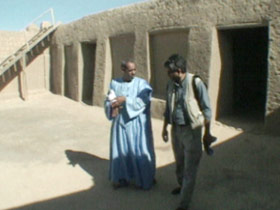
Today, much of Timbuktu’s architecture seems frozen — or more appropriately, “baked” in time. The distinctive Djingerey Ber Mosque, built of limestone and mud, has been run by Imam Abdramane Essayouti’s family for generations. Islam is thought to have come to this region in the eighth century.

Imam ABDRAMANE ESSAYOUTI (Through Translator): For us this mosque is our heritage. Imagine, it was built in 1325, handed down to us by our parents. This mosque has been here for 700 years.

timbuktu-post02-courtyard

DE SAM LAZARO: The 15th-century Sankore Mosque was Timbuktu’s nerve center of intellectual life.

Imam ESSAYOUTI (Through Translator): In summertime, they gave lectures here. You have a circle here — at least 40 or 45 or 50 students.

DE SAM LAZARO: Well before Europe’s Renaissance, students and scholars — as many as 25,000 — came from West and North Africa and the Middle East to study Islamic law, theology, and a range of secular subjects.

Today, the legacy of that scholarship lies in a vast, scattered collection of historical manuscripts.

ALI OULD SIDI (Guide): Yes, this is the library.

DE SAM LAZARO: The Ahmed Baba collection, named after a 15th-century scholar, with some 40,000 manuscripts.

Arabic was used for theological as well as secular works — testament to the Islamic world’s leadership during the period in medicine and the sciences.

timbuktu-post03-hebrew

Every now and then, there’s a manuscript in Hebrew. This one is a 16th-century letter by a Jewish trader, writing home to Morocco about market prices in Timbuktu.

ALI OULD SIDI: Timbuktu was really a melting pot where we had Jewish, we had people from North Africa, people from sub-Saharan Africa, and all of them were living in peace here in Timbuktu.

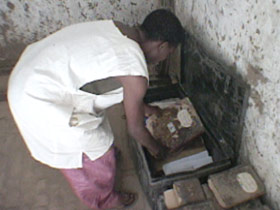
DE SAM LAZARO: So far, only a small fraction of Timbuktu’s one million or so manuscripts has been studied. Stephanie Diakete, a U.S.-born expert on book arts, says the works she’s surveyed are classically Islamic — emphasizing calligraphy — but with distinctive African influence.

STEPHANIE DIAKETE (Specialist on Book Arts): They respect the precepts of Islamic art in that they are geometric based and the use of colors. The drawing is quite close to ethnic art, it’s quite beautiful. The calligraphic style is very specific. It’s quite easy to tell the geographic origin of the scholar by the calligraphy that he uses.

DE SAM LAZARO: Despite a wealth of content, the priority now for scholars and manuscript owners, like Abdel Kader Haidara, is the uphill task of saving the crumbling manuscripts.

Their survival is a tribute to the ancient binders. This Qur’an survived a building collapse. The classic geometric artwork on its goatskin cover is still pristine on the back.

timbuktu-post05-chests

A handful of collections, like Haidara’s, have gotten support from universities and foundations in the West to catalog, conserve, and restore manuscripts.

It’s tedious work and at best involves a small part of the collection. The majority of Timbuktu’s volumes is precariously stored in small family collections.

Abdul Wahid Haidara, who’s not related, has little time. And, on a teacher’s salary of just $50 a month, almost no money to preserve what he calls the family’s heritage.

Haidara has resisted offers from foreign collectors to buy manuscripts, many of which could fetch fortunes in the West. But there’s concern that people struggling to feed their families will be tempted.

Timbuktu’s mayor says the best way to reduce poverty is to attract more tourists — sightseers and scholars — who could both highlight and preserve the historical treasure.

IBRAHIM CISSE (Mayor of Timbuktu) (Through Translator): Timbuktu belongs to all of humanity, not just to the people of Mali. This is a very old learning center, a historical city which has endangered sites declared world heritage by UNESCO. Timbuktu belongs to the whole world and around the world, people should do something to save Timbuktu.

DE SAM LAZARO: There’s not likely to be a renaissance anytime soon. For one thing, the road to Timbuktu hasn’t changed since the city’s heyday in the 1500s. That is, there is no road.

For RELIGION AND ETHICS NEWSWEEKLY, this is Fred de Sam Lazaro in Timbuktu, Mali.

Same-Sex Marriage


LUCKY SEVERSON, guest anchor: A new survey indicates that 52 percent of Americans would favor a law that prohibits same-sex marriage. Two Canadian provinces have now made same-sex marriages legal. And the highest court in Massachusetts may soon rule on the issue. We have a report from Jeff Sheler.

JEFF SHELER: Some are calling it a changing of the guard, a social shift of historic proportions in the Canadian provinces of Ontario and British Columbia where, earlier this year, laws were enacted legalizing same-sex marriage. The controversial change has sent shock waves through legal and religious communities on both sides of the border.

samesexmarriage-post08-deanerussell

But for Americans Herb Russell and Roberto Font Deane, it is an answer to prayer. They have come to Ottawa to be married — something they cannot do back home in New Jersey.

ROBERTO FONT DEANE: To me it is the ultimate public declaration about how two people feel about each other. And it gives me a sense of honesty.

HERB RUSSELL: A lot of people in the straight world take it somewhat for granted. It’s easy to get married and it’s easy to divorce, and all we want is the right to get married.

SHELER: In recent years, the United States has grown more accepting of homosexuality, in public policy as well as in pop culture.

But when it comes to the question of marriage, the nation remains sharply divided. A recent WASHINGTON POST poll found that fewer than four in 10 Americans support same-sex civil unions that would provide some of the rights and legal protections of marriage. Legislatures in 37 states have adopted so-called Defense of Marriage Acts, which define marriage as a contract between a man and a woman.

samesexmarriage-post02-cityhall

But on this day, Roberto and Herb are doing what the law allows, even though they know it will not be recognized at home.

Mr. RUSSELL: We are very proud of this moment.

Mr. DEANE: Okay, I’m ready. Are you?

Mr. RUSSELL: I am.

Mr. DEANE: All right. Don’t change your mind.

UNIDENTIFIED CLERK: There is no legal reason why you two cannot be married and you are not close blood relatives. Correct?

Mr. DEANE and Mr. RUSSELL: Correct.

CLERK: Your license is done. There you go. Congratulations.
Mr. RUSSELL: It’s that simple?

CLERK: It’s that simple.

Mr. DEANE: It is not easy for us. We have to leave our own country and enter a country that will celebrate and honor what we are doing. And hopefully we can take what we have done here back to our country and there’ll be some who will recognize and honor what we have done, and there will be some who are absolutely shocked and disgusted by what we have done.

samesexmarriage-post03-nashthayer

SHELER: Chuck Thayer and Cheryl Nash believe same-sex marriage is a clear violation of God’s law. They plan to marry in September in a church outside of Boston.

CHERYL NASH: If you extend the rights to the same-sex marriage, that is compromising what marriage is all about, which goes back again to the foundation that biblically God designed for a man and a woman. And although it may not affect my everyday commitment to Chuck, it would — in the long run it takes away from what marriage was designed to be.

CHUCK THAYER: I think same-sex marriage would definitely lessen the meaning of what we’re about to undertake.

SHELER: Like Cheryl and Chuck, many Americans view marriage as foremost a religious rite, ordained by God as a lifelong commitment between a man and a woman. That marriage also is a legal contract, they say, is secondary. Laws may change, but the divine ordering of the marriage bond cannot be altered.

samesexmarriage-post04-cott

But Harvard historian Nancy Cott says marriage has changed over the years in some significant ways, as reflected in the high rate of divorce, the changing role of women, and the repeal of laws barring interracial marriage.

Professor NANCY COTT (Historian, Harvard University): These are three areas that are very basic, so that opponents to same-sex marriage who say it has always been the same and this is a big change are neglecting to look at the finer points of history.

SHELER: Moreover, she says, the Christian tradition of monogamous marriage blessed by the church is a relatively late development.

Professor COTT: It doesn’t start until the time of Christ and it is not authorized, legitimated, enforced in Europe until probably 1400 or 1500, when Catholic ecclesiastical law had some purchase over the population. The Catholic Church regards marriage as a sacrament. But historically the Protestant Church broke away from that and said marriage is not a sacrament, it is a civil matter. Historically, marriage has been all about support of children. And that is the tradition in which the United States was founded, being traditionally a Protestant country.

samesexmarriage-post05-hollo

SHELER: But to Pastor Sam Hollo of the Westgate Church in Weston, Massachusetts, where Cheryl and Chuck will be married, it is the potential impact same-sex marriage would have on families that he finds most worrisome.

Pastor SAM HOLLO (Westgate Church): The marriage and family unit has been defined by a number of authors as basically the building block of society. If they’re broken or if they’re distorted, if they lack God’s blessing and his provision, then you wind up with a society whose building blocks are cracked, some are removed, some have been destroyed, and the effects on society will be evident, particularly over time.

Mr. DEANE: Family has been redefined. We no longer have, for various reasons, mother, father, two children. It can be now mother and two children, father two children. It can be lesbians, one child, two child[ren]. It can be gay men.

SHELER: As devout Episcopalians, Herb and Roberto wanted a church wedding.

samesexmarriage-post06-taylor

Mr. RUSSELL: You know, I have been to a lot of weddings. Somehow being in my own wedding in a church — it is not a big wedding today, but my brother and my sister-in-law are reading the scriptures — and being a part of the ceremony is very important to us.

SHELER: The Reverend Susan Taylor, a minister in the United Church of Canada, will conduct the ceremony. Hers is one of the few churches in Canada that will marry same-sex couples.

Reverend SUE TAYLOR (United Church of Canada): Certainly in the United Church of Canada, we said that there is no difference. They are all equal and loved equally.

SHELER: In Canada, as in the United States and Europe, religious denominations are sharply divided over exactly what the Bible and Christian tradition teach concerning homosexuality.

Pastor HOLLO: Every time it is mentioned, it is mentioned as something that is contrary to God’s will. And something that isn’t just sinful but, to a degree that is called, at times, an abomination in his sight.

samesexmarriage-post09-hug

Rev. TAYLOR: We may take a different interpretation. And there is nothing that we have read that says we can’t do this. Others may interpret it differently, and for now, we have to respect that.

Rev. TAYLOR (During Marriage Ceremony): Roberto, will you take Herb to be your lifelong partner?

Mr. DEANE: I will.

Rev. TAYLOR. Herb, will you take Roberto to be your lifelong partner?

Mr. RUSSELL: I will.

Rev. TAYLOR: For as much as Roberto and Herb have made this solemn covenant before God and all of us here, I now declare them to be life, lifelong partners in marriage. And you may kiss one another.

SHELER: As the debate continues, the urgent and unanswered question remains whether same-sex marriage will further erode an already embattled institution or bring it new strength and relevance by expanding and redefining its borders.

Mr. RUSSELL: We are going to toast each other tonight. After this church ceremony.

Mr. DEANE: We are going to have a good time. Just like everyone else. Just like any other married couple.

SHELER: For RELIGION & ETHICS NEWSWEEKLY, I’m Jeff Sheler.

Omar McRoberts Extended Interview

Read more of Kelly Hudson’s interview with University of Chicago sociology professor Omar McRoberts about the suburbanization of black churches:

churchesonthemove-post05-mcroberts

Historically, black religious institutions have had to play the role of the house builder, the psychologist, the bank — all kinds of roles. There’s a lore that’s largely reality of the church being all things to all people. In neighborhoods where black churches have been stable [and] present in very important social ways to the people of those neighborhoods, of course for a church to leave could present a crisis for that neighborhood — assuming that church was playing all of those roles in the first place. To some degree, the idea of the church being all things to all people takes for granted a certain understanding of what community is. Is the church community the neighborhood? Is the church community the people inside the church, the congregation? The way that a religious institution answers those kinds of questions in part helps to determine the kind of relationship that a church has with the people in a neighborhood and, therefore, the impact of the church’s leaving.

I would situate this issue within a broader context. Churches in general, religious institutions in general, have to struggle with where they’re going to draw their membership from. And historically, going back even a hundred years, whether it be a black church [or] a white church, when people leave the immediate vicinity of the church and move elsewhere, a church has about four options. One, they can give up and die. Most churches don’t want to take that option. Another option is to try and get current members who have left the neighborhood to return to the church, even though they now live elsewhere — return to the church for worship. That’s a commuter model of a congregation. A third option is to try and adapt to whatever population has recently moved into your neighborhood or whatever population is left. Then the fourth option, which is what we’ve witnessed over a long period of time and with a great variety of religious institutions, is where a church actually leaves and follows its core membership wherever that membership relocates.

To frame it as just a crisis for poor black neighborhoods might be a bit too narrow, because in a lot of ways these black churches that are moving are doing what churches have done for a very long time in general. The question, then, is whether or not new religious institutions will emerge in the place of those churches that have left, or whether the churches that have left will keep ties with people in the neighborhoods they left.

If a church was the social service agency, the core service institution in a particular neighborhood, and then it leaves, of course that leaves a void. But then religious congregations have to decide at some point in their lives whether they’re going to be primarily member-serving in mission or nonmember-serving or some mixture of the two, perhaps. And then they have to figure out all of the logistics of mixing the two if they’re going to do that. A church is fundamentally a member-serving institution; it makes sense that if all of your members have moved to the suburbs, then that would be a crisis for a church’s survival. If the church wants to survive, it has to be true to who its membership is.

On the other hand, the church may have some commitment to people who may or may not join the church because they’re people in need of one thing or another. This is an extremely important aspect of religious life particularly in the African-American community, where our exclusion from all kinds of public and private services has made the church a much more vital necessity. [But] churches do need to be honest to their memberships. If a church only comes into existence to serve nonmembers, in some ways what you have is more of a kind of religious order and not necessarily a church — a religious order that comes into being to serve the poor, for example. Most churches really aren’t like that. The people who are moving to suburbs have all sorts of needs as well that are being met inside the church, and the church has to face the dilemma of which aspect of the community they want to serve.

mcroberts-extended-oldchurch

Religious institutions, of course, need to be honest with themselves about what their mission is and whether or not their mission is primarily inward-focused and membership-focused or focused on the needs of some broader community. We might also ask, though: Why it is that if one church leaves a poor neighborhood, then suddenly the neighborhood is completely devoid of resources for people, completely devoid of institutions offering opportunities for advancement and alternatives to dangerous and destructive activity? Where are all the other institutions in neighborhoods like this? I go back to the historic role of particularly African-American churches as all things to all people. That tends to lead to an assumption and an expectation that wherever a church is, it is putting the needs of nonmembers over members. I don’t think that is necessarily the guiding mission of every African-American church.

A decision to remain in a neighborhood, even though most of your members have left, for historic reasons or otherwise — it can work as long as your members are still commuting back in to go to church. On the other hand, that doesn’t mean that your church keeps its ties with the area in which it’s located. Sometimes mission follows membership. If all of your members live in another neighborhood or even in a totally different part of the metropolis, and you’re primarily a member-serving church, then there’s a good chance that you will not have a lot of presence in the neighborhood that you happen to be located in. The people who live in that neighborhood will not necessarily feel the benefit of your presence just because you’re located there, because the community that the church is identifying with is its actual membership. Membership and community are based on the congregation itself and not some broad geographic definition.

There is a great variety of mission orientations within black religion in the United States, and there always has been. What’s unique to this time are factors like greater residential mobility among African Americans — being able to move more and more and more easily to suburbs and away from core cities. In some cases, poverty itself is being suburbanized as inner cities get redeveloped and gentrified, and poor people get pushed out to suburbs, and housing projects get torn down, and so on. What will happen to the religious institutions that were serving poor people? We’ll probably see a suburbanization of black religion in general — churches serving middle-class and poor people alike, actually, as black folks end up in suburbs one way or the other.

This certainly is not the first time that churches have needed to respond to survival imperatives. Churches need money in order to operate, and so if members are leaving and they’re the source of your financial stability, then you’re going to have to decide one way or another how you’re going to keep your lights on and the furnace going.

I would be delighted if the wealthiest ministries were able to use their resources and their visibility in the media to bring attention to the plight of people who are suffering in any number of material ways in the country. In some ways, having access to wide media can be an asset because it means that what you say about the nature of suffering and inequality can reach a wider audience, whether or not a particular church has a particular kind of service in the inner city. But I can’t tell the wealthiest and the most powerful ministries or their members how they should be expressing their faith. Again, a church is, to begin with, a member-serving institution almost by definition. And so for a set of people to come together and say, “This is what we want to do, this is the kind of community we want” — churches have not been any different in the past. If they had outsider- or neighborhood-serving functions, those were in addition to the basic member-serving functions.

mcroberts-extended-newchurch

Civil rights gains in the middle of the last century basically opened up a variety of opportunities for African Americans, including opportunities for residential mobility, being able to live in parts of cities where previously we could not live — in some cases, being able to live in suburbs. And increasingly as we see the growth of a black middle class, we are seeing the suburbanization of parts of that black middle class. That puts religious institutions in a peculiar situation, the same situation that a great variety of churches serving whites, blacks, everyone have faced for a hundred years. When your population moves, you have to decide if you’re going to follow your population or remain in one place and serve the people who remain, or try and get your members to commute back into your neighborhood to worship. The suburbanization of parts of the black population that we witness now does put inner-city religious organizations in a predicament. They have to make these decisions about who their community is. Is the community the geographic neighborhood surrounding the church? Or is the community the set of people who have attended your church for a long time and who are also your source of revenue and who are now leaving for the suburbs? Ultimately the question is about how religious institutions understand community and understand their mission. A church that moves to the suburbs to follow its population, its core membership, is being honest about who it is serving. They’re being honest about who has supported the survival of the church.

The expansion model is potentially a very important one, because it could mean people gaining resources and opportunities for upward mobility, even physical, geographic mobility, and yet keeping ties with people who are in very, very different and much more dire situations. If religious institutions can model that, then that’s fantastic, because it means that when the people leave their resources they don’t necessarily have to leave entirely — that the advocacy roles those churches might have been playing in the political sphere on behalf of people in depressed neighborhoods might not have to disappear. Of course, the question is, as an organization, how does a church, how does a congregation survive in two locations? That would take lots of staff; it would take a good deal of money. It would take honesty about who it is that you really need to be and want to be serving. Do you want to focus entirely on your membership, which is fine — that’s what distinguishes churches from many other kinds of institutions — or do you also want to incorporate an advocacy aspect into your ministry as well? It would be premature to say that it simply cannot work. But it would be foolish to say that it would be easy.

Research and statistics on religious institutions often tend to follow other, broader trends. It’s regrettable that we don’t have all of the statistics right now on exactly how many churches are moving and for what reason, or at least one big database containing all of that important data. I would hope that as the phenomenon of black suburbanization begins to take more of a central place within the research community, then research on the trajectory of black religious institutions after that suburbanization will also become more central.

I can only assume that, given the numbers of African Americans moving to suburbs, many religious institutions can be expected to follow them. But we can also expect that, as new religious institutions emerge in suburbs to serve those populations, there will be churches that choose not to leave and that choose to survive some other way in inner cities. And new religious ecologies, if you will, will emerge in suburbs. Things have always been changing, and this is a moment in a much longer process of religious change and development.

Biblical Archaeology


BOB ABERNETHY, anchor: We have a special report today on the debate among archaeologists in Israel over whether ancient ruins support or contradict the Bible’s view of King David and King Solomon. Lucky Severson visited the dig at Megiddo in northern Israel, where scholars are unearthing and dating the remains of cities, altars, and battlefields at one of civilization’s most violent crossroads.

LUCKY SEVERSON: This is Megiddo, one of the world’s most important archaeological digs.

biblicalarchaeology-post01-overview

Dr. ISRAEL FINKELSTEIN (Director of Archaeology, Tel Aviv University): This is the mother of all mounds, so to speak, because this is the place where biblical archaeology was born.

SEVERSON: Israel Finkelstein is director of archaeology at Tel Aviv University, about an hour’s drive from Megiddo.

Dr. FINKELSTEIN: This is quite an amazing place. We are walking through 30 cities, built one on top of the other, starting in the seventh millennium B.C.

SEVERSON: In the world of archaeology, Megiddo is near the epicenter. Over the years it has revealed a treasure of information about early biblical times.

Dr. FINKELSTEIN: This is an altar. It’s an altar from the third millennium B.C.

SEVERSON: What did they sacrifice here?

Dr. FINKELSTEIN: Animals. They brought animals — sheep, goats, things like that, and they sacrificed them.

biblicalarchaeology-post02-finkelstein

SEVERSON: Thirty civilizations guarding the strategically important Jezreel Valley and what was then the most important road connecting east and west. Historians say the Jezreel Valley has likely seen more bloodshed than any other place on earth — huge monumental battles dating back thousands of years — the last one, when the British defeated the Ottoman Empire in 1917. Megiddo has witnessed it all, including the reigns of two of the Old Testament’s most important figures.

Dr. FINKELSTEIN: This is the famous Solomonic Gate at Megiddo. It has been described as one of the manifestations of Solomonic greatness. Look at it. It is beautiful. It’s monumental.

SEVERSON: “Solomonic” refers to King Solomon, son of King David. Without Solomon, the great kingdom builder, and David, who conquered Goliath and the Philistines, Israel might not have survived.

Dr. BRYANT WOOD (Director, Associates for Biblical Research): Under David and Solomon, Israel became a political entity and became a nation similar to the nations around them.

SEVERSON: But what if David and Solomon were not the great kings they were portrayed as? Bryant Wood has been digging in Israel for years.

biblicalarchaeology-post03-wood

(To Dr. Wood): How important is it, biblically, if Solomon and David were not great kings?

Dr. WOOD: Well, I think that would be significant because it would show that the Bible is exaggerating or somehow fabricating the greatness of these individuals.

SEVERSON: But that is exactly what Israel Finkelstein and his associates are claiming — that archaeology does not support the Bible’s description of David and Solomon as great kings.

Dr. FINKELSTEIN: The Bible says not only that Solomon was a great king; the Bible also says that Solomon built at Megiddo. So people in the past took this gate not only as a manifestation of Solomon’s greatness but also as an example of what he did at Megiddo. However, it doesn’t date to the time of Solomon.

SEVERSON: You are saying this is really not Solomon’s gate?

Dr. FINKELSTEIN: No, this is definitely not Solomon’s gate.

biblicalarchaeology-post04-carbondating

SEVERSON: Along with his research, Finkelstein says radiocarbon dating, widely accepted as a reliable method for dating antiquities, proves the gate was actually built as much as 200 years after the time of Solomon, which the Bible places at 1000 B.C. There is no archaeological evidence, he says, that supports the Bible’s depiction of the greatness of Solomon or David.

(to Dr. Finkelstein): He was a tribal chieftain?

Dr. FINKELSTEIN: He was a tribal chieftain, yes, that is correct, and David, too, in my opinion, as far as I can judge.

SEVERSON: There are those who disagree with Dr. Finkelstein’s findings, of course, including other notable archaeologists. Among them there is a vigorous debate — but with huge implications for those who take the Old Testament quite literally.

(to Dr. Wood): You say the Bible is under attack like never before. What do you mean?

Dr. WOOD: Well, I think that scholars are undermining the Bible in trying to show that it is not historical — that events did not happen.

SEVERSON: Professor Finkelstein says the problem with many biblical archaeologists is that they set out to prove the Bible is true.

biblicalarchaeology-post07-finkelstein-l

Dr. FINKELSTEIN: That is the bad part of biblical archaeology, you know. Rushing, roaming the field with the Bible in one hand and a spade in the other. And that is passé in a way, and that was wrong. And that led us astray for almost a century, if you are asking me.

SEVERSON: Few biblical archaeologists have roamed the field more than Bryant Wood, and he finds archaeology and the Bible quite compatible.

Dr. WOOD: You know, there might be a scholar or a number of scholars who would interpret evidence differently, who would say it contradicts the Bible, but I would say they are wrong.

SEVERSON: But Professor Finkelstein says it was the writers who chronicled much of the Old Testament in the seventh century who turned Solomon and David into great kings hundreds of years after they lived.

Dr. FINKELSTEIN: They were there, and they were the founders of the dynasty which became so important in Judeo-Christian civilization. But they became important because of the role in the time of the writers centuries later.

SEVERSON: The writers made them important?

Dr. FINKELSTEIN: The writers made them important.

biblicalarchaeology-post06-tablet

Dr. AMI MAZAR (Archaeologist, University of Jerusalem): I would say that we have to look on it in a cautious way.

SEVERSON: Ami Mazar is an archaeologist at the Hebrew University of Jerusalem. He also disagrees with Finkelstein about Solomon and David. He says there is evidence outside the Bible — a stone inscription about the “House of David” and ruins of ancient cities — that signify a great king, such as Solomon.

Dr. MAZAR: I don’t believe everything was just invented in the seventh century B.C. Now, when we look at the archaeology of these cities, my view, as well as many of my colleagues, is that these buildings can be attributed to the time of Solomon.

SEVERSON: Bryant Wood is convinced seventh-century writers were not inventing biblical history. He says they were relying on documents that have since disappeared.

Dr. WOOD: I think what we have are early documents that were written down and then handed along. Obviously the early documents have disappeared long ago, and so our earliest manuscripts now are the Dead Sea scrolls.

Dr. MAZAR: It depends on the point of view. I think the truth is somewhere in the middle.

biblicalarchaeology-post05-mazar

SEVERSON: Ami Mazar says questions about the greatness of Solomon and David are only the beginning of Old Testament accounts archaeologists need to explore more.

Dr. MAZAR: We have much more serious questions concerning the Exodus from Egypt, concerning the slavery in Egypt, concerning the stories about the patriarchs — of their histories, of the stories of the judges, all of them. Are they true histories or not?

SEVERSON: Archaeological questions don’t challenge Bryant Wood’s faith, but he wonders about Bible students.

Dr. WOOD: I think for the most part a person’s faith is based on personal experience more than what some scholar says at some university. But on the other hand, they do influence mainly students, I would imagine. And some professor begins to tell them, “You know, the Bible is full of myth and folk stories.” They might accept that, and that would turn them away.

Dr. FINKLESTEIN: I don’t want to make anybody nervous; this is not my goal. I mean, I think that there must be a complete distinction between the scientific world and faith. That is to say, you can be a good scientist and you can believe. You can be a good scientist and not believe.

SEVERSON: Megiddo and the Jezreel Valley may loom as large in the future as they have in the past.

Dr. WOOD: The Book of Revelation says there is going to be a great final battle there — in the end of days.

SEVERSON: And the battle will be fought between the believers and the nonbelievers. I’m Lucky Severson for RELIGION & ETHICS NEWSWEEKLY in Israel.

Inner City Churches on the Move


BOB ABERNETHY, anchor: The migration of Americans to the suburbs, a phenomenon of the mid-twentieth century, wasn’t just about families. It included their institutions as well — churches and synagogues. And when they left, those congregations were often criticized for abandoning their urban communities.

Now, a growing black middle class and the lack of available land in cities are luring some African-American congregations to suburbia as well, depriving their old neighborhoods of the ministries that had served them. Reporter Kelly Hudson tells the story of Sharon Baptist Church in Philadelphia.

churchesonthemove-post01-oldchurch

Reverend KEITH REED (Pastor, Sharon Baptist Church): We get locked into doing something one way so long that we have a hard time moving and transitioning to the move of God.

KELLY HUDSON: Four years ago, Sharon Baptist Church moved from its inner-city home in Philadelphia to this new sanctuary near the middle-class suburb of Bala Cynwyd.

Rev. REED: We could no longer grow, we could no longer be effective as we were before — we became that large — so as a result of it, we came to the conclusion that maybe God is trying to push us out of our nest, out of our comfort zone, so that we can become even broader and more impactful.

HUDSON: Sharon Baptist is one of many increasingly affluent black churches that have recently moved from their inner-city homes. While many applaud the success of these churches, there is also concern among some people that this suburbanization is leaving a void in the neediest neighborhoods, like this one.

churchesonthemove-post02-reed

Rev. Keith Reed

For nearly 40 years Sharon’s home had been in this poor community in West Philadelphia, where it seemed to be making a difference.

JAMAHAL BOYD (Member, Sharon Baptist Church): The neighborhood was a troubled neighborhood. You could go two blocks in any direction and run into all types of chaos and trouble that was there. The church was a protected area.

Rev. REED: We ran drug dealers off the corners because of the presence, the activity that was going on because of the church.

HUDSON: Under Reed’s leadership the congregation grew tenfold, from 240 in 1982 to 2,500 members by 1999. Sharon was now reaching beyond its immediate community to serve middle-class blacks commuting from surrounding suburbs.

JOHN YOUNGE (Member, Sharon Baptist Church): We were turning people away. You have to understand. First, we put people in the basement with no monitor — they were just listening over the loudspeaker, and finally we got a TV down there. Then we got a building next to our administration building, put a closed-circuit TV over there, and we still started to turn people away because they couldn’t get in.

churchesonthemove-post05-mcroberts

Dr. Omar McRoberts

HUDSON: Sharon, now located close to a major highway, increasingly serves a membership from as far away as Delaware and Maryland. Some believe this expansion comes at the expense of Sharon’s least fortunate members.

Dr. OMAR MCROBERTS (Assistant Professor of Sociology, University of Chicago): Historically, black religious institutions have had to play the role of the house builder, the psychologist, the bank — all kinds of roles. And so in neighborhoods where black churches have been present, of course, for a church to leave could present a crisis for that neighborhood.

Rev. REED: The thing that is so strange to me is, why do we look at the church abandoning their communities when they grow? It’s not. They’re broadening their effectiveness wherever they go. So they not only have impact where they were, but they also have impact where God has taken them to be.

churchesonthemove-post07-bus

HUDSON: When Sharon departed from the old neighborhood, it took away its food and clothing ministry, youth ministry, men’s ministry, and drug and alcohol rehabilitation ministry.

Church leaders say they’ve compensated in other ways. Its hip-hop-style Christian café draws teenagers and young adults from the inner city. The addiction ministry works with other churches in their old neighborhood. On this night, two members deliver clothing to a halfway house. Sharon has started a community-based credit union and says it plans to build low-income housing. It also buses members from its old neighborhood to Sunday services and other events.

TYLER HARLEY (Director of Business, Sharon Baptist Church): We tried to stay in the West Philadelphia area. The biggest challenge was, where do you find eight acres in the city of Philadelphia?

churchesonthemove-post09-newchurchinside

HUDSON: To help make up for its absence in West Philadelphia, Sharon made a commitment to lease its former building to another church. But with a much smaller congregation of roughly 100 members, it cannot possibly replace Sharon’s presence.

MARY LILLY (Neighborhood Resident): Sharon had a great impact on the neighborhood. They won a lot of souls. Like when I came home from work, it was late at night. Some guys over there were always going in and out. They always had a kind word to say. They know how to touch the heart. That goes a long way.

HUDSON: Meanwhile, Sharon has been enormously successful in nurturing its new church community, which now exceeds 7,000 members.

Dr. MCROBERTS: Is the community the geographic neighborhood surrounding the church, or is the community the set of people who have attended your church for a long time and who are now also your source of revenue, and who are now leaving to the suburbs? So ultimately, the question is about how religious institutions understand community and understand their mission.

HUDSON: The leaders of Sharon Baptist insist they have not abandoned the people of their old neighborhood. But their move does highlight the potential costs of success for inner-city churches and the communities they serve.

For RELIGION & ETHICS NEWSWEEKLY, I’m Kelly Hudson.

Peter Steinfels


BOB ABERNETHY, anchor: Now, a Catholic writer and his new book on what he calls the crisis in the U.S. Catholic Church, a crisis that goes well beyond the sex abuse scandal. The book is A PEOPLE ADRIFT, and the author is Peter Steinfels, a lifelong Catholic who says the church he loves, the largest church in the U.S., the church of one American in four, is “on the verge of either an irreversible decline or a thoroughgoing transformation.”

We spent a recent Sunday with Steinfels and his wife, Margaret, beginning with their walk to mass at New York’s Church of the Ascension.

steinfels-post01-churchfront

Steinfels fears that unless American Catholics overcome what he calls a “vacuum of leadership,” they will experience “a soft slide” into Catholicism in name only, as has happened in much of Europe.

PETER STEINFELS: The danger is a kind of hollowing out of the faith of Catholics, where it no longer will affect the central decisions that they make.

ABERNETHY: U.S. bishops have often been what he calls “disgracefully slow” to respond to problems. Steinfels charges that the bishops are too timid, too subservient to the Vatican.

Mr. STEINFELS: Again and again, they have tended to look over their shoulder toward Rome and the Vatican rather than look right in front of their faces to what was happening in the Church.

ABERNETHY: Steinfels is a religion columnist for THE NEW YORK TIMES, where he had been the senior religion reporter. Earlier, he was the editor of the liberal, lay Catholic magazine COMMONWEAL, and so, later, was his wife.

steinfels-post02-peter

Steinfels is also a historian, who says some of the Church’s conflicts began with changes in the world around it — ideas about human sexuality, for instance, and the equality of women.

Other problems, he says, grew from decisions by the Church itself, such as those coming out of the Second Vatican Council in the early ’60s.

Mr. STEINFELS: The very fact that the priest is facing the people from the other side of the altar, that the Mass is said in English, that the congregation is participating much more fully, both in responding to the priest and in song.

ABERNETHY: Each change, says Steinfels, helped polarize the Church, liberals against conservatives.

Steinfels says some Vatican teachings have been contradictory, and that has caused problems. For instance, the Church has strongly affirmed the equality of men and women. But it also says only men can be priests, and many women resent that.

steinfels-post03-protest

Mr. STEINFELS: The truth is that unless women can be put into visible, ritual roles and have a real decision-making role within the Catholic Church, this conflict is just going to be something that really undermines the Church’s credibility.

ABERNETHY: Perhaps the greatest challenge to Vatican credibility came after Pope Paul VI’s 1968 refusal to permit artificial birth control. By big margins, American Catholics simply ignored the pope’s teaching, and that weakened Vatican authority across the board.

Also, the Church teaches that marriage and raising a family is a holy calling just like the celibate priesthood. But Steinfels says that helped trigger the priest shortage because many men who had been ordained, or were thinking about it, felt they could be just as holy if they got married.

Mr. STEINFELS: There was one priest for about 650 Catholics in 1950. Today there may be one priest for perhaps 1,400.

steinfels-post06-womenservers

ABERNETHY: That decline meant that jobs once done by priests were taken over by laymen and, mostly, laywomen. There are now 30,000 Catholic lay ministers, more than the 27,000 active priests in the dioceses. Steinfels says the Church has not yet adjusted to that new lay leadership.

Sunday brunch at the Steinfels’ now includes three generations, among them two new grandsons.

Afterwards, we talked with Steinfels about the Church’s future. He does not deny that the Vatican helped cause many of the U.S. Church’s problems. But he does not blame the Vatican explicitly because, he says, he does not want American Catholics to think there are no changes they can make.

Mr. STEINFELS: What I am concerned about is that people not just wait upon the bishops, or wait upon a new pope or a change in the Vatican — that there is a lot that can be done by laypeople independently.

steinfels-post08-communion

ABERNETHY: Americans could think through such practical issues as the costs of having married priests with families to support. Lay Catholics could improve the quality of Catholic colleges and hospitals, and of Sunday masses and religious education. He also thinks Americans could press the Vatican to let women be ordained deacons. And the ordination of women priests?

Mr. STEINFELS: I grew up in a family that always wanted to have the Mass said in English instead of Latin. I never expected to see that. I did see it. So when it comes to the question of ordination of women, I don’t know. I may see it.

ABERNETHY: Steinfels is doing a lot of speaking these days, recently at a panel at Boston College.

Mr. TIM RUSSERT: Where do you see the Church at the end of the 21st century?

Mr. STEINFELS: My hope is that we can build and strengthen the kind of infrastructure that will be the platform and the vehicle for the work of grace and the individual heroism. And if we can set that in place, maybe a lot of the 21st century will take care of itself.

ABERNETHY: One remarkable change Steinfels thinks is possible: if Catholic women could be ordained deacons, he says — even if they are not priests or bishops — they might be eligible to be appointed cardinals, and help elect future popes.

Film Review: THE GOSPEL OF JOHN

THE GREATEST STORY NEVER TOLD
by Allen Dwight Callahan

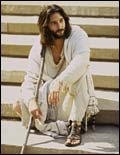
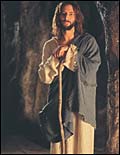
THE GOSPEL OF JOHN is a movie about Jesus. In movies about biblical figures we have come to expect certain stock props, and in this one we get them. Lots of olives and pita bread, earth-tone wardrobes and earthenware, walking sticks and sandals and bearded men wrapped in what look like burlap sacks. Mises-en-scene and characters with the stylized gestures in the schmaltzy devotional paintings that adorn all those deluxe family Bibles. A sound track with reed flutes playing a lot of minor chords, and spooky music when something supernatural happens.

p_exclusive_jesus1

And there are the other clichés peculiar to Jesus flicks. The film opens down by the riverside with John the Baptist publicly raving about how he must be superseded by someone else. He gives the impression of being off his meds — and that impression is unfortunate. John the Baptist is one of the most charismatic and influential figures in the history of religion. The Jewish historian Josephus, the Roman patrician Tacitus, and the provincial Roman governor Pliny all knew of his reputation and say more about him than about Jesus. The Mandaeans, who reject Judaism, Christianity, and Islam, claim John as their patron saint and still immerse their members in flowing water in a ritual practice they trace back to him. But in European painting, which informs so much of what we see in films about the Bible, John is the stern, ascetic antithesis of the serene, superior Jesus.

The movies tend to exaggerate this contrast as they do everything else, and this one is no exception. The cost of this exaggeration is John the Baptist’s credibility. Seeing him on the screen — wide-eyed, bedraggled locks beginning to dread, affect inspired by crystal meth, attire inspired by Fred Flintstone — one is left to wonder who on earth would have run out into the desert to see this demented, hyperventilating loser.

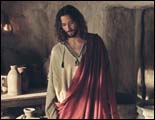
That Jesus’ overpowering charisma eclipses John the Baptist is consonant with the New Testament claims of Jesus’ superiority, but the markers that signify this superiority in the movie make Jesus at least as unappealing as the crazed Baptist. The Jesus of the film is a suave, thirtysomething bachelor with a telegenic smile and a shoulder-length mane of blow-dried hair that is always just so — even when he is walking through a violent squall on Lake Tiberias. He refers to his disciples as his “children,” a term of endearment in the Gospel of John but hardly endearing in the mouth of this smug yuppie.

p_exclusive_jesus2

During Jesus’ extended visit to the Jerusalem Temple in wintertime, he makes several grandiose claims about himself. But in the mouth of the film’s star, these claims, spoken in the da Vinci-type faux perspective of the painted backdrop, make Jesus sound like a megalomaniac messiah stuck on himself. He struts through the streets of Jerusalem smirking at the stupidity of friend and foe alike. He is, after all, the Son of God. And he knows everything — especially how charming he is.

The producers have invested prodigious effort, however, in doing away with one of the worst clichés of Jesus movies — anti-Semitism. Jesus’ polemic against the Jerusalem elites and “the Jews” is more caustic in John than in any of the other gospels. But the movie avoids anti-Semitic stereotypes in a story notorious for them. Jesus, with his dark hair and dark eyes, is far from Max von Sydow’s Aryan icon in THE GREATEST STORY EVER TOLD. His disciples and followers do not appear to be a gang of WASPs miraculously transplanted in Palestine. And when Jesus glimpses one of his first disciples, Nathaniel, under a fig tree, Nathaniel is draped in a prayer shawl, wearing a yarmulke, and wrapping a phylactery around his arm.

We get the point. Having dodged the bullet of anti-Semitism, however, the film exhausts its will to political correctness. The high priest’s slave, Malchus, is a black man. American films about the ancient world have always cast black people as slaves: they are the fan-wavers, litter-bearers, food servers, cooks, and bottle-washers. In this film Malchus is one of two black people with a speaking part — a groaning part, actually; he cries out in pain when his ear is hacked off in the Garden of Gethsemane. The other black actor is the slave’s relative. There are one or two black extras who pop up in crowd scenes, and they too are men. In this movie black people are seen and not heard, or seen and heard as slaves, or, if women, not seen at all. I thought after Denzel Washington and Halle Berry picked up their respective Oscars we were beyond this sort of typecasting in contemporary film. I was wrong.

p_exclusive_jesus3

Understated but no less ugly are the film’s class and ethnic biases. Jesus and all the powerful people in the film speak with an upper-class British accent. Jesus comes off as the Son of God slumming in Cana and Capernaum with the Galilean bumpkins who flock to him — this in contrast to the lower-class British accents (and Irish brogues) of the common people. The film’s subtle bigotry may register only subliminally in the United States, where we still associate an upper-class British accent with intelligence and sophistication, though for the most part unconsciously. I wonder, though, how this will play in Bristol — or Belfast.

One of the most important of the important upper-class voices in the film — nagging and incessant — is that of the narrator. Narration is especially heavy-handed in the Gospel of John: the narrator makes parenthetical comments and offers explanations and even interpretations of events. Lamentably, the film translates the biblical narration into the relentless, intrusive drone of a late middle-aged, upper-class British male voice. Reading the text verbatim, he sometimes actually winds up telling us what we are seeing — a basic no-no in movie making. What is necessary in the text becomes superfluous, and worse, redundant in the film.

This is especially unfortunate because in the Gospel of John, the narrator talks a lot. And Jesus talks even more. The sheer weight of Johannine verbiage bodes ill for film, which has become such an impatient, thrill-a-minute medium. Chapters 13 through 17 of the gospel, which biblical scholars call the Farewell Discourses, are almost entirely comprised of the words of Jesus: in five chapters, the disciples barely manage to get a few words in edgewise. But here the producers exercise some cinematic creativity. As Jesus speaks to the disciples of the persecution that they will suffer in the world after his departure, we see sepia flashbacks of Jesus facing angry crowds in the first half of the film. Though they are only tinted reruns, these sharpen the point that the disciples of Jesus will suffer in the future what Jesus has suffered in the past. And as Jesus speaks of the “prince of this world,” we catch an early full-color glimpse of Pontius Pilate. All the while the locale changes as Jesus walks and talks with his disciples, having gotten up from the table and commanded them to come with him. The change of venue and image helps us to survive Jesus’ garrulousness and saves the monologue from becoming cinematic Sominex.

p_exclusive_jesus4

The screenplay also breaks with the biblical text to bowdlerize some of the gospel’s potentially disturbing details. At the wedding in Cana where Jesus performs his first miracle of changing water to wine, the film dialogue has him respond to his mother’s request that he do something for the distressed host: “Madame, what do you have to do with this?” And of course, he says it with a smile. But in the gospel, the literal rejoinder comes off more gruffly: “Woman, what is it between you and me?” This sounds as though Jesus is telling his mother to get off his back, and given that all the gospels bear witness to some tension between Jesus and the members of his immediate family, including his mother, there is good reason to so interpret his words here. But the screenplay has rendered a more delicate, less faithful translation of them.

The producers were also judiciously inconsistent in their translation of Jesus’ actions. In the movie, “the disciple whom Jesus loved” does not lay his head on Jesus’ chest, as the Bible literally describes his intimate closeness to Jesus. This would look even more homoerotic than it sounds, and so the dubious gesture, though important in the text, does not appear in the film.

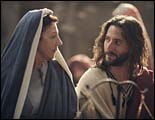
There are other moments in the film that almost suggest the erotic. But those erotic moments — if I haven’t merely imagined them — are all unconscious and unintentional. Jesus stands down a murderous crowd to save the woman taken in adultery; he speaks to her in hushed tones after the mob has dispersed. The two are alone, face to face, almost nose to nose, as Jesus whispers to her, “Go and sin no more.” His sultry smile and her parted lips don’t match the dialogue, and for a few seconds the woman looks as though she is about to steal a kiss — or have one stolen from her by the sweet-talking Messiah. And then there is Mary Magdalene, who makes an early, unannounced but unmistakable entrance in a fetching orange number. She looks longingly at Jesus throughout the movie, and even makes the A list for the Last Supper. But the Jesus-Mary Magdalene dyad, fleshed out, so to speak, in JESUS CHRIST SUPERSTAR, JESUS OF MONTREAL, and THE LAST TEMPTATION OF CHRIST, remains less than a suggestion. Overjoyed to see the risen Jesus near his empty tomb, overcome by the sudden recognition that he is alive, Mary Magdalene reaches out to him — with a handshake. After surviving death, hell, and the grave, a handshake. Where is the love?

p_exclusive_jesus5

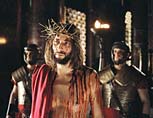
Though the film serves up dollops of melodrama — tears, grateful people falling on their knees, slack-jawed onlookers overawed by Jesus’ miracles and bons mots — there is little passion. The combination of Hollywood cinematography and relentless narration never lets us forget that we are watching a movie. We are not drawn into the drama; we already know, in the worst way, how everything is going to turn out. The Jerusalem leaders are the Bad Guys: they wear black hats. We are not invited to consider the tenuous political situation in which they found themselves. There is no need to dwell on the misery of the common people, desperately looking for a savior; whatever is wrong with them will be fixed by the Hero. They follow him in large but orderly crowds: none of the shoving, ill-mannered throngs we see in Pasolini’s THE GOSPEL ACCORDING TO SAINT MATTHEW. And as his verbal smackdowns and unflappable self-assurance make clear, Jesus has no need of our sympathy. He weeps two tears at Lazarus’s tomb — count them, one, two. He has a brief pang of anxiety after the Last Supper: “Now is my heart troubled,” he says, clutching his chest. Is it fear? A failure of nerve? Or just reflux? No matter; it passes as quickly as it came, and the drama moves inexorably to Jesus’ betrayal, his arrest, etc., etc. We see a Roman soldier energetically flogging him, although Jesus himself is off camera and takes the blows without as much as a murmur. Even when he is on the cross, Jesus sees to the welfare of his mother and yields to death with little ado. He is not even breathing hard. In his postresurrection appearances, his wounds are small, neat, and already healing quite nicely.

This absence of passion points to the greatest challenge of bringing Jesus to the silver screen: theology. The easygoing, otherworldly Jesus is a figment of the modern theological imagination. John’s is the cool, calm, collected Jesus who knows everything and has everybody all figured out. Even biblical scholars, who should know better, read the story this way: Jesus is “God astride the earth,” gushed one German scholar. But the same narrative tells us of a messiah who, with all his power and prescience, gets tired, hungry, angry, lonely, even anxious. The report of his grief at the tomb of his friend Lazarus — “Jesus wept” — is one of the most poignant sentences in all of world literature. As the gospel writer has crafted it, the scene at Lazarus’s tomb is an emotional vortex of love and death, and at its center is Jesus.

p_exclusive_jesus6

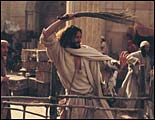
According to the Gospel of John, Jesus begins his ministry in Jerusalem with violent emotion. Yelling and spewing threats, he overturns tables, throws money, and chases sacrificial animals out of the temple court. Pious Bible editors and Sunday school teachers for centuries have traditionally entitled this episode “the cleansing of the temple.” But calling this tantrum a rite of purification is like calling Mike Tyson a massage therapist. John puts this event, reported in all four gospels, at the beginning of Jesus’ ministry, not the end as do the other three. And according to John’s version, Jesus is armed as well as dangerous: he makes a whip and then proceeds to use it to run both people and animals out of the temple. No wonder he is later accused of having a demon: the Jesus of John’s gospel, for all his self-possession, sometimes acts like a man possessed. He is an emotional Jesus, a passionate Jesus, a Jesus who, in the words of novelist David Bradley, “gets fed up.” The temple ruckus scene is one of the highlights of the movie. True to the biblical script, Jesus goes berserk. But then it’s over, and the smug, supercilious Jesus returns and is with us until the credits roll.

Even if it is “the greatest story ever told,” this film does not tell us what is so great about it. For all its fidelity to the biblical text, THE GOSPEL OF JOHN leaves out the very dimensions of the story that make for such compelling reading: its tension, its irony, its danger and pathos. We come away from the film with no better understanding of what is at stake and why someone would tell this story in the first place.

It is the same story in so many Jesus films.

I’ve read the book. I’ve seen the movie. The book is better.

Allen Dwight Callahan is a biblical scholar and the author of the forthcoming book THE SPIRITUAL GOSPEL.

Supreme Court Preview


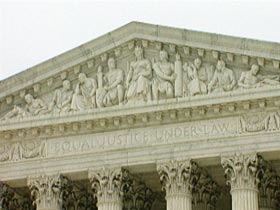
BOB ABERNETHY, anchor: The Supreme Court convenes on Monday — at least, most of the court does. Tim O’Brien looks at the cases the justices will consider.

supremecourtpreview-post02-justices

TIM O’BRIEN: From the first bang of the gavel on this first Monday in October, the role of religion in our society will be on display. The justices will sit — but they won’t be hearing arguments in recognition of Yom Kippur, the holiest of Jewish holidays. That has not happened before.

The court’s two Jewish members, Ruth Bader Ginsburg and Stephen Breyer, are expected to take the day off.

One of the earliest issues the court will have to confront involves the Pledge of Allegiance in public schools. Students clearly do not have to participate. But an appeals court in California ruled merely standing by while classmates pledge allegiance to “one nation, under God” violates separation of church and state.

Congress added the words “under God” back in 1954, at the peak of the Cold War, in part to distinguish the United States from what was called “godless Communism.” But last February the lower court found that adding those two words “impermissibly takes a position with respect to the purely religious question of the existence and identity of God.”

In another case later this fall, the court will consider a new twist in the debate over state aid for religious instruction: not whether states may subsidize religious instruction, but whether they must.

The case involves a theology student at Northwest College, a Christian school in Kirkland, Washington. Because the state constitution prohibits any aid to religion, students majoring in theology are disqualified from competing for a state-sponsored scholarship. The lower court ruled that singling out theology majors for exclusion violates their First Amendment right to the free exercise of their religion.

supremecourtpreview-post01-court

There are some issues that seem to return to the court every year — issues that sharply divide the justices just as they do the country. Religion is one of them; the death penalty is another. It’s mentioned several times in the Constitution itself and it still enjoys broad popular support. So the court is not going to find capital punishment unconstitutional per se — but there are lingering questions about the ability of our justice system to implement it fairly.

There are currently more than 3,500 inmates on Death Row in the United States. The court has agreed to consider the case of one of them: Delma Banks, who has been on Death Row in Texas longer than any other inmate — more than 20 years.

In what could be a made-for-TV drama, Banks was within 10 minutes of being executed last spring when the high court agreed to consider his claims that prosecutors failed to turn over exculpatory evidence and that he was also denied the effective assistance of counsel.

The biggest news from the court on its first day, Monday, will be in the cases it doesn’t take. Nearly 2,000 cases have been submitted for review. But the court is selective; most, if not all of these cases will be rejected. Denying review sets no binding precedent for other courts to follow. But whatever the lower court had ruled stands. It’s the justices’ way of saying yes by saying no.

For RELIGION & ETHICS NEWSWEEKLY, I’m Tim O’Brien at the Supreme Court.