THE GOSPEL OF JOHN


BOB ABERNETHY, anchor: Now, the movie version of the gospel according to John — a word-for-word version. Mary Alice Williams is here with a review:

gospelofjohn-post04-bob

MARY ALICE WILLIAMS: Bob, for the first time in 40 years, the “Greatest Story Ever Told” is being retold in a new round of films with religious themes. The first is THE GOSPEL OF JOHN. Visual Bible International, a faith-based media company, has produced a verbatim adaptation from the GOOD NEWS BIBLE — an accessible translation written in 1966, narrated by Christopher Plummer.

CHRISTOPHER PLUMMER (from THE GOSPEL OF JOHN): In the beginning, The Word already existed.

WILLIAMS: The Gospel of John was written roughly 70 years after the death of Christ and depicts the battle between the emerging church and the religious Jewish hierarchy. Plays about the crucifixion have a long history of inciting anti-Semitic violence, and many scholars believe John’s Gospel is the most anti-Jewish and contentious of the four Gospels of the New Testament.

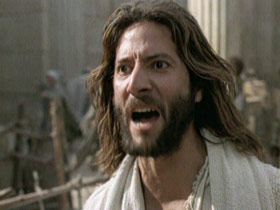
PLUMMER: There in the temple he found people selling cattle, sheep, and pigeons.

JESUS: Take them out of here. Stop making my father’s house a marketplace.

gospelofjohn-post01-yelling

WILLIAMS: Jesus’ arrogant defiance of the Jewish leadership is thought to have been written specifically to quell the intense debate over what would constitute this new Christian theology and to proclaim once and for all the divinity of Christ.

SAMARITAN WOMAN: I know the Messiah will come.

JESUS: I am He.

WILLIAMS: Jesus’ antagonism toward the Jewish leadership never extends to the Jewish people — his own people. To them he dispenses love and forgiveness.

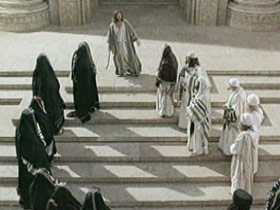
PHARISEE TEACHER: This woman was caught in the very act of adultery.

JESUS: Whichever one of you has committed no sin may throw the first stone.

gospelofjohn-post02-circle

WILLIAMS: It is for the people, as proof of his deity, which John tells of Jesus’ extravagant miracles: converting water into wine and a basket of bread and fish to feed thousands; letting the blind see and the dead rise.

JESUS: Lazarus, come out.

WILLIAMS: The producers of THE GOSPEL OF JOHN enlisted a team of historians and theologians to authenticate antiquity, including the worldview of the Jewish people, who were so oppressed by the Romans that their very survival was at stake.

PHARISEE: If we let him go on in this way everyone will believe in him, and the Roman authorities will take action and destroy our temple and our nation.

WILLIAMS: The film’s depiction of Jewish authorities lobbying for crucifixion, the Romans’ preferred method of execution though not sanctioned by Jewish law, is a dark and negative portrayal indeed. But it dodges the controversial theological conclusion that the Jews killed Christ by making it crystal clear, as John’s Gospel does, that Christ’s life and death were part of a divine plan.

PILATE: I find no reason to condemn him.

PHARISEE: We have a law that says he ought to die because he claims to be the son of God.

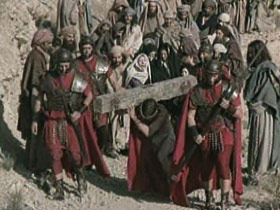
gospelofjohn-post03-cross

PILATE: Remember, I have the authority to set you free.

JESUS (to Pilate): You have the authority over me only because it was given to you by God.

WILLIAMS: The film’s depiction of the crucifixion is brutal. No way around it. But [it] is handled with almost cursory dispatch.

JESUS: It is finished.

WILLIAMS: With a rigid fidelity to a Gospel in its entirety, one expects a certain Sunday school blandness. But its commitment to skip the Cecil B. DeMille pageantry and convey the meaning of the story make it work.

ABERNETHY: Mary Alice, did you find any part of the film offensive?

WILLIAMS: In the segment of the Gospel where the crowd is yelling, “Crucify him, kill him!” the editor selected close-up shots of the Jewish leaders — very negative images. On the other hand, one of the directors of the Anti-Defamation League told me he felt it was a fair and responsible treatment of the text.

ABERNETHY: Mary Alice, thank you very much.

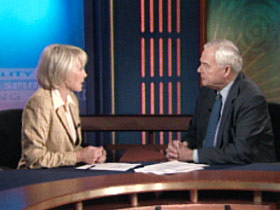
Peter Steinfels Extended Interview

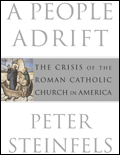
Read more of Bob Abernethy’s interview with Peter Steinfels about his book A PEOPLE ADRIFT: THE CRISIS OF THE ROMAN CATHOLIC CHURCH IN AMERICA (Simon & Schuster):

Q: What does it mean to be a Catholic from Chicago?

p_interview_steinfels

A: I think Chicago Catholicism had a particular open quality. I have a feeling, now that I’ve lived a mere 40 years in New York, that East Coast Catholicism was a little bit more embattled, because the waves of Catholic immigrants landed here and often ran into opposition. There was a more relaxed quality in Chicago and a willingness to let groups experiment and try out new things. Many of the Catholic action movements in the country ended up with their headquarters in Chicago.

Q: What was the effect on you that your father was a church artist, painting murals for Catholic churches?

A: Well, I think the effect, first of all, was that one recognized that one’s faith was not a Sunday thing. It was something that had to do with what you did, I’d say, 40 hours a week, maybe 60 hours a week. Sometimes we became, as kids, directly involved in helping out with little aspects of the job, whether it was sanding wood panels for the Stations of the Cross that would go up in churches, or other aspects of his work.

Q: You were an altar boy.

A: I was, of course, an altar boy, yes.

Q: Why do you say “of course”?

A: I don’t know. It just seems such a natural thing that so many people my age were. I was a relatively pious kid, I suppose.

Q: You’re a lifelong Catholic, a historian, a reporter, editor. Was it a problem at all fitting together your love for the Church with your responsibilities as a scholar and a reporter?

A: I was always convinced — and maybe naively so — that telling the truth about things, whether they made the Church look good or sometimes cast a less favorable impression of it, was the best thing for the Church and, in the long run, that would serve the Church.

Q: Could you state the alternatives that the Church faces, the alternatives you present on page one, right at the top of your book?

A: I think the Church faces the prospect of a very serious decline or a thoroughgoing transformation. I don’t mean a decline so much in numbers. I mean a decline in the way that the faith of Catholics may be hollowed out so it no longer means as much to them, and it no longer affects the central decisions that they make in their lives.

Q: You call this situation a crisis.

A: I do think it’s a crisis in the sense that the Church has 10, 12, 15 years to make some very major choices about important issues that are facing it now.

Q: And if it doesn’t, then what?

A: I think we might see what I call a “soft slide” into a kind of nominal Catholicism. There are two big developments going on within the Church: the decline in the number of priests — and sisters and nuns, as well — who have constituted the middle management of Catholicism, from the parish right up to running major Catholic institutions. That’s one challenge, and that could affect even the availability of Mass and the Eucharist in many parishes.

The other big change is generational — that we’re passing from a leadership made up of Catholics who were formed in a highly defined, often ethnically rooted Catholicism before the Second Vatican Council in the 1960s, to Catholics now in their forties who were often coming of age in a period of Catholicism that was changing very rapidly and was often rather uncertain.

Q: Why should Americans who are not Catholic care about what happens to the Catholic Church in the United States?

A: I think anyone recognizes that this is the largest single religious body in the country; that about a quarter of the population call themselves Catholic in one sense or another; and that the Church has created an enormous network of parishes, schools, health care facilities, social services, colleges, and universities — many of which serve as anchors for neighborhoods and communities, and so they have a very important role in our society.

Q: What are some of the facts, the data, that to you are most telling and revealing about what’s going on?

A: One of the chief facts that we can point to is the ratio of priests to people. There was one priest for about 650 Catholics in 1950. Today, there may be one priest for, perhaps, 1,400 or more Catholics in the country. That’s an important figure.

A[nother] crucial fact is that there are about 27,000 active diocesan priests in parishes. At the same time, there are now 30,000 lay pastoral ministers. These are people who work part-time or full-time professionally, doing the kinds of things that priests, sisters, and nuns used to do. Eighty percent of them are women. Over two thirds of them are working full-time. This is a very positive change in one way. It’s the shift from a clerical leadership to a leadership by laity. But it’s something that the Church has to learn to deal with from here on in.

Q: You write that one of the things that concerns you so much is the “polarization” of the Church that’s taken place — liberals on the one hand, conservatives on the other. It is very difficult for them to meet on common ground. Why is it so vicious?

A: I think you have to go back to the landmark event of the early 1960s, the Second Vatican Council. This was probably the most important event in Roman Catholicism in centuries. Various camps emerged from the debates at that council about changes in the way the Mass was celebrated, changes in understanding of Church practices. Over time, those camps became increasing hardened, if you will, and suspicious of one another. Today, any initiative for change is looked upon by one side or the other as somehow threatening basic things about the Church. The liberals see an initiative from the conservatives as somehow constituting a betrayal of the Second Vatican Council. Conservatives tend to look at any initiative from the liberals as somehow constituting a betrayal of one of the fundamental teachings of the Church.

I’m hoping that somehow the Church can get over this polarization and take a much more practical and pastoral and even empirical view of issues, like the quality of Sunday worship; whether religious education is effective or not; what is going to be the future of the priesthood; and so on.

Q: I am interested in your special take on the sex abuse scandal of 2002 — that its roots go far back and that, for one reason or another, it seemed to some people like a new thing when it really wasn’t.

A: I was surprised at the beginning of 2002 by how shocked many people, including Catholics, were. It was shocking news but, in a sense, it wasn’t surprising, because the Church had seen a wave of revelations about sexual abuse of minors by priests from the late 1980s to the early 1990s.

I think to understand this question we have to look at it in different phases. We have to see the period of time before 1985, when the hierarchy just didn’t understand the seriousness of this problem at all. We have to look at the period from 1985 to the early nineties, when they began to come to grips with it, but did so all too slowly. We have to see the period from the early nineties, when they began to take some actions, but never succeeded in following up or arriving at an obligatory policy the way they did, finally, at the Dallas meeting in 2002.

Q: You come down very hard on the bishops for not addressing it more quickly, more thoroughly.

A: I do think there was a real failure of decisiveness and follow-through. And all along the line there was a failure of openness with the Catholic people and with the public at large about the things they had failed to do, but even about the things they really had done.

Q: The crisis is far deeper than the sex abuse scandal. You describe other major forces and events that caused it.

A: There are two things that have gone on within the Church — the decline in the number of priests and nuns and the generational change — [that] the leadership of the Church now has to negotiate its way through. But there are two other things outside the Church. One is a massive, historical change in our understanding of human sexuality. The other is a global change in the way we understand the equality and dignity of women and women’s roles in all aspects of life. Those are two things that the Church has got to grapple with in the next 10 to 12 years.

Q: What about the sixties, the attitudes that grew out of the protests of the sixties, and what about secularism, generally?

A: It’s very important to realize that certain changes would have taken place in American Catholicism, regardless. The GI Bill changed the educational level of American Catholics. The move to suburbia broke up old ethnic and highly Catholic communities in the inner city.

But in the sixties, you had this landmark event, [the] Second Vatican Council, that changed so much in Catholicism at the same time as you had this decade of protest, of challenge to authority of all sorts — civil as well as religious. Those things came together in a way that made for dramatic turmoil within the Catholic Church.

It’s hard to tell with secularism what is cause and what is effect, but certainly the fact that Catholics had arrived in the mainstream of American society and now had accomplishments in their professional lives, in their business lives, and so on, that would make the religious community less important than it was as a community of survival for many immigrants — that certainly contributed to the attractiveness or the force of secularism.

Q: And out of all these forces, what were the major results within the Church?

A: There were three changes, at least, that you can point to. One, coming out of the Second Vatican Council, had to do with the relationship between the Church and the rest of the world as well as, of course, other Christian and other religious groups. From the time of the French Revolution right up through the mid-twentieth century, the Catholic Church saw itself as essentially at war with the rest of the world. It was a combative relationship. The Second Vatican Council really took the posture that the Church is in dialogue with the rest of the world. We can learn as well as teach. That had a major psychological effect throughout all of Catholicism.

The second thing that happened was the egalitarianism, if you will, within the Church, because the Council made it clear that it was the baptismal calling of all Catholics that was so critical, and not simply the distinction between the laity and the ordained. Even at the Mass the breakdown, the distinction between the priest and the people grew less and less.

The third thing that I think you could point to — and this fell in line with a lot of other events in the 1960s — was the great debate over contraception that went on from the mid-sixties right up to the encyclical by Paul VI, Humanae Vitae. This resulted ultimately in a real shaking of teaching authority on the part of Church leaders, because so many Catholics found themselves unable to agree with the continuing ban on contraception.

Q: I want to ask you about changes in belief. There were some fundamental shifts in what people thought about the Eucharist, about confession.

A: The fundamental tenets of the Church remained unchanged, but there was a different register in which things were played out. The communal dimension of the Sunday worship became much clearer, so it was the entire community gathered together to celebrate the Eucharist, less so than the simply “God and me” relationship that had been very characteristic in the past. There was a new emphasis on the Church’s witness and role in this world, and less emphasis on what would happen to one’s soul after one died.

The subject of what happened to the sacrament of confession is a mystery. Catholics voted with their feet. They stopped availing themselves of this sacrament to a large extent. And nobody, in fact, called for that. No one has satisfactorily explained that to this day.

Q: What happened to the explanation of the Eucharist?

A: For some years now, Church leaders have been concerned that Catholics were losing their traditional conviction that at mass the bread and wine were changed truly into the body and blood and the presence of Jesus. I think there’s evidence that that [shift] was taking place, and it may have had to do with a greater sense that Jesus was also present in the gathered assembly for worship. But I do have to say that within the last few years, there’s been a reemphasis on the traditional teaching, and probably the belief has swung back again.

Q: As you sit in church and look around and listen, what are the signs of the changes since Vatican II?

A: Oh, at worship, the signs of changes are immense: the very fact that the priest is facing the people from the other side of the altar; that the Mass is said in English or in whatever vernacular language — in my own parish, many of the masses [are] in Spanish; that the congregation is participating much more fully, both in responding to the priest and in song. [This] gives an entirely new sense that we are together, celebrating this mass. We are together offering up this thanksgiving, this Eucharist, to God.

Q: But you’re also pretty critical of what happens in too many average parishes at Mass.

A: I’ve argued that the future of the Catholic Church is probably more likely to be determined by the quality of worship on Sunday than what happens in Catholics’ bedrooms, which is the impression one gets sometimes from the news media. I think the issue really is quality. For decades now, there have been debates among Catholics about the liturgy, about the translations of the prayers from Latin, about the kind of music that is sung.

But all too often, these debates have gone on at a very high and often fierce theological level, and there has been too little attention to what actually happens out in the congregation. What is the sense out there? How many people are actually singing? How many people actually understand their role in the Mass? I hope I can make a case for more of this practical, pastoral and, again, I’d even say empirical examination of the quality of our worship.

Q: Once, if a Catholic did not go to mass on the weekend, that was a serious problem. It put his soul at risk. How did that change?

A: That’s a change that is, again, a bit hard to explain. There is a real diminished sense of the danger of damnation among Catholics. I think there is a sense that, perhaps, there was altogether too much stress on the danger of damnation among Catholics, and that it was a very negative, critical view of God and God’s love.

On the other hand, as Bishop Kenneth Untener of Saginaw, Michigan, has said, “We once had two choices. We either went to Mass on Sunday or we went to Hell. Most of us chose Mass.” The fact that that is different really does go a long way to explain the declining numbers of people at Mass on Sunday.

Q: How do you think the celebration of Sunday Mass should be changed?

A: I don’t really think we need to have another round of significant changes. We have to do what in athletics is called “execution.” We have to celebrate the Mass as it’s now set out, but we have to do it well. We have to do it attentively. We have to pay attention to whether we’re succeeding or not. Other people would say the term we need is “craftsmanship.” I think that’s the direction we have to go in.

Q: The papal encyclical in 1968, Humanae Vitae, had been described as the “Vietnam War” of the Church. Talk about the consequences of that.

A: The comparison between Humanae Vitae and the Vietnam [War] … really amounts to this: that we continued for a long time fighting the war in Vietnam because we felt that if we didn’t, the nation’s credibility would be destroyed. What we found out was that by continuing to fight there over such a long time, the nation’s credibility was, in fact, undermined; credibility, in fact, was strengthened when we ceased that effort.

Similarly, in the case of Humanae Vitae, there was a feeling that Church authority would be seriously undermined if the Church reversed in any way its teaching about contraception. But, in fact, by maintaining the same, total, absolute prohibition, that very thing happened. The authority of the Church was, indeed, undermined when Catholics found themselves unable to bring together their own experience of marriage with the teaching as it was declared in the encyclical.

Q: And did that then spill over into attitudes about all kinds of other things coming from the Vatican?

A: It certainly spilled over into all kinds of other teachings that touched on sexuality in any way and, ultimately, I think, in general to other teachings, so that there are a lot of Catholics who, unfortunately, don’t really even grapple with the serious teachings of the Church. They make up their minds in an all too casual manner.

Q: One of the major problems you point out is the difficulty of the hierarchy in dealing with the growing sense of equality of women.

A: In recent years, the Church has affirmed in stronger and stronger terms the equality of men and women. At the same time, the traditional refusal to ordain women to the priesthood has created a conflict with the teaching of equality. The truth is that, unless women can be put into visible ritual roles and have a real decision-making role within the Catholic Church, this conflict is just going to be something that really undermines the Church’s credibility.

Q: Do you expect to see the ordination of women as priests?

A: For me, personally, the arguments — and they are serious arguments — against ordaining women to the priesthood are not persuasive. I would say that the Church should simply go step by step. There are a lot of steps the Church could and should take to demonstrate that it is really committed to the equality of women. I would argue that the Church should ordain women to the deaconate, for example, which is a step, and see if that, indeed, does convince people that there is consistency between the Church’s teaching on the equality of men and women and its internal life. If women were ordained as deacons, it would make it much easier for women to be, in fact, named as cardinals. And women could be named, therefore, as part of the group that elected each pope.

I grew up in a family that always wanted to have the Mass said in English instead of Latin. I never expected to see that. I did see it. So when it comes to the question of the ordination of women, I don’t know. I may see it.

Q: You are, in many ways and many times through your book, deeply critical of the U.S. bishops. Your sharpest words probably come with respect to them. What did they do, or not do, that you see as so damaging?

A: It’s a mistake to think of the bishops as having been bad leaders. The problem is that there’s been a vacuum of leadership; again and again, they have tended to look over their shoulders toward Rome and the Vatican, rather than look right in front of their faces to what was happening in the Church. There are too many problems that they put off dealing with. The sex abuse scandals could be one example of that; their reluctance to deal, except by exhortation, with the problem of the declining number of priests is another striking example.

Q: John Paul II appointed most of the American bishops now. To what extent do you blame him for putting their loyalty to the Vatican so high among the priorities?

A: I think that the pope has wanted to appoint people who were both loyal to the Vatican and who were dynamic and risk takers in their own approach to leading the Church. Unfortunately, again and again, he’s not had all those qualities before him in individuals, and loyalty has been the one which has been the highest priority, so that other leadership qualities — such as willingness to take risks, being farsighted, being capable of communicating one’s views in a public forum — have gone, to a considerable extent, by the wayside.

Q: Is it possible that someday bishops in the American Church could be elected, rather than appointed?

A: The Church throughout the world has to examine the highly centralized nature of selecting bishops, and I think there are real revisions that could be made that would widen the participation, even of the other bishops as well as of the local clergy and laity, in their choice. The idea of an out-and-out election is pretty far-fetched, but there could be revisions.

Q: What are the most important changes the Church should make now to deal with these problems?

A: The biggest single change is to overcome the polarization on theological issues and to take a much more pastoral and practical approach. I think that the bishops really have to look at the reality of the Catholic Church in the pews, in the parishes. But the laity also has to take responsibility for maintaining Catholic identity and continuity, which in the past was something they could give up to their clergy and bishops.

Q: What could be done to bring about what you call “thoroughgoing transformation” in the Church?
p_interview_cover

A: The bishops could open a serious discussion about allowing married men to be ordained to the priesthood, about at least opening the deaconate to women. They need to put an important, new priority on the quality of Sunday worship. They need to take religious education seriously, particularly religious education of adult Catholics, which has never been sufficiently emphasized within American Catholicism.

The laity has to take new responsibility for the institutions, such as Catholic social services, health care, hospitals, and higher education, that they are now leading. They have to take responsibility for maintaining the Catholic character and identity of these institutions. And I think it would be a good thing, generally, if the pool of parish workers and priests could be enlarged so that we not only think about maintaining quantity, but real quality in those ranks.

Q: If there were a change in the celibacy requirement for male priests, perhaps there would be a lot more priests?

A: When it comes to the debate about celibacy, I think it’s important to recognize that the problem is not, as it’s often been, with celibacy. The situation today is that the Church, from the pope on down, has given a new emphasis to the value of marriage — family and human sexuality as a way to genuine holiness. No one’s going back on that, and therefore many people who would be drawn to the priesthood are equally drawn to this other calling of marriage and the family.

Many Catholics still hope that the numbers of priests and those seeking the priesthood can be enlarged. My view is that the decline is probably irreversible. It’s not because of problems with celibacy, which is a practice well rooted in Catholic tradition. The real reason is that, in fact, everyone from the pope on down has given a new recognition of marriage and family as genuine ways to holiness. As long as that’s the case, there are not going to be those numbers who were drawn to a celibate lifestyle, which was always given a very high priority, whereas marriage and family life and sexuality were treated as second best; they were for the “Grade C” Catholic in terms of holiness. In that sense, we really are not going to be able to change the numbers within the priesthood unless we do recognize the possibility of married priests.

Q: Another prescription for the Church from some people is that if priests were just faithful to their vows, to the teachings of the Church, then all these problems would be solved. What’s your response to that?

A: I certainly am in favor of fidelity, of faithfulness to the Church’s mission and teaching. What that approach doesn’t recognize is there are tensions within that teaching. There is the desire to recognize, for example, as the pope himself would say, the value of human sexuality; and yet, there is the teaching that many people find in contradiction to that. There is the desire to be faithful to the Church’s teaching on the equality of women and yet, a tension, as it seems, with the Church’s practice in regard to the roles of women. It isn’t as simple as fidelity versus infidelity. It’s a question of how you exercise your fidelity within the whole array of Catholic teachings.

Q: The U.S. bishops are as they are. The Vatican is as it is. Younger seminarians are said to be very conservative. What do you think the chances are, realistically, of achieving the kinds of changes that you recommend?

A: Well, first of all, I think there are a lot of hopeful things going on. One of the difficulties in writing a book about 65 to 70 million Americans is that there are such differences. There are spots of mediocrity; there are places of tremendous vitality. And there are whole developments, such as the emergence of some 30,000 lay pastoral ministers, that are remarkable and quite promising.

I hope that laypeople can take a lot of initiative on their own without waiting for leadership from the clergy, from bishops, even from Rome. I also think that a lot of the clergy and the bishops, when faced with the perils of pastoral stagnation or pastoral avoidance of these issues, will just act, perhaps inspired by the Holy Spirit, the way people often have acted in the past. They change their approach when necessary.

Then there’s a possibility that, if we were well prepared for another papacy that might give more leeway to local leaderships in different countries and different conferences, the bishops around the world [and] the Church in the United States could take advantage of that situation.

Q: You think that the Church in the U.S. might be strengthened if it could be more independent of Rome?

A: I hesitate to use the words “independent of Rome,” because the connection, the sense of a global Church, the sense of our responsibility to other nations is something very special about Catholicism. On the other hand, I think there’s a general feeling — and this is a feeling among conservatives as well as liberals — that perhaps centralization has gone too far, and there has to be more room for local adjustment around the world by Church leaders.

Q: Other churches have been buffeted by the same cultural forces that have buffeted the Catholic Church — Evangelical Protestants, Mormons — and they seem to have come through it without having the same problems. Why has the Catholic Church been hit so hard?

A: Well, I wouldn’t want to underestimate the very, very positive things that have happened in the Catholic Church — where it has become a voice for social justice, where it is a church that represents both the outsiders in society and many of those who are well established in the mainstream.

I wouldn’t want to put myself in the position of exaggerating how hard hit the Church has been. It is, after all, a church which is still growing in numbers, and it exerts a tremendous presence in American life.

At the same time, we see peril down the road. Whether there’s peril down the road for [others], I don’t know. But I think your question turns us to something very basic in the discussion of what makes churches vital or not. And that is, is it better to be sharply defined over and against your society, or is it better to accommodate the social changes that are going on?

I think the notion that it is important to have a clearly defined identity and not to be accommodating simply for the sake of accommodation is fundamentally true. The Catholic Church needs to recognize that, and I would certainly argue for the maintenance of a firm Catholic identity.

But I also think that it’s wrong to ignore the fact that other religious groups, like the Evangelicals and the Mormons, have adapted in many, many significant ways to changes in American society. You don’t hear Evangelicals saying the same things about gambling, dancing, women working at home, even divorce and remarriage, that you might have 30 or 35 years ago. And even the Mormons have changed considerably, in terms of social changes.

Q: It’s been said that, from the perspective of the Vatican, the pope might think that it was in the best interests of the worldwide Church not to make changes that would, perhaps, be in the best interest of the Church in the United States, and he might be willing to take some losses in the United States in order to prevent them in the rest of the world. What do you make of that?

A: I think it’s very hard now to be a good pope for all the regions of the world, with their different cultures, the different phases they are at in terms of economic life, industrialization. So it would be possible for Rome to think that it’s better for the Church overall, and that there may, in fact, be limitations on what we do, or can do, because of the needs of the Church elsewhere. But I also think it’s important for us to make our own case and to point out that, in many ways, a lot of the rest of the world will, with time, be facing the same problems that we’re facing in the United States.

Q: Would you see different churches and different regions of the world, in different phases of development, being able to have roles that would be somewhat different from those in other places?

A: I think that there is some possibility for this. I mean, we already have within the Catholic Church, for example, branches of the Church which have a married priesthood. We have within the Catholic Church those churches rooted in Eastern Europe or in the Middle East that have a married priesthood, as well as those in the Latin rite who have a priesthood that is celibate. There’s a lot more room for variation, perhaps, than we recognize.

But it’s also true that certain questions, like those about women, really are global questions. Even if the pace of change may not be the same in different parts of the world, the direction of change seems to be clear.

Q: What do you make of some people who see that the problem is essentially a crisis of a male-dominated, traditional Vatican versus a modern America?

A: I think putting this issue in terms of old-fashioned Vatican versus modern America is a little too simple. I’m uncomfortable with that, because I think that takes American society too easily as the one standard that the Church has to adjust to. I would insist much more that the tensions are within the Church. There are tensions within the Vatican; there are tensions within the American Church. They’re not just America versus Rome.

I wrote this book out of a concern as a Catholic that, over the long run, the Church in the United States might follow the same route as the Church in a lot of Western Europe, where it became part of a smaller and smaller minority within the population, where its public influence was less and less. I think I also wrote it out of a concern as an American citizen that this major American institution, that not only served many parts of the country but was the moral and spiritual glue for so many Americans, might decline.

Somehow or other, when I look at the particular issues that the Church faces, I can get rather discouraged about the possibility of there being a sufficient response. And then when I go around to many, many parishes, many Catholic agencies, when I talk to young Catholic students who desire to work within parishes or pursue that kind of pastoral ministry, I think that somehow these problems will actually take care of themselves, and we will somehow successfully struggle through.

Q: But you make it very clear in your book that you’re calling for dramatic strengthening of leadership in the Catholic Church.

A: Leadership is the issue. I actually chose the title of the book, A PEOPLE ADRIFT, in 1997 — years before the headlines were full of the news about sexual abuse and the failures of bishops. All along I was concerned about whether the leadership would be there.

I want that leadership. What I’m concerned about is that people not just wait upon the bishops, or wait upon a new pope or a change in the Vatican; there’s a lot that can be done by laypeople independently. There’s a lot as far as the quality of Sunday worship, for example, that can be done by clergy right now. There’s a lot that can be done in terms of adult and other religious education, by the pastoral ministers that have emerged. There’s a lot that can be done without any conflict with Rome — even quite with encouragement from Rome.

I don’t want us to wait. I am trying to encourage leadership to emerge and people to realize how serious a vacuum of leadership can be for the future of the Church.

Q: And what do you foresee if the changes you recommend do not happen?

A: There is a real danger that Catholicism could become something that people wear the way many of us wear our ethnic labels. It’s something that we identify ourselves with, but it doesn’t really shape the most central decisions of our life. And with that, I think, would come a decline in the presence of the Church in terms of services, struggles for social justice, representation of those people who are in need. In the long run, that might make the United States take a path very similar to what has happened in Western Europe, which is a much more extensive secularization of society.

If we compare Catholics who were born before 1943 with Catholics who were born after 1961, we find out that 37 percent of those in the earlier generation said that the most important thing in their life was their faith. Among the younger generation, it’s down to 14 percent who say their faith is the most important thing in their life. At the same time, the percentage of those who say that their faith is not too important at all has gone from something like 22 percent in the older group to over 40 percent in the younger group.

I think that illustrates the danger of the hollowing out — that the faith will not truly affect how one lives in one’s daily life, how one makes important decisions about marriage and family and what you do in your career and how you deal with your children and the next generation, and whether you forgive one another and how you live and sense your responsibilities. That is, I think, the danger the Church can face.

One other thing that’s very important about American Catholicism is that it is a “bridge” institution. It bridges different parts of the nation; it’s not like the Southern Baptists, located largely in one region. It bridges different classes. It bridges Republicans and Democrats. It bridges people who have now made it into the mainstream, who are well represented on Wall Street and in the halls of Congress, and the newest immigrant groups, whether from Latin America or Asia. That’s another thing that makes it very important to this society.

Q: Have you had any comment that you could pass on from any Catholic bishops?

A: I’ve received a few personal notes from Catholic bishops thanking me for the book. I suspect they may not be representative of the hierarchy as a whole, but one of the things about Catholic bishops is that they are people who play their cards very close to their chests. So I don’t really know.

Seeds of Peace


LUCKY SEVERSON, guest anchor: Seeds of Peace. It’s half a world away from the violence of the Middle East, but supporters continue to hope against hope that what happens each summer in southern Maine may one day make a positive difference. Now in its eleventh year, the program called Seeds of Peace brings together the children of people who are often enemies so that they might learn what they have in common. So that they might one day fight for peace rather than against each other.

seedsofpeace-post01-flags

It’s a summer camp, unlike any other, in the lake region of Maine. The most amazing thing is that it’s still here, after 10 years.

Where else could you listen to slightly off-key renditions of the Israeli and Palestinian national anthems at the same gathering?

AARON MILLER (President, Seeds of Peace): Seeds of Peace trains leaders — leaders of the next generation who have a vision and a purpose.

SEVERSON: These are the leaders of the next generation, soon to be instilled with a vision — of peace. Aaron Miller is the new president of Seeds of Peace.

Mr. MILLER: Seeds of Peace provides one thing that any negotiating process needs. It provides hope because without hope there is no life. There is no purpose, and there is no future.

seedsofpeace-post02-miller

SEVERSON: He left the State Department this year, after 25 years as a Middle East peace negotiator, because he came to realize that without the leadership of the next generation, the struggle for peace will fail.

Mr. MILLER: They are wiser and older than we ever were, beyond their years at their age. Most of these kids have seen things and experienced things that we never experienced.

SEVERSON: The future leaders share bunkhouses with each other, a situation Ayelet Habani, a 15-year-old Israeli, was not thrilled about.

AYELET HABANI (Israeli): One of my friends who was in the army, he told me not to sleep and watch my back, because they could be anything and could come in the middle of the night, and they told me to watch my back and be careful of the Palestinians.

SEVERSON: After a two-year cycle of almost constant bloodshed between Israelis and Palestinians, finally a relative lull as Mideast leaders attempt to follow the American road map to peace. From here, the violence seems a world away, but kids like Aya Hijazi, a Palestinian, know it’s a world they’re going home to.

seedsofpeace-post04-hijazi

AYA HIJAZI (Palestinian): I have hope and I don’t at the same time — it’s confusing. But I’m trying, because if I don’t it’s going to go on forever — the same problem, the same cycle, us killing them, them coming in with tanks and bombing us. We have to reach a compromise and that’s why I am here.

SEVERSON: For 90 minutes each day, the kids split up into small groups and with the help of a facilitator, and with no cameras allowed, they go at it in what are called coexistence, or coex, sessions.

Mr. MILLER: I guess you could describe them as detox sessions. The built-up poison and venom accumulated even in their short lives builds up and comes out.

AVIHU KRIEGER (Israeli): In my coex group we have a lot of fights — me and Amit are in the same coex groups and it’s everybody sometimes against us and we need to defend Israel, which is not always so comfortable.

SEVERSON (to Ms. Hijazi): What do you say to an Israeli who has had a friend blown up on a bus by a suicide bomber? You don’t call them a suicide bomber?

seedsofpeace-post03-habani

Ms. HIJAZI: No, I call them a freedom fighter because we don’t have soldiers. They took away all our soldiers.

Ms. HABANI: Sometimes we got very angry that they justified suicide bombers, or they say things like, “We are happy that the Holocaust happened because now you understand how we feel.”

Mr. MILLER: These kids begin to really understand the needs and suffering of the other side and also look inside themselves … to see what they in fact have to do in order to bring about change.

SEVERSON: The key lessons from the coexistence sessions seem remarkably uncomplicated — listen and learn.

SHAHAR AVENT (Israeli): I don’t know if I see things differently now, but I learn a lot. I didn’t know stuff that I know now about the Palestinians, about the children that live there. Now I know a lot, I think. I could still learn because I don’t know everything.

seedsofpeace-post10-alhassan

HISHAM AL HASSAN (Palestinian): Sometimes I get angry because I think I am saying everything right and they are just saying no, that is not right.

SEVERSON (to Mr. Al Hassan): But you’ve learned to listen?

Mr. AL HASSAN: We learned this after about four sessions. It’s really noticed now, that we are listening.

OFER ROSENBLAT (Israeli): I think I learned a lot about the other side. In coex you hear about what happened to them. You cannot [help] feel a little bit of guilt and mercy for them because they are poor and what happened to them is very terrible.

SEVERSON: The Seeds of Peace camp was founded by the noted journalist and author John Wallach. Tim Wilson has been camp director from the beginning.

TIM WILSON (Camp Director): This is an experience that they are going to remember the rest of their lives, no matter what they do. What happens afterwards, I can’t control, but this one little time in their life where they could sit here and have contact with the other side and they genuinely, genuinely got a chance to be with someone who is called their enemy.

seedsofpeace-post06-wilson

Ms. HABANI: It’s very easy to talk to people who you agree with, your people. But to talk with people who don’t agree with you, and are on the other side of the conflict, we don’t get that in Israel. We can’t — it’s like too risky, too dangerous. We don’t go into those areas.

SEVERSON: These are truly international teams, with kids from all over the Middle East. For some, this is the first time they’ve ever played football. Counselors view sports as an important part of the program, as a way to teach teamwork and eventually trust to kids who once looked at each other as enemies.

Mr. WILSON: You go into coexistence and you spend an hour and a half going at it, you’ve got to have someplace where you even the playing field.

SEVERSON: This was a game against all American boys from a summer camp down the road. When it was over, Israelis and Palestinians and fellow Arabs won, quite easily.

seedsofpeace-post08-prayer

Religion is not a major part of the program here, although Jews, Christians, and Muslims do attend each other’s service.

Ms. HABANI: The religions are very similar and almost identical, so I think if we bring out the religion a little more in the camp, which they don’t really do, we could actually come to a ground for everybody to start with.

Mr. MILLER: We do not actively use religion as a vehicle and as a tool to promote reconciliation and coexistence. The process of creating common ground for these kids on political issues, or let’s just put it this way, on personal issues, is hard enough. To actively pursue a religious dialogue is much too complicated.

SEVERSON: There are skeptics of this program who say the friendships and understanding gained here can’t possibly last when these kids go back home to a climate of violence. But supporters say the seeds planted here will eventually yield a peace.

seedsofpeace-post07-football

Over the years, 2,500 kids, ages 14 to 17, have graduated from Seeds of Peace three-week summer camps. The kids themselves, like Aya, come here and leave here with a healthy amount of skepticism.

Ms. HIJAZI: Sometimes I think that they brainwash us, somehow. I used to think that long time ago, because they can’t just take us away from reality and put us in another one. I don’t think this is reality — later on we are going to go back home and things are going to be the same again.

SEVERSON: Seeds of Peace leaders were also worried about the reality factor and beefed up their program so that counselors keep in touch with kids even after they graduate.

Mr. MILLER: I think by and large the detractors who make that argument are right, it can’t stick without serious and sustained followup — which is why we track these kids from the age of 14, when our youngest kids come to camp, to the age of 22.

SEVERSON: Seeds of Peace now has a center in Jerusalem to keep track of graduates on the path to peace. It is not easy. Three years from now, all the young Jewish boys and girls attending this camp will serve time in the Israeli military.

seedsofpeace-post09-dancing

Mr. ROSENBLAT: We will see the other side not as Arabs or Palestinians, we will see them as human beings.

SEVERSON: This is Aya Hijazi’s second visit to Seeds of Peace. Some kids are brought back to mentor the new ones. A few months ago, Aya was injured in a car accident in Israel. Her Palestinian friends couldn’t make it to the hospital, but her Israeli friends were there.

Ms. HIJAZI: They helped me all the way. They were there every day, and that’s something, I think that’s an experience that will always keep me thinking that I shouldn’t lose hope; because they were there for me I have to be there for them.

Mr. AL HASSAN: I now have an Israeli friend. His name is Danny, in my bunk, and I like him. He is giving me hope, you can say that. He is giving me hope because the way we treat each other is like we are brothers.

Ms. HABANI : I really hope that I could be someone who will be involved politically — then I could make my statements more clearer because at my age, they don’t really mean a lot. You can say a lot of things but nobody really hears you. I didn’t even pass 18 yet.

SEVERSON: She doesn’t even pass 16 yet, but what Ayelet and most of the 15-year-olds here have learned could certainly sow some seeds of peace.

After all, if Israeli and Palestinian kids can share challah bread, maybe one day, they can share peace.

Buddhist Obon Festival


BOB ABERNETHY, anchor: For Japanese-American Buddhists, last weekend was the Feast of Lanterns, when Buddhists pay special tribute to the dead. It’s called Bon or Obon, and our guides were the Nakamuras — Ken, Nori, and their children, Maya and Greg — at the Shin Buddhist temple in northern Virginia, where the ashes of forebears are kept.

obonfestival-post01-ken

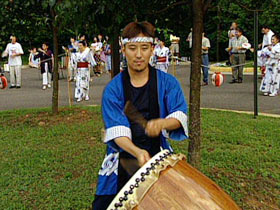
KEN NAKAMURA (Shin Buddhist): Bon as it’s pretty much observed around the temples in the United States is a two-day celebration. The Bon dance is usually first, and the Bon service is the next.

The sense of ancestor worship is not carried forth as much here in the United States. We’ve lost that aspect of ancestor worship that was part of the amalgamation of Buddhism as it is celebrated in Japan.

When we celebrate Bon, we don’t think of spirits coming back. We think of it as a memorial service, a time to remember those who have passed on.

GREG NAKAMURA: For me, Obon — and whether it’s the dance or the service — it’s just a reminder that we are here because of our ancestors, because of the way that they chose to live their lives, the way they taught us. It’s a reminder that they continue to live on through our actions.

Mr. NAKAMURA: We have this board that people can put the memorial plaques or the Buddhist name that’s given at the time of the person’s death.

NORI NAKAMURA: For those who have worked very hard for the Buddhist church, we are given a special title called “ingo.”

obonfestival-post02-drummer

Mr. NAKAMURA: We call ourselves “householder Buddhists” because we don’t have a monastic tradition. We are very much involved in the life we lead, which includes ego, self, ambition, attachments, love for family. You could no more ignore your family and cut them off than if you could stop them breathing.

MAYA NAKAMURA: When people die that are close to you, you feel the grieving and you feel the pain. But you also remember the Buddhist teachings of impermanence and interdependence.

Mr. NAKAMURA: The more popular sense of reincarnation is that there is a spirit that transmigrates upon death from one entity to another. The way we look at reincarnation is not so much the transmigration of a spirit, but the sense that we, in our daily lives, go up and down this whole realm.

We can be really, really greedy or attached to something, and that throws us into the realm of the hungry spirits. If a person suffers from road rage, they’re in the realm of the fighting spirits.

Sometimes we can be really, really good and do something that’s fantastic without any thought of how my ego’s involved, and that becomes the realm of the Buddha.

In our lives, we go up and down this whole realm of existences, and it can change from moment to moment. The hard part is to hit that realm of the Buddha and stay there.

Brain Imaging


BOB ABERNETHY, anchor: Now, a development in medical technology that, like so many others, raises troubling ethical questions. It concerns the emerging science of brain imaging and its potential to reveal not only what is going on now but what a person might be likely to do in the future. Fred de Sam Lazaro reports.

(From MINORITY REPORT): Who is the victim? I never heard of him, but I’m supposed to kill him in less than 36 hours.

brainimaging-post01-watching

FRED DE SAM LAZARO: In the movie MINORITY REPORT, Tom Cruise’s character was convicted of a crime he was supposed to commit — in the future. It may be science fiction, but the idea of predicting future behavior may not be that far-fetched.

With increasing precision, scientists are able to peer into the brain, most commonly with magnetic resonance imaging. MRIs are used to scan the brain for disease. But fast new functional MRI machines can yield snapshots of human emotions and potential behaviors.

MRI TECHNICIAN: All right, John. The scanner’s going to calibrate for 20 seconds. You’re just going to hear a buzzing noise. Okay?

DE SAM LAZARO: At Emory University in Atlanta, Dr. Clinton Kilts recently conducted functional MRI scans on 16 executive M.B.A. students. The study’s volunteers were told to read about and react to a fictional character confronting various moral dilemmas in the workplace.

brainimaging-post02-kilts

Dr. CLINTON KILTS (Emory University School of Medicine): There are specific areas of the brain that represent the repository of all your learned and aspirational content of self, and represent a key element of being able to decide when something is right or wrong.

DE SAM LAZARO: Dr. Kilts is a psychiatrist. His goal is more effective treatment for psychiatric disorders.

Dr. KILTS: We have a very poor understanding of the neural basis of sociopathies. And I think techniques like this offer us a considerable amount of insight into the biological basis and improved treatments.

DE SAM LAZARO: Brain imaging, using tools like this MRI machine, is the new state of the art in medical diagnostics. It goes well beyond genetic tests, which can predict the probability, even likelihood, of developing disease. Brain imaging can probe into the biology of behavior — and thoughts.

Valuable as these insights are to doctors, some ethicists fear they come perilously close to invading people’s zone of privacy.

Dr. ARTHUR CAPLAN (Center for Bioethics, University of Pennsylvania): People are beginning to say, “What if I really did begin to understand personal identity better, who you are, better than you do?”

brainimaging-post03-langlebenfred

DE SAM LAZARO: Without intending it, many researchers are gaining such insights, with far-reaching potential beyond medicine, notably in forensics. For example, Dr. Daniel Langleben’s research could someday yield a lie detector that’s far more accurate than polygraph tests, which are rarely admitted as evidence in courts. Langleben’s interest actually was attention-deficit hyperactivity disorder, or ADHD.

Dr. DANIEL LANGLEBEN (University of Pennsylvania School of Medicine): Patients with ADHD, indeed, have some trouble producing, at certain circumstances, producing intentional lies.

DE SAM LAZARO: So he set out to see what deception, or lying, looks like on an MRI scan.

Dr. LANGLEBEN: We take those images and superimpose them on those (points to brain scan) to be able to accurately locate areas of changed activity.

DE SAM LAZARO: Functional MRIs were conducted on 35 subjects in two studies at Langleben’s University of Pennsylvania lab.

Dr. LANGLEBEN: I was pleasantly surprised to see that there are parts of the brain that showed increased activity when the person is telling a lie. However, there was no part of the brain that showed increased activity when the person is telling the truth.

brainimaging-post08-lies2

DE SAM LAZARO (to Dr. Langleben): So we are naturally inclined to tell the truth?

Dr. LANGLEBEN: Correct. In fact, when you think about it, this is expected because we know the truth and we don’t know the lie, so it should require additional effort.

DE SAM LAZARO: Dr. Langleben cautions his work is still in its infancy and may never result in a reliable lie detector test. But ethicist Arthur Caplan says it may not need to be accurate to be used, or perhaps misused.

Dr. CAPLAN: If somebody says, for example, today, “I am not a pedophile,” well, then I think you could show them stimuli and try to get measurements of their brain that might give you some information about whether that is true or not. I wouldn’t use it to diagnose the condition, but for some purposes right now — for job employment, or let’s say you are trying to screen people for national security reasons or to enter religious orders. Maybe you don’t care if it’s 100 percent accurate. You are just going to avoid people who might be problematic. That technology exists today.

DE SAM LAZARO: So far, brain imaging technology has taken only baby steps out of the lab and into the outside world.

brainimaging-post05-koval

Adam Koval works for one of the first for-profit neuromarketing companies in the world. It is studying how consumers think and respond to marketing messages. It’s information that could never be discerned from the focus groups most marketers use today.

ADAM KOVAL (BrightHouse Institute for Thought Sciences): There are a lot of inherent biases in focus groups, the need for someone to feel like they are presenting you with information that you want to hear. If you say, “Do you like this product?” They will say “Yes,” but they can’t articulate it on an analytic scale.

DE SAM LAZARO: Beyond commercial uses of brain imaging, there are also compelling social applications. Just as brain imaging can tailor effective marketing messages, it could also help create better antidrug campaigns, for example. The question Caplan says we’ll ask increasingly is, “At what cost to our privacy?”

Dr. CAPLAN: I think our ability to protect our confidentiality and our privacy will be put in peril by this technology. Not because we can’t legislate privacy, but those who have the goods will say you have to yield that privacy in order to get them. So you want this job? Yield this privacy.

DE SAM LAZARO: A couple decades from now, Caplan says neuro-imaging could revolutionize our whole concept of self. It could tell us that choices or behaviors we thought were of free will are actually predetermined, the result of our brain’s wiring.

Slowly, it seems, the line is blurring where the neurons end and free will begins.

For RELIGION & ETHICS NEWSWEEKLY, this is Fred De Sam Lazaro in Atlanta.

Old North Church


BOB ABERNETHY: Here at home, for the first time, the National Trust for Historic Preservation has included religious buildings on its list of the country’s most endangered historic places.

Also this week, the federal government reversed a longstanding policy and said churches that are historic landmarks can get government money for historic preservation. The move provoked sharp church-state debate.

oldnorthchurch-post01-ayres

The case in point was Boston’s Old North Church, where in 1775 the sexton signaled Paul Revere how the British were coming by hanging two lanterns in the belfry.

Old North is an Episcopal church, with about 150 members. It is also a historic landmark, with more costs to repair its 43 clear windows and stay open for sightseers than its congregation and visitors donate. So it asked for, and this week got, a $317,000 Federal grant.

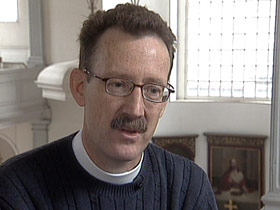
Rev. STEPHEN T. AYRES (Vicar, Old North Church): The balance between the religious activity here and the historic activity is pretty much this: there are about 7,000 people over the course of the year who worship here, and about 600,000 who come to learn about American history here.

ABERNETHY: The Administration’s decision to give Old North a preservation grant provoked an immediate argument.

Rev. BARRY LYNN (Americans United for Separation of Church and State): The Bush Administration seems completely dedicated to its faith-based initiative, which involves not only the funding of religious programs but now, apparently, the reconstruction of religious buildings in need of some kind of repair. This is part and parcel of an overall effort to fund religion at taxpayer expense.

oldnorthchurch-post02-donations

NATHAN DIAMENT (Union of Orthodox Jewish Congregations): What it’s really about is treating religion neutrally and fairly. Not to say that all historic buildings are going to be preserved except for the religious ones, and those have to fend for themselves.

LYNN: I think the Constitution is clear: government cannot give money to support churches, they can’t build churches, they can’t build additions to churches…

DIAMENT: …religious buildings are just as appropriately supported or just as important to historic preservation as secular ones. And to not put them in the same category in this particular policy is to discriminate against religion.

ABERNETHY: Back in Boston, Old North has a foundation for preservation work, and it is expected to match the government’s grant.

With Old North as a precedent, other historic churches are now expected to seek government grants for their preservation, too.

Among them are:

The 16th Street Baptist Church in Birmingham, Alabama, where a bomb killed four little girls during the civil rights movement.

Touro synagogue in Newport, Rhode Island, the first Jewish synagogue in America.

And the Catholic Basilica of the Assumption in Baltimore, Maryland, the oldest cathedral in the country.

Sephardic Art


BOB ABERNETHY, anchor: There is an exhibit at Washington National Cathedral that celebrates what can happen when people of different religions live together in peace. It displays treasures from the Middle Ages in Spain, before the Spanish Inquisition, when Spanish Jews, called Sephardim, lived peacefully alongside Christians and Muslims in a time of vast artistic and scientific achievement.

Washington National Cathedral’s exhibit is a joint venture with the Spanish government and the B’nai B’rith Klutznick Museum. We spoke with the Museum’s Diana Altman and Reverend Canon Peter Grandell of the Cathedral.

sephardicart-post02-exhibit

The Reverend Canon PETER GRANDELL (Precentor, Washington National Cathedral): We viewed it as really part of the Cathedral’s mission to uphold, particularly in these difficult times, a point in history where, without idealizing it, we could say Christians, Muslims, and Jews lived together as human family. And out of that came a brilliant period in history of art, culture, science, medicine. And it had its dark side too, and we also want to acknowledge that … the history of the Inquisition, the forced conversions. You see the testimonials.

My favorite piece in the exhibit right now is the technological wonders, the virtual synagogue, and the 360-degree tours that are taking place. The manuscripts are fabulous, but to actually enter into that full experience of what worship life would have been like, to me, is a real marvel.

DIANA COHEN ALTMAN (Director B’nai B’rith Klutznick Museum): Jews have lived all over the world but what’s clear is this was more than a kind of a way station and a place to long for Jerusalem and wait for the day to move on. I mean, this was their home. They practiced Judaism freely in all its ritual aspects and its daily aspects. It was an opportunity to practice the ancient traditions and, you know, to really, really practice what they believed.

Rev. GRANDELL: When people come together, great things can happen. And I think what the exhibition is trying to say is that, at this moment in history, individual faith groups came together at a point in time and more happened than could have happened had they been isolated.

Church of God in Christ


BOB ABERNETHY, anchor: According to the National Council of Churches Yearbook, the ranking of major Christian groups in the U.S. goes Roman Catholic, by far the largest; then Southern Baptist and United Methodist; and the fourth largest is the Church of God in Christ, a Pentecostal denomination many Americans may never have heard of.

Next week in Memphis, COGIC, as it’s known, has its annual Holy Convocation with 40,000 people expected. Today, a look at what may be the fastest growing denomination in the country.

cogic-post01-altar

UNIDENTIFIED MAN #1: Come on, come on, people. Let’s give Him glory in this place. (singing) All the glory.

The 11 a.m. Sunday service at the Temple of Deliverance Church of God in Christ in Memphis, Tennessee — it has 6,000 active members, almost all of them African-American. There’s a 30-piece orchestra and a 100-voice choir.

CHOIR (singing): Forever, you’re my king.

MAN #1 (singing): You’re my king.

ABERNETHY: Also, dramatic preaching and high-volume, high-energy spiritual experience.

The Church of God in Christ teaches classic Christian doctrine, the Bible is God’s word. But COGIC members also put special emphasis on the power of the Holy Spirit, of which the surest sign — many say — is speaking in tongues.

cogic-post03-scruggs

Michael Scruggs is 23 years old, a college graduate.

MICHAEL SCRUGGS (Temple of Deliverance): Oh, it feels good. It gives you so much joy. A celestial connection with you and God.

ABERNETHY (to Mr. Scruggs): Does that happen to you often?

Mr. SCRUGGS: Oh yes, it happens to me all the time. I love it. I don’t mind. I could be in the grocery store. I don’t mind. Wherever the spirit of the Lord is, there is liberty, and I have the liberty and the freedom of the Holy Ghost and I just can love it.

ABERNETHY (to Mr. Scruggs): Is it something that you can imitate?

Mr. SCRUGGS: Oh no. The Holy Ghost is something that you cannot imitate. You can’t imitate at all.

ABERNETHY: The pastor of the Temple of Deliverance and the Presiding Bishop of the full Church of God in Christ is Bishop G. E. Patterson. He recalled the Bible account of what happened to Jesus’ disciples, 50 days after Easter.

cogic-post04-patterson

Bishop G. E. PATTERSON (Church of God in Christ): On the day of Pentecost, they all gathered in one place and while they were praising God, they begin to speak in other tongues.

So when one receives the gift of the Holy Spirit, something happens down on the inside and Jesus said, from out of your belly, comes from down within. You are opening your mouth to express praise to God in the language that you know. But instead, another language comes out.
ABERNETHY: The Church of God in Christ is an American-born denomination that grew out of the Deep South in the late 1800s and then was inspired by a famous revival in Los Angeles in 1906.

The site was a former stable on Azusa Street, where many people spoke in tongues, giving birth to what became known as the Pentecostal Movement. One of those who spoke was a visiting pastor from Mississippi — Charles Mason, the founder of COGIC, who took his experience back with him to his church in Lexington, Mississippi, which is still growing strong.

COGIC celebrates baptism as a symbol of having been converted, born again. It also teaches that what it calls another kind of baptism — by the Holy Spirit — brings gifts such as healing and prophecy.

Many COGIC members are so exuberant in their praise because, they say, God has rescued them.

cogic-post07-williams

TEMPEST WILLIAMS (St. Paul’s Church of God in Christ): When you think about all the things that God has done for you and when I look back on my life, I think about all the things that he has done for me and what he brought me from, because I didn’t grow up in the church. I come from the streets. I come from drinking, smoking included. I didn’t know anything about the Church of God in Christ at all.

And so when I think about how he delivered me, set me free, changed my attitude, my outlook, and my uplook, I’m grateful.

ABERNETHY: Historians speak of a COGIC tradition called holiness.

Elder NORVILLE VAN WOFFOLK (Church of God in Christ Historian): No card playing, absolutely no drinking, and no public dancing. We dance in church.

ABERNETHY: Holiness becomes possible, says COGIC doctrine, because of sanctification –receiving the power to choose not to sin.

Professor DAVID DANIELS (McCormick Theological Seminary): People would teach, you can speak in tongues all day long, but if you’re not living a holy life, it’s nothing.

ABERNETHY: The typical COGIC church is in a poor part of a big city like this one — the United Tabernacle — on the West Side of Chicago. It has about 70 active members, and it’s family-run. Michael Thurston, 34 years old, succeeded his father as pastor. He is both preacher and organist. His wife, Gina, is a gifted singer, and their children play drums and sing in the choir.

Pastor MICHAEL THURSTON (United Tabernacle Church): My thought today is, well, what do you know?

cogic-post12-thurstonorgan

ABERNETHY: Michael Thurston is studying for a college degree, but he has no seminary training, and that’s typical of most COGIC pastors. It’s also one of the reasons for COGIC’s growth. Anyone who feels a call to the ministry can start a church, and many do. COGIC is working to improve pastors’ education, and Thurston strongly approves.

Pastor THURSTON: Sometimes we, out of — I guess you would say eagerness to start a ministry, we jump out there inadequately prepared, and that sometimes can cause shipwrecks.

ABERNETHY: Thurston is a third-generation COGIC member, trained by his father, the former pastor. He’s worked as a drug counselor, and he’s confident he’s qualified to minister.

Pastor THURSTON: I can relate to a lot of the hurt, a lot of the anger and the frustration. The peer pressure, the drugs, the gangs, the violence. The abuse, the molestation. Who better to talk to the people from the West Side than someone who was born and raised on the West Side?

UNIDENTIFIED WOMAN: Amen, we do have Regina Thurston with us. Amen. Put your hands together, everybody, and receive this woman of God on this side of heaven.

ABERNETHY: As COGIC pastors have always done, the Thurstons take their ministry into the streets, singing gospel this evening at a neighborhood carnival.

COGIC’s energy and growth have not gone unnoticed by national political leaders. Meanwhile, some of its own younger leaders are lobbying in Washington for COGIC’s share of federal money for social services.

cogic-post11-berry

Minister BARRETT-OSAHAR BERRY (Church of God in Christ): Our political agenda right now is: How do we secure funds for the people that we represent?

ABERNETHY: The Church of God in Christ has grown by several million members since the 1960s with its emphasis on spiritual experience and its upbeat music, which is especially attractive to the young. Minister Berry thinks COGIC’s membership could double in the next ten years.

Mr. BERRY: COGIC is, in a traditional worship service, is very emotional practice. I think it gives you all the angles of being a Christian.

ABERNETHY: Pentecostal and other demonstrative churches are growing fast abroad. Bishop Patterson says COGIC is represented now in more than 50 countries, and he expects big new growth in Africa.

Bishop PATTERSON: That is a desire among the African brothers to have a relationship with a church that is predominantly of their own ethnicity.

ABERNETHY: Women play a major role in COGIC churches as teachers, as mentors called church mothers. But there are very few women serving as pastors, and there’s growing pressure on the church to permit women’s ordination.

Mr. VAN WOFFOLK: It’s really a red-hot issue.

Bishop PATTERSON: The power of faith in the spoken word.

cogic-post13-altarcall

ABERNETHY: As his worship service is televised around the country and his denomination continues to grow, Bishop Patterson says COGIC members have come a long way from the days where they were mocked as holy rollers.

Bishop PATTERSON: I grew up with the ridicule of it all. Now we have lived long enough to see others trying to receive what I grew up with. And that’s quite satisfying, terribly gratifying.

ABERNETHY: Inside the Temple of Deliverance, the service closes with written prayers brought to the pulpit.

Bishop PATTERSON: Hallelujah. God loves you.

ABERNETHY: And then the altar call — inviting people to give their lives to Jesus.

Bishop PATTERSON: You can claim your salvation today. Hallelujah.

ABERNETHY: When the service was over, two and a half hours after it began, people familiar with COGIC worship assured a first-time visitor accustomed to more restrained worship that nothing that had happened had been unusual.

Teen Hospice


BOB ABERNETHY, anchor: Now, a story about a special kind of hospice program — people who are near the end of life not only get special care, they get some of it from teenagers, who learn a lot about life by being that close to death. Lucky Severson reports.

LUCKY SEVERSON: This is a suburb of Clearwater, Florida. And a high school project that has nothing to do with how to marry a millionaire or survive on a desert island, though it is reality TV.

(to Mr. Morris): What kept you teaching?

HENRY MORRIS (Patient, “Hospice of the Sun Coast”): I like working with people.

SEVERSON: What they don’t talk about is that Mr. Morris, Henry, is dying of heart disease. That’s why the kids are here.

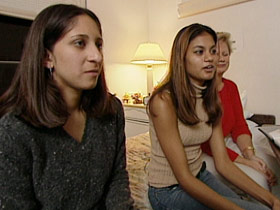
ANJALI SRINIVASAN (Volunteer, “Hospice of the Sun Coast”): My name is Anjali Srinivasan. I think one of the things I have learned from hospice is how important it is to celebrate your life.

SEVERSON: Anjali is part of a unique program for teenagers called “Hospice of the Sun Coast.” It’s offered in 16 Florida high schools; as many as a thousand kids have gone through the program since it started six years ago. Barbara Carrier is the Hospice Teen Volunteer Specialist.

teenhospice-post02-carrier

BARBARA CARRIER (Teen Volunteer Specialist, “Hospice of the Sun Coast”): The teens are coming in a little bit of Pollyanna — that life is good and I am immortal and this will never happen to me.

CHRIS GODDARD (Volunteer, “Hospice of the Sun Coast”): My name is Chris Goddard. Through hospice you really learn how important life is.

SEVERSON: One of the things the kids do is videotape interviews with people who are dying, like Henry. A priceless recording for Henry’s family, thoughts and stories and words of wisdom.

Mr. MORRIS: I always go into a situation with a positive attitude. I always look for the best in everything.

SEVERSON (to Mr. Morris): Has this helped you?

Mr. MORRIS: Oh, it’s been tremendous. They are very helpful.

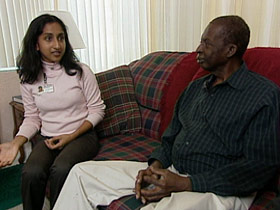
Ms. SRINIVASAN: I get to hear about personal stories and maybe Mr. Morris can tell me something, that in his life he wished he had done something differently, and I can take something from that and I walk away with a lesson in life.

teenhospice-post03-srinivasanmorris

Mr. GODDARD: I like it because lots of times just during my life I feel like I am not really doing anything for anyone else. I feel really selfish sometimes just, like, going to school, like, spending time in my room, like, doing homework and other stuff. And I like to get involved with hospice because I feel like I can do something for other people.

SEVERSON (to Ms. Srinivasan): How has it changed your view of death?

Ms. SRINIVASAN: It’s made me realize it’s a part of life as much as I probably initially denied it. It is just one more level, and I think I am a whole lot more comfortable with the idea after my experience with hospice.

Mr. GODDARD: When you come to see the people and you see that they are not really as bothered by it as you would expect them to be, it’s just the next step that is coming up. And it makes me a lot less fearful of what might happen later.

SEVERSON: The kids who do this are screened pretty carefully. Some discover it’s more than they can handle. But most hang in there, some throughout high school.

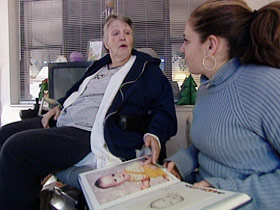
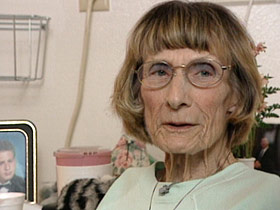
NANCY MCDANIEL (Patient, “Hospice of the Sun Coast”): It started of course with breast cancer, but it has spread. I have some in my chest.

teenhospice-post05-mcdaniel

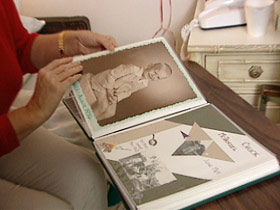
SEVERSON: Nancy McDaniel has come to the hospice to spend her final days. Along with her daughter Barbara, she has some new best friends who have helped her put together a picture book of memories.

Ms. MCDANIEL (Patient, “Hospice of the Coast”): These turned out just beautifully.

KINNARY PATAL (Volunteer, “Hospice of the Sun Coast”): I am Kinnary Patal, and the thing I have learned mostly about death is to appreciate life as it is.

NIKI PATRAWALA (Volunteer, “Hospice of the Sun Coast”): My name is Niki Patrawala. The most important thing I have learned from hospice is that like with dying, cherish what you have, like your family and friends.

SEVERSON (to Ms. McDaniel): What do you think of this project?

Ms. MCDANIEL: The girls have been perfect. They’re so polite and kind. I’d take them as my own if I could.

Ms. PATAL: When we go through pictures she would tell me about her life. I love hearing stories, and she had many to tell, many to tell.

Ms. MCDANIEL: This scrapbook has meant a great deal to me. I shall treasure this as long as I live. To me it is almost like a Bible.

SEVERSON: You hear so much, I don’t know what they call your generation — that it is all about music and clothes and success and cars — but apparently that’s not true. Apparently it is about other things as well.

teenhospice-post09-patal

Ms. PATAL: It’s all on the exterior, but deep down people really do care.

Ms. PATRAWALA: I feel the importance of, like, compassion and helping people. I think being in the younger generation — it is important for us to do that because we can. And it is something that the elderly can gain and we can gain also.

SEVERSON: It would be misleading to imply that these are just ordinary kids. Most come from the top five percent of their class. Some say they chose hospice because it will look good on their record when they apply for college. And some kids say they need the experience to cope with their own lives.

DANIELLE RUGGIERI (Volunteer, “Hospice of the Sun Coast”): My name is Danielle Ruggieri.

SEVERSON: Danielle’s grandmother died in hospice, and three other family members have died in the last couple years.

Ms. RUGGIERI: The meaning of death. It hasn’t really changed. You just grow to appreciate their lives as long as they live.

SEVERSON: (to Ms. Ruggieri): How do you get along with Sharon? Is she pretty tough to deal with?

Ms. RUGGIERI: No, she is fun to be with . She likes going to get ice cream a lot.

teenhospice-post10-ruggieriscrapbook

SEVERSON: Sharon Webber has Lou Gehrig’s, which is advancing on her with terrifying speed.

(to Ms. Ruggieri): Are the two of you pretty close now?

Ms. RUGGIERI: Yes.

SEVERSON (to Ms. Ruggieri): I noticed sometimes that you can finish her sentences.

Ms. RUGGIERI: Yes, you get to understand her.

SEVERSON (to Ms. Webber): Is Danielle almost like a daughter now?

Ms. WEBBER: Yes.

SEVERSON: There is simply no way to explain the bond between Sharon and Danielle, and how they both derive something deep and lasting from their friendship.

(to Ms. Ruggieri): You’ll miss Sharon, won’t you?

These are the tears of a kid who is years ahead of her friends and most adults. A kid who appreciates the moment, as long as it will last. Kendra Polachy is Volunteer Programs Coordinator.

teenhospice-post07-polachy

KENDRA POLACHY (Volunteer Programs Coordinator, “Hospice of the Sun Coast”): I think it opens their eyes[, the realization] of, “I am not invincible. And this could happen to me and this could happen to my family and I need to be prepared,” and you will hear students’ talk that “every day is a gift,” or “I feel really good about what has happened today.” Or maybe that test wasn’t all that big of a deal.

KEVIN HUMPHREYS (to Catherine Christy): How are you doing? Hi, I am Kevin Humphreys. And I think the one thing I am going to take away from this is that attitude is everything in life.

KYLE HUMPHREYS: Hi, my name is Kyle Humphreys. The most important thing I have learned is it is not really how long you live or how much money you have made or anything like that. It is what you make of it.

CATHERINE CHRISTY (Patient, “Hospice of the Sun Coast,” to Kyle): Why are you sitting over there when you can sit here with me?

KYLE HUMPHREYS: It’s pretty hard to believe, but you really do get close to people.

SEVERSON (to Kyle Humphreys): That’s good and bad, right?

teenhospice-post08-hug

KYLE HUMPHREYS: Yeah, the bad side of it is sometimes they go. That’s the hard part.

Ms. CHRISTY: It really isn’t, because hospice keeps you at peace and when you die it’s okay. It’s okay so you never have to worry about dying.

KEVIN HUMPHREYS: That’s what they can teach us. They, you know, she really is showing a lot more courage than I probably had to in my life in just waking up and choosing to make every day good and make every day happy for yourself.

Ms. CHRISTY: If you are going to get up in the morning and be gloomy, you hurt everyone around you.

KEVIN HUMPHREYS: That’s a good lesson to learn. I am sure I am going to keep that the rest of my life.

SEVERSON: Kyle has only been with hospice for a year; his older brother Kevin, over three years.

KEVIN HUMPHREYS: You can learn a lot about yourself from listening to other people. It’s been pretty important to me.

Ms. CHRISTY: And you get a better viewpoint of older people.

teenhospice-post04-scrapbook

KEVIN HUMPHREYS: Exactly. I learned that old people just aren’t a hazard on the roads slowing me down.

KYLE HUMPHREYS: You feel good when you come home. And I hope they feel good after my visit.

Ms. CHRISTY: I think I am going to cry.

KYLE HUMPHREYS: It is kind of special. Everyone in their lives should have something like this.

SEVERSON: Whatever their reasons, their motivation, all of the kids we spent time with are not the same as they were before they started spending their afternoons with hospice patients.

For RELIGION & ETHICS NEWSWEEKLY, I’m Lucky Severson in Clearwater, Florida.

ABERNETHY: We are sorry to report that Nancy McDaniels, the woman who helped make the scrapbook of her life, died last week.

Rev. David L. Moyer Extended Interview

Read more of Deryl Davis’s interview about Archbishop of Canterbury Rowan Williams with the Rev. David L. Moyer, president of Forward in Faith, North America:

On Rowan Williams and the issues dividing the Anglican church:
I’ve never met him face to face, but I’ve had conversations with him and I regard him as a man of great pastoral integrity, from my experience with him and from what I’ve learned from others who have known him for years.

rowanwilliamspreview-post02-moyer

For the past 30 or 40 years, the Anglican Communion has been wrestling with these lightning rod issues of the ordination of women, the ordination of practicing homosexuals, and now the whole hot issue of same-sex marriages. Rowan Williams comes out on a very liberal, revisionist side of those issues, whereas I and the people I work with maintain an orthodox position, what the church has always taught and believed through the centuries. But Dr. Williams is the type of man who will respect the corporate mind of the Anglican Communion. He realizes that he is a radical thinker; he is a theologian who ponders things; he writes extensively. But yet he has come out publicly to say, “It’s one thing for me to do that in my own capacity, but now as the spiritual head of the Anglican Communion, I have a moral responsibility and a pastoral responsibility to uphold the mind of the Anglican Communion” as enshrined for instance in the Lambeth conferences, where the bishops meet every ten years.

Dr. Williams takes what I would call a revisionist point of view He’s on the liberal side of those issues. He’s very convinced and committed to those positions personally, but yet since he has become the Archbishop of Canterbury he has said he wants people to have unity as much as is possible with differing theological passions. I think it’s a very difficult thing that he faces, but I certainly honor him and put my confidence [in him] that he can do this. He is committed, I believe, to working with such people and keeping the Anglican Communion together as we wade through challenging and difficult times. What I’m putting my confidence in is his willingness to say, when he represents the Anglican Communion as its spiritual head, that he will speak forthrightly, upholding the corporate mind of the Anglican Communion, of the historic teachings. He realizes how serious it is for him to do that.

On expectations:
I believe that Archbishop Williams will defend the rights of all within the Anglican Communion. But I think he will see his role not so much as defending people’s rights and having things politicized. I think he sees himself as one who can bring people together to talk and to pray and to seek to honor one another, but realizing that there could be points where the differences are irreconcilable. For instance, he has said recently that if the Church of England passes legislation for the ordination of women to the episcopacy (as the American church has done), he knows that this would cause a major problem that is irreconcilable, a major fracture in the Church of England that would ripple out farther in the Anglican Communion. There’s a sizeable group of clergy and lay people in the Church of England who simply could not abide by that. I do believe, from what I know of him and what he has said, that he would seek some creative form of accommodating, of providing a place for traditionalist clergy and lay people in order to avoid the breakup of the Anglican Communion.

I believe that Archbishop Williams is a liberal thinker, but yet he also is steeped in the tradition of the church-what has been passed down from generation to generation. He is not going to abandon that. It’s a dynamic. He’s sitting in the middle of polarities; it’s a real pull. Here is a man who’s a very bright man, a very creative thinker. But yet he’s rooted in something that’s very historic and in something he knows he has a particular role of stewardship for. He really has been entrusted with a major role in the Christian world as the Archbishop of Canterbury.

On separation and support:
The big issue right now as I see it worldwide is the issue of homosexuality and particularly same-sex blessing. It’s a hot button issue. Obviously, same-sex blessings introduces into the church a new morality, a new understanding of human relationships, and Archbishop Williams knows that this could be something to could lead to schism and separation.

I am prepared to offer my support to Archbishop Williams in prayer and hopefully develop a personal relationship with him, if I would be granted that. He has stepped into a huge job; he’s been called to be the spiritual head of the Anglican Communion in a very difficult time, and I think we need to give him the benefit of the doubt. I mean, he is the Archbishop of Canterbury, so let’s pray for him. Let’s support him. Let’s let him grow into the role. I would want people to grant me the same latitude, the same privilege if I were in his position.