Transcendental Meditation


BOB ABERNETHY, anchor: Transcendental Meditation — TM — was widely popular 40 years ago: a technique for relaxation and awareness using certain sounds and ways of breathing, 20 minutes, twice a day.

You might have thought TM had disappeared, but last winter in Iowa, Lucky Severson found a town where it is flourishing and, for some, controversial: is it just a meditation practice or is it also a religion?

transcendental-post01-university

LUCKY SEVERSON: Who would imagine that the nerve center of Transcendental Meditation in the U.S. would be located in the middle of cornfields?

It was 1974 when Maharishi Mahesh Yogi founded what is now the Maharishi University of Management in a bankrupt Presbyterian campus in Fairfield, Iowa. That was after he had gained fame as a guru to the Beatles.

Now, twice each day, the university’s twin 25,000-square-foot domes are filled with the silence of hundreds of Transcendental Meditators, or “TM’ers,” attempting to achieve a state of inner calm that transcends the hustle and bustle of everyday life.

This is not the average farm town. Even the mayor, Ed Malloy, is a TM’er.

Mayor ED MALLOY (Fairfield, Iowa): I’ve discovered that this world is the real world and it’s a beautiful, beautiful place to live.

transcendental-post12-class

SEVERSON: These are sixth graders who learned how to meditate when they were in the third grade.

Unidentified Girl #1: ’Cause it releases all your stress and makes you feel very calm and focused.

Unidentified Girl #2: I never feel stressed about schoolwork.

Unidentified Girl #3: And I’ve been doing it for many years and it’s just — over the years — it just makes you feel so much better.

SEVERSON: Mario Orsatti is a TM’er from Philadelphia, with a master’s degree in education.

MARIO ORSATTI (Spokesman, The Institute of Science, Technology and Public Policy, Maharishi University): I think too many adults don’t realize how stressful our children — the amount of stress that our children are experiencing as a result of their education.

SEVERSON: Maharishi University is nationally accredited and it offers advanced degrees in management, education, [and] Indian philosophy, as well as other fields, to about a thousand students from all over the world.

transcendental-post05-devlin

Alisa Devlin is from London.

ALISA DEVLIN (Student, Maharishi University): And it just flipped my life to the other side in all positive ways — all the negativity, all the, like, hurt and all kinds of things that was going on, it just fell away.

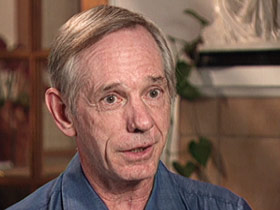
Dr. FREDERICK TRAVIS (Director, Center for Brain, Consciousness, and Cognition, Maharishi University): David has been meditating since he was four.

SEVERSON: There’s even a brain research lab on campus where technicians trace the effects of meditation on student volunteers.

Dr. TRAVIS: During Transcendental Meditation practice, you see a greater lever of integration in brain functioning.

SEVERSON: The results are all positive and self-evident, according to TM’er John Hagelin, a renowned physicist.

transcendental-post06-hagelin

Dr. JOHN HAGELIN (Quantum Physicist, Maharishi University): Transcendental Meditation is a powerful technique to turn human awareness powerfully within, to experience deeper levels of mind. And that correlates with things like IQ, creativity, learning ability, academic performance, moral reasoning, intellectual achievement, scholastic achievement.

SEVERSON: Fairfield has grown dozens of new businesses and hundreds of jobs, many of them high-tech; why it’s been called the “entrepreneurial Mecca of the Midwest” and “Silicorn Valley.”

Where else in small town America would you find five Indian restaurants, three Thai, and more hybrids than Hummers?

Mayor MALLOY: I describe it as really a model community for the 21st century. I think that there is going to be a natural trend for people to move out and move away from those cities and look for small communities that offer quality of life.

transcendental-post13-mayor

SEVERSON: The mayor is serving his second term. He was elected by both meditators and nonmeditators — which is the way people divide themselves here. Fairfield has a population of about 10,000, with approximately one third claiming to be meditators.

For 30 years, meditators and nonmeditators here have been getting along in splendid isolation — some grumbling, but nothing serious. There is growing unease, though, in some circles, but it’s not about people or lifestyles. It’s about whether it’s possible to be both a meditator and a believer.

Reverend GREG CRAWFORD (Pastor, Jubilee Christian Fellowship Church): It’s somewhat deceptive in the fact they’re telling people it’s a science when in reality, it’s really a religion.

SEVERSON: Greg Crawford is pastor of the Jubilee Christian Fellowship, which has schools, churches, and missionaries throughout Africa and Asia. But in Fairfield, the church is struggling to attract new members, and Pastor Crawford believes it’s because of competition from Transcendental Meditation.

Rev. CRAWFORD: From the forefront, it looks like it’s a science and they’ve posed it as a science, but as you start to study it out more, you see that it’s actually Hinduism.

transcendental-post10-crawford

SEVERSON: To attract more attention, the pastor sponsors weekly services where the pulpit and the music rock. Kai Druhl is a former TM’er who actually taught meditation at Maharishi, and is now a convert to Christianity.

KAI DRUHL (Former TM Teacher) (Speaking to Students): Let me explain to you how the whole thing will proceed today.

SEVERSON: He teaches physics at the local community college via closed-circuit TV. Druhl says he has no doubt that TM is derived from Hinduism.

(To Mr. Druhl): Does that mean it’s anti-Christianity?

Mr. DRUHL: It excludes and takes away from the experience of Christ.

SEVERSON: Mario Orsatti could not disagree more.

Mr. ORSATTI: There’s no doubt in my mind that the practice of Transcendental Meditation has helped me enjoy being a Catholic.

SEVERSON: Students like Jenoa Kohn agree.

transcendental-post11-meditators

JENOA KOHN (Student, Maharishi University): I’m a spiritual person, but I don’t think that, you know, TM is something that I do that is separate. It’s like brushing your teeth twice a day.

SEVERSON: Virtually all the TM’ers we spoke with insist that TM is a science of the mind, not a religion. But there appears, at least, to be a connection to Hinduism.

The lavish health spa outside of town offers treatments based on a 5,000-year-old Indian holistic medical system called ayurveda.

The official language of the new town on the edge of Fairfield, Maharishi Vedic City, is Sanskrit, the classical Hindu language — although its significance is largely symbolic.

The Vedic architecture recommends that all homes face east to catch the warming rays of the morning sun. Pastor Crawford doesn’t care so much about the architecture. It’s the connection to Hinduism that troubles him.

Rev. CRAWFORD: Hinduism believes in reincarnation, believes in multiple gods; and so with a Hindu philosophy it enables you to embrace Christianity, but with Christianity you can’t embrace Hinduism.

SEVERSON: TM’ers believe any conflict will eventually fade away. They believe if they can accumulate enough mediators in Fairfield and Vedic City, peace and harmony will pulsate from the Iowa prairie throughout the world.

For RELIGION & ETHICS NEWSWEEKLY, I’m Lucky Severson in Fairfield, Iowa.

Doug Pagitt Extended Interview

Read more of Kim Lawton’s interview about the emerging church with Doug Pagitt, pastor of Solomon’s Porch in Minneapolis and author of REIMAGINING SPIRITUAL FORMATION (Zondervan):

Why was the traditional way of “doing church” not resonating for you?

emergingchurch1-post01-pagitt

From my vantage point, at least, I think that we really are quite traditional in one sense, because I think what we’re doing is what those who have gone before us have also done. So while we’re not doing precisely the same model or the same feel or the same sound or the same look, we are trying to figure out in our day what Christianity would mean for us. And so in that way we’re much like the first century or the nineteenth century or the twenty-first century, so we’re trying to figure out what would it mean for us to live out the hopes and dreams and aspirations of God in the way of Jesus in our world, and trying to organize ourselves in a way that would make sense for us. You know, there’s people who tend to think that Christianity has one way of going and one way of functioning and one way of organizing itself, and that’s just simply not the case. From the very beginning Christianity has been a disparate religion; it doesn’t mandate one language, it doesn’t mandate one culture, it doesn’t mandate one way of meeting. We really are doing what’s very normal for Christians, and that’s to find ways for us to meet and to gather and to try to be shaped in the way of God in the setting that we find ourselves in. So it’s not like we looked at something and we said, “Well, those people are doing something wrong and we’re going to make it better.” We said we needed to do something that really is honest and representative of the lives that we’re currently living today. So we became, you know, an active part in the creation of the kind of church that we want to be in.

What are some of the characteristics that help you express Christianity today in this culture and time?

The hallmarks of our expression of Christianity, of course, aren’t stagnant either, right? So that’s kind of something changing. I’ll try to speak as honestly as I can, but that may change at some point as well. But for us, meeting in the round is kind of an important thing. Part of it has to do with how we understand our community and how we’re going to relate to one another. So to be face to face in our weekly meeting is an important thing. We’re trying to live lives that are open to one another, that are face to face, that are inclusive of other people’s lives in our pursuit with God. So meeting face to face is important. For it to be representative of our community and to come from us matters. So we write our own music, we create our own prayer, we do use a number of elements from the church throughout history. We’ll recite creeds, we will borrow prayers and invocations, we will use the scriptures quite regularly and frequently and in-depth. But we’re also trying to say what are the words that we would put around it? In some ways we’re trying to figure out how we would leave, you know, something of value to our own children’s children. So they will look back and ask what their great-grandparents did in the twenty-first century, back when things seemed easier, I’m sure, from their vantage point.

So to meet face to face, to create our own language, to create our own expression really matters to us. To have creativity and art and beauty matters. It’s more important for us to feel like we’re representing a beautiful expression of our life with God than it is to be right about everything. Some people hear that, and it just sounds like, “Well, that’s just going to go down the road of all kinds of trouble.” I guess it could, but what I am certain of is that churches who have tried to be right about everything have also gone down a road full of all kinds of trouble. So it’s not like were choosing a road of peace and a road of trouble; it seems that there’s trouble on both sides, and we would just as soon be careful about being a people of peace and of beauty and of goodness and not have to be right about everything, so there’s as much an attitude of sharing and of dialogue and of input and of the people who are here actually having a part to play in what we’re doing.

You know, for Protestants the notion of the priesthood of the believer was an important part of the Reformation of the fifteenth and sixteenth centuries, and it seems that in a lot of ways that goes by as an unfunded mandate for the church. We talk about it and never put any resources behind making it happen. We’re working really hard at trying to make the priesthood of the believer mean something not only in our Sunday gathering but throughout the course of what it means to be a church, and I’ll tell you that comes with a lot of cost, and it’s much more difficult than it is to just set aside a few people to make all the decisions and ask everyone else to fall into line.

Why is it more difficult?

It’s difficult to involve everyone in the life of a church because people think differently, and part of the beauty of a community is the diversity. We’re not all the same. We don’t think the same, we don’t vote the same, we don’t shop at the same stores, we don’t raise our children in the same way, we don’t come from the same families. So you bring all of this together into one meeting, and you say to people, “Well, what should we do?” And when the conversation shifts from what would I do, what would I like, to what would we do and what’s best for us, this becomes a different question, and now we have to put together the structures and the mechanisms to include as many people as possible in that, believing that all people have the spirit of God in them and can be led by God. So there’s no chance that one person gets to say. “Well, I have an education, or I have a level of experience, therefore I speak for God and you don’t.” I can say, “I speak for God and so do you.” So now we have to negotiate even that.

Fortunately, we’re in good company throughout the life of the church. Churches tried to figure this out in local congregations and across the world for centuries. But it’s a difficult thing because to move together means giving up something. You don’t get to move as quickly; you’re not able to make decisions as clean. We probably waste a lot of time and energy. But it’s really not a waste in my view because we’re doing something collectively, and we’re doing something together, and it seems that’s more in harmony with what God would have us to do. If God invites us to be co-creators with God in the life of the world, which I think God does, then to look at other people as co-creators with God is just what you do.

So we have to figure out how to organize ourselves, and some of that means running against the flow in what the church expects and what the people expect. One of the real struggles in involving people in the life of the church and feeling that they’re a part of it is that people don’t want that. There’s an awful lot of people who want to go to church and have a service provided for them; to be serviced in some way and to engage in a religious activity and then to go and hope that those people who run the religious service will be there again next week so that they can engage in it again. When you say to them, “No, you’re a part of this,” it changes their mindset. It’s like if someone were to go out to a restaurant and they were to sit down and they placed their order and the waiter said, “Well, get up and go into the kitchen and make your food then.” They think, “No, I’m at a restaurant. I come to these places because I don’t want to make my own food.” There are an awful lot of people who want to go to church because they don’t want to do their own spirituality. When they come, and we start saying to them, “No, this is a place where you take on greater responsibility for your spiritual life and for the spiritual lives of those around you,” it changes the relationship a little bit. We’ve had to work hard to renegotiate what it means to be a part of a community where your involvement is a necessity and isn’t just something to do if you’re sort of more involved than others, but it’s the baseline.

Is everyone qualified to do that? Are some people in a place where they shouldn’t be determining the spirituality of a group?

Qualification for involvement in other people’s spiritual life is a big deal. Not every opinion is equally valid, and that’s just simply the case. Some people just don’t know as much as others do. That’s what makes it work; you have to now determine whose opinion really does matter on a particular topic. I think you always have a leader. Anytime you have a group of people together, someone’s the leader. But it doesn’t have to be the same person all the time, leading on every topic and leading in the same way. Leadership can move. It can rotate, but someone’s always going to have leadership. That’s part of what give-and-take means. I’m the pastor of our community, but that doesn’t mean that I’m this most qualified on every topic and every subject. There may be a case in which someone is better qualified for that situation but not for something else, and how do we find a way to get them engaged in the place where they’re best qualified, but not having to have all the power to be involved in everything else? That’s the part that makes this an awful lot of work. it would just be easier to say someone decided years ago who was going to make these decisions, and that’s just what we’re going to do. This is a big conversation in a lot of churches, especially churches that talk in the emergent-esque kind of language — that experience is really important. For us, the kind of experience we want to get after is people actually become full participants, not just where they have some experiential activity that takes place, but where they actually become the people who say, “This is my community and I am engaged and I’m involved in all of this.” So what we mean by experiential life is that when someone becomes a part of our community, we’ve actually become a new community. We’re not just the same people with more members. We’re now a new people in some way. We have to be shaped and changed as a new people, because now we have more folks that are a part of it. And so we’re constantly adjusting, and it’s not major adjustments, and it’s not a total reworking of everything. It’s not chaos, but it does mean that it constantly changes and adjusts. We’re not the same people that we were six years ago when we started, and we won’t be the same people six years from now. We find ourselves at a particular place in time trying to figure out how do we do this in the midst of our life now?

What are some of the connections between current cultural trends and what you are doing at Solomon’s Porch?

Cultural trends don’t tend to run evenly across all of culture. They tend to pop up in places, in ways different than other places. I think part of what’s happened in the grand scheme in last 30 years or so is that individual people have felt more empowered to make decisions for their life and for the lives of those they care for than they used to, in relationship to institutions. There’s a grand shift away from organization and institution being right, and individuals and collections of people with a voice have as much power and as much say. We are definitely a reflection of that. There’s not doubt about it; that’s just the water that we swim in. We are people who tend to think we matter, and our voice matters, and our opinion matters. Even in we’re not all that educated, even if we’re not as qualified as someone else, [it] doesn’t exclude that voice from the conversation. That’s definitely a piece of it.

A place where I think we’re a little countercultural to some of the trends is there’s been a strong move toward an individualization of spirituality, where each person has their own individual spiritual life, and you utilize other people as they would be an added resource or benefit to you. But the idea of collective spirituality, where it’s still personal, where people are personally engaged and it matters to them in their life, to somehow connect the personal life with the corporate life is a bit countercultural; it’s a hard thing to do. We’re having to say to people, “Look, you matter, but you’re not the only one who matters.” And there’s an awful lot of cultural trend and cultural pressure toward people gathering in large groups of people so that you can sort of get the greatest value for your resources, but then to have individual experiences together. One of the reasons we meet in the round is that we want people to know that other folks are around and that they matter. It’s not just them all alone. But there’s an awful lot of trendy Christian spirituality that really individualizes everything. You get into the room, it’s very dark, you close your eyes, you separate from everyone, sort of light it with candles, and it really doesn’t matter who’s around you. We’re trying to create a bit of a countercultural experience saying it does matter who’s around you, and that person wrote the song, and this person’s prayer — they wrote the prayer, and this pastor, you’ve been to the pastor’s house and you know the children and this is very personal in that sense without being individual.

I think there’s also a sense of individual creativity that we’re tapping into. It’s a big cultural trend, you know, that people have their own Web sites, their own Web logs; they create their own music lists, they create their own art. There’s very much a sense of people’s personal creativity, and we try to be a community that allows for personal creativity to become a part of our collective experience.

I think that there’s this cultural trend of “casual” that’s taken over large parts of our society. You see it in clothing, workplaces and I think it’s happened in the church some — that there’s very much a relaxed feel, and not just a southern California sort of relaxed feel, but a sense that true spirituality can also be comfortable and can be normal. But there’s an awful lot of our people who still want a formal element to it, so we have some elements of formality that we do because it feels right. But the formality tends to be the occasional, and the casual tends to be more normative. That’s something our community reflects, and that fits us and probably is much the product of the culture that we live in.

Many folks in this movement use the label “post” a lot: post-conservative, post-liberal, post-evangelical. Why? What does that mean?

dougpagitt-extended-post02

Well, in the emergent conversation there’s a lot of use of the word “post,” and it’s a bit of a cop-out, frankly, because “post” means after, but it’s the opposite of the word “pre-.” “Pre-” means that which is before, what’s about to come, a thing just preceeding. “Post-” means the thing that follows. People have been quite comfortable describing the cultural shift in North America and, really, around the world, and I can speak more fully about North America. The shift in North America is unclear at this point what it is, so the use of the word “post” means after — doesn’t mean “anti-,” doesn’t mean “against.” It means the thing that comes after. And so for someone to refer to themselves as postmodern or as post-evangelical, or as post-mainline or as post-Christian — these are words that mean not against, but after. People are trying to say, “Yes, we understand what it means to be a modern person, we understand what it means to be an evangelical, we understand what it means to be a mainline church person, we understand what it means to be a Christian.” But what exactly does it mean if you’re not quite that anymore, like that was a good place to start but it’s not the place that you want to finish? What words do you put around that? In some ways it’s a cop-out and in some ways it’s honest, because no one wants to try to be the one to coin the expression and to coin the phrase.

In fact, five years ago or so when numbers of us started using the phrase “emergent” to describe the conversation that we were trying to have, it was in reaction to the postmodern language. We wanted to stop using that word. It didn’t seem helpful any longer in this discipline. Postmodern is an effective word in certain disciplines, but it seemed that in the world of religion it had sort of run its course, and so we tried to create a new one. As soon as that happens, of course, you have detractors and those who want to make it better, and you have people who are trying to fix it all along.

It’s a bit of a cop-out, but it’s also a humble stance to try to say, “We know we’re after something that’s quite defined, but we’re moving into a period of time that’s much less defined, and we’re hopeful that we’re going to be as faithful in our day as those who went before us were in their day.

What is emerging — from where to where?

Five years ago or so when numbers of us started using this phrase “emergent,” there were a number of reasons why we thought this word worked well. The reason I was most excited about it is the use in a forestry term or an agriculture term. Emergent growth is the growth in a forest that is growing below the surface, that if you were to knock away the dead pine needles and leaves and branches, you would see the growth that’s happening there. The health of a forest is determined by the health of the emergent growth, the growth that’s about to come up. In farming, people talk a lot about applying pre-emergent herbicides and so on, which they probably ought not do but. The idea is there’s something that’s about to come to the surface, and it’s growing in the environment of the rest of the forest or the rest of the field. So it’s not against, it’s not over in another field, it’s not something that wants to destroy the forest; in fact, it’s going to grow because of the protection of it — the idea that there was this emergent growth that was happening in Christianity, that was protected and that was going to have the chance to survive because of the environment. We wanted to talk about what is the nature of that emergent growth of Christianity in the world: Is it healthy, is it good, does it seem that it’s going to be able to take root and to stay and what would we need to do if not? People who care for forests go around, and they find out what is the growth right down close to the ground. And, you know, most of us who don’t know anything about forests, we look at the tree tops and we think it’s a beautiful forest. But you can have a dead forest with a lot of trees in it. Our thought was how could we turn our attention, our concentration, to that which is growing? So our idea was let’s switch the conversation from being just a cultural conversation to saying what is the nature of Christianity as it’s growing from its organic roots, and what’s going to be the nature of that which is going to come? That’s how we wanted to use the language.

But emergence theory also began to be used in this conversation at the same time, and emergence theory has to do with complexity and that which is going to develop out of chaos and complexity — that what we would look at and think is just random actually starts to form patterns to it, and that’s a helpful way to think about this, too, that there seems to be this chaos that’s happening, but if you were to study it long enough you begin to see the patterns. People studied ants and they’ve studied wave theory and they’ve studied light. How it is that things that seem to be moving without any pattern to them actually do have a pattern? They do function according to a set of principles and to a set of rules. That’s not a bad way to talk about it as well.

But the hope was to try to be as generative and as creative with the language as we possibly could. We tried to come up with a phrase, and it’s caught on a bit and may have outlasted its usefulness already.

Are you surprised by the extent to which this conversation has seemed to resonate in so many quarters?

I don’t think I’m too surprised about the spread of interest and the amount of resonance that there is in this. I don’t think I’m concerned or too surprised about that, because this is the time for the larger Christian community to be interested in these ideas. Many of the conversations that people are having today about how church functions, about the nature of Christianity, about theology, about the role of humanity, about our engagement in caring for the earth and our engagement of people who live in other cultures — these are conversations that have been going on for more than a hundred years in North America at least, and in Europe for at least that long and maybe longer. It has just now hit the point of being more popular in that the language has been refined, and people have been thinking in deep and often complicated theological terms. They’ve been having this conversation for some time until people who can put that same conversation into a more common parlance have come on the scene, and so I’m not too surprised that this is the time when it has sort of caught the imagination of numbers of people. It’s not something that really started in the last 5 or 10 years. The really public side of this has caught the attention in the last 5 or 10 years, but it has really been a conversation that’s been going on since the dawn of the Industrial Revolution, and some of the things that happened in the late 1800s and really the development of most American cities in the last hundred years have included many of these same pieces of conversation: Who are we, how do we live together, what’s the nature of God with us, and what’s the role of the church in that? Those are the deeply considered ideas.

The reconsideration of this isn’t surprising to me, especially when you put in the generational component with the marketing component, and there are plenty of people now who want to market particular ideas to generations, so there are far more people who are interested in taking religion as a marketable tool and making that accessible to a larger group of people. When you’ve combined deep, century-long theological and sociological thought with people who are articulate, who are actually creative themselves, are freed up to do that, and you put that together again with marketing, you end up with something that spreads at a pace that seems to be unexplainable. But I don’t know it’s all that unexplainable; I just think it’s a feature of where that is right now.

How diverse are the churches that use the title “emergent”? Is it just style that is different, or are there some real theological differences?

Because there’s no gatekeeper to the emergent conversation or to using that language for someone to describe themselves or their community, there’s just no way to say what the real spread is; we don’t have any way to know that. But there clearly are some people who are thinking more methodologically: What do we do and how do we do it and how would that matter? There are some who are thinking more philosophically and theologically, and there are some who are even considering what the message of Christianity is, so a number have been saying for quite some time [that] it’s really all three of those; they work together. A deeply held theological understanding is going to produce a certain way of functioning and is going to produce a certain kind of message that we’re communicating. There’s been a lot of work done with Christians who have thought that the problem is that the church has the wrong methodology. That could be the problem, but it may run deeper than that. It might be the wrong message that’s being communicated; there might be some more deeply held presuppositions that have to be altered. Within the emergent conversation, people will run into folks who are just beginning and are right there theologically but haven’t rethought their methodology; some have begun with the methodology and that will later transform the way that they think about God and the way that they think about people and Jesus and sin and redemption. So because of the way they work together, the theology and the method and the practice that we’re communicating, there’s a symbiotic effect of those, and so to change one really will change them all. There’s some who’ll become a little frustrated that people don’t do it in the same order. I tend to be a little more forgiving on that; I tend to think that change is a very difficult thing and to try to rethink church and life and Christianity in the midst of all that we all have going on — that’s just a lot of effort and a lot of work, and any place that someone can begin, that seems to me a good place for someone to begin if they feel like they need to be deeply reconsidering what they’re about and reimagining what their faith would mean to them or to their community.

I think that ultimately there will be change methodologically and theologically. But some might begin with the method and others might begin with the theology, and those two might find the other to be a little less attractive than they would see themselves, but I think they both count. If people are seriously considering either of those, it’s going to lead them to the other. It’ll lead them from theology to methodology or from methodology to theology.

When you use phrases like “rethinking Christianity” or “rethinking the Christian message,” or when you say you are not so concerned about getting things right, a lot of evangelicals and a lot of Christians overall are threatened by that. What exactly are you calling for?

I understand that when someone hears people talking about rethinking Christianity or saying that we’re more concerned about being good and beautiful than being right, that can unnerve someone, and it can make them think that you’re going to lose the essence of Christianity. We’re not talking about doing anything beyond what the church has always done, and that is to continually understand what God’s activity in the world has been and what God’s activity in the world continues to be. Christianity is just simply not a stagnant belief. I know that that comes as a very hard concept for some people to put their minds around or for people to accept. But Christianity has never been stagnant and has never been about uniformity. It has been about unity within distinctiveness. Christians are called to Christian unity but not uniformity, and to be right is a contextual reality. We certainly should be right in our contexts. But let’s say that the Christians of the third century had felt that there was no need to reconsider what it meant to understand how Jesus was fully God and fully man for their language of the day. They were trying to take the first-century terms of what does it mean for the fullness of God to have dwelled in Christ Jesus, and they had to articulate that in a way that made sense for their day. And so the Trinity became a more unified belief and a statement of Christian doctrine. It didn’t exist in that same context before, but they were right to do so, and they put it in a way that made sense in their day.

To assume that Christianity has been this little pearl that is just covered by culture, and that all we need to do is pull away the culture and we’ll find the pearl on the inside is not a historically accurate or theologically accurate way to understand Christianity. I like to think of it much more as an onion — that an onion is made up of a series of layers, and there is no core to it; that you pull away all the layers and you get to the core. It becomes a series of layer upon layer upon layer. That’s not a bad thing; that’s a really wonderful thing — that all throughout culture and all throughout history God has been engaged in cultures where Christianity has been spread, and then Christianity has become that expression of the life of God inside that culture. So often Christianity does not bring the story of God to people; it rearticulates the story of God that is already functioning in culture and puts it into a broader Christian context. It’s simply the call of Christianity, in my view, to rethink and reimagine the very understanding and essence of what Christianity is. Never thinking that we have to begin from a dead stop or that we look at our past and we walk away from it; you never could. It’s just simply not something one should do or could do. We’re always living in a cultural context, and we’re always living in a historical context. In the emerging conversation you’ll hear a lot of people talk about what we mean by community is global, what’s happening around the world, that this isn’t just a North American thing, that it’s historical, the faith that has come before us. But it is also local, where we are, and it’s even the future; there’s a future element to all of this. The future of Christianity is important to us because we are living the past that other people are going to reflect upon. We live as these people caring about the future, caring about the past, caring about the world and caring about our current setting. There’s just no way to understand Christianity in my view without saying that we have to continually be reconsidering, reimagining, and rethinking what it means to be a Christian inside that broad context.

Scot McKnight Extended Interview

Read more of Kim Lawton’s interview about the emergent church with Scot McKnight, religious studies professor at North Park University in Chicago:

How would you describe the emergent church?

It’s a conversation among 20- and 30-year-olds about the direction of the evangelical and post-evangelical church in the next generation. That will focus on local communities and embodiment or performance of the gospel by everybody involved. It’s a reaction or a protest at certain levels against traditional evangelical churches.

emergingchurch1-post06-mcknight

What precipitated this conversation?

I think dissatisfaction with traditional evangelical answers to questions that are emerging at universities and [in] the younger culture. I often tell our people that this generation did not grow up with Mr. Green Jeans, they grew up with Mr. Rogers and Sesame Street and the emphasis upon diversity and pluralism and dialogue and conversation, rather than taking hard lines and making firm judgments about people and groups.

So how does that play out in religion and church?

There’s a general recognition, I think, among emergent voices that there should be a conversation among all Christians about what unites Christians, rather than drawing firm lines, denominational distinctives, and emphasizing differences. It’s a post-Catholic form of Catholicism, where they want to be universal and global, but they want to be global and universal at a level of community and practice rather than trying to get into long discussions and debates about theology.

Is this something new and radical, or does this kind of rethinking happen in every generation?

When I first heard about the emergent movement, the emergent conversation — these are profound categories that are being used — it reminded me of the Jesus people of the ’60s and ’70s. But the Jesus people were concerned with a post-Vietnam or a Vietnam phenomenon and were reacting to what was going on in American culture, and I think the emergent conversation is a reaction against a Christian culture rather than simply a social response. So it reminded me of that and no, I don’t think it happens in every generation, but every now and then it does happen, and this has taken hold globally, so it’s not simply a North American-United States-Canadian issue. This is a global response to how Christianity should be performed in our world.

How far are the edges being pushed?

Some traditional evangelicals have responded vehemently and almost with volatility to the emergent movement, because they see a blurring of theological lines that were earned and worked for very hard in the previous couple of generations. Evangelicals fought hard for their own distinctives over and against mainline generations. This emergent conversation wants to knock down those boundaries and engage in conversation across old-fashioned theological walls. I do think there is something very significant at this level of conversation.

And this is threatening to some wings of the church?

It threatens the more conservative evangelical group in many ways but mostly just over theological affirmations and doctrines.

In what way?

They want to open up questions. They’re asking questions about how we should understand our relationship to scripture: Is it inerrant? Is it true? And many of the emergent people are saying that it is the senior partner in the conversation, which is a healthy category. They’re asking questions about what we should believe about the afterlife. They want to ask questions about heaven and hell. They want to challenge some of the traditional Christian views on these questions. They’re very big on how to “do” church, which is not an expression that I prefer, but they are big on how the church should operate as a community of faith.

The emergent voices want to ask whole new sets of questions, answer these questions in new ways and work out church in this generation. And the final [question] and perhaps the most explosive one has been: How certain can we be about what we know? Many of these emergent voices are less certain of their theological ideas, and this appeals to a generation that is given to dialogue and to discussion and to conversation, and not making firm judgments about people.

Why is that so controversial in some parts of the church?

In the conservative evangelical wing, scripture forms the foundation for truth, and insofar as we know what scripture says, we know the truth. This has been challenged by the emergent conversation because they are saying that what we know is what we think we know, rather than what is to be known. There is a recognition that we as subjects, as knowers, influence what we think we know. Involved in this also is the belief that truth is a relationship and a life or a performance of the gospel. It is action. Truth has moved out of the realm of just what we know to who we are and how we exist as a community.

How have some conservatives reacted to that?

Several of the major conservative evangelical leaders have contended that the emergent leaders have denied the possibility of knowing truth. When significant leaders make strong pronouncements that this is dangerous or it borders on heresy, there are many people who will listen to that voice. There is a general concern about how viable, how reliable and how firm the emergent conversation really is.

How widespread and influential is the emergent church movement?

The instincts of our current generation of teenagers, 20s and 30s are in line with the instincts of the emergent conversation: dialogue, conversation, debate, respect one another, tolerance, diversity. These are the instincts of the emerging conversation.

How diverse is it? Why is it so difficult to define?

The emergent conversation is difficult to categorize because it is focused on local expressions of the gospel tied to local culture. Depending on the environment, the neighborhood, the specific culture in which an emergent conversation begins will completely shape how that local expression of the gospel works out. So it can’t be simply defined; it can’t be simply categorized, and it’s causing no end of frustration for people who would like to have tidier boxes. This is the way they want it, because they believe the gospel should have a local expression. It should be extremely different in different places because cultures are different in different places.

Emergent conversation is going to vary in different ways to the degree that a local group of people decides to embody it all. Some of them are radically emergent, some of them are moderately emergent, and some of them are just — there’s a whiff of emergence in what they have to do. It reminds me in many ways of how the seeker movement began to impact churches.

Talk a little about the categories they use. They call themselves post-modern, post-conservative, post-liberal, post-evangelical.

It’s a recognition of the postmodern context of our world. Theologically, they are not evangelical or anti-evangelical or moderate evangelical. They believe that evangelicalism and mainline denominations and even Roman Catholic churches, even Orthodox churches, are an expression of a modernist impulse. As we move beyond or become postmodern, we will also become post-evangelical, post-mainline because those distinctions were based largely on theological differences rather than practical performances. And in the postmodern church, they are concerned with performance-based faith. It’s all about mission, how we live out the gospel in our world. This will allow churches and Christians to unite.

Most of the emergent churches are post-evangelical rather than post-mainline. Evangelical churches defined themselves theologically largely, and they did so with doctrinal distinctions that sealed them off from mainline denominations, that distinguished them from mainline denominations. The emergent church is concerned with knocking down those boundaries, so it becomes post-evangelical in the sense that “that’s the way we used to do things.” We no longer do things that way now. We have more of a conversation and a dialogue than a robust debate where we draw lines and divide ourselves off from one another.

What are some of the big challenges that face this movement?

The biggest challenges that the emergent conversation is facing is whether it will be truly evangelistic and reach out or whether it will be, at times too often, disaffected evangelicals getting together to be disaffected; whether it will be genuinely global, whether it will be genuinely diverse, attracting people who are not just of one ethnicity or one intellectual level or one economic makeup but one that will minister to an entire neighborhood in all different kinds of contexts.

I think that one of the major issues for the church is going to be whether the emergent conversation becomes genuinely theologically coherent. Right now, a lot of people have trouble figuring out what this is all about, and until that answer comes — what is it all about? — there will be people who will simply not write their name on the line. The church has always defined itself on the basis of some of its theological commitments — its creeds and in Protestantism, what took place in the Reformation. Until this emergent conversation does draw a few lines in the sand so people know where they are, there will be challenges.

The emergent conversation is being challenged by traditional Christian groups to articulate its theology. What do you believe is a question being asked, and until the emergent conversation and its leaders articulate its theology at some level — this is what we believe, this is what we don’t believe — then the church will not take notice to the degree that it perhaps should, because the church always has articulated its theology. We expect a local church to say what it believes and what it doesn’t believe, and it will have to define itself in its own way. We’re not asking for every emergent church to have a 55-point theological set of affirmations, but instead to affirm what you believe about theological ideas.

They like to say it’s not about finding answers, it’s about asking questions. But is there a point at which a faith group needs to offer some answers? Do questions alone sustain spirituality?

This is a good question, and it’s an important question for emergent leaders to consider. The emergent conversation and its leaders recognize that the church has traditionally defined itself by creeds. They are worried about how many lines of creeds we have to affirm because they believe that genuine Christian spirituality is action and life and community and performance and embodiment rather than simply the affirmation of certain doctrines. I understand that many of them want to ask good questions, but for things to be Christian, to hold scripture as the senior voice in a conversation means that there are answers and there are limits to what those answers can be.

Is the push for institutionalization also a big challenge for folks who don’t even like to call themselves a movement?

There are so many people now interested in the emergent conversation that it will not be possible to stop some levels of institutionalization. We know how groups and churches develop. They begin informal; they begin at the level of community and relationships and friendships. It’s small. People know one another, they know they’re ideas, they trust one another. But as a group grows it has to institutionalize, develop lines of authority, lines of leadership, and when they don’t develop that, they generally fall apart. Right now the emergent conversation has found itself so big so fast that there has to be some institutionalizing process going on. But I hope they keep some of the informality, because it allows freedom and growth and new ideas to take place.

How influential has Brian McLaren been in all of this?

What I like most about Brian McLaren is he’s asking hard questions and he’s not letting people get by with shallow answers. He’s forcing conversation about topics that are sacred cows in the evangelical church.

How controversial within the evangelical world is it for Brian McLaren to be raising questions about hell and the afterlife?

Most evangelical Christians have a view of hell that came out of Dante’s Divine Comedy and out of categories and images that they heard from pastors and preachers. Brian McLaren has [asked], what was the rhetorical function of this literature in the Bible and is it really describing the afterlife? Can we imagine fire or should we imagine that this is rhetorical language about separation or pain or a less than noble state in the presence of God? Brian is asking a very difficult question. He’s challenging evangelicals to look at their Bible again, to see what it really does say and how much of it is myth and how much of it is straightforward description of the afterlife. It’s a good question to ask.

And how provocative is it for him to be asking it?

It’s so provocative because it challenges the foundation for many people and the reason for preaching the gospel, because it’s about eternity. McLaren is saying the focus of Jesus, the focus of the Bible is on life in the world as we live it here and now rather than heaven, whereas the evangelical gospel has very often been, “Jesus came to earth to die for my sins so I can go to heaven.” The rest of the world really doesn’t matter that much. And McLaren is saying no, that’s not what Jesus taught. He’s trying to get people into a conversation about a powerful subject that lies at the heart of what many people think the gospel is about. I think he has been a masterful success at getting a conversation going, and I think this is a conversation worth having.

How important has the Web and blogging been to this conversation?

The emergent conversation is essentially a theological conversation. Theological conversations in the past have taken place in books and magazines and articles. The emergent conversation is taking place in books, in conferences, but especially on blogs and Web sites. You can’t become conversant with the emergent conversation until you get on the Web sites and start reading the blogs. Tall Skinny KiwiTheoblogy — these are important blogs that people go to to find out what’s being said and what the conversation is going on now. I had a conversation with an emergent-type pastor the other day who told me he subscribes to 250 blog sites. I didn’t know there were that many. This is not a conversation that is taking place in a traditional way. If you think you can go to the bookstore and check out the most recent book and find out what’s going on, you’ll miss 90 percent of the conversation, which is essentially a grassroots, democratic, electronic and interpersonal conversation in local churches.

Is this conversation all that different from past movements within Christianity?

The emergent conversation operates more in theology than in the past. In the past, the evangelical conversation and theology take place by believing in the total doctrine of scripture so that all of scripture must be mined to find out what we are to believe. The emergent conversation says we begin with Jesus, and everything else is secondary to what Jesus says in his vision for the kingdom. And it’s not just what Jesus says, it’s the community around Jesus, it’s the practices of Jesus, it’s the relationship to Jesus that gives rise to all other theological reflections. They’re trying to figure out how to live the gospel in our culture today, as other Christians have always tried to work out the gospel in their generation. But they are so self-conscious about the culture and how to relate to that culture that there’s a sharper knife and a deeper perception than some generations that simply absorbed the culture in previous eras.

D.A. Carson Extended Interview

Read more of Kim Lawton’s interview with Trinity Evangelical Divinity School professor D.A. Carson, author of BECOMING CONVERSANT WITH THE EMERGING CHURCH (Zondervan):

What are your main concerns about the emerging church movement?

emergingchurch1-post02-carson

The movement is enormously diverse, and I really don’t want to come across as just panning it. Part of it is concerned with reaching people who are often disenfranchised from what the Bible says or from Christians, and for this sort of concern the emerging people should only be praised, in my view. On the other hand, some are so eager to make adaptations to fit what is understood to be the postmodern mind, or the sensibilities of the so-called “Y Generation,” sort of under 25, under-30-year-olds, that parts of what the Bible actually says get shifted to the side. And so what comes across is not, sometimes, the historic Gospel that you actually find in the Bible. If you start losing the good news about Jesus, then the price is pretty high.

Could you give examples of that?

Well, for example, the historic good news of the Gospel right across the centuries has always been concerned not only with excellent relationships and who God is and turning from that which is evil, but it has also been concerned to confess certain things as true. And the opposite of these things, then, is not true. But some in the emerging movement so influenced by postmodern sensibilities find any mention of truth, objective truth, angular or offensive. It might sound intolerant, and so people like to talk about Jesus himself as the truth, so the truth is relational. Well, I want to talk about Jesus as the truth, too. But the same Gospel, the Gospel of John that portrays Jesus as the truth — the truth made flesh, as it were — also insists that certain things are true, and without them the whole good news about Jesus and what he’s done and why he came and how he actually transformed us gets lost somewhere in the shuffle. So, the Gospel itself is angular. It always has been. It always conflicts. It always challenges every generation. It challenges different generations in different ways. But it can never be — it should never be simply domesticated to the current sensibilities.

In your book you outline concerns about how some in the movement handle the notion of “truth.” What are your concerns when some say, “We’re limited human beings, so we may not have the right understandings of truth”? Are there some things we can be certain of?

It is important to say that we can never have the knowledge of God, what might be called an omniscient access to truth — that is the access to truth only a mind that knows everything can actually have. Postmodern sensibilities have, in fact, helped to remind us that we can only know things as finite human beings can know things. But if you set the bar for the possibility of talking about knowledge at the level of omniscience, of actually being able to know something perfectly and absolutely, the bar is just set too high — it’s unrealistic. I’d want to say that human beings can know things not with the certainty that belongs only to God, but with all kinds of degrees of certainty on which you base your life — the kinds of knowledge that are appropriate to human beings. Paul goes so far, for example, when he’s talking about the resurrection of Jesus, as to say, “If you believe that Jesus rose from the dead” when, in fact, he didn’t rise from the dead, under the assumption now that it was made up or something, “then your faith, far from being commendable, is useless, it’s vain. In fact, he goes so far as to say, “You are of all people most to be pitied if you are believing something, no matter how sincerely, that isn’t true.” In the Bible, genuine faith is increased and multiplied by the articulation in defense of truth. If instead you try to make faith merely a sort of existential leap — a kind of “I want to join this community because the benefits seem to me to be good. I will confess the kinds of things this group confesses, without any claim about whether this sort of thing is true,” one is leaving an awful lot of the New Testament behind. The price is simply too high to pay.

In your book you are also very critical of some of the theological discussions going on within the emergent church movement. What troubles you?

A very significant percentage, probably the majority of the leaders of this emerging movement — they prefer to call it the emerging conversation rather than the movement — are folk who come from a culturally pretty conservative background, most of whom have not had much significant biblical or theological training, but who have been part, in the words of [Brian] McLaren — it’s a lovely expression — on the most conservative twig, on the most conservative branch of the evangelical tree. And then they found this cultural location so narrow or so disassociated from the culture, so removed from where things are happening in our world that eventually they jumped off. They sort of jumped onto a vine and swung to another part of the tree. There’s been a pendulum swing away from things. Instead of finding how to reshape things in the light of what the Bible actually says, using the Bible as the norm, the thing that actually establishes how we should live and how we should think and what we should teach, how we should interact with each other, there has been a kind of pendulum swing to another part, away from this conservative cultural isolationism to something else.

Now I want to say that thoughtful Christians should, by all means, try to read the culture; in this regard I am thankful for the concerns of the emerging church. But it would be really good if they did a little more serious Bible study, got a little better training and aimed to be in the center of historic confessionalism rather than merely taking what is, sometimes from my perspective, a bit of a pendulum swing.

Do you feel they are not within traditional, historical Christianity? They say every generation must figure out what it is to be a Christian in their particular time.

The movement is so large that I don’t want to answer that with a simple yes or no. Many, many in the movement are certainly in the stream of confessing Christianity but are merely adding a few candles or a bit of liturgy or reshaping how they do corporate worship or having more discussion or whatever and call it “emerging.” … Most insist that the Bible really does think of the devil as being a personal individual. But on the other hand, some within this movement disavow that entirely. Although it is true in one sense that every generation has to work things out from the Bible for itself — I don’t want to deny that; you shouldn’t merely accept formulas from the previous generation — at the same time you learn from other generations, too. It’s not as if all wisdom begins and ends with us. That is leaning too hard on a kind of postmodern subjectivism so that nothing can ever be overturned or refuted or corrected. Whereas even in the New Testament documents themselves there was false teaching that was perceived to be false and condemned as false, even within the first century. In other words, the appeal to work something out afresh, to think it through must be made with a kind of humility of mind that listens very carefully not only to the biblical texts themselves but also listens to what Christians have understood across the centuries and does not too easily leap to the present generation, as if its own accounting of these things [is] a certain kind of independent norm.

What cautions do you have for the emerging church movement as it develops?

One of the things I like about them is their emphasis on being authentic. I think that’s wise. But the authenticity is so often tied, as far as I can see, to their passion for the emerging movement. It seems to me that Christians ought to be passionate, first of all, about Christ and about the Gospel, about the Good News. And then, of course, things have to be worked out in different contexts — whether you’re in an urban setting, or you’re working with old-age pensioners or a Y-Generation crowd. By all means, you’ve got to work things out in a local ministry. But what should characterize Christians is a passion for people because of the Gospel, because of Christ, because of God’s love for us in Christ. If people are passionate about that and then are working out cultural challenges — fine, I can live with that. But as soon as someone begins to assume the Gospel and become passionate about something like the emerging movement, I get a little nervous. It’s not that there are not really excellent people in the movement who really do believe the Gospel, but when you listen to what they talk about, what they write about, what they go to conferences for, it all has to do with emergent profiles and how you do this and that. It has to do with the in-house jargon of this developing movement. Some of them go as so far to say that if you’re not with them, you really are unable to minister at all to this new emerging church, this new generation coming along, which, quite frankly, is a load of piffle. There are some excellent people who are ministering all around the country outside the movement to the people that interest this movement the most.

What I want to see in the movement is less focus on emerging as a category and more focus on the Gospel, because otherwise, if the Gospel is merely the assumed thing rather than the thing about which we are passionate, in another half-generation, another generation, the Gospel itself becomes diluted, even denied. The successors and heirs of the current leaders to the movement will be passionate about the things they are passionate about, and they are being stamped now, it seems to me, by whether they are or are not sufficiently emerging, rather than being stamped by whether they are or are not sufficiently faithful to the historic Gospel.

Do you see this as a fad or as something that will really transform the church?

I think that the movement itself is likely to split. In fact, in some ways it already has. One of the figures, for example, who was instrumental in starting the movement in the early ’90s is Mark Driscoll from the Pacific Northwest. He still is extraordinarily fruitful today in multiplying churches and reaching out to people who are not normally touched by other churches. Hats off to him.

Another segment will continue, more or less, doing what it is now doing — that is, using the “emerging” label as the banner flag around which various people coalesce. And others could easily hive off, and, quite frankly, become cultic and dislocated from historic confessionalism at all.

What is your assessment of the role scripture seems to be playing in emergent theology and spirituality?

Many in the movement use scripture in one fashion or another. But I have yet to see any serious work from this camp, studying scripture closely, thinking of scripture carefully. It tends to be a kind of proof-texting, pick-a-text-to-prove-a-point sort of approach rather than really getting inside a biblical book or a chunk of scripture and thinking it out and bowing before it. In other words, scripture really must have a reforming power in our lives. It’s got to say where we’re wrong as well as encourage us where we’re wounded and forgive us where we are repentant sinners, and so forth. The scripture has a lot of different effects. But one of the effects it must have is to correct us. What I do not hear from this camp is the kind of serious wrestling with scripture that will enable scripture to contradict not only modernism but [also] postmodernism. In other words, most in this camp are so concerned about the evils of modernism that they cannot see any dangers at all in postmodern trends in the culture. Or there are very slim and slender dangers that are admitted by way of concession.

In your book, you call some emergent thinking “theologically shallow” and “intellectually incoherent.” Why do you think that?

Let me give an example. Two or three or the authors in the movement, for example, when they come to try to understand afresh what Christ accomplished on the cross, proceed by listing some of the ways that Christ’s cross work has been understood in the past. For example, some have understood what’s called the “Christus Victor” theme, that is, Christ overcomes; he’s the victor over sin and death and so forth. Another is that he is in some ways our representative. Another is that he provides a model for absorbing the guilt and penalty. It becomes the model for the way he should live. And still another is that he is our substitute. He bears our death. He bears our penalty. He takes our place and we are permitted to go free. That’s why God has accepted us, because Christ has died in our behalf. Now the way this is regularly set out is something like this: Here we are in the history of the church with these various models. They each have strengths or weaknesses. Pick one. Pick two, if you like, and see how they fit in to where you are in your life and live it. Well, I want to argue that is usually a bad use of history … That simply isn’t biblically informed. It’s not being informed by scripture. It’s got a shallow approach to the history of doctrine, in the sense that it’s a theologically shallow pick-and-choose sort of approach rather than trying to bring everything so far as we possibly can for the test of scripture.

One of the hallmarks of the movement is that it doesn’t want to have preachers from a pulpit or a professor’s desk telling Christians what to believe. Shouldn’t Christians wrestle for themselves with a lot of these issues?

Sometimes the problem is the way it is set up, as it were. No one believes more strongly than I do that every Christian should be a theologian. In that sense we all need to work it out. I want all Christians who can read, to read their Bibles and to read beyond the Bible — to read the history and theology. By all means read, read, read and, in that sense, interact. I don’t want a kind of priestly class of scholars or pastors or theologians who somehow give dictates to the church about what must be believed. One of the great emphases, in fact, of the Reformation is the so-called universal priesthood of all believers. I certainly don’t want to give any impression that I have some sort of inside access to God that others don’t have or can’t have in principle. On the other hand, clearly some people know more than others or live longer, study Scripture more, or the like. After all, that is what these leaders of the movement must think, the way they keep writing books and telling the rest of us what we should be believing about the relationship between the Bible and movement. There are degrees of seniority and experience. What is passed on should not be in a sort of dictate fashion and “You believe this because I said so. You obey me because I’m up and you’re down.” On the other hand, there are many, many ordinary pastors and teachers of scripture who convey something of the truth of scripture with enormous personal warmth and humility of mind even while themselves conveying something of the authority of scripture itself. This is God’s self-disclosure in words. God is a talking God, and thus you must come to wrestle with him. You must wrestle with what he said. And insofar as pastors or preachers or teachers are seen actually to be faithfully representing what is given, then eventually people are not arguing with some authority figure. They are arguing with scripture itself. Of course, I want Christians to wrestle like that. On the other hand, precisely because not everybody is as mature, as informed, as well read as others, this does not mean that every opinion has equal weight in terms of the kind of influence it should have in the church.

There needs to be a place in the church or just outside — there needs to be a place where people feel free to ask questions without being put upon, where they feel free to ask difficult, challenging questions to voice their skepticism. All of that’s necessary; I couldn’t agree more. On the other hand, there also needs to be a place where more senior Christians are teaching more junior Christians. Come see for yourself. Read, read. Find out these things for yourself. Grow, grow. There is some material here to learn and not simply give your opinion about.

Are young people today looking for a place to ask spiritual questions or to find answers?

There’s often a sort of stereotype to the Y-Generation or postmodern people that they can’t stand any authority. In fact, it’s even arguable that there’s even a swing back in university student profiles and elsewhere — there’s a kind of suspicion of people who are so endlessly open that they can never articulate anything. In fact, I’m neither a prophet nor a son of a prophet, but it wouldn’t surprise me if there were a kind of a cultural swing to the right on some of these issues in the next 20 years. But whether that’s the case or not, there is always a segment of the population, even in very fluctuating times, that because the times are fluctuating want a little more stability and structure and order. … Ultimately, if you try to weigh and evaluate and think without having the grist for the mill, it just becomes a pretty empty-headed discussion.

Is it possible to generalize about the emerging movement, since it is so diverse?

One of the reasons why it is difficult to evaluate the emerging church movement fairly is because of its diversity. Some people, especially if they have come from conservative backgrounds, have found themselves disenfranchised in their ability to talk with ordinary people. They’ve picked up some tips from some of the emerging leaders, and so they think of themselves now as part of the emerging movement. Basically, they’re simply ordinary Christians who have just learned a little bit better how to talk with people who aren’t Christians and who live outside their own contextual Christian culture. That’s all to the good as far I’m concerned. On the other hand, as the emerging tag becomes stronger and stronger, then sometimes they become a little more interested not in actually winning other people to Christ as [in] winning other Christians to the emerging flag. That becomes a little more troubling. And then you keep moving farther out and farther out and farther out until the whole cultural shift that is sometimes characterized by the label “postmodern” begins to domesticate what the Bible is actually about. At that point it becomes more than troubling. It becomes really a threat to historic Christianity. All of it still flies under the label “emerging,” and so you can go to a major emerging conference and all of these different voices are speaking equally. If you criticize someone for example at, oh, we’ll call it the far left end — although it’s not really a left and right sort of thing — at the more skeptical end of things, at the postmodern end of things, at the more open-ended end of things, you criticize someone along those lines and say, you know, I’m a little worried about just where this is taking us, there’ll be a whole lot of people at the other end of the spectrum saying, don’t put me in that basket. I’m as strong a believer in what Christ has done for us as you are.

But nevertheless, for both groups, the emerging flag becomes a little more important than the Gospel itself, and that eventually begins to trouble me.

You’ve said some wings of the emerging church are posing a threat to traditional Christianity. Is that really the case, or is it overstating the case?

Christianity itself is far more stable than something that can be shoved over by a movement. Christ himself said, “I will build my church and the gates of hell shall not prevail against it.” God is not going to be threatened by any movement in this century or any other century. The church in that sense has withstood wars and persecution and attacks and its own seductions and stupidities. It’s not going to be overturned by a movement, so I don’t want to say that. All I’m saying is that those who get sucked into the far-out end so that accommodation to postmodern sensitivities, a refusal to deal with the category of truth, a refusal to say that, according to the teachings of Jesus, some things are right and some things are wrong, that there is an objective truth, propositional truth to be announced as well as discipleship to Christ to be lived and displayed, and authenticity is delight in God to be demonstrated individually and corporately, in addition to all of these things there is truth to be announced — if you start losing that, you really step outside what Christianity is. The Gospel is something to be taught and to be believed. It is not something simply to be experienced.

One of the troubling features of the movement is that it is investing so much energy and self-identity in the movement itself and merely assuming the Gospel, rather than investing this passionate energy in the Gospel and in the application of the Gospel to people using genuine cultural insight to learn better how to do it. As soon as the Gospel becomes something that is merely assumed, while the movement becomes its own raison d’etre, its own reason for being, then it is approaching silliness. It is certainly losing the story. A wheel is coming off somewhere.

What’s your impression as you read Brian McLaren’s writings and what he is calling for?

Well, first of all, I want to say that he’s a charmer. He writes well. He writes engagingly. I’ve never had the privilege of meeting him. But I’m sure I would enjoy sitting down and having a drink with him and long conversation. He’s clearly warm-hearted and winsome. So, if I disagree with him on some point or other, I want to say in the strongest terms that he is, as least as I’ve seen him, above being a nasty or a petty or the like, and for all of these reasons I appreciate him. Moreover, some of the questions he raises have to be raised again and again every generation. I’m far from saying that there’s nothing beautiful or interesting or challenging in the book [A GENEROUS ORTHODOXY]. On the other hand, his very niceness can sometimes entice people to come along with the niceness, even if he’s saying something that is not, at the end of the day, really sensible.

What are some of the points that concern you?

Consider his book A GENEROUS ORTHODOXY. The subtitle is impossible to repeat. It’s something like probably 20 or 30 more words [“Why I am a missonal evangelical post/protestant liberal/conservative mystical/poetic biblical charismatic/contemplative fundamentalist/Calvinist Anabaptist/Anglican Methodist Catholic green incarnational depressed-yet-hopeful emergent unfinished Christian”] and in one sense that really fits the postmodern mood, doesn’t it? A pick-and-choose bit that takes a bit from here and a bit from there and refuses to be tied down to any tradition. There’s something really attractive about that in the contemporary culture. But when you actually look at the arguments he makes for why he belongs to this or that camp, sooner or later one becomes — I don’t know how to say it but — gently appalled at the lack of rigor, even the way serious discussions are skated over.

For example, “Why I am an evangelical”: The reason he says he’s evangelical is because he likes evangelical passion. Now notice, he likes evangelical passion, not evangelical Gospel or their historic commitment to good works and service or their relationship to the great doctrines articulated in the Reformation or their worldwide evangelism. It’s the passion. There is nothing distinctive about passion and evangelicalism. Many movements are passionate. The fact that a movement is passionate does not make it evangelical. So for him to say that he is evangelical because he is passionate is simply a non sequitor.

Similarly, when he says that he is Reformed he takes one slogan from the whole Reformation heritage: Semper Reformandum, that is to say, the Reformers thought that the church should always be reforming itself in light of the word of God, and he says in that sense he, too, is Reformed. Well, yes, yes, just about every group wants to be reforming itself in the light of scripture. … The only element that he identifies himself with in the Reformation, to call himself reformed, is he’s always reforming himself. I find this sort of argumentation to be either be cute and clever or, frankly, right on the edge of dishonest. If you claim to be something, you ought to be identifiable as such by at least some others in the party. I don’t know anybody in the Reformed tradition that would think of McLaren as being Reformed. In fact, it’s hard to imagine his definition of being passionate as adequate for being identified as an evangelical in the evangelical tradition, too — the same also with his definition of liberalism and Catholicism and so on. It becomes a slippery way of picking and choosing rather than a way of being, somehow, the kind of person who can put all of these traditions together. At the end of the day, it becomes a very isolated new form of individualism, in which I pick what I want from these things rather than, in fact, belonging honestly to any of them. Instead of being all of these things, he really isn’t any of them but is really becoming his own new identity by picking and choosing among them. That sort of self-focus and self-definition — it’s really right on the very edge of a new form of self-idolatry, isn’t it?

Is part of your problem that it’s hard to tell exactly where he comes down?

It’s not because he doesn’t want to give any answer at all, it’s because he wants to give answers that are fuzzy. That is his intent. It’s not because he is a clever diplomat who is trying to avoid the toughest questions by using ambiguous answers of a diplomatic cast, but everybody who understands the language knows what he really means. He really does want all of these edges taken away. He wants to avoid what he perceives to be the angularity of confessional truth. And he’s very good at dancing around. He’s very good at it. At the end of the day, it seems to me that it avoids some of the angularities of the Bible itself.

He raises the topic of hell and criticizes traditional evangelicals for putting so much emphasis on “personal” salvation. How provocative is this kind of language?

On the personal faith sort of thing, there are segments of the broad evangelical movement where, quite frankly, I share his concerns. It’s often been pointed out — this is really coming to it from the side, but — it has also been pointed out in recent times that when you take out the morals profile of the evangelical movement as a whole — let’s say, divorce rates — that profile, those rates are indifferentiable from the rates of the culture at large, and that can be very troubling. But as soon as you start putting in some filters, as soon as you start saying so-called evangelicals who go to church at least once a week, and who read their Bibles regularly, and who really do confess Jesus as Lord meaningfully, and who want to live under the authority of the Bible, then the morals profiles of that group of evangelicals is hugely different from the profile of the culture at large and of evangelicals self-proclaimed at large. In other words, I would say that the so-called evangelical movement today is so broad that there are all kinds of people who sort of “get done”; they’ve made a personal statement of faith and think that they’re in and they signed a card or they walked an aisle, but [they] really haven’t, in any biblical terms, been regenerate. They really haven’t come to know God. Their lives really haven’t been transformed by the Gospel. Whereas the Bible is very clear that the genuine faith does transform you. It really does change you. Now, if that’s what he’s saying, I’m with him. I’m with him one hundred percent. On the other hand, it’s a bit of a caricature to say that all of evangelicalism is like that. There are some big swathes of it that are, in my view, a long way away from the Bible itself. The Bible must be the reforming agent. But there are also huge swathes of evangelicalism which stress not only that individuals must individually repent and believe but that they join together as brothers and sisters in Christ who constitute a local church, in part of the people of God adjoining men and women from every town and tribe and people and nation. I believe that as passionately as anyone. And many of us do. Yet at the same time, while you’re stressing this corporateness, you still want to say that people have to trust individually. That too is something that is demanded again and again and again in Scripture.

Do people walk away and say, “Brian McLaren does not believe in hell”?

It is worth reminding ourselves that the person who speaks most often about hell in all the Bible is Jesus. I know that there are very clever attempts to domesticate what he says, but it really is hard to avoid the angularity of his insistence that there is a heaven to be gained and a hell to be feared. Now that does not mean that Christianity is only for the life to come and is not for this life. That’s simply isn’t the case. And it does not mean either that most Christian preachers of the traditional camp spend all of their time warning against hell. In fact, in my judgment, broader evangelicalism today is so diluted on what Jesus himself actually says about hell that there aren’t many serious warnings at all, even from within the traditional camp. The day when people were so heavenly-minded there was no earthly good — if it ever existed, certainly it isn’t today. Nowadays we’re so earthly-minded that we’re probably good for neither heaven nor hell.

There’s such a focus on the [contemporary] dimensions of Christianity that the eternal dimensions of being ready to meet your Maker can get lost in the shuffle somehow, but those dimensions are taught by Jesus himself. … And so it is important to capture that dimension or you lose something that is integral to the teaching of Jesus himself.

How provocative is it for McLaren to raise these questions and make suggestions that challenge traditional understandings?

If the suggestions he were making were based on careful, close reading of scripture, and [if he] interacted with people who, similarly, have made close readings of scripture, then it would be simply part of the broader discussion. But, in fact, if he takes people farther and farther away by clever arguments that are not submitting to scripture, then I fear that what will happen [over] the long haul is that he will be disenfranchised. He will disenfranchise himself. In some ways, his theology reminds me very much of a sort of old-fashioned 1920s liberalism, and eventually, I think, more and more people will see that, unless he himself self-corrects, which is still possible.

How should people read his writings, especially those who do not have theology degrees?

Read discerningly. Read everybody discerningly, whether you’re reading my books or his books. Test everything by Scripture. Don’t believe somebody just because they’re nice and write well, or just because they’re scratching where the current culture is itching. Always, always, always if you’re a Christian, come back to the test of scripture, so far as that is humanly possible.

Some evangelical leaders have accused him of being heretical. Is that fair?

Brian is so careful to dance around the edges that he’s shrewd enough not to come into the position where he simply says, “I know that’s what the Bible says, and I disbelieve it.” At some point, when a person does that, then categories like “heresy” are appropriate categories. But he’s so careful not to do that while skirting the same issues, giving the impression that they’re either not important or he wants to reinterpret them, that at some point I understand why those labels are being raised. But with my whole heart I would much rather see him hear these sorts of criticisms and self-correct. Come back and re-read scripture afresh and reform himself in the light of the word of God rather than simply being turfed out too soon, too quickly, as it were. He is helping some people rethink. Do I think he’s saying some dangerous things — dangerous in the sense that he’s diverting people from things that are central to the Gospel, that are nonnegotiable as part of the Gospel — he’s diverting people away from those things? Yes, in that sense, I think he’s dangerous. On the other hand, I hope and pray with all my heart that he will, as he’s made several shifts in his life already, make another one that comes back to the centrality of what the Bible actually says and be more concerned to be faithful to that than to the current postmodern agenda.

To what extent do you think these are lasting ideas or a current fad?

The staying component in what they’re doing is the missional concern to reach a new generation of biblically illiterate people who don’t know any of the theological jargon, don’t know that the Bible has two testaments, don’t know how it’s put together. The emphasis on understanding the culture, reaching out to people — all of those things are hugely important. They have a staying power. They’re part of Christian confessionalism, Christian mission, in every generation. And there are many, many, many Christians outside the movement that share exactly that perspective. In that sense, they’re not nearly as new or as innovative as they think they are. But the bits that are most distinctive in the so-called emerging church movement are, in my judgment, largely ephemeral, because they have been called forth by certain cultural developments, and as the culture changes, as cultures do change, then those things will shift again. I just can’t predict how the shifts will come about, but my guess is that in 50 years, nobody will be talking about the emerging church movement. They will still be talking about the Gospel of Christ.

Journalistic Ethics


BOB ABERNETHY, anchor: This week, Judith Miller, a reporter for THE NEW YORK TIMES, went to jail rather than reveal to a federal grand jury the names of sources she had promised to keep confidential. We want to explore the moral arguments of that case with Deborah Potter, a former network news correspondent who now teaches newsroom ethics.

Deborah, welcome. What did the judge want Judith Miller to do and why?

journalisticethics-post01-miller

Judith Miller

DEBORAH POTTER (Executive Director, NewsLab): Well, the judge wanted Judith Miller to testify before a federal grand jury about some reporting she had done on who might have leaked the name of an undercover CIA agent. That’s a federal crime — leaking the name.

ABERNETHY: If that in fact happened.

Ms. POTTER: If it did, and we don’t know, because Judith Miller never wrote anything about this story.

ABERNETHY: And why did she say, “No, I’ll go to jail rather than do that”?

Ms. POTTER: She agreed to go to jail rather than testify because she believes it’s important to protect her source — a source whom she promised to keep confidential. In essence, she’s going to jail rather than break her promise.

ABERNETHY: But, isn’t it more than just her word to this source? Isn’t it part of a larger constitutional question about the rights and the duties of the press?

Ms. POTTER: Well, journalists believe they need the right to promise confidentiality to a source in order to get at information that is important to the public, of exceeding interest to the public. It shouldn’t be done — this kind of promising of confidentiality — just on an everyday, willy-nilly basis. But when really important information is at stake, journalists think they should be able to make a promise and keep that promise.

journalisticethics-post02-potter

ABERNETHY: And there is no so-called “shield law” that protects Miller in this case?

Ms. POTTER: No, there isn’t. There are 31 states that have sort of absolute protection for journalists in situations like this on state law, but no federal shield.

ABERNETHY: So what it comes down to then, again, is on the one hand, a judge’s order and obeying the law, not being above the law, and on the other hand, keeping your word?

Ms. POTTER: Yes, and there is always a conflict, I think, for journalists and for others in similar situations, as to whether the public good is better served by maintaining the confidentiality of your source and providing that information that you learned to the public or actually going forward and testifying in a court of law.

ABERNETHY: And it’s an individual choice all the way how you balance this?

Ms. POTTER: It is, and in this case, I think Judith Miller has decided as an act of conscience that she wants to take the stand she’s taken.

ABERNETHY: Deborah Potter, many thanks.

Diana Butler Bass Extended Interview

Read more of Kim Lawton’s interview about the emergent church with Diana Butler Bass, author of THE PRACTICING CONGREGATION: IMAGINING A NEW OLD CHURCH (Alban Institute):

What is an emergent church?

An emergent church is a congregation that is trying to speak to a new set of cultural conditions. It’s not any longer assuming that American culture is a Christian culture or a Protestant culture. Instead it’s trying to speak the old truths of the Gospel in new ways that respond to a post-Christian setting.

dianabass-extended-post01

What are the shifting cultural patterns that are posing challenges for congregations?

Once upon a time in America you could assume that people were Christians and not only Christians but you could assume they were Protestant Christians. Almost all the recent studies show that the name “Protestant” doesn’t mean nearly what it used to in previous generations. Fewer people are identifying themselves as Protestants, and that whole cultural package that went along with being Protestant — praying in certain kinds of ways, scripture reading, going to church weekly — that’s all become something of the past. It’s no longer part of the fabric of what people just grow up with any longer in the United States. So there’s been a real shift away from a distinctly Protestant culture, and even in more recent years away from a distinctly Christian context in the United States as we become much more pluralistic. There’s also an increase of people who don’t identify at all with any religious tradition. And so there are people who belong to a lot of different religions and many more people who claim no religious allegiance whatsoever.

Today people are growing up in that kind of setting. There’s no kind of expectation we can have anymore that people speak a particular religious language. For Protestants that’s been a big change, because Protestants used to assume that the culture would simply carry Protestant faith to new generations. It doesn’t do that anymore.

What are some of the characteristics of people growing up in this generation? If they don’t understand the Protestant language, if they’re not getting that from the culture, what are some of their cultural characteristics?

They’re very savvy church shoppers. They’ve been marketed to by consumerist culture all of their lives. I mean, the Gap knows how to market to them, Coca-Cola, any media company knows how to get the allegiance of these folks. And so when they come to a congregation, they don’t essentially want to be marketed to. But they come in the door and they’re looking for something that’s genuine. They’re looking for spiritual practices that will meet their needs and they’re looking for a meaning in their lives. So often I think 20s and 30s say that they feel disconnected from any kind of religious tradition at all, so they want to reconnect and they also want to be able to learn about religion because they don’t have any kind of grounding, typically, in a tradition. They’re kind of rootless, and they’re very savvy. They’re not just looking for you to throw a lot of snazzy programming at them. Instead, they’re looking for real people who are on a real spiritual journey that they can join into and find a way to live their lives with meaning in a very chaotic world.

You’ve been listening in to the emergent conversation. What are some of the needs of this generation that the movement seems to be touching on?

They seem to be hitting the chord about authenticity. I think that a lot of the 20s and 30s who are going into the typical megachurch setting — the kind of Willow Creek-type churches that were set up mostly in the mostly the 1970s and 1980s — some of these younger adults are finding them phony. The Willow Creek-type church structure that was very popular with baby boomers has not really adapted to meet the needs of a much more rootless generation that’s in search of tradition. I think that the programs and the leadership structures of the old megachurch movement just doesn’t seem as authentic spiritually to younger adults in their 20s and 30s. They’re looking for new expressions. They’re looking for different ways in which people gather together.

I’ve been very surprised in recent years. I’ve seen a couple of smaller studies saying that younger American adults prefer to be in middle-sized to even smaller congregations where they can make greater personal connections and can also have a more hands-on contribution in terms of the ministry. I think there’s a shift away from entertainment-oriented, program-based megachurches among younger adults to wanting to be part of a genuine spiritual community where they can learn a tradition, school their children in tradition, as they’re now getting married and having young families, and where they can connect with other people in community who are the same age and who are interested in some of the same things they’re interested in.

There is a change in the structures that they’re expecting out of congregations. [It] doesn’t mean the megachurch is going to disappear. There’s always going to be an audience or a market for that. But it also means a cultural space is opening up for a different kind of congregation, and the emergent congregations appear to be entering into that space and meeting the needs of a different generation of Americans.

You say they’re looking for tradition. In some cases they’re creating their own traditions by borrowing from lots of different traditions.

That is one of the most stunning trends in American religion right now — this return to tradition. Because people didn’t have it they’re needing to go out and look for it, and that means when they find a tradition they’re not usually adopting whatever tradition just because it’s Lutheran or Episcopalian or whatever. They’re going out, and they’re searching for traditions that have meaning. They’re stitching together a variety of traditions to create a complex of traditions in a new congregational setting. They are borrowing. I’ve seen some amazing instances of people with one sort of denominational level reaching way far into Eastern Orthodoxy or some other form of ancient Christianity, medieval mysticism, even to Jewish and Buddhist traditions, and then Christianizing them within the context of their congregations. It’s a very fertile time for traditions blending, but people are typically taking old stuff and remaking it in new ways. Even when they’re creating, they’re creating tradition on their own.

Why is this happening? What do you think underlies this trend?

When people grow up without any tradition, there appears to be almost a psychological or theological or spiritual need in human beings to connect with something that people have done before. I’m sure there are some people in this culture who are perfectly comfortable living a completely contemporary life. But for most of us there’s a need, even on a personal or family level, to be in touch with our grandparents, to understand what life was like in the past. And now with mobility and people not growing up within religious traditions, they have to go out, and they have to find those connections themselves. That’s part of it. Once you de-traditionalize culture — which is a word that socialists particularly in England use to talk about the cultural condition in which the West finds itself — then there’s this open territory in which different kinds of traditions can be birthed. That’s what we’re going through right now, a kind of cultural re-traditioning. We’ve moved away from what we had in the West, particularly in the 18th, 19th and early 20th centuries. All those traditions have been broken, and now we’re in a space where we’re exploring to see what kinds of traditions will carry us into an uncertain future.

Emergent congregations which are newly birthed and see innovation as something at their core — the place where they’re going to be innovative is this area of re-traditioning. Here are a number of people, many of whom grew up in evangelicalism, a tradition that in and of itself is sort of rootless, and now they’re wanting to root in tradition. In the emergent congregations that I’ve visited, and I’ve been in quite a few now, you see them taking traditions out of mainline Protestantism — weekly Eucharist, for example. You see them taking mystical practices out of medieval Roman Catholicism. You see them borrowing all kinds of things. It’s really stunning to see within these post-evangelical, Free Church, nondenominational settings this great grasping or groping for traditional structures in which to reshape congregations. It’s a really interesting development.

But at the same time that they might be borrowing traditional practices, many of them are urging a rethinking of traditional teachings or doctrines. Why is that happening at the same time? What does that say?

In the same way that they’re willing to blend spiritual traditions, they’re also willing to blend theological traditions. You see people from emergent [churches] pulling out of their own evangelical backgrounds, happily reading folks like John Stott or traditional of evangelical theologians, but also reaching into neo-orthodoxy from the middle part of the twentieth century — tremendous influence of Dietrich Bonhoffer and Karl Bart on these folks theologically. But now they’re beginning to be in conversation with mainline theology as well. There’s an interest in people like Walter Brueggemann and Phyllis Tickle, Stanley Hauerwas, Miroslov Volf, and so they’re reading theology that’s being written by people who teach at mainline seminaries. You hear more conversation about that in emergent circles than you do about the theologians writing in evangelical seminaries. I’m sure that has some evangelical seminary professors a little upset. But it’s part of the whole ethos of spiritual blending that very much is part of emergence personality as it is coming to be.

Some are even pushing beyond that, though, urging a real rethinking of traditional Protestant doctrines. How does that reflect the cultural direction?

I haven’t seen any emergent people moving off of centering, classic Christian doctrines. I’m not familiar with anybody who is saying that the Trinity is not a good idea. But what I do see them arguing is that even classical Protestant thought is weak in some places, in this understanding of the Trinity or other central points of Christian theology. They’re willing to reach into Eastern Orthodoxy or Roman Catholicism. You also do see interesting conversation between some of these folks and Jewish scholarship, which I think is unexpected. They’re willing to listen to voices outside the Christian tradition to understand some of the theological riches within the Christian tradition. It’s an interesting moment in terms of people being willing to cross boundaries to think about very old issues within Christian theology.

What have you been finding of these trends within mainline congregations?

One of the big surprises of my research in the last three years was to study mainline churches that are interested in reappropriating tradition and introducing new Christian practices — well, old Christian practices, as it were — into their congregations. As I was studying those, all of a sudden I found these emergent congregations on a parallel track to these mainline churches.

A friend of mine refers to the congregations in my study as re-emergent congregations. What these Protestant congregations are doing is saying we were effectively secularized in the 1960s and 1970s. We were much more interested in cultural questions — being modern or relevant, being cutting edge. We lost our grounding within the larger sense of Christian tradition and spirituality. They’re getting back to basics in that way. They’re going back to Bible study. They’re going back to small groups. They’re going back to centering prayer. And by going back to what was, in a sense, best about themselves four, three, four, five hundred years ago, they’re beginning to find new life. They’re doing a very similar piece of work. But as with the emergent congregations, a Lutheran congregation might not just be borrowing out of Lutheran theology.

As a matter of fact, there’s a congregation in the study, a Lutheran church in southern Virginia, and one of the ways that congregation has grown in the last eight years is by taking Ignatian spirituality and introducing that as a spiritual practice into the life of the whole congregation. Now, that might not seem like very much, but the reality is 500 years ago, St. Ignatius started his movement as a way of stopping the Protestant Reformation and limiting the effect of Lutheranism throughout Europe. So here in southern Virginia 500 years later there are Lutherans finding new life through adopting Ignatian practices. That kind of blending is something we have seen in studying reemergent styles within mainline congregations.

And many of these congregations are becoming more vital and are growing?

The 50 congregations in my study are representative of the mainline. They come from six different denominations. They’re geographically spread. They have male and female pastors. They are theologically centrist to theologically liberal. The churches in the study are growing by several different measures. When we went out to look at these churches, we were not necessarily looking at numerical growth. We were interested more in vitality of spiritual depth, whether or not a congregation was viable, because right now, it’s sad to say, there are thousands of Protestant congregations in this country that are no longer viable. They don’t have enough money to pay their pastors. They don’t have pastors, and they’re barely keeping the doors open. There’s a threshold of viability we were looking at: Is a congregation supporting itself? Can it take care of its needs? Is it reaching outside of itself in order to do mission? We were looking at these kinds of congregations for these benchmarks of vitality and viability. All of our congregations passed that. There is a certain kind of spiritual depth or spiritual vibrancy present in the congregation. It’s obvious when you go in; you can just sense that this is a congregation that’s excited about the future, and it’s a congregation that’s growing and engaged both with the Gospel and with the culture around the church.

We weren’t looking for numbers, and what we found, occasionally, were numbers. Probably 80 percent of the congregations that we have studied have experienced numerical growth, even in places where the demographics cut against mainline Protestants, where the population is moving away from, say, a rural area or where you have more younger people than older people. Even in those areas the congregations are holding their own or growing at some slight level. Most of our congregations have experienced anywhere from a seven to 15 percent per year growth rate.

At Cornerstone United Methodist Church in Naples, Florida — how does that congregation embody some of these new trends?

Most of the congregations I’ve been studying in the mainline are old congregations that are finding new life. In Naples, we have the example of a new congregation that’s part of an old tradition. The congregation is a mission congregation. I believe it started in 1996, and the current pastor is indeed the founding pastor of the church as well. So Naples is a little different. But even in Naples one of the things that is going on is this picking up of old tradition. The new congregation was started around some of the very oldest kinds of practices that Christians have shared. Central to their identity is this idea of the “apostolic core,” a few verses that are found in the Book of Acts about what happens when Christians gather together; they break bread, they pray. And they’ve taken these directives from the Book of Acts, and they made that essentially the congregation’s mission statement. Everyone in Naples can talk about that apostolic core, and they think of the apostolic practices as being central to their lives.

The other thing that Cornerstone has done is gone back to some of the earliest practices of British Methodism in small groups, biblical study, holding one another accountable, the practice of confession, and even, believe it or not, altar calls. It’s really interesting to be in a congregation where every week there’s the possibility of going forward and committing yourself to God in some sort of new way. They have worked that into the Methodist liturgy, and people take it very seriously. They also take public confession as a very serious practice. A brand new church in a growing, dynamic, Sunbelt place where there are lots and lots of new immigrants — they’ve set up their church on some of the oldest and most traditional stuff that Methodist can reach for. It’s all in a very contemporary package. The music is very contemporary, and the setting is, as well, contemporary.

You mentioned a parallel conversation going on among the emergent churches and in the mainline. What are the parallels?

The parallels are this picking up a tradition, blending, returning to the past in order to move forward into the future, a breaking with the business-as-usual models for congregations. The people in the mainline congregations I’m studying are as dissatisfied with their bureaucratic and denominational structures as these emerging evangelicals are with the traditional patterns of setting up evangelical congregations. On both sides of this conversation, they’re reaching toward new kinds of structures. There’s an imagination that’s really freed up in these congregations. They don’t feel like they have to do business in the way their parents or grandparents did it. In other words, it’s not your grandparents’ church. Even though some of the practices are actually practices that they’re lifting from their grandparents’ generation, they don’t want to do it quite in the same way. They’re willing to be very innovative with a lot of different stuff, and you don’t hear in either one of these two arenas, “That’s not the way we do it.” So often you hear that in congregations: “We can’t do that. That’s not the way we do it here.” But in reemergent mainline congregations and emergent evangelical congregations the attitude is more like, “Let’s do it,” which is an interesting shift. It’s a risk-taking orientation rather than a rules orientation.

These two groups of people didn’t know one another for a long time, which is one of the cultural aspects of this that I find, as a scholar, pretty intriguing. When you have people who are winding up doing things that look a lot alike but they didn’t know one another, then you know that they’re responding to cultural trends that are pretty widespread. It’s only been in the last two or three years that they have begun to have conversations across what once were very rigid boundaries of evangelical versus mainline.

With these kinds of congregations, that’s one of the boundaries they’re crossing. They’re beginning to attend one another’s events. They’re beginning to talk to one another. They’re reading one another’s books. Recently an Episcopal priest at a fairly large and influential congregation in the southern part of the United States said to me that he thought Brian McLaren’s GENEROUS ORTHODOXY was the best mainline theology book he’d ever read. He was going to go out and buy 200 copies of it to give to his congregational leadership so that they would understand why they’re different from the fundamentalist culture in the city that surrounds them. That would not have happened some 15, 20 years ago, when mainliners paid no attention to stuff that was being published by evangelicals leaders. Now there’s so much cross-fertilization that they even see one another’s theological interests in a book like GENEROUS ORTHODOXY.

How influential has Brian McLaren been? What has his contribution been to this conversation?

Brian’s main contribution is to give emergent a real face and voice. Clearly he’s become the figurehead leader of these kinds of churches. There are many, many, many fine and hardworking pastors who have been toiling away at the same stuff in emergent for a long time. But for whatever reason Brian, probably because he’s such a good writer — his voice seems to be the most heard at this moment. People look to him for leadership. What the Episcopal priest said holds on the mainline side: Brian himself crosses boundaries, and so he models the very phenomenon that he writes about. That has an authenticity about it, a genuineness, and people from various sides of the theological spectrum respect and recognize that. I think that that’s why he’s having a considerable influence among these groups right now.

This movement has a lot of trouble with labels. It is post-conservative, post-liberal, post-evangelical. Why are the old labels not working any longer?

I hear all those labels, too. I’ve heard post-Reformation, post-denominational, post-Christian, post-Protestant, postmodern, post-everything. A friend of mine says the only thing that the “post” labels means is we know where we’ve been, but we don’t know where we’re going, and I think that that’s true. We know where we’ve been. We were in the Enlightment, we were in the modern period, we were in a denominational period. We were in a time in which Christianity used to be the dominant religion. None of those things are true anymore. But nobody knows what it’s going be like in another 50 or 100 years. In many ways I think these kinds of congregations are simply responding to the break with the past and trying to set up some way to be faithful to that future that none of us can yet see.

I don’t know if this, as a congregational style, will last any longer than this transition period. Something new may grow out of the work that all these churches are doing that my children and grandchildren may be participating in. The kind of congregation that develops sometime in the future that my children or my grandchildren will want to be part of may or may not look like these kinds of emergent congregations. I have a sense that these kinds of congregations serve this hinge period in which we’re all living. They are trying to respond to the break with the past, but they are not fully whatever they’re going to be in the future. We used to be one thing. We don’t know what we’re becoming. But we want to go toward the future, toward that hopeful place where our children and grandchildren will want to be Christians instead of just trying to serve the people who have already passed on. That’s what emergent is about: being responsive to the future that is coming, the future that can’t be known, and to be faithful to that future by drawing the wisdom from the past that we think is important and valuable and that we cherish, but nevertheless not being bound by the rules in the institutions of the past and being free to shape responsive institutions for the future.

One of the most conflicted areas right now, I think, in American religion more broadly is the understanding of the word “tradition.” Many mainliners and many evangelicals would like to think that they’re holding on to tradition from the past and [they] look at places like emergent or the congregations we’re studying and think those places are violating tradition. But what it really shows is that there are two contending definitions of tradition shaping American religion right now. There’s a definition of “tradition” that is more like a custom. People have to do things the exact same way that they’ve done them in the past. That is a static view of tradition. It’s an accepted view of tradition. People certainly understand that rather broadly. Tradition is what people have always done. But there’s another definition of tradition that is becoming more widely spread in the culture, and that is understanding tradition itself is flexible and fluid. Tradition is something you appropriate, you live into and you work with, sort of like the clay of the past. It’s not like a statue in a museum, but it’s more like the material of the art itself. In that view a tradition creates all kinds of possibilities. It opens up the future, and in the emergent congregations, both in the mainline and in evangelicalism, they lean into that view of tradition. Tradition is to be played with by the congregation, and it’s not just a museum piece that you have to preserve at all cost.

That argument is a more invisible argument that surrounds these churches. I think it’s surrounding a lot of the conflict between the old structures of both evangelicals and the mainline religion and these kinds of congregations. Brian McLaren is an artist with tradition, and it gets him in trouble with a lot of evangelicals who think that tradition is a bank deposit, something you can never touch. You know, don’t go there; we have to save that for our grandchildren. I don’t think Brian and some of the other emergent leaders feel that way about tradition at all.

The Emerging Church, Part One


BOB ABERNETHY, anchor: Now, the first of a special, two-part series on a growing movement that is rethinking what Christianity and the church should look like in a contemporary culture. Some call it “the emerging church.” Some say it’s “emergent.” Whatever it’s called, it is developing among both evangelical and mainline Protestants, especially young ones. For some, it’s confusing. It’s also controversial, as Kim Lawton reports.

KIM LAWTON: In a dark sanctuary filled with votive candles, fast-paced images flash across video screens. Participants come forward to write their names on a wooden cross on the floor. At the altar, a DJ with a computer mixes the music to set the mood.

emergingchurch1-post11-dark2

Welcome to worship for the coming generation.

More and more Christians say the usual ways of “doing church” no longer resonate in a contemporary, postmodern culture. Seeking to fill the gap, a growing movement called “the emerging church” is developing new forms of worship and theological questioning for a new cultural context.

DOUG PAGITT (Pastor, Solomon’s Porch Church): Christianity is just simply not a stagnant belief. And I know that that comes as a very hard concept for some people to put their minds around, or for people to accept. But Christianity has never been stagnant and has never been about uniformity.

LAWTON: But critics fear some parts of the movement may be heading in a dangerous direction.

DON CARSON (Professor, Trinity Evangelical Divinity School): You keep moving farther out and farther out and farther out, until the whole cultural shift that is sometimes characterized by the label “postmodern” begins to domesticate what the Bible is actually about. And at that point, it becomes more than troubling. It becomes really a threat to historic Christianity.

emergingchurch1-post07-mclaren

LAWTON: The emerging church movement began several years ago as a conversation among evangelical Gen-X leaders who were alarmed at church dropout rates among 20s and 30s. About the same time, a pastor from Maryland, Brian McLaren, began writing about what he saw as a growing disillusionment with the way evangelical Christianity was being practiced.

BRIAN MCLAREN (Pastor, Cedar Ridge Community Church): So it was [a] very exciting coming together of some of these younger leaders, and some of us a little bit older, saying, “This is our world, and this is the future. And the Christian faith and our individual churches, we’ve got to engage with and deal with it.”

LAWTON: They formed a loose network named Emergent to discuss what it means in today’s world to follow Jesus and to reach out to others. Their discussions exploded over the Internet, especially through several lengthy and ongoing blogs. The network now sponsors national conventions and offers resources, but emergent leaders still resist becoming institutionalized. Many vigorously deny that it should even be called a movement.

Call it what you want, the emerging church is having a big impact across denominational lines. But there are no easy labels. Participants have called themselves postmodern, postconservative, postliberal, postevangelical, and post-Protestant.

emergingchurch1-post06-mcknight

Professor Scot McKnight of North Park University in Chicago is closely monitoring the Emergent conversation and its participants.

SCOT MCKNIGHT (Professor, North Park University): It can’t be simply defined; it can’t be simply categorized. And it’s causing no end of frustration for people who’d like to have tidier boxes. This is the way they want it because they believe the gospel should have a local expression.

LAWTON: Solomon’s Porch is an emerging church that began six years ago in Minneapolis. Its pastor, Doug Pagitt, was one of the early Emergent leaders. The church meets in the round and has couches and recliners instead of pews.

Pastor PAGITT: When you sit on a couch as opposed to a bench or a pew or something else, you just sort of have a sense that you’re supposed to talk to that person. Because who do you sit on a couch with, other than a friend? And so, it implies a relationship.

LAWTON (To Pastor Pagitt): Why do you worship this way, in the round, as opposed to, you know, a more traditional model, which is everybody looking forward?

emergingchurch1-post01-pagitt

Pastor PAGITT: We’re trying to say something about where power lies in our community. And so to meet in the round says all of these people matter.

UNIDENTIFIED WOMAN (To Congregants): We gather not simply to be a blessing.

LAWTON: Every member here has a say in what happens. They don’t call it a Sunday worship service; it’s a worship gathering, and it happens on Sunday evenings. Pagitt doesn’t preach sermons, he leads discussions. No question is off limits.

UNIDENTIFIED WOMAN: There’s a sort of comfort in knowing that one, I don’t have to have the answers, and that there aren’t necessarily answers.

LAWTON: Pagitt says their community reflects the contemporary culture.

Pastor PAGITT: We are people who tend to think we matter and our voice matters and our opinion matters, even if we’re not all that educated, even if we’re not as qualified as someone else. It doesn’t exclude that voice from the conversation.

LAWTON: Individual emerging churches may look different, but they share many characteristics. Most are casual, with a big emphasis on the experiential.

emergingchurch1-post04-standing

Pastor MCLAREN: It’s not just a matter of coming and sitting in a pew and enduring 50 or 70 or whatever minutes of observing something happen. But it’s saying, “I want to experience God. I’m interested in coming into an experience here.”

LAWTON: Worship is participatory and multisensory. People are encouraged to tangibly express their spirituality. Many are weaving together elements from different religious traditions, especially Catholicism and Eastern Orthodoxy. Some are discovering medieval mystical practices such as walking the labyrinth, but adding decidedly modern twists. It’s a pick-your-own-mix approach that also stresses community and social justice.

Pastor MCLAREN: More and more of us are feeling that if we have a version of the Christian faith that does not make us the kind of people that make this a better world, we really want no part of it.

LAWTON: There are similar practices in mainline Protestant churches, such as Cornerstone United Methodist Church in Naples, Florida. There, a blue jeans-wearing, electric guitar-playing minister leads a lively service that combines United Methodist tradition with high church liturgy and a Pentecostal flavor.

emergingchurch1-post05-cornerstone

ROY TERRY (Pastor, Cornerstone United Methodist Church): I joke around in saying I’m more of a Metho-Catho-Costalite than I am a United Methodist, and I think that’s because each of those traditions has added so much to my faith experience and my growth.

LAWTON: Historian of religion Diana Butler Bass has studied mainline congregations.

DIANA BUTLER BASS (Religion Historian, Virginia Theological Seminary): These mainline churches are as dissatisfied with their bureaucratic structures and their denominational structures as these emerging evangelicals are with the traditional patterns of setting up evangelical congregations. So they’re — on both sides of this conversation, they’re reaching toward new kinds of structures.

LAWTON: And it’s more than just worship styles. Some, but not all, in the emerging church movement are urging profound theological reassessments. They advocate wrestling with traditional understandings of the faith, rather than accepting pat answers.

Pastor PAGITT: It’s more important for us to feel like we’re representing a beautiful expression of our life with God than it is to be right about everything.

Professor MCKNIGHT: Many of these emergent voices are less certain of their theological ideas, and this appeals to a generation that is given to dialogue and to discussion and to conversation, and not making firm judgments about people.

LAWTON: In some cases, McKnight says, they are challenging deeply held views.

Prof. MCKNIGHT: They’re asking questions about how we should understand our relationship to Scripture. Is it inerrant; is it true? They’re asking questions about what we should believe about the afterlife.

LAWTON: Brian McLaren has been especially provocative.

emergingchurch1-post02-carson

Pastor MCLAREN: When we make it sound like we have all the bolts screwed down tight and all the nails hammered in, and everything’s all boxed up and we’ve got it all figured out, at that moment, I think we have stopped being faithful.

Prof. CARSON: There is truth to be announced. If you start losing that, you really step outside what Christianity is. The gospel is something to be taught and to be believed. It is not something simply to be experienced.

LAWTON: Professor Don Carson of Trinity Evangelical Divinity School in Illinois is among the evangelical leaders troubled by some emergent ideas. His new book critiques the movement.

Prof. CARSON: Some in the emerging movement, so influenced by postmodern sensibilities, find any mention of truth, objective truth, angular or offensive. It might sound intolerant.

LAWTON: Emergent leaders say because the spectrum of their beliefs is so diverse, it’s impossible to make sweeping judgments. Tony Jones, Emergent’s new national coordinator, is not concerned by charges of theological sloppiness.

emergingchurch1-post08-jones

TONY JONES (National Coordinator, Emergent): Is it more sloppy than what a systematic theology professor does, sitting in his tenured chair typing up a book on the doctrine of the atonement? Yeah, it’s messier than that! But that’s, I think, theology as it works itself out in the lives of human beings who are kind of scratching and clawing their way to try to follow Jesus on a daily basis. It’s a messy endeavor, and I embrace that messiness.

LAWTON: Still, even sympathetic observers say the movement faces big theological challenges.

Prof. MCKNIGHT: I understand that many of them want to ask good questions, but for things to be Christian means that there are answers and there are limits to what those answers can be.

LAWTON: There are also questions about the extent to which the emerging church conversation will push out beyond a white middle-class movement to become truly diverse and global, and whether it will have a lasting spiritual impact.

Mr. JONES: The emerging church is a place of conversation and dialogue and movement. Where that’s going to go, we don’t know. We’re figuring this out together. We don’t have an agenda of what it looks like at the end of the road. We just want to gather up people who are on this road, who want to go together on it.

LAWTON: And they believe that journey is just as important as a final destination. I’m Kim Lawton reporting.

ABERNETHY: Next week, in part two, Kim has an extended conversation with Brian McLaren, whose provocative writings have played a key role in the emerging church movement.

Sikh Saint-Soldier

BOB ABERNETHY, anchor: Now, Belief and Practice: Today, a special ceremony for Sikhs, followers of the Guru Nanak, who founded Sikhism in India and preached the equality of all people and religions. The ceremony commemorates the creation of a Sikh brotherhood called the Khalsa. At the Guru Nanak Foundation of America in Silver Spring, Maryland, our guide was Manjit Singh.

MANJIT SINGH (Guru Nanak Foundation of America Gurdwara, Silver Spring, MD): The word “Sikh” means student or disciple.

sikhsaintsoldier-post01-singh

Sikhs have three basic core beliefs: constant meditation and remembrance of the Creator, the importance of earning a living by honest and hard work, and the importance of justice and freedom for all.

Sikhs are disciples of Guru Nanak and the nine gurus — prophets who founded the religion almost 300 years ago.

The way that the tradition evolved is that each guru selected a successor guru. The tenth and final guru, Gobind Singh, in 1708 decided to end the successive lines of human gurus and decided to appoint the Sikh scripture called Guru Granth Sahib as the eternal guru. It is the eternal guru of the Sikhs because it contains all the revelations received by all the ten gurus.

In 1699, the Guru Gobind Singh revealed the Khalsa and the five Articles of Faith. The Khalsa is a brotherhood of Sikhs who publicly take a vow to follow a certain spiritual discipline along with a physical discipline.

sikhsaintsoldier-post02-swords

The five Articles of Faith are: Kesh, which is uncut hair. The Sikhs are required to keep uncut hair on their entire body, and this applies to both men and women; Kara, which is a steel bracelet worn on the hand and reminds Sikhs to always do good deeds; the Kanga, which is a small wooden comb, and its purpose is to remind Sikhs [of] the importance of cleanliness. The fourth is Kuchara, which are worn to signify the importance of chastity. And the last Article of Faith is the Kirpan. It’s a religious sword that is worn to remind Sikhs that they have a responsibility and a duty to stand up for justice.

Sikhs are not pacifists, but at the same time, we do not espouse violence. The philosophy is that if all other means of achieving justice have failed, it’s righteous to raise the sword. That philosophy comes out of this concept of “saint-soldier,” where the common analogy given is that a sword is merely a tool. In the hand of a righteous man, it can be used to uphold justice; in the hands of somebody who is evil, it will be used to commit atrocities.

Being a Sikh is immensely spiritually uplifting. At the same time, it is also a challenge, because you stand out in the crowd. But my faith helps me sustain, on a day-to-day basis, living a life of spiritual and physical discipline.

Jesuit Arizona Observatory


BOB ABERNETHY, anchor: Over the years, Catholic leaders have often expressed their opposition to certain uses of science, such as anything that threatens human life. But the Church has no objection to basic scientific research itself — far from it. That work is honored as trying to understand what God created, such as the entire visible universe, as Saul Gonzalez reports.

jesuitobservatory-post01-mtgraham

SAUL GONZALEZ: Rising nearly 11,000 feet above the deserts and small rural communities of southeastern Arizona, Mount Graham dominates the landscape.

It’s a mountain with an abundance of natural treasures, such as snow-fed springs and old-growth forests.

And on Mount Graham’s peak can be found another kind of treasure. It’s both an observatory and one of the world’s most unusual scientific research centers, unusual because of the institution that built, operates, and staffs the state-of-the-art telescope — the Vatican.

Dr. CHRIS CORBALLY (Vice-Director, Vatican Observatory Research Group): It is so often a huge surprise to Catholics, let alone to everyone else, that the Church does have a professional scientific observatory.

jesuitobservatory-post04-corbally

GONZALEZ: Chris Corbally, a Jesuit priest and respected astronomer, is vice-director of the Vatican Observatory Research Group.

Dr. CORBALLY: We are scientists, but we are also scientists as we are representing the Catholic Church’s regard for science, and that, as far as the Church is concerned, is its purpose — is to do good science and to show that the Church values good science.

GONZALEZ: Of course, the Catholic Church has often had a troubled relationship with science, most famously in the 17th century, when Church authorities put the astronomer Galileo on trial for heresy for arguing that the earth revolved around the sun and not vice versa. The astronomer was found guilty and placed under house arrest until his death.

jesuitobservatory-post03-observatory2

Although most Catholics embraced Galileo’s views centuries ago, it took until 1992 for the Vatican to issue a formal apology for the astronomer’s trial and treatment by the Church. Now the Catholic Church honors the astronomer’s importance.

Dr. CORBALLY: I respect Galileo. I respect his science very much, and as Newton said, “We stand on the shoulders of giants,” and he is one of the giants on whose shoulders we stand.

GONZALEZ: The Vatican’s Mount Graham Observatory is known formally as the Vatican Advanced Technology Telescope. Run in cooperation with the University of Arizona, the observatory has been used to study everything from comets in our own solar system to exploding stars and vast nebulae in distant corners of the galaxy.

As evening approaches, Father Jose Funes, one of the Vatican’s staff of 12 priest-astronomers, is preparing the telescope for a long night of observation. Father Funes’s research focuses on how newborn stars, as depicted in this NASA animation, affect the development of galaxies.

jesuitobservatory-post05-funes

Father JOSE FUNES (Vatican Staff Priest-Astronomer): There are different kinds of galaxies: elliptical galaxies, disc galaxies, spiral galaxies. And, in this case, in this particular project, we are looking for star-forming regions in the outer part of the disc. So we are interested to know what are the physical conditions that can trigger star formation in clouds or can stop them? And for the moment we don’t know the answer.

GONZALEZ: The Vatican provides about $1 million a year to operate this observatory. Its money, the Jesuit astronomers say, comes with no strings attached.

(To Father Funes): No one at the Vatican and in Rome tells you what you can do or can’t do?

Fr. FUNES: No. No. No. We are completely free to do the research we think is important.

GONZALEZ: Actually, the Vatican’s interest in studying the heavens dates back at least to the late 16th century, when the Catholic Church set out to fix problems in the old Western calendar, problems which jeopardized the accurate observance of holy days.

jesuitobservatory-post06-oldobservatory

Dr. CORBALLY: The Church found that the calendar that we follow, the dates that we have, was getting out of synchronization with the seasons. And so Easter was in danger of slipping backwards into a winter feast, and yet in the Northern Hemisphere it has got to be a springtime feast for the Resurrection of Christ. That is when the Church brought in a team of mathematicians and scientists to advise on reforming the calendar.

GONZALEZ: It was Pope Leo XIII who, in 1891, founded the modern Vatican observatory — its telescope was located near St. Peter’s Basilica. In the 1930s, the observatory was moved to the pope’s summer residence at Castel Gandolfo, just outside of Rome.

In 1981, the Vatican moved its astronomers to Arizona. That was followed by the installation of the Mount Graham telescope in 1993.

For astronomers like Jose Funes, this mountain, far from sources of light pollution, is an ideal location from which to observe the heavens.

jesuitobservatory-post07-nebula

Father FUNES: Well, the main quality of this site is it’s very dark, and the quality of the atmosphere is very good. It’s like you can touch the sky, you can touch the stars.

GONZALEZ: Like their professional colleagues at other observatories and research institutions, Vatican astronomers and astrophysicists are trying to unlock the secrets of the universe and push back the frontiers of human knowledge and understanding. But they say they have another important mission: to build a bridge of understanding between science and religious faith.

Dr. CORBALLY: It goes together, and it goes together naturally in our lives, and maybe that’s an inspiration to people who are also trying to, you know, be — to join their science with their faith and say, “No, there isn’t a contradiction between the two.” The whole realm of the heavens is part of our Christian lives, as well as understanding how the whole universe works is part of Christianity.

GONZALEZ: Vatican astronomers say that their efforts to understand the cosmos are a form of ministry. It’s a ministry which extends to what they believe are the farthest reaches of God’s creation.

For RELIGION & ETHICS NEWSWEEKLY, I’m Saul Gonzalez atop Mount Graham, Arizona.

Evangelicals and Identity


BOB ABERNETHY, anchor (March 18, 2005): Today, a look at one of the great phenomena of religion in America — the prominence and the paradox of white Protestant evangelicals. They make up about a quarter of the population. Their political influence is strong. Their churches seem to be thriving. And yet, many evangelicals say they feel misunderstood by the wider culture — under siege — as if they were an estranged minority.

Judy Valente has a special report on who evangelicals are, how they worship and what they believe.

UNIDENTIFIED PASTOR: Would you come and join me here at the altar and let’s pray together.

JUDY VALENTE: Listen to the words of born-again evangelical Protestants on their personal relationship with Jesus Christ.

NOEL TURNER (Dauphin Way Baptist Church, Mobile, Alabama): The Lord saved me when I was nine, and that has transformed me.

JUNE FORBES (Vineyard Christian Fellowship Church, Bloomington, Illinois): It gives me the courage to go on day to day because I know that I do have a redeemer.

MARGARET TURNER (Dauphin Way Baptist Church): I don’t feel like my life would be worth much without him.

evangelicals-identity-post01-congregation

UNIDENTIFIED PASTOR: Dear Jesus, we remember what you have done for us.

VALENTE: The core belief of evangelicals is that they are saved because Jesus died for their sins. They believe it’s their duty to share their faith with everyone. They try to live according to the commands of Scripture.

A variety of factors have galvanized American evangelicals in recent decades, among them the election to the presidency of Jimmy Carter, a born-again Christian, and the polarizing debate over abortion on demand. Also, evangelicals have proved adept at using radio and television to spread their message.

BILLY GRAHAM: Do you love God? Do you love him with all your heart? With all your soul?

The majority of evangelicals are white, and most of them are politically conservative. African Americans make up about one fifth of the total. Most black Protestants share many of the same religious practices as white evangelicals, but they are much more liberal on a number of social and political issues.

Hispanics make up a smaller percentage. Many attend Pentecostal churches, heavy on emotion and faith healing. They are not as conservative as white evangelicals, nor are they as liberal on some issues as African Americans.

Evangelicals are a little more Southern, rural, and older than Americans as a whole. But what distinguishes them most is the intensity of their beliefs, and how actively they try to live them out.

evangelicals-identity-post02-noll

Dr. Mark Noll

Dr. MARK NOLL (Historian and Professor, Wheaton College): Evangelicals often focus upon their spiritual lives and on the good they can do in a community.

VALENTE: Mark Noll is a historian and professor of Christian thought at a leading evangelical liberal arts institution, Wheaton College in Illinois. According to Noll, evangelicals are still looked down on by some people.

Dr. NOLL: Often, to those who don’t appreciate evangelicals, they’re seen as rednecks, as crypto-fundamentalists, as people without education.

VALENTE: But in fact, nearly half of all evangelicals say they have some college education or a college degree. Increasingly, they see themselves as part of the mainstream.

Margaret Turner is a court reporter; her husband, Noel, a mortgage company officer. Theirs is a traditional congregation: the Dauphin Way Baptist Church in Mobile, Alabama.

Ms. TURNER: Everybody thinks Baptists are just Bible-thumping people that don’t ever have any fun, and Baptists don’t dance, and Baptists don’t drink, and Baptists don’t do this.

We had a supper club last night here at our house, and we had 12 people here and we laughed and cut up and listened to music just like everybody else does. It’s not a bunch of “do nots.” The Bible is not a bunch of “do nots.”

VALENTE: But to a greater extent than most Americans, evangelicals say they are concerned about moral values, including sex and violence in the media.

evangelicals-identity-post07-commandments

And they worry about the secularization of society. For example, Dauphin Way Baptist Church was very active in trying to keep a monument depicting the Ten Commandments on display at the Alabama Supreme Court building. The specific issues that concern evangelicals: abortion rights, prayer in schools, and same-sex marriage. And when it comes to personal moral behavior:

Mr. TURNER: The things that we don’t participate in that other fellow employees might participate in …

Ms. TURNER: They might go out for a drink after work, and we would not go.

Mr. TURNER: Participating in e-mails …

Ms. TURNER: Right, dirty jokes, we might walk away from that.

UNIDENTIFIED PASTOR: Look at verses three to five.

VALENTE: Margaret goes to Bible study on Thursdays, and again on Sunday mornings, with her husband.

Mr. TURNER: We view the Bible as the inspired word of God.

Ms. TURNER: If we want answers, that’s where we get it. We can go to the Bible, and we can find our answers there.

VALENTE (To Ms. Turner): The story of creation, the story of Adam and Eve, how the world was created — literally true?

Ms. TURNER: Absolutely. Yes.

Dr. NOLL: I think evangelicals may still feel marginalized and as minority members in a hostile culture.

Ms. TURNER: That doesn’t bother me that I’m in the minority. I’m not offended that I’m in the minority. I’m not ashamed that I’m in the minority. If anything, I’m proud that I’m in the minority.

VALENTE: Like 90 percent of evangelicals, the Turners describe themselves as born again.

evangelicals-identity-post03-turners

Margaret and Noel Turner

Ms. TURNER: If you’re non-Christian, then you’re not saved.

Mr. TURNER: You’re basically a nonbeliever.

Ms. TURNER: You’re a nonbeliever.

VALENTE: But according to our survey, less than half of evangelicals feel it is necessary to be a born-again Christian to get to heaven — perhaps an indication of a more accepting attitude among some evangelicals toward other believers.

UNIDENTIFIED TEACHER: Where’s your Bible, Jenna?

VALENTE: Bible study begins early in life at the Oak Hills Church in San Antonio, Texas. The church is trying to give its youngest members a head start.

At Oak Hills, as in other megachurches, a person’s denomination is not considered important. Overall, about one quarter of evangelicals say they are nondenominational. And a third of them say they have converted to evangelicalism.

Gabriela Gomez, for example. She came to the U.S. from Mexico as a young girl. She had been raised Catholic. Now she teaches one of the Sunday school classes at Oak Hills.

GABRIELA GOMEZ (Sunday School Teacher, Oak Hills Church, San Antonio, Texas): The core values are in the Bible. Your children are involved in Bible study and Bible lessons, and I think that’s very important, for our children to be growing with spiritual values.

VALENTE: Gomez opposes abortion and same-sex marriage. But as an immigrant, she finds issues of poverty and education just as important.

evangelicals-identity-post04-gomez

Ms. GOMEZ: My kids have a better life than the life I had when I was growing up. But I also want them to see that life is not just here at home, that there’s children that don’t have homes, that lack going to school, that lack food.

VALENTE: Her pastor is Max Lucado, who is also a best-selling inspirational author.

Reverend MAX LUCADO (Pastor, Oak Hills Church) (To Congregation): God will take care of me. Now you say: God will take care of me. Now doesn’t that feel good?

VALENTE: Lucado changed the name from Oak Hills Church of Christ to Oak Hills Church. He calls it a “community” church, and wants it to be the biggest in town.

Dr. NOLL: People come to the church because of its skillful presentation of the Christian message and its efficient organization of Christian worship and Christian practice.

VALENTE: Part of the broad appeal of Oak Hills has to do with diversity of worship styles. An a cappella service takes place in the main sanctuary, while at the same time other congregants, including Randy Boggs, listen to bluegrass at a service down the hall.

RANDY BOGGS (Congregant, Oak Hills Church): We are evangelicals and we are, I believe, much wider and deeper than some stereotypes would indicate. We represent a broad spectrum of political views.

The one thing we do have in common is that outlandish, crazy story about Christ on the cross — the Passion of Christ.

We kind of see ourselves as this pipeline, with God at one end, the world at the other. And we just want to be this conduit of his love. Sometimes in trying to do that, we’re misunderstood.

VALENTE: For Boggs — unlike most evangelicals — issues of immigration and the environment are at least as important as abortion and same-sex marriage.

evangelicals-identity-post05-boggs

Mr. BOGGS: I wince a little when I hear these harsh judgments. The Bible says we are all sinners. This is an area where I think we will grow and develop and be able to show compassion for every human being, every human being, and at the same time hold up Christ as our model.

VALENTE: One reason evangelical megachurches have succeeded is their welcoming, contemporary worship style. But some evangelical leaders wonder whether, in trying to be popular, they’re watering down their doctrine. Mark Noll:

Dr. NOLL: If the end product is to be wishy-washy and unsettled, without an anchor, tossed about on every wind of contemporary culture, then of course that would be a negative situation. If something genuine and filled with integrity from the Christian tradition is maintained, then this is probably a good thing, to reach out more broadly with that kind of message.

VALENTE: June Forbes calls herself a “prayer warrior.” At six a.m. every day of the week, she arrives at the Vineyard Christian Fellowship Church in the central Illinois town of Bloomington. For an hour, along with anyone else who shows up, she prays.

Ms. FORBES: It’s very important to me because we really focus in on many issues of the day, our nation, and our president.

VALENTE: And during this time she prays that the gospel will be spread.

Ms. FORBES: It’s very important to me to reach the lost. It is so important. That’s why I go to prayer every morning. That’s why I cry out to the Lord for people that don’t know Jesus.

When you believe the Bible, that there is a hell and eternal damnation, you do not want to see one precious soul go to hell, because eternity is forever.

VALENTE: The Vineyard churches sprang up in Southern California 20 years ago. There are now about 600 of them around the country. This one is small, perhaps about 150 members. Informality is the key, and so is an emphasis on the Holy Spirit. They want their message to be a universal one — hence, the prominence of a world map. June Forbes came here after 50 years in a mainline Protestant church, where she says something was missing.

evangelicals-identity-post06-forbes

Ms. FORBES: You put on your very best clothes, you went, and you smiled and you were nice to everybody because everybody was nice to you. But you might truly have had a real problem in your heart, but you just didn’t feel free to share it with other people.

Reverend DAVID BIELBY (Pastor, Vineyard Christian Fellowship Church): The idea with the Vineyard movement is to take away the barriers between real Christianity and people where they live today. We’re trying to take authentic Christianity and put it into the culture of America.

Lord, for those who have been weak lately, they’ve been struggling physically, I ask you to restore them.

Dr. NOLL: The Vineyard churches have been weak on tradition but strong on personal experience. In a way, they have appealed to an American environment that is also weak on tradition and strong on personal experience.

Always, however, when you stress personal experience, the risk is run that you, rather than God, will become the center of religion.

VALENTE: It is the personal experience with Jesus that has meant the most to June Forbes. She describes the pain of losing her husband three years ago.

Ms. FORBES: I thought I couldn’t stand it. I would just cry out to the Lord – “I can’t take this pain any longer, you’ve just got to come and help me walk through this.” And he did. The loneliness was sometimes overwhelming. He held me so close some nights, I can’t tell you how sweet it was.

I’m happy. I’m happy to serve him. I’m honored to serve him.

Dr. NOLL: To be a Christian of any sort, and certainly to be an evangelical Christian, is to remain confident in the work of God and Jesus Christ. So long as evangelicals are secure in that confidence, then whatever happens, they will be secure in the future.

VALENTE: The evangelicals we met seemed convinced of the rightness of their beliefs and secure in their behavior, and with a strong sense of belonging — often instilled at an early age, as when the kids at Oak Hills sing to “The One True God.”

(KIDS SINGING): All right let’s hear you: “He is God, He is God. The one true God, the one true God. There is no doubt, there is no doubt, so shout it out!”

VALENTE: For RELIGION & ETHICS NEWSWEEKLY, this is Judy Valente reporting.