Organ Donation: Press Conference

Watch scenes from a June 15 press conference at Washington Hospital Center when kidney donors and recipients, some relatives and some strangers, met after the largest kidney donor exchange ever. Doctors said they called the 14 transplant recipients “the Prodigal” because many of them could not find a compatible donor and so were not going to get kidneys through traditional waiting lists. But because of the exchange program they were able to return to the hospital for transplants and, like the Prodigal Son, a second chance.


Robert Veatch Extended Interview

“We can open up the question of financial incentives” for organ donations “without worrying about undue coercive pressures,” says Robert Veatch, professor of medical ethics and former director of the Kennedy Institute of Ethics at Georgetown University.


Religious Values, American Ideals, and NYC Islamic Center

Watch excerpts from August 17 remarks made by religious leaders at the National Press Club in Washington, DC on Muslim, Christian, Jewish, and American ideals and values and the controversy over building an Islamic community center near Ground Zero. Speakers are Mahdi Bray, executive director of the Muslim American Society Freedom Foundation; Ibrahim Abdil-Mu’id Ramey of the Muslim American Society Freedom Foundation; Ron Cruz of Pax Christi USA; Rabbi Arthur Waskow of the Shalom Center in Philadelphia; and Corey Saylor, legislative director of the Council on American-Islamic Relations.


Rev. Dr. J. Herbert Nelson II: Who Is My Neighbor?

The director of the Presbyterian Church USA’s Public Witness, Compassion, Peace and Justice Ministry speaks about the biblical meaning of neighbor and family and how it shapes the perspective of some faith communities on comprehensive immigration reform.


Cutbacks and the Poor


AIDA REYES: We always are looking for a scapegoat in regards to what the budget crisis is.

LUCKY SEVERSON, correspondent: Aida Reyes has a master’s degree but volunteers all her time for a low-income parental support program called SPIN, enjoying this church-sponsored picnic in a San Diego park.

REYES: And who else is the easiest scapegoat than the poor people, the people who’ve always is never heard.

SEVERSON: California has been hit hard by the ailing economy. Over a million jobs have been lost since 2007. Even San Diego, advertised as America’s finest city, has seen the numbers of those living in poverty increase to over 300,000. Joni Halpern is a lawyer who founded SPIN.

JONI HALPERN: So I see more homeless, people who’ve never been poor before, I see those now. People who’ve lost houses, jobs, cars; people who have never ever expected that they’d be on public assistance. I see those now, too.

SEVERSON: Even as welfare rolls are increasing, San Diego, like local governments everywhere, has been forced to cut programs for those in need, like those at this picnic, programs like child welfare. Advocates for the poor say it is even more difficult in San Diego because of the county’s unusual and controversial program created to police welfare fraud. It’s called Project 100 Percent, and it’s extremely unusual because it stipulates that a fraud investigator will visit unannounced anyone applying for welfare or cash assistance. Critics say it treats those in need, like some of the people here, as criminals. County officials say it’s an ethical way to save taxpayers money.

PRODUCER: Project 100 Percent, do you think it’s working?

post01-cutbacksJOHN HALEY: Absolutely.

SEVERSON: John Haley manages Project 100 Percent’s fraud investigators.

HALEY: Project 100 Percent provides an integrity component to the public aid that goes out to those people in need, and without that integrity program then there is no way to insure that the monies go out to the people that are actually eligible, deserving, and actually have the need.

REYES: It’s terrible. I think it’s a way of criminalizing poverty, and it is a way of making people feel ashamed of asking for help.

SEVERSON: Maria Orozco, who now works full time to help those applying for aid, says a few years ago she needed help. When she applied for welfare the fraud investigator came to her house.

(speaking to Maria Orozco): It was a pretty degrading experience, was it?

MARIA OROZCO: Yes, because I mean my dirty clothes, you know, your purse, you know. What if you have something not to be shown or something?

HALEY: We do not set up appointments, we just show up. And we just make sure that all the facts that they have presented to their case worker are correct. And if there are any allegations of maybe the absent parent’s in the home or one of the children actually doesn’t live at the home, then we can ask questions about that stuff. So it’s not really intrusive.

post07-cutbacksLILIANA: This is Jasmin’s, my sister’s bed and her space over here. My mom and my nephew Aiden sleep in this bed.

SEVERSON: Liliana lives in this tiny two-bedroom apartment with her mom, Yolanda, her sister, Jasmin, and their two children.

JASMIN: I love working and actually I miss working. But I went to welfare because I needed the help, because I was laid off and I needed the help from the government, but they make it really hard.

LILIANA: If we have maybe a t-shirt that might be a man’s t-shirt but we wear it, they think that we have a man living here, and since they’re not on the application, then they pretend you know like we’re lying or something. I don’t know what they look for.

SEVERSON: Bill Oswald is an associate professor at Springfield College’s School of Human Services in San Diego and an outspoken critic of Project 100 Percent.

BILL OSWALD: And any inconsistency they might find there, and I could fill this time with stories of inconsistencies, like your application says two adults but there’s three adult tooth brushes here, that’s an inconsistency so the investigator checks that off, and then when it goes back to Health and Human Services they say, “Oh, potential fraud,” and they deny you benefits.

HALEY: It’s just another piece of information that we collect. It doesn’t mean that they are going to be denied. We have run into cases where the absent parent was reported to be in another state, for instance, and we show up, and they’re there at the apartment, and they are actually working somewhere, and there is money coming in that wasn’t reported. So that is what we are out there for, just to verify the facts.

post08-cutbacksSEVERSON: County officials say their efforts have saved taxpayers millions of dollars, that they have prevented or detected fraud in nearly one out of four welfare applications. But a state audit report earlier this year says that number is not verifiable. Bill Oswald says Project 100 Percent has actually prevented worthy recipients from receiving aid.

OSWALD: For us it’s not the issue that you’re checking for fraud. We think that’s a reasonable thing to do, because you got to protect the public dollar. It’s when you create a program that is, makes it difficult to get the benefit and then doesn’t demonstrate any benefit to the county or the state or the taxpayer. So we’re paying for a program that no one can prove has any impact.

HALEY: If we did not have Project P-100 or the public assistance fraud division or our efforts, then fraud would probably go through the roof, especially with the economy now and the identity theft that is going on—things like that.

SEVERSON: Critics say county officials appear to be more focused on fraud than hunger, that they neglected to apply for millions of dollars in temporary assistance for needy families and their record of food stamp distribution is one of the worst. Low-income residents also complain that San Diego has been stingy with food stamps.

HILDA CHAN: One woman that helped out last Friday applied, waited, waited, waited and finally got a notice in the mail, the notice of action, they’re called, saying you’re denied because you do not want food stamps. Anything under the sun—it’s just unbelievable.

SEVERSON: Hilda Chan is a law student at Berkeley and a SPIN volunteer who helps parents needing food stamps maneuver through the welfare bureaucracy.

post05-cutbacksCHAN: We are the lowest metropolitan area in the nation for five years straight for food stamp participation. We have about a third of people who are eligible, families and individuals who are poor enough to qualify for food stamps. Out of all of them in San Diego only a third of them are getting them.

SEVERSON: She says many people think that illegal or undocumented immigrants clog welfare rolls and then receive public benefits.

CHAN: You can’t get public benefits if you are undocumented.

SEVERSON: Period?

CHAN: Period.

OSWALD: The assumption is that they are lazy people. They are people with no real work values. I mean for a lot of times we talk about the culture of poverty, which says people who are poor are people who can’t delay gratification. You’re not motivated to do anything in the long run, you’re promiscuous, and that’s generally our image of people who are in poverty, and it’s been that way for a very long time.

SEVERSON: Oswald doesn’t deny that there are cheaters but says he thinks that most people, like Lilana’s mother, would rather work than take a government handout.

LILANA: My mom is saying that another income we have is that she goes around like to the park and around the blocks. She collects cans to recycle. To wake up at four in the morning and walk around the streets is really strong of her.

post06-cutbacksHALPREN: And I’ve been in their homes. I’ve been in their schools. I’ve been in their churches. I’ve wrapped my arms around their family members, and I do not see this disgraceful population of people who don’t appreciate the work ethic. They are the people who do every crappy job that no one else wants to do, and they do it for less than anyone else is willing to do it for.

SEVERSON: John Haley says his investigators are doing what the taxpayers want them to do.

HALEY: You know, as someone who is contributing to this as a tax payer, wouldn’t you want some kind of assurances that the monies that you’re paying and contributing are going to the people that actually need it? We’ve got to make sure it goes to the right people, and that’s the way I look at it.

OSWALD: Poverty is an economic condition, not a moral issue. People are not poor because they have weak characters. They’re poor for lots of different reasons, but in my experience they’re pretty the hardest working people I know.

SEVERSON: For the moms, dads, and kids at this SPIN homework tutoring section, there is good news: the Board of Supervisors has finally agreed to take a closer look at Project 100 Percent. The bad news is not certain, but the state assembly is considering an emergency budget that would cut state welfare benefits even deeper. For Religion & Ethics NewsWeekly I’m Lucky Severson in San Diego.

Thistle Farms


BOB FAW, correspondent: For the women of the Magdalene community, now mornings begin quietly, with prayer.

WOMEN PRAYING: God grant me the serenity to accept the things I cannot change.

FAW: With meditation and expressions of gratitude.

WOMAN: Today I don’t feel alone. I know God has got me right where he wants me.

FAW: It is a long way from the violence and addiction they have known. Tara Adcock, once in and out of prisons, started that life on the streets of Nashville at 17.

post01-thistleTARA ADCOCK: My pimp—I was just like his everything. He fed me with crack, bought me new clothes. I didn’t know nothing about none of this, and then just one night he said come on I’m taking you and another girl, and she’s going to show you the ropes. So he dropped me off right here. I’ve been dragged up and down this road. I was raped. I hated myself.

FAW: For 12 years, Regina Mullis also worked the streets.

REGINA MULLIS: I never thought that I would be in prostitution and an addict. I did it because this man offered me $300 to be an escort at a dinner ball, and he was a doctor, and he sent for me in a limousine, and I was like, if this is what it’s about I can do this. But throughout the years quickly it went from being a $300 escort to, you know, just accepting $5.

FAW: Regina has a job now after going back to school and reclaiming her children. She survived, along with Tara, with the help of a remarkable program called Magdalene started by a somewhat unconventional Episcopal priest, Becca Stevens—a free spirit who not only preaches barefoot at the Vanderbilt University chapel but who turned a vision into reality.

post03-thistleREV. BECCA STEVENS: I wanted to create a space that felt like it was healing and luxurious and safe and hopeful for women, so that there would be a space to feel like you could do the work and the healing that needed to happen in your life.

FAW: What Stevens created was a nonprofit organization for female addicts and prostitutes, most who have been sexually abused, all who have been raped. By hand they create natural bath and beauty products—soaps, balms, candles—all made under the label Thistle Farms.

STEVENS: The thistle is the weed or the flower, depending on your perspective, that still grows on the streets and the alleys where the women walk. It has the deepest taproot of any plant, and it can push through two, three inches of concrete. It is a great reminder that all of us, with our prickly outer selves, have this beautiful, deep, rich center that’s a gift from God.

FAW: Here they not only pick thistles but crush, moisten, soften and then turn the thistle into paper. With the products and through donations which Thistle Farms has raised, Stevens has opened a residential community of six homes where women off the streets are given rooms and food for two years at no charge. Stevens takes neither federal nor state money.

STEVENS: It’s great because it keeps you pretty honest, and it keeps you working pretty hard. You know, give us this day our daily bread. Be thankful for this day and for all the gifts. I mean people give to us because they’re grateful for all they’ve been given.

FAW: Here residents not only get shelter but medical help, counseling, and spiritual guidance.

post09-thistleSTEVENS (speaking to woman): Where is God in this recovery for you?

FAW: And here faith is a component of healing, but no doctrines are taught. Nothing is force-fed or imposed. There is a very spiritual, loving foundation, Magdalene graduate Katie Lynn says, but…

KATIE LYNN: …they don’t push religion on you, so that you can make the choice of your own, because a lot of people such as myself come from a background where I was told that if anything bad I did God was going to get me.

STEVENS: I think most of the women have pretty strong feelings about what their spiritual path looks like, and I’m more interested in encouraging them to have that religious and spiritual voice, where nobody’s saying like this is what you need to believe.

FAW: For the women who come here there is no staff hovering about, no one telling them what to do. What they do get: something most of them have never gotten before.

KATIE LYNN: I felt unconditional love. They loved me for who I was, and they wanted to help me through anything, just to get better.

FAW: At first that environment, that acceptance seemed unreal to Tara and Shelia McClain. When she was very small, Shelia was repeatedly abused for years. Leaving home at 14, getting addicted, at 18 she turned to prostitution. Tara and Shelia bonded when they were working the streets.

ADCOCK: Like we’d go do a trick, a date together, or we’d go to an apartment.

SHELIA MCCLAIN: We were treacherous, okay?

ADCOCK: I would rob and she would…

post05-thistleMCCLAIN: I would flat-back.

ADCOCK: She would flat-back.

MCCLAIN: We were treacherous out there together.

FAW: So on a good day you could make how much?

MCCLAIN: Most days it was easy to make at least $1,000 a day.

ADCOCK: Yeah.

FAW: They both hated it, they say, but neither could break loose.

MCCLAIN: After I turned the trick to get a room, I’d feel the degradation hit and then I’d have to buy dope to medicate how I was feeling about just dealing with the trick, and it’s a vicious cycle, you know.

STEVENS: My theory is no woman ended up on the streets by herself. Whether it’s a failed family, violence experienced early on, she didn’t get out there by herself, and so it’s crazy to think she’s going to come off the streets by herself, you know, out of jail with no provisions. They’re going to call their drug dealer to come get them, and it just starts over again.

FAW: Ready for a change, Shelia wrote to her judge from prison asking to be admitted to the Magdalene program. Two years later, she graduated with the judge by her side. She is different now: clean, owns her own house, is married with two children, and a college student. Tara, who graduates in December, has also put her drug-ridden past behind.

post06-thistleADCOCK: There was no judgment. They just want to help you. They showed me what I can do, you know, and I believe in myself today.

FAW: Assisted on that Vanderbilt campus chapel by her Grammy-winning songwriter-husband, Marcus Hummon, the barefoot priest sees the Magdalene homes and Thistle Farms as part of her ministry.

STEVENS: I’m doing the best that I can to live out my faith as I understand it, and I’m doing it on the path that I have chosen, and I’ve chosen as an Episcopal priest to do this work.

FAW: Her ministry springs partly from sexual abuse she suffered from a deacon in her church when she was just six to eight years old.

STEVENS: I get some of the recovery issues. I see in my own abuse in my life as in some ways strangely a gift—that I learned a lot. It’s nothing I would have asked for, but it is a gift, and it’s a powerful tool. So I’m a defender of a lot of women, because I know you don’t get over that stuff. I have a tenderness for what it does and how it makes you look at the world.

FAW: Through natural products, private grants, and gifts Stevens has raised nearly $13 million, with it sending the women of Magdalene to visit women in prison. She has also helped fund a school in Ecuador and to help establish a business for women’s groups in Rwanda—abroad and at home demonstrating what she says is the same theme:

post08-thistleSTEVENS: That love is the most powerful force for social change. That love could be powerful enough to change a life. And what I think it means now is it has changed my life, and I think I’m really different because of the gift of this work. I believe that more now than when I started out.

FAW: What happens at Thistle Farms and at Magdalene seems to be working. Seventy-two percent of the women who complete the program, says Stevens, are clean two-and-a-half years later. And while not everyone embraces the program—this streetwalker, Angie, said she just wasn’t ready when her old friends, Tara and Katrina, urged her to join— nearly 80 to 100 women are waiting to get in. For those who do graduate from what Becca Stevens has started, there is exhilaration and pride and a conviction that their lives have been transformed.

ADCOCK: I know that now there is a different way, and I will never go back. Never. And a lot of people say you never say never, but I know I will never go back.

MULLIS: My gift now is to be, now that I’m breathing, is to be able to show other women a way out, and Magdalene was that way out for me.

FAW: A way out where abused women bond sharing simple daily chores, where they grow closer helping one another, where, with hands that have known hardship they now make candles which burn sweetly, where the faces change but the circle of healing grows stronger.

For Religion & Ethics NewsWeekly, this is Bob Faw in Nashville, Tennessee.

Muslims in Germany


Originally broadcast October 30, 2009

DEBORAH POTTER, correspondent: Almost 90 percent of the students at Rainbow Elementary School in Berlin are from immigrant families, most of them Muslim. Fitting in can be tough, because a lot of them can’t speak German—even though many of their families have been here for decades.

HEIDRUN BOEHMER (School Principal): When I started being a teacher more than thirty years ago I thought that problem we won’t have in ten years. They all will speak German. But they don’t.

POTTER: Heidrun Boehmer has watched her students struggle to succeed. About 75 percent never finish high school—more than double the national rate. In school and the outside world, their chances are limited by a complicated mix of social and economic issues, religion, and history.

Muslim immigrants, mainly from Turkey, first came here in large numbers in the 1960s, when Germany was facing a severe labor shortage. They were called “guest workers,” but most of them never went home. Instead, they brought their families and settled in neighborhoods like Neukolln in Berlin, where shop signs are in Turkish and Arabic, and satellite dishes bring in programs from back home. Storefront mosques are tucked behind fruit stands. Until ten years ago, immigrants could not become German citizens, and they still don’t have a chance at most government jobs. Integration just hasn’t happened.

post01RIEM SPIELHAUS (Humboldt University): People who live here since forty, fifty years, were born here in the third generation, are understood as foreigners, are understood as immigrants while they are not. They just have a different faith. So this debate leads to people thinking about their neighbors as problematic because they do have a different faith.

POTTER: Today, Germany has about four million Muslims—five percent of the population, making Islam the second largest religion. Germany has more Muslims than Lebanon and twice as many mosques as the United States. Young Muslims here describe themselves as more religious than their parents, in a country where few Christians go to church. Berlin is sometimes called the atheist capital of Europe. But while religious freedom is enshrined in the German constitution, public schools are required to offer Christian religious instruction. Leaders of Muslim organizations are now demanding Islamic religious instruction as well, and tensions are growing.

SPIELHAUS: The number of people that don’t want to live together with Muslims, that don’t want to have a mosque in their neighborhood—this number is rising.

POTTER: According to public opinion polls, the vast majority of Germans associate Islam with violence and terrorism, and they resent what they see as too many Muslims sponging off the German welfare system. But the country’s strong social safety net may be one reason why Germany has not seen the kind of violence that scorched Muslim neighborhoods in France a few years ago. Young Muslims there took to the streets, angry about unemployment and police brutality. Nothing like that has happened in Germany, even though the jobless rate in some Muslim neighborhoods hovers near 50 percent.

BARBARA JOHN (Office Against Discrimination): If there is no easy opportunity, or if they can’t make as much money as they get from the state as welfare money, they don’t work, of course. It’s not that they don’t want to work, it’s just reasoning, and they are rational people.

POTTER: Barbara John has spent 30 years dealing with integration issues, a task complicated by the fact that Germany has never had a policy of limiting immigration.

JOHN: It’s part of our history of Nazi times. We were guilty, and we still feel guilty, especially when it comes to minorities and to accepting people who are persecuted, and once we were, ourselves, able to give it, we could hardly say no, and now immigrants come, and they want to live in Germany, they want to be proud of this country, and the Germans themselves are not. So integration is difficult for these minorities.

post04POTTER: The government is now trying to help, offering subsidized language and culture classes for adults at a cost of about $200 million a year. But those who sign up don’t always come.

NADINE HASKE (German Language Teacher): Some of them, they’re not interested. But some of them, also, they have many problems here with immigration, problems that we can’t understand—problems with job, to find a job.

POTTER: The problems are all too apparent to Ender Cetin, who says Muslims want more than equal job opportunities. They want to feel truly accepted.

ENDER CETIN (Turkish-Islamic Union): We feel many, many attacks, not violence but in words, feel many, many kind of discrimination. This makes us also afraid a little bit. There’s a distance. That’s not so good for integration.

POTTER: Cetin was born in Germany but chose to retain his parents’ Turkish citizenship rather than give it up, as required by law, to become a German citizen. As a spokesman for the biggest mosque in Berlin, he now gives tours to school groups, hoping to make Islam seem less threatening.

CETIN: We have many, many questions also in these years and the questions are always the same. The question is—terrorism and Islam, can it be together?

ERDINC SINAC: Not every Muslim are terrorist, something like that, yeah? Sometimes in the TV it looks like that. Every Muslim looks like terrorist. It’s not true.

POTTER: Erdinc Sinac came here from Turkey at age five and recently became a German citizen.

SINAC: I go to school, learn very good German. For me it’s okay, and I have not problems.

POTTER: In the long term, Germany needs immigrants. The country’s birth rate is one of the lowest in Europe, the cost of its social programs among the highest.

JOHN: We have to consider these people as our future, too. They are—their children, the children of the immigrants, are our children, are the children in Germany, they are the children of everybody, and we have to care for them and look after them and give them a better education, give them a good education, so why shouldn’t they be successful? It’s everything in human nature that can make them successful, and we are a country that has money, and we have educators, so we should improve our system.

POTTER: But there’s a long way to go. Other Western democracies have similar problems, but a new study by an international economic group says Germany does about the worst job of providing equal opportunities for immigrants and their children.

For Religion & Ethics Newsweekly, I’m Deborah Potter in Berlin.

Reiki and the Catholic Church


Originally broadcast February 12, 2010

KIM LAWTON, correspondent: At the CORE/El Centro natural healing center in Milwaukee, Sister Madeline Gianforte is using Reiki on one of her clients. In this Eastern healing technique, practitioners place their hands on or above someone in an effort to enhance the body’s flow of energy. They say that can lead to physical and spiritual healing.

SISTER MADELINE GIANFORTE (CORE/El Centro): As a practitioner, I’m just facilitating that energy. But you are doing your own healing in the sense of connecting to the divine and the healing that happens within.

LAWTON: Gianforte is a nun with the Sisters of Saint Agnes. She’s also a trained Reiki master. She says Reiki fits well with her faith.

post01-gianforte
Sister Madeline Gianforte

GIANFORTE: It’s an incredibly spiritual, prayerful experience for me. It calms the inner part of my being so much that I can tap that deepest place, the core place of who I am.

LAWTON: But the US Catholic bishops say Reiki is superstition, and they’ve urged Catholics not to provide or support it. Reverend Tom Weinandy is executive director of the bishops’ doctrine committee.

REV. TOM WEINANDY (US Conference of Catholic Bishops): The problem that we had with Reiki, in the end, was that we felt it sort of fell between the crack, that it was neither really a medical or scientific technique nor was it a religious technique that was compatible with Christianity.

LAWTON: Reiki, with its strong emphasis on the spiritual, was developed in Japan in the early 20th century. Using various hand positions, practitioners help their clients access what they call a universal life force, a spiritual or divine energy force. They claim that energy force can reduce stress and accelerate the body’s natural healing process. A favorite of New Age centers, Reiki is also increasingly used in hospitals and medical clinics.

GIANFORTE: I did a lot of Reiki with my mom when she had cancer, and she was very, very sick with chemo and radiation, and one of the greatest things for her was that it alleviated a lot of the side-effects and the symptoms of radiation and chemo, and then ultimately in her final stages it kind of allowed her to peacefully go.

LAWTON: Gianforte helped found the nonsectarian CORE/El Centro as a place where everyone, but especially low-income people, could have access to alternative medicine and natural healing techniques. Reiki is one of many practices here based on an Eastern holistic philosophy focusing on the body, the mind and the spirit.

GIANFORTE: If the spirit isn’t addressed, and only the body is, a complete healing won’t be possible.

LAWTON: Lauri Lumby Schmidt uses Reiki in her ministry as a spiritual director.

LAURI LUMBY SCHMIDT (Authentic Freedom Ministries): There is a wide range of things that people can experience, but it does tend to be much more profound than just straight relaxation.

LAWTON: Schmidt did her Reiki training or “attunements” with Catholic nuns, who she says, taught it from a Christian perspective.

post02-schmidtSCHMIDT: When I really look at Jesus’ ministry and what he was all about, it was about healing, and he empowered his disciples to do the same thing. He commissioned them to go out and heal.
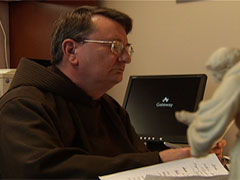
LAWTON: But the Catholic bishops say they received more and more questions about Reiki, so they commissioned a study, and last year released guidelines which said “a Catholic who puts his or her trust in Reiki would be operating in the realm of superstition.” And the guidelines concluded “it would be inappropriate for Catholic institutions, such as Catholic health care facilities and retreat centers, or persons representing the Church, such as Catholic chaplains, to promote or to provide support for Reiki therapy.”

WEINANDY: God is God, and human beings are human beings, and we can petition God, but we can’t manipulate him, and we felt that this was what was happening in the context of Reiki, that the person learned how to be in touch with the divine cosmic forces such that they could now manipulate it through a laying on of hands or a massage or something that the person could be healed.

LAWTON: Many Reiki supporters were taken aback by the statement’s tone.

GIANFORTE: It’s not a religion. It’s just a practice that assists people in connecting more deeply to the more spiritual soul places within themselves, so I was pretty surprised by that.

LAWTON: The document said the Church recognizes two kinds of healing: natural means through the practice of medicine and healing by God’s divine grace. In the Christian tradition, there is the sacramental anointing with oil and the laying on of hands.

WEINANDY: Christians can pray for one another, lay hands on a sick person, and ask Jesus to heal them, but you’re not channeling divine energies through your hands.

LAWTON: Weinandy says sometimes individuals or even places such as the pilgrimage site in Lourdes, France appear to have a special gift of healing. But he says physical healing is never guaranteed, and it’s always up to the will of God.

WEINANDY: It’s not that he loves one person more than the other, but we don’t know why the Lord would heal one and not another person, but it is a mystery.

LAWTON: Reiki practitioners deny that they are trying to manipulate God.

post03-weinandy
Rev. Tom Weinandy

SCHMIDT: You can tell when you are facilitating and sharing Reiki with someone that you are not guiding it, you know. You can tell that there’s a higher power that is doing the work.

LAWTON: Schmidt says she chooses to give the credit to God.

SCHMIDT: For me, Reiki is another form of prayer. It’s allowing myself to be a vessel through which then God’s healing can then be experienced by the person that is receiving the Reiki.

WEINANDY: If you try to plug Reiki into Christianity, what you’re saying is Jesus is not good enough on his own. He’s got to be supplemented by something else, in this case, the divine forces, so you’re either downgrading Jesus and Christianity or you’re taking the heart out of Reiki.

LAWTON: The bishops’ document is not a mandate, and local dioceses may implement it as they choose. But Reiki supporters say it’s already had a chilling effect. Many Catholic institutions, including hospitals and retreat centers, are no longer offering Reiki, and most nuns are reluctant to speak publicly about their use of Reiki.

SCHMIDT: Some people, I think, find comfort in the perceived security of a black and white theology, and Reiki doesn’t fit within that black and white theology, and so in those kinds of situations there tends to be judgment, there tends to be fear, there tends to be reaction.

LAWTON: Schmidt says she’s sad the bishops would oppose something that has meant so much to her spiritually.

SCHMIDT: I see Reiki as being life-giving. It definitely flows out of my relationship with God. It’s drawing me closer in my relationship with God. I certainly have grown in my awe and wonder over how God can work in the world.

LAWTON: But Church leaders say they believe Reiki is spiritually dangerous.

WEINANDY: I want to stick with Jesus. I don’t want to open myself up to other forces that may be, you know, supernatural in some sense but not of God. I think it’s a risky business to be playing around with this sort of thing.

LAWTON: While the theological debates continue, the National Institutes of Health has funded a study on the possible health effects of Reiki.

I’m Kim Lawton in Milwaukee.