Listen to this episode now:
[powerpress]

Listen to this episode now:
[powerpress]
Watch excerpts from correspondent Kim Lawton’s August 5, 2010 interview with Andrew Bacevich, professor of history and international relations at Boston University, retired US Army colonel, and author, most recently, of “Washington Rules: America’s Path to Permanent War” (Henry Holt). They spoke at the Center for a New American Security in Washington, DC.
Originally broadcast July 17, 2009
KIM LAWTON, guest anchor: It’s the time of year when many of us try to schedule a vacation to get away from it all. Scientists have long found an association between relaxation and health. Now there is growing evidence that spiritual practices have a beneficial and measurable effect on the brain. In his book “How God Changes Your Brain,” Andrew Newberg reports that meditation improves memory and reduces stress, and how you view God can affect the structure of your brain. Lucky Severson has the story.
VINCENT FEDOR (meditating and reciting mantra): Sa, ta, na, ma…
LUCKY SEVERSON: As unlikely as it may seem, Vincent Fedor is practicing meditation.
 VINCENT FEDOR: …and you go into the whisper sa, ta, na, ma…
SEVERSON: Vincent and his wife, Judy, started meditation after they answered a questionnaire about improving their memory. That was one objective of Dr. Andrew Newberg. The other was that he wanted to scan their brains while they did it. Here are Vincent’s scans before he learned to meditate and after he had been doing it for eight weeks.
DR. ANDREW NEWBERG (University of Pennsylvania, with brain scans): Okay, so it is asymmetric, more active here than here, and after meditation it’s more active here than here. So simply doing the practice of the meditation he’s altered the activity in this very, very important part of the brain, and this is really important, because this means he has changed the way his brain is working.
SEVERSON: Since meditating Vincent feels he’s become a better high school track coach.
VINCENT FEDOR: I think I’ve become a calmer, more tolerant person. If the situation comes up I don’t go to the angry side. I go take the calmer road. And you know, I think the kids see this. I think I’ve become a better coach because of it.
NEWBERG: It makes sense that if by doing this practice he has increased the activity in that frontal lobe, he’s actually able to improve the way in which he monitors his emotional responses to people and perhaps can treat them with more compassion.
SEVERSON: Dr. Newberg has studied nuns who do repetitive prayer, and he has seen the same kind of results. He’s been studying the effects of meditation and prayer on the brain for several years and is considered one of the leading experts in a new field called neurotheology.
 DR. NEWBERG: We’ve learned that being religious or spiritual has a very profound effect on who we are, has a very profound effect on our biology and on our brain, and what we’ve found more recently is that not only does it have a profound influence on who we are, but it actually can change our brain and to change ourselves over time.
SEVERSON: Here at the University of Pennsylvania Center for Spirituality and the Mind, images of the brain are taken during or after a person prays or meditates.
Dr. NEWBERG: The more you use a part of the brain the more blood flow it gets and the brighter or more red it looks on the scans.
SEVERSON: Over the years Dr. Newberg has adapted a 12-step meditation exercise that includes sound, movement, and breathing.
JUDY FEDOR: Sa, ta, na, ma. The first two minutes the mantra is sung. The second two minutes the mantra is whispered. The third sequence is silence, back into the whisper and finishing with the song. After that it’s deep breathing, holding in, that’s done three times, body relaxes, and the mantra is completed.
The minute I can start doing it and moving my fingers my body gets calmer. It’s very soothing. To me it gets almost in a passive mode, and then you have energy afterwards because you became so calm.
Dr. NEWBERG: Religion and spirituality do help to lower a person’s feelings of depression, anxiety, gives them some meaning in life, helps them to cope with things, and that’s going to have a potentially very beneficial effect.
SEVERSON: But Newberg has made another discovery, a controversial one, that our belief system, how we view God, can make a huge difference in how it affects our well being. If we believe in a loving God it can have a positive effect, even prolong our lives. But believing in a judgmental, authoritarian God can produce fear, anger, and stress, and that’s not healthy.
Dr. NEWBERG: When it ultimately turns towards hatred, and whether it’s people who believe in abortion versus those who don’t, whether it’s just one religion versus another, when you hear rhetoric which is hateful, filled with anger, that turns on the different parts of the brain that are involved in our stress response and our anger response.
 SEVERSON: George Handzo is a chaplain with the Healthcare Chaplaincy of New York City. He says Newberg’s conclusions, that a person’s belief in a certain kind of God can be unhealthy, is bound to be controversial among people of faith.
CHAPLAIN GEORGE HANDZO (Healthcare Chaplaincy of NYC): They’re saying that there is one word of God, and God commands us to follow that word, and if we want to save people from God’s anger and condemnation we’re obliged to get other people to believe as we do
Dr. NEWBERG: I’m not arguing that people need to change their beliefs per se. I mean if they feel that their perspective on God is right, I mean then that’s terrific. But I think that what we have to all be careful about is the anger and the hatred, and that’s what has detrimental effects both on the individual as well as on society as a whole.
SEVERSON: Skeptics of Newberg’s work question if science should be delving into religion and spirituality in the first place, and they ask if his research has actually proven much of anything.
HANDZO: Faith is, by definition, reliance on things you cannot see and cannot know. Faith is something we believe God gives to us. It’s not something we invent. As a person of faith, this whole debate about what is going to be knowable is not a particularly interesting question to me.
Dr. NEWBERG: You know, if we get a brain scan of somebody while they’re experiencing being in God’s presence, as I’ve always said that doesn’t prove that God was in the room. It doesn’t prove that God wasn’t in the room. What it proves is that when the person had the experience of interacting with God this is what change was going on in their brain.
 DONNA MORGAN: Can I just praise the Lord right now? I feel like if I don’t praise the Lord I am going to bust…Thank you Jesus. Thank you Jesus…
SEVERSON: Dr. Newberg has found there are some religious practices where the person is intensely focused and others where they just allow themselves to be taken over, for example, speaking in tongues. Dr. Newberg has scanned the brains of people of all belief systems, of people with no faith, and those of deep conviction, like Donna Morgan, who is a Pentecostal.
DONNA MORGAN: When are you in that realm of praise you just give over to the Holy Spirit. Then you let him take control, and when he’s taking control, right, you can speak in tongues, if you’ve been given that gift.
Dr. NEWBERG (with brain scans): Speaking in tongues you’re going to see that the frontal lobes are going to decrease in activity. So that means that the frontal lobes, the part of the brain that normally makes them feel like they are in control of what they are doing, is shutting down.
SEVERSON (to Dr. Newberg): It is shutting down because…
Dr. NEWBERG: It is consistent with the feeling that they are not in charge of the process.
SEVERSON: There are some who argue that certain people are predisposed or hard-wired toward transcendent experiences, and some are not. It’s an argument Chaplain Handzo disagrees with.
HANDZO: I don’t believe in a God that creates people, especially selectively, in a way that makes it difficult for them to access this God. That’s not my God.
Dr. NEWBERG: I think to some degree we all are hard-wired to be able to think about things on these levels. It’s just a matter of how much we engage that and if we find a path that does help us to engage that for ourselves.
SEVERSON: Newberg says people of faith shouldn’t worry that his research will ever diminish their faith.
Dr. NEWBERG: I don’t think that our science is going to be able to definitively prove that God exists or doesn’t exist. It is, ultimately, a leap of faith.
SEVERSON: Newberg believes the number one activity that can exercise your brain and enrich your life is faith.
Dr. NEWBERG: When you have those kind of positive, optimistic beliefs in the world, in God or religion, depending on the person, that that really, over the long haul, seems to be the thing that really provides a benefit for us in terms our mental state and in terms of our physical health and well-being.
SEVERSON: As for his own faith, he describes himself as a searcher who is still searching. For Religion & Ethics NewsWeekly, I’m Lucky Severson in Philadelphia.
Originally broadcast September 4, 2009
KIM LAWTON, correspondent: Roman Catholic priests deal a lot with spiritual food, but Father Leo Patalinghug works with food of a more earthly nature as well.
REV. LEO PATALINGHUG (at Delaware State Fair): And I’ve got myself here a nice, beautiful piece of flank steak.
LAWTON: Father Leo is a chef who has his own Web-based cooking show called “Grace Before Meals.” It gets more than 10,000 hits a day from around the world. He’s written a cookbook with the same title.
REV. PATALINGHUG (on “Grace Before Meals” show): We ask God to bless us this holy season and the food we’re about to receive.
 LAWTON: He says food is very much part of his priestly ministry.
REV. PATALINGHUG: Theologically, this is what Jesus did. Most of his greatest lessons were taught around a dinner table.
LAWTON: In his day job, Father Leo is director of pastoral field education at Mount St. Mary’s Seminary in Emmitsburg, Maryland, the second oldest and second largest Catholic seminary in the country.
REV. PATALINGHUG: Sometimes I like to say I’m teaching future shepherds how to feed their hungry flock.
LAWTON: He teaches classes on a variety of subjects, such as how to give a good sermon, and even here, he finds a connection with food.
REV. PATALINGHUG: I teach a preaching class, which means I can’t have guys dishing out stale, boring leftovers, but dynamic things that are going to make their appetites just expand, and to whet their appetites to show that what we have to offer is good news
LAWTON: Father Leo says his mother taught him how to cook when he was a kid.
REV. PATALINGHUG: My love for cooking started just because I like to eat!
(Cooking at state fair): I love that sound.
After doing my activities I would get bored quickly. Mother would invite me to help her with cooking because it’s a multi-tasking thing, and that actually piqued my interest.
LAWTON: Father Leo grew up in Baltimore, where his family had emigrated from the Philippines. He says faith and food were both very important in his family’s life.
REV. PATALINGHUG: My family style of eating is very much a feast day celebration and yes, we prayed before every meal, and it was something serious, because in my country not everyone gets a chance to eat, and so they reminded us that even though we were living in America, a land of plenty, there are a lot of people who don’t have the blessings on the table as well as the blessings around the table.
LAWTON: He didn’t always know he would become a priest. He first dabbled in several other fields, from break dancing to martial arts.
REV. PATALINGHUG (at state fair): I used to be a martial artist. I still practice a little of it. Third-degree black belt instructor in tae kwon do, as well as a full-contact Filippino martial art called arnis. So if you asked what I did for fun before I became a priest, I used to beat people up with sticks. That’s what I did.
 LAWTON: In the midst of it all, he says a series of events, including a skiing accident and a breakup with his girlfriend, had him turning to God in prayer. Then, he says, he traveled to the Philippines with the US stick-fighting team.
REV. PATALINGHUG: I remember going to this one village, and we were handing out candy to people, and there was one little boy who only had a t-shirt, on and he came up to me, and I gave him a piece of candy, and I looked in his eyes, and I thought to myself, had it not been for my dad bringing us to America, that could have been me.
LAWTON: He felt that God was calling him to help people like that boy, and to do so by becoming a priest. He entered seminary and was ordained ten years ago when he was 29. Father Leo says the food part of the ministry evolved naturally as he began building relationships with his parishioners. He often scheduled counseling sessions around meal times.
REV. PATALINGHUG: They call me Father. I’ m supposed to be part of their family. So I would help them, we would gather in the kitchen, we would cook, I helped set up the table, and they saw the human side to me and not just the spiritual side.
(on “Grace Before Meals” show): Bless this food.
LAWTON: The idea for a cooking show was born just after the attacks on September 11, 2001.
REV. PATALINGHUG: So after a very tragic weekend worth of Masses where the churches were full, hungering for an inspiration of hope, we ourselves, the ministers, we were spent. So we went on a little retreat together, and I did all the cooking—comfort food. So one of the priests suggested, “I love watching you cook. It would be great if I had a video camera and taped all of this. You could talk about food, faith, family and culture.” And I looked at him and said, “That’s one of the dumbest ideas I have ever heard.”
LAWTON: But his fellow priests didn’t think it was so dumb. Father Leo says they kept nagging him about it and eventually connected him with a producer and a production company who loved the idea of a priest cooking show.
 REV. PATALINGHUG (on “Grace Before Meals” show): Ketchup—do you see that slob right there? That’s what confession is for.
LAWTON: He now does “webisodes” of the cooking show online, often with the help of his seminarians, and his Web site has recipes and blogs.
REV. PATALINGHUG (on “Grace Before Meals” show): Cleanliness is next to…you know what I mean.
LAWTON: He’s also become a much sought-after speaker, and he does cooking demonstrations around the country, such as this appearance at the Delaware State Fair.
REV. PATALINGHUG (at state fair): This beef is going to—oh, my gosh, it’s making me pray already.
LAWTON: His motto is feeding people, mind, body and soul, and he believes that families are strengthened when they share meals together.
REV. PATALINGHUG: We know that families are buying so much into the fast-food mentality that they spend no time with each other. My objective for “Grace Before Meals” is to create mini-Thanksgivings throughout the year.
LAWTON: When he speaks to a secular audience, he tries not to be aggressively religious.
REV. PATALINGHUG (at state fair): We all are hungering for something, and that’s why people go everywhere to find something to satisfy them. What I would like you to consider is to make sure you have a balanced diet for your body, your mind, and your soul.
Unidentified woman at state fair: I loved how he brought the spirituality into the mealtime and the family. I think that’s what drew everybody’s attention. And the food was delicious!
LAWTON: He’s gaining international attention and was just challenged to a cooking competition by celebrity chef Bobby Flay. I asked him how he keeps it all from going to his head.
REV. PATALINGHUG: I guess the celebrity status can be a temptation for anyone, but as a priest I’m somewhat protected in this. I’m required to spend time in quiet prayer and reflection. A holy hour a day gives me a great perspective. I’m just me doing something good for God.
LAWTON: Father Leo does get criticism from some Catholics who think it’s inappropriate for a priest to be doing what he does. But he asserts that his food ministry is deeply Christian.
REV. PATALINGHUG: We believe, at least in the Catholic Church, what binds us together and what binds God to us is food: a piece of bread turned into the body and blood of Christ in which we are incorporated into his family.
(at state fair): I’ve got to tell you that I know that the collar freaks people out a little bit.
LAWTON: Father Leo says for him, one of the most important parts of his cooking ministry is reaching out to people who may be uncomfortable with priests and helping them learn a little about God.
REV. PATALINGHUG: He can take a break-dancing, board-breaking, bread-breaking priest and, you know, give hope to people who might not understand the church or who might not understand the priest.
LAWTON: And that, he says, is a grace that extends beyond every meal.
I’m Kim Lawton in Emmitsburg, Maryland.
Read more of Kim Lawton’s interview with Father Leo Patalinghug, director of pastoral field education at Mount St. Mary’s Seminary in Emmitsburg, Maryland, and watch him talk about his television cook-off with celebrity chef and restaurateur Bobby Flay:
Q: Tell us a little bit about how you started cooking.
A: My love for cooking started just because I like to eat, and my mom would bring me into the kitchen when I was younger. After doing my activities I would get bored quickly. Mother would invite me to help her with cooking because it’s a multitasking thing and that actually piqued my interest.
Q: And where did you grow up? Talk a little bit about your memories of your family coming together over meals.
A: Being a traditional Filipino family growing up in Baltimore, I joke with people and say the reason why I had friends as a kid was because my mom cooked so well, and so we would eat traditional Filipino food, so for me to go to my friend’s house and eat Mac ‘n Cheese was exotic. But we had a real sense of eating together as a family. Every meal was together.
Q: Did faith play a role for your family as well when you were growing up?
A: Because we were immigrants, my mother needed a connection back to her own homeland, and the universality of the Catholic Church gave her that. In fact, we moved in location to our church. She would only go to a place, a home that was close enough where she could walk with her children to church.
Q: And did you have that memory of eating together—you know, food, grace before meals—there?
A: My family style of eating is very much a feast day celebration and yes, we prayed before every meal, and it was something serious because in my country not everyone gets a chance to eat. And so they reminded us that even though we were living in America, a land of plenty, there are a lot of people who don’t have the blessings on the table as well as the blessings around the table.
Q: Let’s jump over to your journey to the priesthood. Tell us a little about how that happened. I know that wasn’t necessarily your original path that you started on.
A: No, the original path for me was to do something in journalism or to do something in law. But at the same time I wanted to do something that was service-oriented, and it was only after what is now known as a conversion I realized that there is a God, God has a plan for me, and after a few years of discerning that, praying through it, going to retreats, I felt at peace in this calling and this lifestyle, even though most of my friends would be very surprised I decided to become a priest. I was 29 years old when I was ordained. I entered when I was 24 years old.
Q: What was happening that led to that conversion or led you to really start listening and seeking, is this something that is for me?
A: I think I was given a great, for lack of a better word, grace/opportunity to think about the big picture in life: What do I want to do? I was a deeper thinker than most. I wanted to not just take care of the temporal things, but knew that there was emotions, that there’s a spirit to people and how can I help with that? There were many events that made me turn to God and prayer, whether it be a major skiing accident, whether it be a breakup with a girlfriend, whether it be trying to find the right job, whether it be a very special moment of prayer. And there was one in particular when I went back to the Philippines and I was working—not working, I went back to the Philippines and I was a participant in a world stick-fighting competition because I was a martial artist, and I was with the USA team, and we had brought some supplies over just to give to some of the poor children in the area. I remember going to this one village and we were handing out candy to people and there was one little boy who only had a t-shirt on and he came up to me and I gave him a piece of candy and I looked in his eyes and I thought to myself, had it not been for my dad bringing us to America, that could have been me, and it just made me stop and think of the hunger of the people in the world. But even though this was a poor baby, he had a bigger smile than some of our children who have plenty to keep them occupied. And so I began to think more deeply of that and obviously through the assistance of good priests as spiritual directors and confessors, I was able to come to a peace that maybe God is calling me to the priesthood. So I walked into a seminary and six years later I was ordained a priest.
Q: Did that freak you out when you even started considering that possibility?
A: Yes, it was a very shocking thing. I actually played a joke on my mother. It was Halloween, and I was in a cast and I was teaching karate, and our karate school was having a big Halloween costume [party], and I couldn’t think of a costume with this cast on, and I was going to be a mummy but that was just too much cloth. So I had this black shirt on, I had a white thing around my neck, and I looked in the mirror and I thought, “Oh gosh, I could pull this off.” So I wrapped it around and it looked like a priest collar! And I remember crutching into my mother’s room and showing her. She was obviously very shocked and all the karate students at the time said, “You look good in that.” But it was a real shocker when I put it on for the first time as a seminarian.
Q: How did you start incorporating the cooking after you started going down the seminary/priesthood path? How did the cooking come into play there?
A: Well, the cooking has always been a part of my whole family’s life, and when I studied at the North American College in Rome, I realized the importance of a family meal, that seminary required the men to come together for every pronzo, which is a lunch or a supper, dinner experience, and so coming together we developed more than friendships. We developed a brotherhood, and that was abundantly clear being so far from my family that Thanksgivings, although I missed being with my family, were nonetheless special because I was with this family celebrating a meal. As far as it becoming a ministry, it’s basically the natural becoming more apparent, simply because families in the parish would invite me to come to their home for dinner, and that was code word for, “I’d like to talk to you, Father, about something.” So I would actually show up, but about forty-five minutes earlier, which really shocked them. But I wanted to see them interacting normally. I didn’t need them to put on a front. I needed them just to be a family, because they call me Father. I’m supposed to be part of their family, and so I would help them. We would gather in the kitchen. We would help cook, I’d help set up the table, and they saw the human side to me and not just the spiritual side. They realized that as I priest I had just as many feelings and questions and needs to pray about as they do. And in that camaraderie around the table I began to think theologically: this is what Jesus did. Most of his greatest lessons were taught around a dinner table.
Q: What is that connection between food and spirituality?
A: Food and spirituality’s connectors are so evident, because it addresses hungers. What are we hungering for? If it’s just food without company, then we could be living a very secluded life. That’s why we make an effort to reach out to people on those holidays. How? Through soup kitchens. Through handing out food. The word “religion” is something that everyone’s afraid of, but the Latin verb is simply religere which means “to bind.” What brings people together and in what forum? We believe, at least in the Catholic Church, what binds us together and what binds God to us is food—piece of bread turned into the body and blood of Christ in which we are incorporated into his family, and so when we look at food as a connector, we not only look at the hunger, we also look at what we’re being fed with, and so we think that food can also be inspiring.
Q: I’ve watched some of your shows on the Web, and I know that you talk about being fed mind, body, and soul. What’s that all about?
A: Being fed body, mind, and soul is a reminder that people can’t just live in the corporeal world, just to address the earthly things that make me feel good in body, because I know a lot of people who feel good in body, but their minds are so distraught with either guilt or shame and their heart is broken because of maybe of a bad relationship. People walk around this world with a great mask looking very good in the body but being very broken in the insides. My objective is to make sure that there is a connection, to not live a dualist spirituality, to live in this world as, the word is “hypocrite,” which means “actor.” I’m very happy on the outside but broken on the inside. We need to bring those two together.
Q: When you started doing the cooking shows that went online, why did you decide to take that route? You’re doing it for your parish; you’re doing it for the fellow priests and all of that. Why did you decide to go public?
A: Going public—I mean, there are so many angles to answer this question. The “Grace Before Meals” started because I simply took a hobby and I put it in God’s hands. He turned my hobby into a ministry. It became very apparent to me that people wanted this, hungered for something like this. If I could say, after September 11, it really was September 11, we know what happened, 2001. I was actually supposed to go to France on a pilgrimage with two other priests, but all the flights were canceled. So after a very tragic weekend worth of Masses, where the churches were full, hungering for an inspiration of hope, we ourselves, the ministers, we were spent. So we went a little retreat together, and I did all the cooking—comfort food. And it really made it a clear message that we were all hungering for support from one another. So one of the priests suggested, “I love watching you cook. It would be great if I had a video camera and taped all of this. You could talk about food, faith, family and culture.” And I looked at him and said, “That’s one of the dumbest ideas I have ever heard.” But they kept egging me about it, and so I kind of took it seriously, but half seriously-half jokingly said, “Oh fine, well let’s do that and we’ll call it Grace Before Meals.” I thought that was the end of the story until one day when I was in the sacristy where the priests vest, and I was disrobing from the liturgical vestments, and a man walks in wanting to meet the new priest, me. And there was another priest there who was “inside” on that joke. He started coming to church regularly because he was looking for meaning. His son has autism and that’s hard for a family. So we started to go to daily Mass. In meeting him I just generically asked, “What is it that you do, Tim?” He said, “Well, I produce TV shows and commercials for Comcast.” Immediately the other priest said, “Well I’ve got an idea for you!” And I’m looking and going, “It’s a joke.” He said, “It’s called Grace Before Meals, it’s a priest cooking show.” I didn’t think anything of it until I get an email, and he says, “Father Leo, I’m flying in red-eye from LA. Can I have a breakfast meeting with you to discuss GBM?” It’s now given an acronym. I didn’t even know what “GBM” is. I tell people I thought he was talking about the “Great Blessed Mother” But he simply said, “I’d like to discuss in a Hollywood minute, which is thirty seconds or less, what’s Grace Before Meals.” I told him it’s a joke. He said, “No I’m serious.” So I said, “Fine. Grace Before Meals is maybe a show or a movement about a priest helping families, strengthening their relationship the way Jesus did, and it’s ultimately my responsibility to feed people body, mind and soul.” He said, “I love it.” And I said, “You’re sick” And from there, a very slow start, it’s turned into a pretty big movement.
Q: How do you balance that, the movement, with your responsibilities here at the seminary, your responsibilities as a priest? I know this is your ministry, but do you ever feel there is a conflict, or do you get pulled in different directions?
A: I’m blessed to have a rector, an archbishop, and faculty and seminarians who see the need to not live many ministries, but to try to bring them together as one. So this is connected to what I do here. As the pastoral field educator, my job is to teach future shepherds how to feed their flock. I teach a preaching class, which means I can’t have guys dishing out stale, boring leftovers, but dynamic things that are going to make their appetites just expand, and to whet their appetites to show that what we have to offer is good news. You can take corned beef hash, but if you put it on a beautiful square plate, make sure that the potatoes are perfectly scalloped, normal ordinary food becomes something worth celebrating. So, to a degree, this is my job. Does it put a strain on my schedule? Yes, which is why I make sure that I master my schedule rather than it master me, and also I have great access to spiritual companions who help me to keep focused on what it is that I’m supposed to be doing.
Q: I well know, being in front of the camera, being out there can have almost a seductive aspect to it, where you like being in the limelight. It can pull you in. Is there a struggle for you as a priest, to keep that humility virtue when you’re getting all the accolades and people want to get your autograph and all of that?
A: I guess the celebrity status could be a temptation for anyone. But as a priest I’m somewhat protected in this. I’m required to spend time in quiet prayer and reflection. A holy hour a day gives me a great perspective, and honestly, Leo, you’re not that good looking. You should be taller and more blonde. You should have straighter teeth. You should be thinner. I’m just me doing something good for God. I know ultimately what my faults and failures are because of confession and because I spend time in prayer. If there’s one thing that has actually been helpful about being in front of a camera, it has taught me patience and humility. Hurry up to wait, and then I look at myself or listen to myself and say, “Is that what I look like? Is that what I sound like?” I’ve got to approach this ministry seriously, but not take myself seriously.
Q: It’s very clear that you have fun and that you try to have fun with this and project a really fun image. I’ve seen you online break dancing and doing other stuff like that. What do you make of the image of priests that you’re projecting, especially given the stereotypes many people in the wider society might have?
A: If there’s anything that “Grace Before Meals” has been able to do, it’s to shatter some of those stereotypes. We are human just like everyone else. But we’re not satisfied with that. We want to be better at what we do, and God uses even our broken past to help us turn toward a better future. A lot of people are surprised that before I was a priest I used to teach martial arts, third-degree black belt structured taekwondo, full-contact Filipino stick fighting on our knees, I wanted to either be a journalist or a lawyer, I used to teach speech and debate, and yes, the rumor is true, I used to break dance. You take a guy like that and the next logical step is priesthood, right? No, it just shows that God can use anything if we are willing to give it to him. Who would have thunk in a million years that cooking a meal with a family would inspire so many people around the world who email me and say this has been an inspiration for me. Who would’ve thunk? If we’re generous with who we are, and God has given all the priests tremendous gifts and talents, if they’re willing to put that in his hands, he can turn six fish sandwiches into a feast for five thousand. He can take a break-dancing, board-breaking, bread-breaking priest and give hope to people who might not understand the church or might not understand a priest. It’s just one more connection that I’m not ashamed of, because Jesus used food all the time to make connections with others.
Q: I know you say your bishop and seminary have been very supportive, but are there other folks who say, “I don’t really think a priest should be doing this”?
A: Absolutely. I have experienced enough criticism just because we’re public people. But priests are going to experience criticism all the time by the evangelical message which might be hard for people to accept, by other religions that might not agree with the dogma. But one thing we’ve got to do is live on this earth together and help each other get to heaven and maybe one thing I can do is bring people closer to the table by sharing with them a little bit of our culture through food and maybe learning a little bit from them too. I’d love to have an opportunity to have either a show or a radio show, and “A Place at the Table” is what I’d like to call it, where we can just bring people of diverse opinions together, share a meal, celebrate what we have in common and respectfully discuss what we don’t have in common, and if there’s anything that we have in common it’s that: Was this food tasty or not? Are you walking away unsatisfied or dissatisfied? I think it’s one of my personal objectives to make sure I can feed people at least on one level.
The family is important to “Grace Before Meals” because I think families have bought into the fast food mentality, which basically says I’m too busy for you. I’m too busy to care about what you’re eating. I’m too busy to care about who’s feeding you. And there was a commercial at one point that said, “It’s ten o’clock, do you know where your children are?” Just rephrase the question: It’s dinner time; do you know where they are? Do you know what they’re eating? Do you know who’s feeding them? Because it’s easy to swallow a bunch of lies, and this about the family being the infrastructure of society, the basic building blocks for society, we know that families are buying so much into the fast food mentality that they spend no time with each other. My objective for “Grace Before Meals” is to create mini-Thanksgivings throughout the year, a time to celebrate the blessings we have not just on the table, but around the table.
Originally broadcast August 21, 2009
KIM LAWTON, guest anchor: Parents are often looking for entertaining and educational outings for their kids. An interactive museum in Brooklyn, New York helps children learn about the Jewish faith, from holidays to traditional rituals and Bible stories. Education director Rabbi Nissen Brenenson gave us a tour of the Jewish Children’s Museum.
RABBI NISSEN BRENENSON (Director of Education, Jewish Children’s Museum, Brooklyn, NY): As you approach the museum, the first thing you see is a giant photo mosaic, and as you get closer you realize that it’s made up of thousands and thousands of smaller photographs of children of all ages, of all races. Then that contains a special message, and that is that we’re really one.
The gallery on the six days of Creation and the Shabbat, the Sabbath, contains a Shabbat table where you’re actually walking on the table. There are Shabbat candlesticks, a giant crawl-through challah tunnel. Inside the tunnel, you can learn about the ingredients, the significance, of the special challah bread.
 Hanukkah is also a favorite. We have an olive oil pressing station where children can actually squeeze their own olive oil. They like to do that, and the olive oil represents the miracle of the oil that happened at the time of the Hanukkah story.
I think we have the world’s only touch-screen Seder plate, and by pressing the screen and selecting the various symbolic items on the Seder plate, the children can watch short clips of what these symbols represent and the story of Passover.
The holiday of trees is called Tu B’Shvat, and here at the museum we have our own special talking Tu B’Shvat tree:
Talking Tree: Tu B’Shvat is my birthday.
RABBI BRENENSON: He’s sort of a storyteller and explains how man is compared to a tree in many ways. We have our roots, and that’s our faith, and we also have our fruits, and those are the good deeds that we perform.
The journey continues into our kosher supermarket, where children can scan products. Instead of coming up with prices, there are trivia questions about the kosher diet as well as a full-scale kosher kitchen.
The last gallery on that floor focuses on values that are rooted in Jewish tradition but have also become universal, such as kindness—kindness to others, kindness to animals, respecting the environment, charity.
Listen to this episode now:
[powerpress]

In a July 28 roundtable discussion on Capitol Hill with religion reporters, Democratic senators acknowledged the involvement of faith communities in debating moral and social issues such as health care reform and economic recovery, but they also questioned whether there are limits to the role religious groups can play when it comes to what Minnesota Senator Amy Klobuchar called “dealing with the nitty gritty” of partisan politics.
No cameras were allowed at the meeting, billed by the Democratic Steering and Outreach Committee as a conversation about “shared values and common ground.” It was one of several “faith and media” discussions Senate Democrats have held since 2008, responding to criticism of weak Democratic outreach to religious voters and faith communities over the years. The last session with religion reporters was held in October 2009.
Michigan Senator Debbie Stabenow, a member of the United Methodist Church who chairs the committee, said Democrats have been “governing with a different set of values” for the past 18 months. “It’s not about a particular president,” she said. “It’s about a philosophy we debate every day on the Senate floor.”
Stabenow cited Wall Street reform, job creation, economic stability, small business credit access, and extension of unemployment benefits among the Congress’s recent accomplishments, despite what she called “a maze of filibusters.” She thanked faith communities “for being with us every step of the way” and for supporting passage of last year’s Recovery and Reinvestment Act and this year’s health care reform bill—domestic policy achievements that “wouldn’t have gotten done without the strong voice and commitment” of communities of faith, she said.
Ohio Senator Sherrod Brown, a member of the Evangelical Lutheran Church in America, praised the economic and social justice values of religious groups, citing a trip he took with Illinois Senator Dick Durbin earlier this year to examine peacekeeping issues and US foreign assistance programs in Sub-Saharan Africa, where Brown said “so many faith-based groups deliver direct services.” The values that underlie their work, he said, are “what bind us,” and such values should inform “what we ought to be doing in foreign policy.”
Both Durbin and Maryland Senator Ben Cardin addressed the looming foreign policy issue of America’s nine-year-old war in Afghanistan, where Cardin acknowledged that the lack of a legitimate, credible partner is “testing the resolve of the American people.” Durbin, who voted against the Iraq war but for the Afghanistan war, said the consequences of combat in Afghanistan, particularly growing numbers of wounded and disabled veterans, “weigh dearly on me.” He added that Americans must continue to ask not only what the US has achieved in Afghanistan but also “how will it end, when will it end, and at what cost.” This week, more than 100 Democrats in the House of Representatives voted against a $58.8-billion war funding bill, which passed 308 to 114.
Asked about arms control and nuclear nonproliferation, issues long of concern to religious groups, and about prospects for Senate ratification of the New START treaty, Oregon Senator Jeff Merkley said it will be “a very heavy lift to get it done.” Merkley said the treaty is in trouble “because it’s an election year,” and there are “not many voices to depoliticize” the debate, despite what he called “an international social contract around nonproliferation.” Merkley praised Republican Senator Richard Lugar of Indiana for trying to keep the treaty “out of the political realm” and called for more grassroots efforts to weigh in on its importance. At town hall meetings, said Merkley, he hears only from treaty opponents, and “that’s a problem.”
But just how far religious groups and communities of faith are willing and able to go when they enter the political fray on moral and social issues was a question raised by Klobuchar, who suggested there are “limits on advocacy” for religious coalitions. She said that is especially the case when Republicans represent “a clear obstacle to moving forward” in areas such as immigration reform, one issue that has attracted considerable faith-based support across the spectrum. “How far can they go in pointing out the obstacle?” asked Klobuchar. “How strong an advocate can they be?” Durbin added that while 11 Republican senators once supported immigration reform, now there are none. “That’s what’s stopping us” from passing a bill, he said.
Klobuchar said in conference calls with Minnesota faith leaders about Senate slowness on immigration issues she has been told that when it comes to pure political strategy, religious groups are “not involved” and “don’t deal with that stuff.” How, then, can faith communities “play a larger and louder role” and “push back,” she asked, at a time when the politics of immigration reform are most at issue? Can they serve as a force and a voice for getting past political differences to common ground? Stabenow added that some religious groups do, in fact, have “comfort in the partisan arena” and are willing to “get into strategy and partisan differences.”
Asked about a reported decline in Democratic Party outreach to faith communities, Stabenow characterized Senate Democratic outreach as “aggressive” and “not diminishing.”
“Every issue,” Stabenow said, “is about values.”
KIM LAWTON, correspondent: It’s sunrise over Louisiana bayou country. Normally, this is when the fishermen here set out in search of shrimp and oysters and crabs. But things aren’t anywhere near normal. Instead of fishing, these men have been hired by BP to look for spreading oil, to document damaged wildlife, and to assist in the cleanup. There’s a safety briefing before they head out, and Pastor John Dee Jeffries opens the meeting with prayer.
REV. JOHN DEE JEFFRIES, First Baptist Church, Chalmette, LA (praying): Father God in Heaven, I pray that you will watch over these men, these women. Protect them today.
 Rev. John Dee Jeffries |
LAWTON: Jeffries is pastor of the Chalmette First Baptist Church. He’s one of several local ministers who have been coming out to the docks every day to support the fishermen.
JEFFRIES: Can’t solve all of the world’s problems, but sometimes just knowing that there’s someone who’s there who cares is more than sufficient.
LAWTON: Jeffries is concerned that despair is growing across the entire area.
JEFFRIES: Basically what I hear is a lament, a sorrow, because of what was and what now is. It seems to me to be too meager a choice of words to simply say that a lifestyle is at stake here. It is the entire context of a person’s life, the whole backdrop, the fabric, that is being torn asunder by this crisis.
LAWTON: So much in these communities revolves around the seafood industry, and that has been thrown into turmoil, from boat captains who can’t fish and therefore can’t hire deckhands to the mechanics who aren’t being hired to do repairs and the small businesses that aren’t selling supplies. According to US government figures, more than 6,000 vessels and 40,000 people have been brought in to help clean up the oil and deal with the crisis. But many in the fishing industry say they haven’t been able to get replacement work, and they don’t know when they’ll be able to resume their livelihoods.
 Byron Encalade |
BYRON ENCALADE, Louisiana Oystermen’s Association (speaking at meeting): And I know this is not going to end in one or two weeks, one or two months. May not even be one or two years…
LAWTON: Byron Encalade is president of the Louisiana Oystermen’s Association. He’s become a vocal advocate for the poorest fishermen, especially in remote bayous.
ENCALADE: Why must I always have to go through loops to get you to do the right thing toward my people?
LAWTON: He says after Hurricane Katrina, it was contractors and large, politically connected organizations that received most of the government grants and outside aid. He worries about the same injustices this time.
ENCALADE: If it takes every ounce of my breath, it’s coming out, the truth is coming out. And you’re not going to sit up here and hoodwink the system and think that you’re going to go around and pay your big salaries and all that to the people that works inside your organization and these poor people are suffering.
LAWTON: Many fishermen are having trouble filling out the complicated forms to get compensation from BP, or they don’t have adequate receipts to document their loss of income. People like Errol Battle are falling through the cracks. Battle is a deckhand on oyster boats. He lost everything in Katrina and has been living paycheck to paycheck. Since the oil spill, the boats he works on haven’t been leaving the dock.
ERROL BATTLE, oyster boat deckhand: It really hurts. The oil spill came. It really punished us. It really did.
 LAWTON: Local faith-based groups have been trying to do what they can to help. Catholic Charities of the Archdiocese of New Orleans has set up relief centers in churches around the region. At Saint Anthony’s in the fishing village of LaFitte, people packed in the church hall to receive bags of food and gift cards for groceries. Case managers helped people fill out BP claims and apply for government aid. A crisis counselor mingled in the crowd, offering emotional support and referrals for more intensive counseling services. And there were activities to help the children focus on something other than the oil spill. At this center, there was also specific help for the Vietnamese American community, which makes up more than 30 percent of the Gulf Coast fishing industry.
MARGARET DUBUISSON, Catholic Charities Archdiocese of New Orleans: Those Vietnamese immigrants are a very independent group of people. Their culture is intact. I mean if you go out to certain sections of New Orleans East you’ll see entire neighborhoods where all the signage is in Vietnamese. For them to negotiate with the BP claims process, and food stamps, and a lot of forms that are only in English, and a lot of websites that are only in English, it’s very difficult.
LAWTON: In May, BP gave $1 million to Catholic Charities and the Second Harvest Food Bank, but that money has now been spent, and other potential donors seem to be holding back.
 Margaret Dubuisson |
DUBUISSON: One of the kind of astounding things that we’ve been hearing is that this is a BP problem and BP should pick up the tab. And you know we’re not here to assign blame, we’re just here to help people.
LAWTON: New Orleans Archbishop Gregory Aymond has been visiting some of the hardest hit fishing communities, sometimes traveling by helicopter to get to the more remote places. On this Sunday, he visited Lafitte.
ARCHBISHOP GREGORY AYMOND, Roman Catholic Archdiocese of New Orleans: Personally I wanted to be with them in solidarity, and also as the archbishop and their shepherd to reassure them that in times of challenge and difficulty God never abandons us.
LAWTON: Virtually everyone here at St. Anthony’s has been affected by the oil spill. And the archbishop says the situation has been especially difficult coming on the heels of Katrina.
AYMOND: What has happened through this is that all of the wounds and the fears and the discouragement, and the intensity of Katrina has reopened. I can see it on people’s faces, I can hear it when they talk. There is definitely post-traumatic stress, which has not yet been fully dealt with. And then this tragedy on top of that just reopens all of that stress.
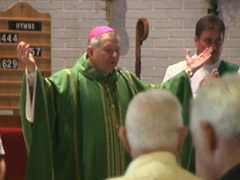 Archbishop Gregory Aymond |
LAWTON: Still, he says he’s been encouraged by the strength of faith that he’s seen.
AYMOND: They are an amazing people. They are resilient. They get discouraged, but they don’t give up. They become puzzled and questioning of God, as we all would in circumstances like this, but they are people of faith.
LAWTON: St. Anthony’s parishioner Tilden Perez, Jr. says he still trusts God, even though he and his entire family have been devastated financially. Perez says his life, past, present and future, is tied to the bayou.
TILDEN PEREZ, JR., commercial fisherman: I’m born and raised here. My people build boats all their lives. My people come from Canary Islands in Spain, which you know is how we got here in the first place. Because it’s Spanish boats that brought the people here in the first place.
LAWTON: Perez is a commercial fisherman, but he hasn’t been able to get work since the oil spill.
PEREZ: On a regular day, none of these boats would be here. Mostly everybody would be working. I’d love to be in the bayou. I want to be in the bayou, and I can’t be in the bayou.
Watch Tilden perform a song |
LAWTON: He takes solace in prayer and worship music. He played us a song he says God put in his heart.
LAWTON: Even as people here try to hold on to hope, worries about the future seem almost overwhelming. In addition to the economic worries, there are concerns about the long-term environmental impact, not only of the oil, but of the chemicals being used to disperse it, chemicals that have been banned by other countries.
ENCALADE: That oil is still there. It didn’t just vanish away like people may want to think. It vanished from where you can’t see it from the TV cameras, but it’s down there, and that dispersement is down there. We’ve been asking from day one, we want to know what’s in that dispersement, we want to know about the carcinogens in it, we want to know. We have a right to know. And the people that’s going to consume this seafood have a right to know.
LAWTON: There are worries about what’s going to happen to the wildlife and the beauty of the bayous.
AYMOND: A part of our faith is that we have to take care of the environment, and the environment has certainly been changed and polluted, and we don’t know how long this will take. Is this going to be a change of environment for two or three years? Is this going to be ten years? Is this going to be twenty years? What will this do to the Gulf of Mexico?
LAWTON: And mostly, worries about what will happen to the people here.
JEFFRIES: Katrina was sudden, it was rapid, everything was gone in an instant. But now this is slow. We have time to build up worries, anxieties, fears. Before we were stunned. Now we’re filled with question marks in our minds.
LAWTON: Questions with no quick and easy answers.
BOB ABERNETHY: Kim, welcome back
KIM LAWTON (correspondent): Thank you.
ABERNETHY: It seems as if there’s not nearly as much help going from churches and other organizations around the country going to New Orleans as there was right after Katrina, is that right?
LAWTON: Well, certainly after Katrina there was this huge outpouring, people wanted to do things, although in the immediate aftermath of Katrina they were still trying to figure out what to do. I think that’s what’s happening here as we heard from so many of the people we interviewed. This is still unfolding, and you know people aren’t sure what the needs really are, what they are going to be. Also, things aren’t quite as obvious. With Katrina, there were houses, people could really dive in, you know, and with this the people who are cleaning up the oil have to be specially trained, so there aren’t that many hands-on jobs right now.
ABERNETHY: Meanwhile, BP is saying, well, we are going to do it all, we are going to clean up everything. Well, that can be a disincentive for people around the country who might want to help.
LAWTON: Exactly. We heard, you know, BP has the ads saying we are going to make this right. And so we heard from many of the local groups that are trying to give immediate help or intermediate help saying they’re not getting donations from the outside like they did from Katrina in part because there’s this feeling of, well, BP should be taking care of it. BP did give some money to charity, but the Catholic Charities, as we said, they’ve already used it up, and in this intermediate time people still are in need.
ABERNETHY: Kim Lawton, many thanks.
Watch more from New Orleans Roman Catholic Archbishop Gregory Aymond, Margaret Dubuisson of Catholic Charities of the New Orleans Archdiocese, and Rev. John Dee Jeffries, pastor of the First Baptist Church of Chalmette, discussing the spiritual toll of the oil spill crisis for people along the Gulf Coast.
