Listen to this episode now:
[powerpress]

Listen to this episode now:
[powerpress]
Listen to this episode now:
[powerpress]
We continue our series on the rise of the religiously unaffiliated with a report from managing editor Kim Lawton on political implications. Watch clips of her interviews with young “nones” in Akron, Ohio about their views on religion and politics.
FRED DE SAM LAZARO, correspondent: Angeles City is one of the Asia’s most notorious sex districts. Even on a rainy evening, dozens of young women were outside their establishments on the look out for customers.
FATHER SHAY CULLEN: Don’t touch me, ma’am.
DE SAM LAZARO: Shay Cullen cuts a promising customer profile around here, and on this night he was frequently accosted. In fact, the 74-year-old Ireland-born Dominican Catholic priest has campaigned for four decades to clean up this district.
The boom in commercial sex here dates back to the Vietnam War, when the U.S. military greatly expanded its Philippine bases nearby. Today, Father Shay, as he’s called around here, says 12,000 women work this strip.
(speaking to Fr. Cullen): Where do they come from primarily?
CULLEN: The majority in this area are coming from North America, Australia is quite big, Koreans, there’s special clubs here for the Koreans, but also from Europe, we have Germans, Swedes.

DE SAM LAZARO: Over the years, Father Cullens’s People’s Recovery, Empowerment and Development—or PREDA Foundation—has sheltered and rehabilitated thousands of young women rescued from the sex trade.
CULLEN: Many of the girls are underage and young and available. On these clubs and bars, this is only the outer, the more legitimate looking trafficking of human beings, no, but the trafficking of minors, younger girls is secret, and it operates on a different system. It’s all done by cell phone, without any direct contact between the supplier, the trafficker, and the customer. They have go-betweens.
DE SAM LAZARO: Their stories have common threads: physical or sexual abuse in childhood and families in various forms of dysfunction and separation. In all cases, abject poverty underlies their child labor and prostitution.
UNIDENTIFIED WOMAN 1: They told me that I was only to work there as a housemaid or house helper but after 4 days of being there they brought me to a bar to work there as a guest relation officer.
UNIDENTIFIED WOMAN 2: I left our house because I had a misunderstanding with my grandmother. My parents are not here. My father is in Saudi Arabia and I don’t know where my mother is.
UNIDENTIFIED WOMAN 3: I was inside the room of Alex and he had instructed me to remove my clothes. So we were naked when the NBI arrived in the house.

DE SAM LAZARO: Many of the young women and girls brought here were rescued by NBI, the National Bureau of Investigation, usually responding to reports and pressure from PREDA and other advocacy groups that look out for potential trafficking victims.
UNIDENTIFIED WOMAN 2: I didn’t want to leave because I needed the help of the pimp. I could not survive without it.
DE SAM LAZARO: Father Cullen says the goal of counseling here is to allow these children to be children. Many have come from jails where they were sentenced for petty crimes. Many are reconciled, if not comfortable, with a life of prostitution before they come to PREDA.
CULLEN: So the first thing, the service, is the sense of welcome, acceptance, relief and protection. You’re safe at last. No one can touch you again. They meet friends who suffered the same, so it’s not only me, and the essence of our program, of course, is giving affirmation. They’ve been told they’re nothing, they’re worthless, they’re only good for prostitution.
MARLENE RICHTER: This is the hotline…
DE SAM LAZARO: The PREDA Foundation runs a hotline to rescue women and girls from prostitution. They can call in or, as many now prefer, send a text message.
RICHTER: December 2011, I received 756 texts.

DE SAM LAZARO: The hotline is never far from Marlene Richter, one of 19 counselors and facilitators who work here. She coordinates rescues with law enforcement, a job the 31-year-old may be singularly well-qualified for. When she was 13, Richter and an even younger child prostitute were rescued.
RICHTER: I have two abusers, one from Germany, one from Netherlands. That’s the time that our abuser fly back to Germany and Father Shay helped us in pursuing our legal case in Germany.
CULLEN: I alerted our contacts, ECPAT in Germany, which is a campaign to end child prostitution and pornography. And in a week or so we’re on a plane, Marlene gets up and gave her testimony and everything and that’s it. Then he was—within a week he’s convicted and sentenced.
DE SAM LAZARO: It was a rare triumph. Most cases proceed far more slowly and must be pursued in a Philippine legal system riddled with corruption.
GERONIMO SY (Prosecutor, Department of Justice): Who polices the policemen? Who prosecutes the prosecutor? Who judges the judge? Who polices a corrupt media, you know, when everybody’s in cahoots, especially these are well entrenched interests? So that’s a major challenge.

DE SAM LAZARO: The two-year-old administration of President Benigno Aquino has tried to crack down. Trafficking is now a non-bailable offense, for example. But Fr. Cullen fears that could actually increase corruption.
CULLEN: If you make the penalty so huge that the bribe has to be so huge and they pay it because of the penalty would be in prison.
DE SAM LAZARO: That’s so ironic, that the harder you penalize somebody the higher the stakes are for people to make money on the deal.
CULLEN: Exactly, and therefore the temptation of the judges and the prosecutors is just, you know, fantastic.
DE SAM LAZARO: The U.S. State Department, which monitors trafficking worldwide, has the Philippines on a watch list. But it does praise a stepped-up government commitment, noting there were a record 27 convictions in 2011. But Father Cullen says the influential church leaders in this predominantly Catholic nation have not been sufficiently committed.
CULLEN: There have been statements made from time to time, but in practice as regards challenging the sex industry and the tourist industry, they have not taken a stand against this as they have with, say, taken a stand against contraception, for which they are very outspoken at the moment.
 DE SAM LAZARO: Father Shay Cullen, ordained in 1969, describes himself as a product of the historic Second Vatican Council that exhorted Catholics to be outspoken on poverty and social justice issues. He arrived in the Philippines in 1972.
CULLEN: You couldn’t miss it coming here and seeing it on the streets and all around, so it made a strong, no, challenge, no to me, personally to, you know, get out of the rectory and into the streets more or less.
DE SAM LAZARO: He actively campaigned to close the U.S. naval base in Subic Bay, arguing that it wasn’t in the Philippines’ best interest. The base was closed in 1992. And he sued the U.S. government to help the support of thousands of children born to Filipina women and U.S. servicemen fathers, with whom they have no relationship. But to make a dent in the entrenched sex industry, he wants to attack the underlying poverty. As long as it persists, he says, people will be vulnerable to traffickers. His foundation has various enterprises, selling these soap stones to a boutique chain in America, for example, and local crafts and dried mangoes grown by local farmers.
CULLEN: We really want to go into all these villages, give seminars, training and then buy their products and give them fair trade prices, really good money, so they can use that money to send their kids to school.
DE SAM LAZARO: The PREDA Foundation sends the children under its care to school, training and, in cases like Marlene Richter, college. She’s now happily married—ironically—to a German tourist and has a baby boy, living happily ever after, she says.
For Religion & Ethics NewsWeekly, this is Fred de Sam Lazaro in Olangapo City in the Philippines.
Listen to this episode now:
[powerpress]
FRED DE SAM LAZARO, correspondent: Minnesota is the 32nd state where voters have been asked to weigh in on same sex marriage. In every case, they’ve voted to ban it. Eighteen states outlawed civil unions as well. Minnesota’s question is narrow: Should the state constitution define marriage as the union of one man and one woman? A “yes” vote would prohibit laws to legalize gay marriage, though it wouldn’t preclude civil unions.
DALE CARPENTER (University of Minnesota Law School): The fact that the amendment is just focused on the marital status itself is a reflection of a new reality, which is that much of the public accepts that same sex relationships are legitimate and that they have legal needs but may not be ready to accept the title of marriage quite yet. I don’t think that’s a form of bigotry, I think that’s a form of risk-averseness.
 DE SAM LAZARO: Law professor Dale Carpenter has studied the issue of gay marriage. He’s with the No Campaign, which includes civic and gay rights groups and a growing number of churches sympathetic to what they say is equity for gay couples. But Carpenter admits many people are reluctant to redefine an age-old social institution.
CARPENTER: I think for a lot of people there’s a strong religious conviction that God made marriage and marriage is for one man and one woman…
Cathedral service: This year as we come for the Rosary parade, we are thinking about the beauty of the sacrament of marriage..
DE SAM LAZARO: For supporters of the amendment, that conviction is at its core.
ARCHBISHOP JOHN NIENSTEDT (St Paul-Minneapolis): Marriage matters to every Minnesotan, whether or not we personally choose to marry. Intuitively we know it is the natural way we bring together men and women to conceive and raise the next generation…
 DE SAM LAZARO: Minneapolis St. Paul Catholic archbishop John Nienstedt has spearheaded the pro marriage amendment campaign, appropriating more than one million dollars and delivering public messages like this one…
NIENSTEDT: What will happen to children growing up in a world where the law teaches them that Moms and Dads are interchangeable, and that marriage has nothing intrinsically to do with the bearing and raising of children? We know from experience that in other states, children as young as first-graders are taught by the government that gay marriage and traditional marriage are both the same…
DE SAM LAZARO: Several churches and faith-based groups have joined in the Yes Campaign. A Minnesota law passed in 1997 already prohibits same sex marriage. But proponents say absent constitutional protection, that could change at the whim of a judge or legislature, with daunting consequences for institutions and people of faith who oppose gay marriage.
 JEFF EVANS (Evangelical Pastor): Catholic Charities, for instance, in Boston, they were mandated after same sex marriage was legalized there by the legislature, it was mandated that they place children in their adoption agency within same sex couples and of course that violated the conscience of Roman Catholics there and they/were forced to close their doors
DE SAM LAZARO: It’s such concerns that have drawn volunteers to the Minnesotans for Marriage phone banks. Tommy Burns, a father of six, is a recent transplant to Minnesota from Massachusetts
TOMMY BURNS (Volunteer): When I think back to again, to what happened in Massachusetts and New York, when politicians can push that through on the people, it’s disheartening. So again I am just very pleased that this state is allowing us to vote on it.
 LISA RUMBAUGH (Volunteer): I got involved because I want to see the Bible being preserved, so many of the moral things, the moral fiber of society is being erased and I believe that it’s a sin to practice homosexuality; there’s many places in the Bible that say that.
DE SAM LAZARO: High profile personalities have thrown their hat in. For the Yes side, former Minnesota Vikings star Matt Birk.
MATT BIRK (NFL): I can put up with a lot from government, like higher taxes. And while I don’t like it, pushing God out of public schools. But letting a small number of government and business elites and judges define what marriage is to Minnesotans doesn’t seem very fair.
DE SAM LAZARO: Amendment opponents have their own take on government interference.
JESSE VENTURE (Former Governor, I-MN): Government should not be telling people who to fall in love with, government should not be telling people who to cohabit with.
 DE SAM LAZARO: Some big employers, like cereal maker General Mills have publicly opposed the amendment, arguing it would hurt recruitment. Others have stayed neutral but say they support their gay employees and customers. Retailer Target notes that its marriage registry welcomes gay couples. However, unlike many other state campaigns, some of the most prominent No voices have also come from pulpits and preachers.
CARPENTER: Many campaigns have run away from religion, in the past, trying to say there’s a separation of religion and state. Whereas in Minnesota I think we have embraced the idea that a person of faith can and should oppose the amendment.
DE SAM LAZARO: The No campaign’s faith director, Grant Stevensen, is a pastor at this St. Paul Lutheran congregation.
REV. GRANT STEVENSEN: We’re acting on our faith but we’re also acting on behalf of children that come from families that don’t fit in one small box of what a family looks like. It’s terrible for children to hear that one type of family is a normal family, is a good family and then another family, maybe your family, with two moms or two dads is not a normal family. I think that’s really difficult and devastating for children.
 TV Spot: Used to be this wasn’t even an issue. Marriage was one man and one woman. But times change and I’ve thought about it more…
DE SAM LAZARO: Campaign commercials for both sides have been largely free of anger or vitriol. This ad for the “no” side emphasizes fairness.
TV Spot: My marriage is the most important thing in my life. Who am I to deny that to anybody, gay or straight? I’m not going to limit the basic freedom just because I’m uncomfortable.
FMR. GOV. JESSE VENTURA: This is not a Democrat issue, this is not a Republican issue, this is not a liberal or a conservative issue.
DE SAM LAZARO: It is a deeply religious issue, and the religious coalitions, like the political ones, transcend the traditional divide.
PASTOR EVANS: There are Roman Catholics, Baptists, Pentecostals, minority ethnic churches, Presbyterians like myself, non-denominational folks, all coming together, rallying together behind marriage, and it’s brought people together on the yes side.
 But at a cost. Sharp divisions have played out publicly in the Catholic Church. Priests were asked not to publicly oppose the amendment but some have been defiant. This video posted on the internet is of Fr. Bob Pierson, a Benedictine monastic and therefore not under diocesan jurisdiction. He says the church has no business in this issue.
REV. BOB PIERSON (St. John’s Abbey): Until now, the Church hasn’t concerned itself with civil marriage. The church doesn’t recognize civil marriage of its members. If a Catholic is married in a civil ceremony, they are said to be married outside of the Church and the marriage is not recognized.
DE SAM LAZARO: Whatever the ballot outcome, the rift is likely to linger.
PIERSON: Is it getting uncomfortable to go to church these days? (nods, yes)
DE SAM LAZARO: A group of prominent Catholics called this news conference to express their opposition.
NANCY SCANLAN: When I first heard about the amount of money that was taken out of the archdiocese funds to pay for this amendment and know how schools closing and teachers not getting paid well and things that I think that should be addressed in a social justice way, I was so angry I sat right down and wrote a letter. And the letter that I got back said to me, “I’m sorry you don’t see things our way. We may end up being a smaller—stronger church.”
DE SAM LAZARO: The church has come under fire for heavy spending. However, opponents of the amendment have outspent its supporters by four to one. Still, recent polls show a tight race, well within the margin of error.
For Religion & Ethics NewsWeekly, this is Fred de Sam Lazaro, at home, in St. Paul.
Listen to this episode now:
[powerpress]
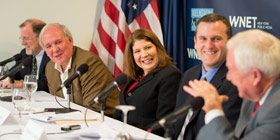
On October 9, 2012, Religion & Ethics NewsWeekly hosted a panel discussion at the National Press Club to explore the impact of the rise of the religiously unaffiliated—often called “the nones”—on politics. The discussion was based in part on a new joint survey by Religion & Ethics NewsWeekly and the Pew Research Center’s Forum on Religion & Public Life which looked at the characteristics, beliefs and practices of the 46 million Americans who now describe themselves as not affiliated with any particular religion.
The panel featured Bob Abernethy, host and executive editor of Religion & Ethic NewsWeekly, Kim Lawton, managing editor of Religion & Ethics NewsWeekly, Greg Smith, senior researcher at the Pew Forum on Religion & Public Life, Mike McCurry, veteran communications strategist and spokesperson, and Michael Cromartie, vice president of the Ethics and Public Policy Center.
Watch video excerpts of panelists discussing the survey findings and how the rise of the “nones” may challenge political parties.
NEW MINISERIES FROM RELIGION & ETHICS NEWSWEEKLY EXPLORES VIEWS OF 46 MILLION RELIGIOUSLY UNAFFILIATED AMERICANS
Program releases new survey of this rapidly growing population
WASHINGTON DC (October 9, 2012) — Religion & Ethics NewsWeekly, the national PBS television program produced by Thirteen/WNET, is launching a three-part mini-series, “None of the Above: The Rise of the Religiously Unaffiliated,” based largely on a new survey about the views of the 46 million Americans who say they are not affiliated with any particular religion. Watch a preview.
According to the Pew Research Center, one in five American adults — nearly 20 percent of the US population — now describe themselves as religiously unaffiliated, the highest percentage ever in Pew’s polling. Religion & Ethics NewsWeekly partnered with the Pew Research Center’s Forum on Religion & Public Life in a survey to delve more deeply into the theological, social and political views of these Americans, who are often called “the nones.”
“We’re getting a growing group, as much as one-fifth of the adult population, that do not identify with some kind of organized religion, and that has a lot of implications for religion, for politics, for society,” Prof. John Green, director of the Bliss Institute at the University of Akron, told Religion & Ethics NewsWeekly. “It represents a very significant change.”
Among the joint survey findings, the miniseries explores:
Two-thirds (68 percent) of those who describe themselves as religiously unaffiliated say they believe in God or a universal spirit. More than half (58 percent) say they often feel a deep connection with nature and the earth, and more than a third (37 percent) describe themselves as “spiritual” but not “religious.”
A third of adults under 30 have no religious affiliation, compared with just one-in-ten who are 65 and older.
The Pew Forum: “Nones” on the Rise
Download the full report (PDF, 1.37MB, 80 pages)
The majority of the religiously unaffiliated are Democrats or lean Democratic, and 67 percent of them believe churches and other religious institutions are too involved with politics.
Large majorities of the unaffiliated say religious institutions are too concerned with money and power (70 percent) and focus too much on rules (67 percent).
More than three-quarters (77 percent) say religious institutions play an important role in helping the poor and needy and bring people together and strengthen community bonds (78 percent).
While 76 percent of Americans overall believe that churches and other religious institutions protect and strengthen morality, only about half (52 percent) of the religiously unaffiliated agree.
The vast majority of religiously unaffiliated Americans are not actively seeking to find a church or other religious group to join. Of those who describe themselves as “nothing in particular” (as opposed to atheist or agnostic), 88 percent say they are not looking for a religion that is right for them.
The survey was conducted among a nationally representative sample of adults in all 50 states, including 958 who are religiously unaffiliated.
The impact of the rise of the religiously unaffiliated on politics was further explored today at a panel at the National Press Club featuring Bob Abernethy, host and executive editor of Religion & Ethic NewsWeekly, Kim Lawton, managing editor of Religion & Ethics NewsWeekly, Greg Smith, senior researcher at the Pew Forum on Religion & Public Life, Mike McCurry, veteran communications strategist and spokesperson, and Michael Cromartie, vice president of the Ethics and Public Policy Center.
“None of the Above: The Rise of the Religiously Unaffiliated” will look at the impact of the rise of the religiously unaffiliated in three segments:
The first segment, None of the Above: Who Are They, will begin airing on public television stations nationwide on October 12, 2012. It provides an overview of who these religiously unaffiliated people are and what they believe. The story will be reported by R&E Host Bob Abernethy and produced by Marcia Henning.
The second segment, None of the Above: Political Implications, which begins airing on October 19, 2012, focuses on how the growing number of religiously unaffiliated citizens could affect elections and the role of religion in politics. The segment will be reported by R&E Managing Editor Kim Lawton and produced by Patti Jette Hanley.
The third segment None of the Above: Religious Implications, which begins airing October 26, 2012, looks at the possible influence of this trend on religious congregations and institutions. This segment will be reported by R&E Contributing Correspondent Deborah Potter and produced by Susan Goldstein.
Please check local listings for time and station information. Additional resource material, including video excerpts from the National Press Club panel, will be available here on this website.
LUCKY SEVERSON, correspondent: This was the Family Leadership Summit in August on the outskirts of Des Moines, Iowa. For Christian conservatives from throughout the state and from as far away as Alaska, this was the place to be. The hot subject of this day was judicial restraint. Listen to former Republican presidential candidate Rick Santorum.
RICK SANTORUM: We need to make it very, very clear what our values are, and that they are not to have elitist judges rule from on high and tell us that we have to fundamentally change who we are as Americans, and that’s what this is about.
SEVERSON: What this was about in particular is that Iowa’s seven supreme court justices ruled in 2009 that a state law prohibiting same sex marriage violated the Iowa constitution. In 2010, three of the seven who were up for retention were voted off the bench. It was decisive and it was orchestrated in large part by a nonprofit organization called the Family Leader, founded by Bob Vander Plaats.
 BOB VANDER PLAATS (The Family Leader): When you have a supreme court that is willing to legislate from the bench saying Iowa will now be a same sex marriage state and when you allow them to amend the constitution basically saying we’re going to grant rights that our founders could have never imagined, that is a dangerous path to go on.
SEVERSON: This is former justice Michael Streit, one of those removed from the bench after serving 27 years, nine years on the state’s highest court.
JUSTICE MICHAEL STREIT (Iowa Supreme Court, 2001-2010): We did what we had to do, not what we wanted to do. And that’s the essence of good judging. Good judging, a fair and impartial court are courts that are allowed to rule as they must, not how they want to rule, and that’s what we did here.
PROFESSOR RACHEL CAUFIELD (American Judicature Society): Judges have one job and one job only. They take an oath to uphold the constitution.
SEVERSON: Rachel Caufield is a professor of political science at Drake University and a research fellow at the American Judicature Society. She thinks it’s the Family Leader and other conservative groups around the country, that are inserting money and politics into the judicial system.
 CAUFIELD: I think we have a movement afoot to politicize our courts and in politicizing our courts I think basically that undermines the quality of justice in America. There’s definitely a trend nationwide. We’ve seen a huge increase in campaign spending among judicial candidates, many of whom are supported by similar interest groups.
SEVERSON: According to the nonpartisan group called Justice at Stake, from 2000 to 2009, money spent on state supreme court justice races jumped more than two-and-a-half times to over $206 million. In Iowa in 2010, money spent, mostly from out of state totaled over $1.2 million to un-elect the three justices there with ads like this:
TELEVISION ADVERTISEMENT (National Organization for Marriage): “If they can redefine marriage none of the freedoms we hold dear are safe from judicial activism. To hold activist judges accountable, flip your ballot over and vote no on Retention of Supreme Court Justices.”
 JUSTICE STREIT: They were attacking judges that had devoted their lives to being fair and impartial, to not let theology, ideology, campaign considerations, political considerations sway their opinions one way or the other.
CAUFIELD: We’re seeing that increasingly the money that’s being given to judicial campaigns, and particularly contested judicial campaigns around the country, is really dominated by a few super spenders. The average donation beyond those, that handful of super spenders, is very low.
SEVERSON: At the leadership summit, Vicki Crawford doesn’t think money makes much difference.
(to Crawford): Does it worry you that the person who has the most money is more than likely going to win?
VICKI CRAWFORD: Actually my thought is the truth will win if it’s given enough of an opportunity to be out there.
VANDER PLAATS: A lot of people make a big deal about, okay, money came from a lot of different places. Only the people of Iowa were allowed to vote on this issue. And Iowans are very intelligent, they’re very savvy. They voted those three justices off, and I think there were 76 judges on that ballot that year, only those three judges lost their job. Everybody else kept their job.
 SEVERSON: Vander Plaats says he does not want to see the courts politicized, doesn’t want to see judges campaigning door-to-door. It was, he says, the Iowa Supreme Court ‘extremist’ justices who inserted politics into the system.
CAUFIELD: If you really value a fair and impartial judiciary then you have to ask yourself, you know, what about these people who are, who are politicizing the judicial branch and who are going after judges knowing that it’s difficult for judges to respond, knowing that when a judge responds that automatically throws their integrity into question.
SEVERSON: The gay marriage decision was unanimous. All 7 justices, some democrat, some republican, voted to invalidate Iowa’s ban. In Iowa, the governor appoints the justices who then have staggered terms. Three lost their jobs in 2010. Another is up this year and then the other three will be up for retention in upcoming years. The Family Leader’s founder wants them all punished.
VANDER PLAATS: I’m going to go back to being a high school principal. Sometimes when we’d have under aged drinking going on and we’d show up at a beer party and say only three kids remain there. Well, those three got the discipline to them, but if we knew there was four others, we called on the four others to fess up and accept the same kind of punishment that the other three did.
 SEVERSON: This year, Justice David Wiggins is up for retention, and he has already been targeted by the Family Leader.
SANTORUM: Judges are not there to impose their will on the rest of us. Will you decide on this election day to vote out Justice Wiggins and send another strong message here in the state of Iowa? (applause)
CAUFIELD: We do have the right to kick them out if they’re not abiding by the constitution.The idea that judges predetermine what their decisions would be on hot button issues, before they reach the bench, what that effectively does is it says that the entire judicial process is a sham.
SEVERSON: But that is a view not held by some at the Family Leadership Summit.
PASTOR LAURENCE WHITE (Our Savior Lutheran Church, Houston, Texas): The people have the right to know what the beliefs and convictions of a candidate for any position, whether that be a justice or a judge or a senator or representative. Simply to say I’m going to uphold the law is no longer adequate, as we have taking place within our culture a collision of two fundamentally different views of the meaning of the constitution and the nature of American political life.
CAUFIELD: All across the country, every citizen deserves to know that if they’re going to walk into a courtroom, they’re going to have a fair trial and a decision’s going to be rendered by a judge who’s not tarnished by any sort of political agenda, and when we start inserting politics into the judiciary we threaten that ideal.
SEVERSON: There are several other states where spending on judicial races appears to be setting records. And now, a new study by the Center for American Progress shows that judges in races that have seen the most campaign spending between 2000 and 2010 have ruled in favor of big business 71 percent of the time.
JUSTICE STREIT: The study confirms that those judges that have to raise money to get elected and to get reelected, they know who’s buttering the bread. They know that they are going to have to please somebody. These corporations that give money to judges are not doing it out of civic interests for good courts. They’re trying to get people that will rule in their favor in the long run.
SEVERSON: It’s an important discussion because state courts decide the vast majority of the country’s legal cases.
For Religion & Ethics NewsWeekly, I’m Lucky Severson in Des Moines, Iowa.