Combating Hunger


BOB ABERNETHY: One important lobby is the Christian group Bread for the World, which fights hunger here and abroad. Reverend David Beckmann, a Lutheran pastor, is president of Bread for the World. David welcome.

DAVID BECKMANN (President, Bread for the World): Thank you.

ABERNETHY: Bring us up to date, how many hungry people are there in the United States?

BECKMANN: It’s now 1 in 7 Americans who lives in a household that runs out of food.

ABERNETHY: Runs out of food what? Each month or?

BECKMANN: The typical pattern is the last 2 or 3 days of the month, people run out of food. So the kids may not eat for the last couple days, the mom may not eat for 4 days, it’s 1 in 4 children under the age of 5 who lives in one of those households and that kind of moderate under nutrition does permanent damage to children.

ABERNETHY: Now the supercommittee in Congress failed this week to come up with any plan about the long term control of the deficit. What does that mean for you and the people who are trying to fight hunger? There was to be an across the board cut that was gonna kick in if there was this failure. Is it going to kick in and if so what does that mean for hungry people?

post01-combatinghungerBECKMANN: Well, Bread for the World and other faith groups have been fighting for a circle of protection around funding for hungry and poor people because we can reduce deficit spending without making hungry people hungrier. And we were able to secure in the Budget Control Act that established the super committee and these automatic cuts a provision that will exempt some of the low income programs from cuts if those automatic cuts go into effect. So I would have liked to see the super committee reach a deal but the automatic cuts aren’t necessarily a disaster for poor people.

ABERNETHY: Because of the exemption?

BECKMANN: Yeah, and because people of faith pushed for it.

ABERNETHY: What about overseas? What’s going on there with American food aid?

BECKMANN: Well we were terrified earlier this year because the House of Representatives voted on a deep cut in food aid. Their cut would have thrown 14 million of the world’s most desperate people off food aid rations this year. So we really sounded an alarm about that, we talked to Mr. Boehner’s office, we talked to the President himself and in the final bill which passed this week they backed away from that really disastrous cut for hungry people.

ABERNETHY: A few weeks ago we heard that there were 7 billion people on Earth and the forecast was this would be going up to 9 billion by 2050. Can all those people be fed?

BECKMANN: Well I think we need to curtail population growth, but those people can be fed, and the key is an expansion of the productivity of poor farmers in poor countries. They can grow more to feed their own families, to raise their incomes. That’s where the food will come from for poor countries.

ABERNETHY: You mean rather than have it grown here and shipped someplace else?

BECKMANN: I think expanding demand for food will also be good for US agriculture but the bulk of the supply needs to come from the expansion of poor country, poor farmer agriculture.

ABERNETHY: And this week you came out with a proposal to change the system between the government and farmers in this country. What do you want to do?

BECKMANN: Well, we think it’s possible to develop a system that would be better for farmers especially small medium scale farms, fruit and vegetable growers, better for hungry people, better for a healthy food supply and that would cost the government less money. So this is an area where we want to support cuts but we don’t want the cuts to come from the nutrition assistance to poor people that’s included in the farm bill. On all these things basically we have to create the political will to overcome hunger. When we’ve had that political will to reduce poverty we’ve been able to do it in our country, and that’s what we need to mobilize now.

ABERNETHY: If all the federal aid for hunger, to prevent hunger, went away, could private charities pick up the slack?

BECKMANN: No, absolutely not. People think that but in fact all the food that we collect from all the churches and synagogues in the country, all the food banks, it’s important but it all amounts to 6% of the food that poor people get from the federal food programs. That’s food stamps, school lunches, WIC. So if Congress decides to cut the federal food programs by 6%, 12%, there’s no way that churches and charities can pick up the gap. We need to also get our government to do its part to end hunger.

ABERNETHY: David Beckmann of Bread for the World. Many thanks.

Donor Fatigue


FRED DE SAM LAZARO, correspondent: It’s here at the Ethiopia-Somali border that some 400 refugees arrive every single day, most of them women and children, most of them fleeing not just famine, but fighting.

So far this year, 135,000 mostly women and children have registered here in this harsh but promised land for refugees. They have suffered for months and walked for days to get here. There’s food and some basic medical care — just barely enough.

LINN BIORKLUND (Doctors Without Borders): I think it’s important to point out that the emergency’s not over. It’s ongoing. We continue to see people coming and these people are living here in camps and they are in great need of humanitarian assistance.

DE SAM LAZARO: For humanitarian agencies, the challenge is to sustain the supply pipeline and keep the attention in donor countries focused on this remote region that’s seen hunger and conflict for decades. It’s an ongoing, perennial and at least partially man-made disaster. In the minds of donors, that’s very different from sudden disasters, says Mike Lloyd.  He heads a Minnesota-based group called Kids Against Hunger.

post01-donorfatigueMIKE LLOYD (Kids Against Hunger): When the earthquake struck in Haiti, there was a tremendous outpouring for that event. It went on for several months. We had groups all over country wanting to pack meals, and it was a real scramble for us to meet that demand. Of course, donor dollars followed that demand for packaging the meals. When the Joplin tornado happened, of course we had a similar experience.

DE SAM LAZARO: This year, Kids Against Hunger volunteers will pack some 50 million ready-to-mix meals to be sent to needy regions around the world.  Lloyd says the response to the crisis in East Africa has been much smaller.

LLOYD: Situations like we see in the Horn of Africa are long term, they are political, at least partly political, they’re somewhat related to the drought situation but it’s been a long term political struggle in those areas and that has not excited the packers and the donors in the same way.

DANIEL WORDSWORTH (American Refugee Committee): It’s not so much about compassion fatigue. I think people are as compassionate today as they ever have been. For us, it’s actually more a belief fatigue.

DE SAM LAZARO: Daniel Wordsworth heads another Minnesota-based group, the American Refugee Committee.  ARC also saw a huge response to the Haiti earthquake.  But support for Pakistan, hit by massive floods a few months later, was far weaker.  Initially, Wordsworth says, there also was indifference toward the Horn of Africa.

post02-donorfatigueWORDSWORTH: I think what we see in both Pakistan, and we’re seeing it very strongly in Somalia, is that — and it really is almost confronting to us – is the lack of belief that people have for that country. So it’s not that they don’t feel compassionate. They just can’t make the connection. They don’t believe that either change is possible there or that their money, or their resources, what they give, will actually translate into something different on the ground. That’s the crisis that we’re seeing.

DE SAM LAZARO: Wordsworth says it’s the deeds of one percent of the population that have given Pakistan and Somalia their reputation as hostile terrorist havens.  So in its fundraising campaigns for Somalia, the American Refugee Committee has tried to “de-fang” Somalia’s image, drawing heavily on the fact that the largest Somali-American community is right in its home base in Minneapolis.

WORDSWORTH: Our doctors may be Somali, our local business professionals Somali, our taxi drivers Somali. We actually get to meet the 99% on a regular basis.

Video clip: Hi, I am a star…

DE SAM LAZARO: Somali-Minnesotans — prominent and otherwise — have led a varied media campaign, drawing in the larger local community.

Video clip: We hosted a charity dinner… I’m a star because I donated money that I earned from a car wash… I organized an art show… I collected pennies for Somalia…

post03-donorfatigueWORDSWORTH: It’s a whole different side of Somali culture that people don’t normally see. And then through, I think, that lens, you can see a dynamic, amazing group of people and your ability then to believe that if this country is full of people like this, there’s huge hope for that country.

DE SAM LAZARO: Is it working?

WORDSWORTH: It’s working really well for us.

DE SAM LAZARO: How do you know?

WORDSWORTH: Actually we are seeing the same outpouring of compassion that we saw for Haiti. I think we will be one of the very few organizations in the world that can say that – that we’re tracking about the same.

DE SAM LAZARO: In response to crises, donors fall into two distinct categories, according to Mike Lloyd. He says grassroots campaigns and images of suffering are less effective with large donors and philanthropists than they are with individual givers.

LLOYD: Those gifts are given from the heart. They really react to the emotional sense that they’re making a difference in the individual’s life. And when we talk to corporate givers or large donors, their dollars are usually more intended, in their minds at least, the things that are going to have lasting impact. So they’re less likely to be driven by the emotional aspect of having an impact on an individual and what’s going to happen to my dollars. Are these going to really change anything or is it just going to be the same after the dollars are gone?

DE SAM LAZARO: The American Refugee Committee says it has gotten some major corporate donations, most likely because they’re local, says Wordsworth.

WORDSWORTH: Groups like Best Buy, General Mills, the Mosaic company, U-Care, a health insurance provider. Because they’ve got Somali staff, they can see it more quickly and then the rest of the staff and the rest of the company comes around behind them and shows some solidarity

DE SAM LAZARO: ARC has used its donations to run a hospital in the Somali capital, Mogadishu. The recession at home has not hurt contributions. The group says people tend to be more sympathetic and responsive in tough times. Larger donors, though, need more convincing that their dollars, should they contribute, will bring enduring change over the long term in addition to easing the immediate suffering.

For Religion & Ethics NewsWeekly, this is Fred de Sam Lazaro in Minneapolis.

Dr. Brenda Williams


DR. BRENDA WILLIAMS: (singing) God is a good God, yes he is. God is a good God, yes he is. One more time.

LUCKY SEVERSON, correspondent: This is the medium security pod at the detention center in Sumter, South Carolina, and this is Dr. Brenda Williams, all four feet, eleven inches of her.

DR. BRENDA: OK, now listen up. What were going to do is this. A couple of things, then we’re gonna go on, ’cause I am a very short-winded person.

SEVERSON: She says she was afraid to talk in public until the teacher made her give an oral report in 7th grade. Her husband, Dr. Joe Williams, says that was just the beginning.

DR. JOE WILLIAMS: She was talking when I first saw her and she’s continued to talk since then.

DR. BRENDA: (To inmates) Talk, talk, talk, talk, talk, talk, talk. That’s all some folks do. We do more than talk. We back up our talk.

post01-brenda-williamsI called Mr. Mathews and said, “Hi, my name is Brenda Williams,” blah, blah, blah, and he said, “I know about you. You don’t have to give me an introduction.”

SEVERSON: Few in Sumter would deny that Dr. Brenda Williams is a force of nature, or that her husband Dr. Joe is the calm in the eye of the storm. She’s a general practitioner. He’s an internist and geriatrician. They’ve run a clinic in this city of 100,000 for 30 years. No one is turned away. Her latest project is called Do Right and the folks who agree to “do right” get on the list to get a free home. So far they’ve given away four.

PATRICIA DUNHAM: This is my dining room. I never had one of those before.

SEVERSON: (to Patricia Dunham) It’s a nice dining room.

It’s the first house Patricia Dunham has ever owned. For her and her husband and three kids, it’s a dream come true. It may be comfortable now but it wasn’t when the doctor found it.

DR. BRENDA: The house had a porch that was falling in. It had 59 broken window panes. All of the wiring was stripped of copper. The plumbing stuff was missing.

The houses are not just given, quote unquote, “given” to the families, they have to work for it. They have to earn it.

post02-brenda-williamsPATRICIA DUNHAM: I do community service, clean up paper, go to church, be active in my kid’s schooling, come to the meetings once a month, basically easy stuff that’s not hard to do to get a free home, and I thank you very much. (hugs her)

SEVERSON: The cost of fixing-up these fixer-uppers comes out of the Williams pockets. They receive no outside funding. But they’re not pushovers. People who don’t follow the rules don’t get a home.

DR. BRENDA: The Do Right families have to do at least 4 hours of community service a week. The Do Right families have to turn in a church program. The pastor or the leader of the religious organization has to sign that program and date it. I want a written report, not an oral report, it has to be in writing…

SEVERSON: You’re pretty tough.

DR. BRENDA: Yes, I know.

SEVERSON: Nick McCormac is a staff writer for Sumter’s newspaper The Item. He’s covered Dr. Williams.

post03-brenda-williamsNICK MCCORMAC (The Sumter Item): She doesn’t want people to take things for granted, basically. She wants them to earn it. It’s to give them that empowerment, to make them proud of themselves, to build themselves up so they can go on and own their house or be a voter and be engaged and have that pride that comes along with those kind of things.

DR. BRENDA: It’s demanded that the recipients of that free home go back to school and get a high school diploma if they haven’t graduated from high school. It’s mandatory.

SEVERSON: Patricia got her high school diploma. Now she’s attending college, and she has her own home.

PATRICIA: It feels so good when I go pay my taxes in January.

SEVERSON: Linda Prince earned her new home by following the rules, which includes cleaning up litter in the neighborhood.

DR. BRENDA: The neighborhood is improving and you know one thing, we ran the drug dealers away. OK, there might still be one or two hanging around somewhere, but there was a house not too far from here, by the way, that was all the time frequented by drug dealers, and they’re gone now.

post04-brenda-williamsDR. JOE WILLIAMS: I for one believe that this is the best country in the world. I believe that we all have to figure out a way to make it better.

SEVERSON: It’s a calling for them, making things better, a way to pay back for their good fortune. Both are deeply religious. He is a United Methodist. She belongs to an Apostolic church.

DR. BRENDA: (singing) And we all know that he loves us.

SEVERSON: She says she gets her inspiration from the good book, from scriptures like the 41st Psalm, verse one.

DR. BRENDA: “Blessed are ye who consider the poor for the Lord will deliver you in your days of trouble.”

DR. JOE: There’s a large portion of our community, the so-called underclass, that seem to be mired I poverty. And really, as I tell my wife all the time, those are the people I’m really concerned about.

SEVERSON: For them, the core of the problem facing the African-American community is the break up of the family.

post05-brenda-williamsDR. JOE: We have problems with men and women not getting together and getting married, or breaking apart in terms of the family, that we really feel very discouraged about.

SEVERSON: Makesha Kennedy is an exception. She and her husband were married ten years ago after the Williams prodded them and other couples to tie the knot.

Makesha has three children, getting good grades, with a father at home. She now works at the doctor’s office. So does Amanda Elizabeth Wolf. She met Dr. Brenda, as the staff calls her, when she was in jail a year ago.

AMANDA ELIZABETH WOLF: I mean, we’ve come a long ways, and you know, I have to give number one credit to God, but if it weren’t for Dr. Brenda and Dr. Joe, I wouldn’t be blessed with this house right now.

SEVERSON: Amanda is now a member of what is known as the Do Right Crew, mostly former inmates who meet with the Do Right Kids, youngsters Dr. Brenda has recruited, to do community service and talk about the problems of growing up.

AMANDA ELIZABETH WOLF: You know whenever I do, I guess, want to relapse or think about going back to my old ways, I think, you know, well I’m accountability to the Do Right kids, you know. And I don’t want to have to go to them and say, “Hey, listen, I screwed up, I’m back in jail.”

post06-brenda-williamsDR. BRENDA: I need you to sign up. Here’s lime-green paper, it says do right, do right, do right. If you’re part of the Do Right Crew, there’s so many benefits that come along with being part of the Do Right Crew.

SEVERSON: Even these prisoners are eligible for a free home, and she’ll help with a job too, if they “do right.”

DR. BRENDA: I’ll do everything I can to find you a job. I can’t promise you that job will come but I’ll sure do my doggone best to help you get a job.

SEVERSON: The director of the detention center says he had to turn the lights out late one night to get her to go home, but he’s glad she comes.

SIMON MAJOR (Sumter Lee Detention Center): She’s very encouraging, but not only that now, there’s another population that she talks to also, as she speaks with the inmates, our officers get to hear that same encouraging word.

SEVERSON: And then she gets to her most passionate cause right now, registering pre-trial inmates to vote.

DR. BRENDA: Your vote is just as powerful as Donald Trump’s vote. Your vote is just as powerful as President Barack Obama’s vote. Your vote is just as powerful as Oprah Winfrey’s vote. Your vote is just as powerful as Bill Gate’s vote. They’re billionaires. You have power.

SEVERSON: Before she was done, most of the men signed up to register to vote. It’s not an easy process in South Carolina.

DR. BRENDA: (To inmate) I’ll bet your momma has your birth certificate.

(To inmates) You all come and give us a hug, we love you now..

The bible says that many are called but few are chosen. But I truly believe that he chooses certain individuals to do his tough stuff.

(singing) Thank you Jesus.

SEVERSON: For Religion & Ethics NewsWeekly, I’m Lucky Severson at the Sumter Lee Regional Detention Center in South Carolina.

Penn State and Clergy Sex Abuse Parallels


DEBORAH POTTER: As the US Conference of Catholic Bishops gathered in Baltimore this week, the group’s president, Archbishop Timothy Dolan, said the sex abuse scandal at Penn State “reopens a wound” for the church. To discuss the parallels, we’re joined by Kevin Eckstrom, editor of Religion News Service, and Kim Lawton, managing editor of Religion & Ethics Newsweekly. Kevin, let me start with you. What are the parallels, as you see them, between what happened at Penn State and the long running sex abuse scandal in the Catholic Church?

KEVIN ECKSTROM (Editor, Religion News Service): Well in both cases you had people who should have known better who made bad decisions and often times the worst part of this whole scandal is not necessarily the abuse, I mean as bad as that is, that’s horrible, but it’s the cover-up that really gets people upset. And you saw that with bishops who would move priests from one place to another and you saw it from people at Penn State who knew what was going on but didn’t report it to the police and kind of, at least from the outside it looks like they tried to keep it quiet.

POTTER: And they moved locations. They allowed Jerry Sandusky to have access to a satellite campus and it’s sort of like the same thing you are mentioning with the priests being just moved even though you know something’s going on. It’s that sort of effort to protect the institution that seems to take over, doesn’t it, Kim?

KIM LAWTON (Managing Editor, Religion & Ethics NewsWeekly): Right and that’s what a lot of people are noticing is this, you know, circle the wagons, protect the institution at the expense of the children. So that was one of the parallels. I think one of the differences though is that the institution at Penn State moved, in a certain sense, belatedly, but they moved to hold some people accountable. And some of the victims’ rights groups that I’ve been talking with this week were frustrated that the church itself hasn’t always seemed to do that. Or, if there were repercussions it comes from the state as we saw in the Kansas situation where it was the state that did the indictment.

POTTER: What do you think the church really has to teach on this subject? Are they in a position to be advising others on how to deal with a sex abuse crisis like this?

ECKSTROM: Well to their credit, the church has actually done a fairly comprehensive study with John Jay College in New York about the roots of the problem, how it developed, how it got worse, how it was ignored. So they do have some sort of statistical data to offer on this is what we’ve learned and these are the steps that we’ve taken to try to prevent this from happening again. So, Archbishop Dolan says, you know, we learned the hard way how this got out of hand and to the extent that we can help other institutions deal with this, you know they’re happy to do it.

LAWTON: It’s interesting because when they first put those new guidelines together in 2002 even back then the bishops were saying they hoped that they could be a model for other institutions and of course, they point out that the church isn’t the only place where sex abuse takes place. And so they’ve been hoping all along they could be a model, but you know, they haven’t always lived up to the guidelines and to the things that they’ve done. And Archbishop Dolan acknowledged that this week and he said we’ve been hesitant to offer advice. He said people in glass houses and all of that. But, indeed, he feels that they do have some resources to offer for how to deal with these situations.

ECKSTROM: Right and the big challenge for the church and for Penn State is it’s one thing to have policies and guidelines, but if you can’t implement them. And that’s been the big problem for the church is getting the bishops or the individual dioceses to implement these policies and if you can’t do that, the policies are sort of meaningless.

LAWTON: I saw somebody this week said that while the church may have some things to teach, the church might also been able to learn some things from Penn State in terms of how they handled it by holding people accountable.

POTTER: And moving quickly to do that at a higher level than it has been the case in the Catholic Church up until now, at least.

LAWTON: Right and you know, also, I think for the church, a lot of people think this is the church. These are people who speak for God, who are God’s representatives on Earth and so in a sense they should be held to maybe a higher standard than Penn State or some other secular institutions.

POTTER: Well although if you talk to some people at Penn State, you know, football is a religion and there are some parallels there in terms of the high regard in which a football coach, for example, might be held. And therefore is in a position of authority and power in order to be able to really manipulate young people.

ECKSTROM: Right. The big difference to remember here though is that Penn State has the ability to fire people.

POTTER: And did.

ECKSTROM: And did. And it’s much harder to do that in the Catholic Church.

POTTER: Thank you both very much.

Happiness and a High Standard of Living


BOB FAW, correspondent: We are very good at measuring what we make in this country and the services we provide. It’s called the gross national product. But 43 years after Robert Kennedy complained that the gross national product “measures everything except that which matters most,” economists like Carol Graham say maybe there should be an additional barometer.

CAROL GRAHAM, Brookings Institution: We need more metrics to fully understand human well-being and human welfare and how to advance it.

FAW: In other words, happiness, the subject of a torrent of recent books from the Dalai Lama to Harvard’s ex-president. Even in the academic world, “happiness” has become a cottage industry.

GRAHAM: There’s a search for a new paradigm with the financial crisis and the sense of were our fundamental’s wrong? Were we chasing the right goals?

FAW: The tiny country of Bhutan now actually uses “gross national happiness,” a survey that measures the quality of life there. France and England are also trying to include “happiness” when assessing their economies. International business consultant and author David Rothkopf:

post01-happinessDAVID ROTHKOPF: Something like happiness, it sound frivolous, but it’s not frivolous. The purpose of society is to create a better quality of life for all the people. It’s not to create the highest amount of aggregate wealth.

FAW: From the sublime moment of an artist in a performance, to children playing blissfully, to church-going ladies displaying their Sunday-best, we know what happiness looks like. But what exactly is it? For the last eleven years Carol Graham has tried to measure happiness.

GRAHAM: We’re getting a handle on this. There’s a new science of measuring it. We haven’t cracked all the codes and it’s not an exact science by any means but we do find some very consistent patterns.

FAW: By surveying thousands of people about how they view their lives, if they smiled that day or were worried, Carol Graham found that money doesn’t necessarily guarantee happiness, that anxiety actually diminishes it, and that people of faith tend to be happier than people without.

GRAHAM: One of the things that surprised me when I got into this enterprise was how common the determinants of happiness were around the world. People actually get happier as they age, as long as they’re healthy.  Health is incredibly important, stable employment. Friendships and family tend to matter. Income matters but only up to a point.

FAW: The fabulously successful internet pioneer and sports team owner Ted Leonsis had to learn what brings happiness the hard way. As a young man, he literally made a fortune, and found it was not enough.

post02-happinessTED LEONSIS, entrepreneur : Maybe you’re lucky and you can start your own business and take it public and sell it, make a lot of money, and declare victory. And I did that in a really compact amount of time, and you get there and think: Is that it? Is that what the dream was all about? It’s not as fulfilling as you were told it would be.

FAW: So after a near-crash in an airplane, Leonsis vowed to seek not wealth, but happiness.

In his book, Leonsis outlines five steps to happiness. One of them: Empathy. For example, after making a harsh statement about his cleaning crew.

LEONSIS: I called a meeting and I said, “Look, I apologize. Teach me what your job is. I want to clean the building. I want to walk a mile in your shoes.”

FAW: So on the same day that President Obama attended a game…

LEONSIS: I’m sitting next to President Obama. ESPN reports on it live, first time a sitting president has gone to a game. Game ends, president leaves. I’m feeling like a million bucks. And now it’s, let’s go clean the women’s bathroom.

FAW: Leonsis says he did it to show empathy for the clean-up crews.

post03-happinessLEONSIS: It really taught me a lot. It’s a year later. No one in our company of 1500 people ever talks about me sitting next to the president of the United States. But they all reference when I cleaned the women’s bathroom and showed empathy.

FAW: Leonsis says what he has also found is that truly happy people recognize what he calls “a higher calling.” To leave in this world more than you take.

LEONSIS: People who give back, who are self-reflective of their role in society, they tend to be the people that are role-modeled, that are remembered, that are loved.

FAW: Father Jonathan Morris, vicar at St. Patrick’s Old Cathedral in New York City, has also written a book about happiness.

FATHER JONATHAN MORRIS, St. Patrick’s Old Cathedral: Part of finding out who we are and flourishing at the deepest levels of who we are, has to do with helping my neighbor. And that’s part of really tapping into this notion of a search for meaning and purpose and the pursuit of happiness.

FAW: From the beatitudes of Jesus in his Sermon on the Mount, philosophers and poets agree true happiness is rooted in a higher calling. That is possible only, says Father Morris, through “a union with god.”

post04-happinessFATHER MORRIS: Which means connecting to my very origin, my essential origin and somehow developing a relationship with him that gives us purpose, a special type of purpose, and then gives us joy.

FAW: In his blueprint for happiness, even Ted Leonsis, hardly an avid church-goer, says stay in touch with a higher being.

LEONSIS: Some people interpret that as meditation, some interpret that as your inner voice, some people interpret that as prayer. Regardless of how you personally internalize and make an outcome of it, I think that is a very, very important part of the process of finding what makes you happy.

FAW: All that research on happiness does have real-world implications. For example, if a lack of medical care causes anxiety, shouldn’t government pay more attention to health care than, say, general prosperity? Or, maybe we should do what they’re trying in Bhutan.

post05-happinessGRAHAM: It’s hard to imagine increasing contentment being a goal that we would agree on as a public policy objective, at least not in the United States, which is a very opportunity-focused society. But I do think we could agree that giving more people the opportunity to lead fulfilling lives is an objective of public policy that fits with everything our country is about.

FAW: After all, despite our enormous wealth, in quality of life surveys taken in various countries by Newsweek and Gallup, the US doesn’t even make the top ten.

ROTHKOPF: What could we do to improve the quality of people’s lives? Is it education, health care, rewarding jobs, environment? You find there are a lot of measures of quality of life and you find the countries that do better than we do, in terms of those metrics of quality of life, actually have an approach towards government where government sees its role as providing those things.

FAW: Even hard-headed businessman Leonsis agrees we should focus less on things like the gross national product and concentrate more on what really matters.

LEONSIS: You don’t necessarily win if you’re successful. There’s lots of miserable wealthy people. There’s way more people who if they focused on their communities, their giving back, they’d be much happier in their life.

FAW: Happiness then has many faces. And what all the books, and all those academic studies suggest is that happiness is elusive, is a process, not an end-point. After all, said Albert Einstein, everything that can be counted does not necessarily count; everything that counts cannot necessarily be counted.

For Religion & Ethics NewsWeekly, this is Bob Faw in Washington.

Spirituality and Humor

The Colbert Report courtesy of Comedy Central (c)2009, (c)2010 and (c)2011. All rights reserved.

KIM LAWTON, correspondent:  Did you hear the one about the funny saint?  Probably not.

REV. JAMES MARTIN, S.J., author, Between Heaven and Mirth (in speech):  In the third century, St. Lawrence was burned to death on a gridiron over hot coals called out to his executioners, “Turn me over and take a bite, I’m done on this side.” In Latin. Or St. Augustine who famously prayed, “Lord give me chastity…but not yet.”

LAWTON: Father James Martin says humor is an underappreciated value in the spiritual life.  Martin has written a new book called Between Heaven and Mirth.  He says humor, laughter and joy are essential elements of spiritual health.

MARTIN: If you’re not finding joy in your faith, there’s something wrong with the way you are looking at your faith. And humor keeps us human, basically, brings us down to earth and reminds us that we’re not God.

LAWTON: Martin says all too often, joy has a “disreputable reputation” in religious circles.

MARTIN (in speech):  Have you ever been to Mass where the priest says (in boring voice) “And so we join with choirs of angels and their unending hymn of praise, holy, holy, holy Lord?” And you think, if that’s the way the choirs of angels are singing their praise we are in big trouble. (laughter)

post01-humorspiritualityMARTIN: I think there’s a fundamental misunderstanding that says that religion needs to be serious all the time and gloomy and dour.  A lot of things about religion are serious—it’s concerned about your salvation, the afterlife, suffering, those kinds of things. But I think that we tend to focus so much on that to the exclusion of joy.

LAWTON: Part of the problem in the Christian world, Martin says, is a distorted view of Jesus.

MARTIN: We focus a lot of the Passion and death of Jesus, which is certainly very important, sometimes to the exclusion of the rest of his ministry, which was, you know, much more extensive and much of his ministry had to do with joyful things:  Table fellowship, visiting friends, those kinds of things, so I think we need to just have a little more balance.

LAWTON: According to Bible scholars, many of the parables Jesus told were probably considered pretty hilarious.

MARTIN: Well the idea that someone has a plank in their eye and another person has a speck of dust in theirs would have been funny to somebody. The problem is that because we’re so far away from that culture and that time, we don’t get some of the humor.  But for people in first century Palestine the parables would have been laugh-out-loud funny.

LAWTON: Martin says he gets frustrated that in so many churches, the images of Jesus and the saints have serious, anguished or sometimes even angry expressions.

post02-humorspiritualityMARTIN: If we think of Jesus as a grumpy person and the saints as gloomy people, then it’s going to affect what we think that the sort of model Christian should be, which is grumpy. And I think that’s a real mistake.

LAWTON: Consider John the 23rd, who was pope from 1958 until 1963.

MARTIN: His most famous joke came when a journalist innocently asked him, ‘Your Holiness, how many people work in the Vatican?’  And he said, ‘Ah, about half of them.’

LAWTON: Or John Paul the Second, who was known for his sense of humor, even in his last days.

MARTIN: Archbishop Timothy Dolan of New York recently told me that he was once visiting Pope John Paul during the end of John Paul’s life and to sort of buck his spirits up, Archbishop Dolan, who was then the archbishop of Milwaukee went to John Paul and Dolan is a very big guy and said, ‘Your Holiness, I’m happy to report that the archdiocese of Milwaukee is growing.’  And John Paul said, ‘So is the archbishop!’

LAWTON: Martin says humor has played an important role in his own spiritual life.

MARTIN: I think sometimes that the funny or wonderful or unexpected things that happen to me that make me laugh at myself might just be signs of God’s playfulness.  I can’t speak for God, but sometimes when I’m brought up short or find myself laughing at myself, I think, hey, maybe this is God saying, ‘you know, don’t take yourself so seriously.’

STEPHEN COLBERT, host, The Colbert Report, on show:  Please welcome the official chaplain of the Colbert Nation, Father Jim Martin.  Papa J, what’s going on?

post03-humorspiritualityLAWTON: Martin has appeared several times on the popular Comedy Central television show The Colbert Report. Comedian host Stephen Colbert calls Martin the program’s chaplain.

MARTIN (on show):  Jesus was relatively poor.

COLBERT(on show):  He wasn’t poor.  I mean, he may not have had much, but he was like, you know, one of those hobo hipsters or a trustafarian, you know?  You know his dad is loaded.  He was just choosing to be poor.

LAWTON: What’s that been like for you to be on that show?

MARTIN: In a word, fun.

LAWTON: He believes it’s a wonderful place for a Catholic priest to be.

MARTIN: Even if I’m only on for two or three minutes, I probably reach more people than I do in a year’s worth of homilies or even in all of my books.

LAWTON: Humor and joy, he says, are great means of evangelism.

MARTIN: Why would anyone want to join a group of miserable people? Joy shows not only that you believe in God but that you’re happy in your faith.

LAWTON: Martin cautions that there is bad humor, which mocks people or even worse, people’s beliefs.  And especially when it comes to religion, some can be very sensitive.

MARTIN: There’s a difference between making fun of God and just being silly about the way that we relate to God, which are two different things.  I always say err on the side of safety. If you think something might be offensive to someone don’t say it.

LAWTON: As a Jesuit priest, Martin says he often makes jokes about Jesuits because people know that underneath the humor is love and commitment.

MARTIN: A guy goes to a Franciscan church, knocks on the door, a Franciscan opens, the guy says, “Will you say a rosary for me for my intention?” Franciscan says “Sure, what’s your intention?”  Guy says, “I want a Lexus.” And the Franciscan says, “What’s a Lexus?” And the guy says, “Well forget it, I’ll go to another church.”  Goes to the Jesuit church, knocks on the door, a Jesuit opens up and he says, “Father before I ask you something, can you tell me, do you know what a Lexus is?”  And the Jesuit says “Sure, top of the line car. A lot of my parishioners drive it.”  He says “I want one.”  Jesuit says, “I don’t blame you.”  He says, “Will you say a rosary that I get one?”  The Jesuit says, “Sure…what’s a rosary?”

LAWTON: Martin says joy is something different, something deeper than happiness.  Being joyful, he says, doesn’t mean being happy all the time.  Gratitude can help move people toward joy.

MARTIN: Frequently we’re so focused on the negative things in life, you know, of which there are many, that it moves us away from being grateful for that which we have so, a roof over our heads, food, clean water, those kinds of things, if you can ground yourself in gratitude, it usually reminds you of the blessings you have in life and it usually can connect you more with God, which brings a sense of joy.

LAWTON: And a little laughter doesn’t hurt either.

Chaplain Burnout


CHAPLAIN STEVEN RINDAHL: The month of May, we sustained our largest volume of casualties. We were conducting memorial ceremonies every few days, and by the time that month was over, I was pretty well worn out.

LUCKY SEVERSON, correspondent: Chaplain Steven Rindahl served 15 months in Iraq. Now he’s the chaplain at the Fort Jackson hospital in South Carolina, which is also the headquarters of the Army’s Chaplain school. There are 2900 full and part-time chaplains, and many have served at least one tour of duty in a combat zone, and, like Chaplain Rindahl, been haunted by the experience.

CHAPLAIN RINDAHL: We have 17 of our soldiers killed and one of our contracted interpreters, and I did not keep count of how many traumatic amputations and other wounds that caused our people to be evacuated from theater.

post01-chaplainburnoutSEVERSON: It was his fellow chaplains who took him aside and told him that he was suffering from what has become known as “compassion fatigue.”

CHAPLAIN RINDAHL: I realized that what they were saying was true because I would hear footsteps outside in the gravel, the crunching noise, and I would just be terrified that somebody was coming to tell me about another casualty.

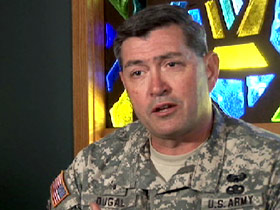
CHAPLAIN MIKE DUGAL: Across the board we have recognized that we do have chaplains that have experienced combat trauma.

SEVERSON: Colonel Mike Dugal is the Chaplain Director for the Center for Spiritual Leadership at Ft. Jackson. The center opened in 2008 partly in response to the realization that, like soldiers, chaplains also suffer the trauma of combat stress.

CHAPLAIN DUGAL: We do have chaplains that are going through the same psychological and traumatic events that our soldiers are going through. It is hard to be empathetic and to show compassion to our soldiers and to see the brokenness, to see the carnage and that not to affect you.

SEVERSON: According to the army, since the beginning of the war in Iraq and Afghanistan, it’s chaplains have served a total of more than 20,000 months in combat zones, some have gone on as many as eight tours of duty. One survey revealed that 20 percent of these chaplains had suffered compassion fatigue or some sort of PTSD.

post02-chaplainburnoutLike the soldiers, these chaplains are often in the heat of battle where death is very real and the casualties are friends. Lieutenant Colonel Graeme Bicknell is not a chaplain, but he is an army expert on compassion fatigue.

LT. COL GRAEME BICKNELL: It can be nightmares. It can be lack of desire to eat, sort of feeling sad, sadness, avoiding certain behaviors because it reminds you of what happened.

SEVERSON: He says it’s understandable that chaplains would experience compassion fatigue.

LT. COL BICKNELL: The more empathic a person is, the more they’re able to relate to somebody or be in their shoes. The more vulnerable they are to compassion fatigue. And I think that with chaplains, that empathic relationship is incredibly important to be able to benefit the soldier.

CHAPLAIN JOHN READ: I guess I first learned in a profound way how trauma can damage the soul when I was clinically trained at Brook Army Medical Center.

SEVERSON: Chaplain John Read is the army’s Director of the Soldier and Family Ministries.

post03-chaplainburnoutCHAPLAIN READ: You see the gun shot wounds, the stabbings, the burn patients, all the volatility of the kinds of things you see in a war zone. I mean I recognized there, as a clinically trained chaplain working in a hospital setting how that would affect me in terms of questions of life, death, grief, loss. The things that profoundly become kind of moral, ethical, spiritual aspects of our lives.
SEVERSON: He tells of seeing the body parts of 38 little Iraqi kids blown up by a terrorist bomb right after learning he had just become a grandfather. And of the soldier who died in his arms.

CHAPLAIN READ: He had just become a naturalized citizen two months before his death, killed in a rocket attack. I held him in my arms as he died and gave him, recited a prayer from his specific faith that he was from, and the peaceful look on his face as he thanked me and died, I will just never forget. But there isn’t a day that I don’t wish that he could somehow be with his wife and kids.

SEVERSON: One thing that often comes through is the deep, abiding respect and fatherly love these chaplains have for their soldiers.

post06-chaplainburnoutCHAPLAIN DUGAL: It is natural for chaplains to weep with those who weep because a lot of these kids, most of these kids are the age of my youngest son and I’m a father to them. There are times that when I reflect about the cost that our military has paid since 911, I’m grateful that I had the opportunity to be with them. Because it is an honor.

SEVERSON: And it is not only the soldiers chaplains weep for — it’s the soldier’s families.

CHAPLAIN READ: The chaplains that go out and do many notifications, supporting the casualty notification process and the death notifications. It’s a heavy load to bear. And so at some point in time, invariably they have to re-engage themselves in a meaningful way to move in and through and beyond that.

SEVERSON: That’s where the chaplain’s school and the Center for Spiritual Leadership come into play. They get training here, discussion groups, reading lists, counseling.

There’s a chaplain museum tracing back to the Revolutionary war. It was George Washington who first dictated that each regiment should have it’s own chaplain.

CHAPLAIN DUGAL: When pain and suffering is very real, soldiers know that they can turn to the chaplain.

post05-chaplainburnoutSEVERSON: Chaplain Greg Cheney served in both Iraq and Afghanistan. He says there was a time when what he experienced in combat challenged his faith.

CHAPLAIN GREG CHENEY: Definitely, I mean when you go through that kind of extreme circumstances, there were times when I would, you know, question God and ask God what’s going on. Yeah, it’s one of those experiences where everything doesn’t make sense when it’s happening.

SEVERSON: Ultimately, he says, his faith actually grew from his combat experience.

CHAPLAIN CHENEY: Even when I was going through that, I felt an amazing sense of calm in those situations as I ministered to those soldiers, and I know that that could not have been anything from myself, it was only God, you know, Jesus Christ working through me to touch these soldier’s lives.

CHAPLAIN DUGAL: I would definitely say that my faith has developed and not to the point of questioning the existence of God, but having to deal with the reality of pain and suffering and realize that there are no just simple answers.

CHAPLAIN RINDAHL: If you think about what Christ did for humanity. He left a place of ultimate privilege in order to take on a hardship and ultimately sacrifice himself for people who didn’t know him. And soldiers take upon themselves the obligation to leave the most privileged county in the world and be willing to sacrifice personal comfort and, although not intending to sacrifice their own life, at least be willing to.

SEVERSON: There’s a phrase that’s become quite common among veterans, and among chaplains, of the Iraq and Afghanistan wars. It’s called “the new normal.” It means that their lives are never going to be quite the same as before.

CHAPLAIN READ: Sunday school teachers I had had as a kid growing up who kind of always celebrated my journey, said you’re not the same. And I would say, reflectively, how am I different? Well, you’ve seen things that none of us will ever see. We can see that in your eyes.

SEVERSON: For Religion & Ethics NewsWeekly, I’m Lucky Severson in Crystal City, Virginia.