Don’t Ask Don’t Tell


BOB ABERNETHY, host: Secretary of Defense Robert Gates told the Associated Press this week that if the top military officer recommends an end to the Don’t Ask Don’t Tell policy relating to homosexuals he will okay the new rules before he retires the end of June. Gates also said he sees no barrier to that happening. Since Congress repealed Don’t Ask Don’t Tell last December, more than a million US troops have taken instruction in the new policy. Gates says that training has gone well. Still, there are concerns, especially among some military chaplains. Betty Rollin reports.

Gunnery Sergeant Taylor conducting Don’t Ask Don’t Tell training: Lance Corporal A, he’s gay. Lance Corporal B and Lance Corporal C are his roommates. They know he’s gay, or they think he’s gay, but due to the fact that he dresses in a certain way they request to move out of their room. Do they have that right?

BETTY ROLLIN, correspondent: Here at the Quantico Marine Corps base in Virginia, as well as at other military bases, they’ve been holding voluntary training sessions on the repeal of Don’t Ask Don’t Tell: What does it mean? What changes? What doesn’t change?

Training session slide presentation with narration: You are not expected to change your personal, religious, or moral beliefs; however, you are expected to treat all others with dignity and respect consistent with the core values that already exist within the Marine Corps.

ROLLIN: The Marines in this group didn’t seem to have any trouble with these instructions.

post01-dadtCORPORAL JASMINE CASTENADA: The most important thing we are still Marines in the end. We sign a contract, and we are still going to follow orders. We are still going to wear the same uniform. So when we go into combat it’s not going to matter if a Marine is straight or gay.

SERGEANT CRAIG TAYLOR:: I’m a Baptist, but the role that my religion plays is not really important because I have to adhere to the rules and regulations that are governed over me.

ROLLIN: A Pentagon study released last fall showed that a majority of US forces, 70 percent, said that serving with gays or lesbians would have no negative effect on them. But there was a very different response from forces fighting in Iraq and Afghanistan. Fifty-eight percent of combat Marines said they would prefer not to serve with gays. Another group that has voiced concerns about the repeal are chaplains. Of the 3,000 active-duty chaplains, a majority are conservative Christians. Brigadier General Douglas Lee has served over 31 years as both a reserve and active duty chaplain and now heads the joint commission that represents Presbyterian and Reformed chaplains. He is one of 66 retired chaplains who wrote a letter to President Obama and Secretary of Defense Gates urging them not to repeal Don’t Ask Don’t Tell.

post02-dadtCHAPLAIN DOUGLAS LEE: Homosexuality is one of a multitude of sins. Chaplains essentially help people wrestle with the sins that beset them in their lives and try and give them encourage and hope and a way out of all that, and for the Christian the way out is Jesus Christ. For another religion it might be some other means. The problem with this repeal is that this particular sin is being legitimized as being normal and okay.

ROLLIN: Whereas some chaplains support the repeal, and all chaplains accept their obligation to minister to everyone, Chaplain Lee fears the conflict conservative Christian chaplains are bound to have when counseling openly gay service members.

LEE: Chaplains are concerned that when it comes to the bold preaching, teaching, counseling, marrying, burying, sacramental duties, that there would be challenges to those things if they were decided to speak against homosexuality.

ROLLIN: These chaplains fear that if they express what they really believe they might lose their jobs.

LEE: We believe there needs to be a freedom of conscience clause somewhere Congress has to wrestle with to make sure that chaplains and the troops have freedom of conscience when it comes to proclaiming their own particular faith, and of course they would do that. We would never want that proclamation to be done in a mean-spirited way or hateful way.

ROLLIN: The underlying cause for conservative chaplains’ difficulty with repeal is their belief that homosexuality, like all the other sins in the Bible, is a choice.

LEE: Just to say they can easily choose to get out of this, I wouldn’t say that. I would say it’d probably be a struggle for many. But I know people who have come out of the homosexual community and basically through Christ have actually changed their choices.

post04-dadtJONATHAN HOPKINS: My parents were devout Christians. My values are pretty consistent with theirs. I grew up in a town of 1,000 people, and within my parents’ view that didn’t fit with being gay, so of course I was straight. You had to be straight to be successful. But that was a lie. It was a lie to myself. I told my Mom for the first time when I was 30 or 31 years old and I said, Mom, I spent 20, nearly 20 years of my 30-year existence trying to fight this everywhere I could, or find some way around it, or finding, okay, maybe if I just find the right girl I won’t be gay. But that’s just impossible. It’s a lie.

ROLLIN: Jonathan Hopkins graduated fourth in his class at West Point and was deployed to Iraq and Afghanistan. He was awarded three bronze stars and was promoted unusually early in his career to Major. And then, last August, it was all over. Although he says many of his fellow soldiers knew he was gay and accepted him, a few didn’t and reported him to the commander. After a 14-month investigation, he was honorably discharged. Hopkins says throughout his military service he was afraid of this happening.

HOPKINS: Sometimes you might be scared of getting shot at, but you shouldn’t have to be scared of your own fellow service members turning you in for something that you can’t change.

post05-dadtROLLIN: Hopkins is now a graduate student at Georgetown University in Washington, DC and a spokesman for Outserve, an organization representing active-duty gays in the military. He says he is optimistic about the repeal and its future.

HOPKINS: Will repeal go through? Yes. And once that happens and nothing substantive goes wrong, then it’ll be a done deal.

ROLLIN: So the war is won, in effect?

HOPKINS: It’s not a war. It’s not a war.

ROLLIN: What is it?

HOPKINS: It’s just people trying to serve their country. It’s just people trying to be treated as people, as upstanding Americans. It’s the most American of things there is.

ROLLIN: Under Don’t Ask Don’t Tell, 13,000 gay and lesbian members of the military were dismissed. The military plans to finish training for the repeal this summer. After that, if the president, secretary of defense, and chairman of the Joint Chiefs of Staff certify that the military is ready for this change, 60 days later the repeal becomes official.

For Religion & Ethics NewsWeekly, I’m Betty Rollin in Quantico, Virginia.

ABERNETHY: The answer to that question about whether Marines can ask not to share a room with another Marine just because they say he’s gay is no.

Buddha Garden


LUCKY SEVERSON, correspondent: It has been described as a piece of heaven on earth, tucked in the foothills of the glacier topped Mission Mountains in northwestern Montana, a place where cows and farmers manicure the green grass. It is not a place you would expect to see a 24-foot-tall Buddhist statue of Yum Chenmo, the Great Mother of Wisdom and Compassion—certainly not in a land that has been sacred to Native Americans for centuries.

STEPHEN LOZAR: This is where we live. This is where we were born and where the bones of our ancestors reside, so this is our home.

SEVERSON: Steve Lozar is a council leader for the Salish Tribe. Julie Cajune heads the Center for American Indian Policy at the Salish Kootenai College.

JULIE CAJUNE: The land around us, you know, is part of our creation story. The geography, the place names go back to our creation stories when coyote and fox went through this area and got this place ready for human beings.

post06-buddhagardenSEVERSON: One of those human beings turned out to be Tulku Sang-ngag Rinpoche, the highly respected Tibetan lama who says he saw this exact place in a dream when he was eight years old in Tibet.

TRANSLATOR FOR TULKU SANG-NGAG RINPOCHE: And he says when he came here to this very site – little bit that site also – he says there was such an overwhelming sense of déjà vu, and it was as if he had seen it before, as if he had really known this place, and he talked to his acquaintance about it, and of course they convinced him that he had never been here before. Then he realized that this was the exact visualization that he had of America when he was a child.

SEVERSON: So this is where Rinpoche supporters bought a 60-acre sheep ranch. It’s inside the confederated Salish-Kootenai-Ponderai Reservation. Because of a unusual hundred-year-old federal law, non-natives can acquire land within the reservation. Guided by his vision, the Rinpoche determined that this was where he should build a Garden of 1000 Buddhas to promote world peace.

Workers have been busy casting Buddhas for months, but it’s a slow process, and each Buddha must be perfect before it’s blessed.

post02-buddhagardenTRANSLATOR FOR RINPOCHE: This is the spine of the statue which has been cast. All these are scrolls which contain sacred Tibetan power syllables or mantras all with healing prayer, all that goes right in the cast.

SEVERSON: Sitting in this old barn are hundreds of Buddhas waiting to make their grand entrance.

The site is still under construction, but when it’s completed it will resemble the shape of a dharma wheel, which symbolizes the basic teachings of Buddha. At the center of the eight spokes is the statue of the Great Mother packed inside with sacred texts. But before the Rinpoche did anything, he wanted to make sure the garden of Buddhas was acceptable to the tribes.

TRANSLATOR FOR RINPOCHE: And so he extended his hand to the tribal elders to come and bless the land.

SEVERSON: Dan Decker is the lead attorney for the Salish Tribe.

DAN DECKER: And they didn’t come to the reservation saying you have to think like we do, which has been our history. Our history has been that newcomers come in, want us to welcome them, and then immediately tell us how we need to think. That’s not the experience here. The experience is “share with us.”

post04-buddhagardenLOZAR: I actually was so excited I yelled out in the tribal council meeting, I think it’s a spectacular opportunity for cross-cultural associations that are peace-based, that are based in the holiness of this land. I can’t think of better possibility for neighbors.

SEVERSON: It turns out that Tibetan Buddhists and Native Americans have quite a lot in common.

TRANSLATOR FOR RINPOCHE: He gets a sense that, you know, there are similarities in our experience as oppressed people. He understands that once these particular areas were numerous with the natives, and their numbers have dwindled so much so that now they’re in the minority—a similar situation we may be facing in Tibet also.

SEVERSON: In Tibet, the Rinpoche was revered as the sixth incarnation of one of the great Buddhist teachers. He was imprisoned for nine hard years, and he says he was tortured. His prominence did not sit well with the Chinese.

TRANSLATOR FOR RINPOCHE: That’s what got him into trouble, because he says, from the Chinese perspective, number one they look upon religion as poison, something that is totally undesirable, and so if you were a religious person it’s almost the same as if you were like a drug peddler or somebody wh’os peddling something really terrible.

post05-buddhagardenCAJUNE: Another thing that we share with the Dali Lama and the Tibetan people is nonviolent resistance, and if you knew the history of our people, we have really been engaged in nonviolent resistance for hundreds of years. We’re still engaged in nonviolent resistance.

SEVERSON: They also discovered a shared belief, that all natural things—the earth, trees, animals—have spirits dwelling within them.

TRANSLATOR FOR RINPOCHE: In the Tibetan tradition, suppose you were embarking on a journey, and you saw an eagle overhead. You would celebrate, and you would look upon it as a good omen, that success is on the way, and he was amazed that the Native Indians have such a similar belief.

SEVERSON: Now they share another tradition, an annual peace festival at a time when peace seems almost unattainable. Originally the Rinpoche planned to put a statue of Buddha at the center of the wheel, but after the terrorist attacks of Sept. 11, he decided instead to build a statue of the Great Mother with guns and swords buried underneath, symbolizing the victory of peace over violence.

post07-buddhagardenTRANSLATOR FOR RINPOCHE: He sensed that 9/11 may have planted a seed of conflict, enmity, hatred, and according to the scriptures, and according to his religious training, the Great Mother has that unique blessing to bring about peace, to reduce conflict.
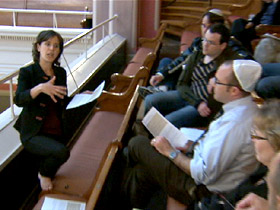
SEVERSON: And so now they dine together and share a dream that the Buddha garden will one day contribute to peace.

CAJUNE: There’s that old saying that says never underestimate what a single act of integrity can accomplish, and I really believe that that is what Rinpoche has done here. Something very good is going to come from it.

SEVERSON: The Rinpoche says the Garden of 1000 Buddhas will be ready for visitors by 2014 and that the Dalai Lama has agreed to personally consecrate it.

For Religion and Ethics NewsWeekly, I’m Lucky Severson in Arlee, Montana.

Shavuot

RABBI SHIRA STUTMAN (Director of Community Engagement, Sixth & I Historic Synagogue, Washington, DC): The Shavuot holiday is actually one of the more important holidays in the Jewish tradition, and it basically has two reasons for being. The original reason comes out of the Israelite people being an agricultural people a few thousand years ago in the land that we now call Israel. The Israelites would bring the bikkurim, the first fruits, the first offerings, of their harvest up to the temple as an offering to God, as a way of saying thank you and in hopes of a good harvest.

After the temple was destroyed in about 70 CE, the rabbis needed to enlarge the understanding of Shavuot because we no longer had a temple to which people could bring their offerings. So they brought forward this understanding of Shavuot as being the anniversary of revelation: the anniversary of the moment that God gave the Torah, our Bible or a part of the Hebrew Bible, to the Israelite people on Mount Sinai, basically turning them from this rag-tag group of slaves who had just weeks ago come out of Egypt into a people complete with its own set of texts and ways of being in the world.

post01-shavuotShavuot, actually, probably more than any other holiday on the Jewish calendar, is very difficult for American Jews in the 21st century to wrap their hands around, and one of the reasons is because there are not a lot of the same home-based rituals that we have, for instance, with the Passover seder or lighting the Hanukkah menorah.

You are seeing more and more people trying to engage Jewish people and Jewish families in the Shavuot holiday in unusual ways, and that is what Sixth & I is doing tonight: people using traditional Jewish texts to have contemporary conversations. What—how does my life have meaning? What are the 10 Jewish commandments of sports? How do we take this tradition that has been going on for thousands of years and make it relevant to us today?

It is traditional to read the Book of Ruth, because it is a book about the barley harvest. It’s also about what happens in a society where there are haves and have-nots, and how we can act as people who have more, or people who have less, and engage each other to make sure that there’s more equity and social justice in the world.

Some of the other traditions you’re going to see here tonight are the making of cheesecake and challah, because on Shavuot the understanding is that we’re supposed to eat dairy foods, because on the day that the Israelites received the Torah they also ate dairy foods.

There are not a lot of laws that are specific to Shavuot. But one of the laws that’s specific to Shavuot is the vehayita ach sameach—that you should be really, really, really happy, and on the Shavuot holiday it is a time of rejoicing, rejoicing in the harvest, rejoicing in this gift of Torah that God has given us, and rejoicing in the ability to learn from Torah in each and every generation. Tikkun Leyl Shavuot: that’s what you’re seeing us do here tonight—stay up all night and study Jewish text.

Reassessing Libya Intervention


KIM LAWTON, managing editor and guest anchor: There were also rising concerns about the situation in Libya. NATO stepped up its airstrikes while alliance leaders called for more support in the effort to protect civilians. Meanwhile, a UN human rights panel said Moamar Gaddafi’s forces have committed crimes against humanity. Secretary of State Hillary Clinton met with regional leaders to discuss future strategies, but the Obama administration is coming under increasing pressure. Last week, the House of Representatives approved a measure giving the president until June 17 to provide detailed justification for why the US got involved in Libya and why it should continue. An even tougher measure is being taken up in the Senate.

Joining me now is Gerard Powers, director of Catholic Peacebuilding Studies at the Kroc Institute for International Peace Studies at the University of Notre Dame. Jerry, we’re hearing a lot about political and financial questions about the situation in Libya. What are some of the moral and ethical questions that should also be considered right now?

post01-reassessinglibyaGERARD POWERS (University of Notre Dame): Thanks for having me, Kim. I think there are three broad questions. One is, were we morally justified in going in in the first place? The second is are the means that we are using morally justified, or are we proving through the means we are using that humanitarian invention, as some allede, is really just an oxymoron? And three, I think we have to think about what an ethics of exit means in Libya.

LAWTON: Well, let’s unpack all of that. Were we justified in going in? The president said it was to protect civilians.

POWERS: I think humanitarian intervention in extraordinary cases to protect the civilian population is justified, and not only that, there’s a duty in some cases to do that. My concern is that that objective seems to be subsumed by other objectives. We are focusing on regime change, not just protecting the Libyan civilians, and that will likely prolong the war and actually increases the risk to the very civilians we’re purportedly there to protect.

LAWTON: And how does that change the moral calculus? If the mission or the purpose seems to be changing, does that then effect how we look at it from a moral perspective?

POWERS: I think it does, absolutely. The only way you can keep humanitarian intervention from becoming a guise for the great powers like the United States to intervene for self-interested reasons under the guise of humanitarian intervention is to have strict criteria, and one of those is to make sure that you limit your objectives to the original humanitarian objectives. In this case, I’m concerned that not only are our objectives expanding, but the means that we are using are not appropriate to meeting those objectives, because we are pursuing a zero-casualty war, at least zero casualties on our side, by an exclusively air campaign, and that raises serious questions about can we really achieve our legitimate humanitarian objectives through bombers, cruise missiles, drones, and now attack helicopters.

LAWTON: Well, what, given the obligations, you know, what are the obligations, given what we’ve done? Are you talking about boots on the ground?

POWERS: I think we should be pursuing not the almost exclusively military strategy that we are now pursuing, but we need to pursue a political strategy. We need to go beyond the current position of the United States and NATO, which is that we will not negotiate until, even on a cease-fire, until the Gaddafi regime steps down, and that’s not a serious political, not a serious political strategy. Secondly, we need to be much more serious about the consequences of being successful. What comes after Gaddafi? Are we going to be in another nation-building situation like Iraq and Afghanistan? And are we really prepared to assume the heavy moral responsibilities that come with that?

LAWTON: Alright. Well, obviously a lot of very complicated questions. We will be watching and debating.

POWERS: Yes.

LAWTON: Thank you so much, Jerry Powers.

POWERS: Thanks very much for having me.

Gerard Powers Extended Interview

Watch more of our conversation about Libya, humanitarian intervention, the use of force, and ethical questions being raised by NATO’s current military tactics with Gerard Powers, director of Catholic peacebuilding studies at the University of Notre Dame’s Kroc Institute.


Medical Cost-Benefit Ethics


BOB FAW, correspondent: From his backyard dock, the setting seems idyllic. With his devoted wife of 47 years, retired Air Force colonel Jim Horney should be enjoying the golden years.

JIM HORNEY: You know, you can look at me and say, golly, that guy looks good for 70. But there’s a worm in the apple.

FAW: The “worm” is prostate cancer. Jim’s doctor first diagnosed it as an aggressive cancer eight years ago.

HORNEY: I said how long can I expect to live with this serious prostate cancer? Her reply was on average about two-and-a-half years. This was in 2002. So two-and-a-half years—I am obviously well past my expiration date, if you will.

FAW: Jim kept alive during the past eight years by undergoing hormonal therapy and radiation. But now the cancer has spread throughout his body. Desperate, this fall he started a revolutionary new treatment—Provenge.

post01-medicalcostFAW: Did you regard it as a miracle drug?

HORNEY: Absolutely, absolutely did, because I was tired, I was fatigued, I had no future looking at what I was doing now except a slow deterioration.

FAW: Provenge is the first so-called cancer vaccine—not a pill mass-produced in a factory, but an individual treatment. The patient’s blood cells are first drawn, exposed in a lab to a protein which mimics prostate cancer, then put back in the patient’s body—“supercharged,” if you will, to stimulate the patient’s immune system to fight prostate cancer.

DR. PAUL SCHELLHAMMER (Urology of Virginia): The idea of having the body’s own defenses revved up against this foreign invader is quite novel. It had never been applied to humans in a satisfactory and successful way, and this was, in that sense, a big breakthrough.

FAW: Approved last year to treat men with incurable prostate cancer, Provenge extends life for many patients by roughly four months.

HORNEY: That’s the average. I’m well on to beating the averages, and I will work at beating the averages. It is a miracle drug, and so yeah, I have great expectations for this. Huge expectations. Will it? We’ll see.

(speaking to wife): …$37,000 for the one treatment…

FAW: But the price tag for this so-called miracle drug is on average $93,000. Jim Horney’s bill: $110,000.

HORNEY: $110,000. My goodness gracious! How do you, how do you work with something like that?

post02-medicalcostFAW: Jim Horney had to take out a $22,000 loan to pay for the first treatment while waiting to see if Medicare foots the entire bill.

HORNEY: They do have me over a barrel, and if push comes to shove I will probably suck this up.

FAW: Urologist and oncologist Dr. Paul Schellhammer plans to use Provenge one day to fight his own prostate cancer. He has recommended it to some of his patients knowing how some will struggle with the decision.

SCHELLHAMMER: For the person for whom it becomes a major hardship—i.e., do I mortgage my home, do my kids not go to college—I think that becomes an ethically based decision as to how important is life? Most men in this situation have lived 60, 70 years, and how important is another one, two, three years or two, three, four months?

BILL MCCLOSKEY: Yeah, it’s not a long time. But, you know, when you’re fighting for your life, four months, you know, is just four months more to be with your family, to be with your wife and to enjoy life.

FAW: Sixty-two-year-old engineer Bill McCloskey’s insurance company is paying for his Provenge.

MCCLOSKEY: My father died of prostate cancer. This stuff was not available to him. I feel lucky to be living at a time when new treatments are being developed, when there is hope for the future.

FAW: And while the price is high, says McCloskey, in the long run it may prove to be anything but.

MCCLOSKEY: This opens up a whole brand new type of treatment and hope for cancer patients where utilizing the body’s own immune system to fight the disease. This is not the end; this is just the beginning.

post03-medicalcostFAW: Dr. Schellhammer says Provenge has almost no side effects and costs about as much as chemotherapy. Still, he is troubled by the skyrocketing cost of many cancer treatments.

SCHELLHAMMER: Once the FDA approves a drug, the pharmaceutical company or the biotech company then has carte blanche in establishing the price. I think there’s been a disconnect between what it costs to develop, produce, and bring to market versus what it eventually translates into with regard to either a windfall or a fair profit.

FAW: Dendreon, the developer of Provenge, says the price is fair for this revolutionary procedure, which it says took 15 years to perfect and at a cost of over one billion dollars. [Editor’s Note: The original version of this story included a statement about Dendreon’s return on investment. It has been removed from the script and the video at the company’s request.] But as the cost of new cancer treatments continues to escalate, ethicists are asking how does one put a price tag on human life? And in a society with limited resources and virtually unlimited medical needs, who decides who will get that expensive treatment and who doesn’t?

DR. RUTH FADEN (Director, Berman Institute of Bioethics, Johns Hopkins University): If we think it’s worth the money, right, do we find a way to squeeze it out of the allocation we’ve got from health care now? Do we find places where we want to squeeze it out from something else? Do we want to attach a higher value to extending the last few months of a person’s life than we would to any other random four months over the course of a lifespan?

post04-medicalcostFAW: Ultimately, and unfortunately, says ethicist Dr. Ruth Faden, director of the Johns Hopkins Berman Institute of Bioethics, the basic question comes down to cost and benefit.

FADEN: It would be really nice if we could come up with a structure in which the price of the drug was attached to its value and we had a way of agreeing what that value was.

FAW: There is no such mechanism?

FADEN: Not yet.

FAW: In fact now, say medical practitioners, now there is no such mechanism. Who gets Provenge and who doesn’t comes down to a basic proposition.

(speaking to Dr. Schellhammer): The bottom line is economics.

SCHELLHAMMER: Currently, that is the case.

FAW: As to who gets the drug.

SCHELLHAMMER: Yes. We have many more patients than the supply could provide, but many of them say, “I just cannot afford it, and that’s not in my realm of possibility.” So they are screened out by that fact.

post05-medicalcostFAW: Let’s be candid. They are screened out by economics.

SCHELLHAMMER: Oh, absolutely.

FAW: For some, however, economic considerations are secondary. Getting that extra four months of life—maybe more—is priceless.

ANNE HORNEY: My husband’s worth it, and if it means selling our house, so be it. He’s more important to me.

FAW: What’s his life really worth? Is it—can you put a price tag on life?

ANNE HORNEY: No, certainly not. No, no.

FAW: It is, then, an ongoing debate over a medical treatment which is new—and a problem which is not.

FADEN: Even before we get the Provenges, we have lots of cancer patients in this country who can’t afford their cancer medications as it is. We’ve got a messy health care system where we haven’t figured out what we think constitutes good value for our money. It’s that striking a balance—easy to say, almost impossible to achieve so far.

FAW: Until that balance is reached for Bill McCloskey, who recently completed his third and final treatment of Provenge, and Jim Horney, still waiting to see how Provenge affects his cancer, there will be both hope and anxiety.

For Religion & Ethics Newsweekly this is Bob Faw in Poquoson, Virginia.

Since this piece first aired in February, Jim Horney tells us he is “hugely” disappointed with the drug. He says he had only a brief improvement. He’s now back undergoing radiation treatment.

Stephen Ministry


ELIZABETH (speaking in Stephen Ministry training session): I just don’t know what to do.

DEBORAH POTTER, correspondent: Sometimes you just need someone to listen.

ELIZABETH: I just don’t know how to resolve this in my head. I’m just really upset. I can’t forgive myself.

POTTER: Sometimes you need something more—a hand to hold, and maybe a prayer.

PAMELA (praying with Elizabeth): Dear Lord, Thank you for watching over all of us today. In your name we pray.

ELIZABETH: Amen. Thank you. I feel so much better.

POTTER: At Good Shepherd Lutheran Church in Raleigh, North Carolina, parishioners are training to become caregivers.

STEPHEN MINISTRY TRAINEE: The key thing that I saw is you leaned into her. You engaged her and told her, “I’m listening to you.”

post03-stephenministriesPOTTER: They’re learning to be Stephen ministers, named for Saint Stephen, the first Christian martyr who cared for the poor. Parishioners are recruited and interviewed by the pastor, then trained to offer one-to-one care to people in and around their congregation. They commit to be available as needed for two years, but many serve longer. Pam Montgomery has been involved for two decades, balancing Stephen Ministry with responsibilities at home. But sometimes the caregiver is the one who needs care.
PAM MONTGOMERY (Stephen Minister): This is my dad and my mom.

POTTER: Seven years ago, Pam’s father died of cancer. Just two weeks later she lost her grandmother. As she grappled with her grief, a friend surprised her with a suggestion: What if Pam herself asked for a Stephen minister?

MONTGOMERY: When you’re so close to it I didn’t even think about me having one, and that Stephen minister was the best gift I could have given myself. She came week after week after week when other people, even my wonderful neighbors, even my wonderful friends, stopped asking, “You doing okay?” She came and she prayed for me, just for me, and that’s really powerful.

REV. KENNETH HAUGK (Founder, Stephen Ministries): When a person allows you into their life and shares their feelings and their hurts with you, they are giving you a fantastic gift, and I think when you listen to them and when you accept their feelings and when you love, share Christ’s love to them, you are giving them a similarly powerful gift.

post04-stephenministries
Rev. Kenneth Haugk

POTTER: Kenneth Haugk started Stephen Ministries in 1975, when as pastor of a church in St. Louis he found he just couldn’t do it all. So drawing on his background as a clinical psychologist, he enlisted and trained a handful of lay people to offer confidential care to their fellow parishioners. And then it spread, becoming a nonprofit juggernaut.

Good Shepherd is one of 10,000 congregations around the world where parishioners serve as Stephen ministers. More than 150 Christian denominations have adopted the program.

HAUGK: Christianity is not a spectator sport. It was never intended to be a spectator sport. God gave to the church apostles, evangelists, and pastors and teachers whose job is to equip the saints for ministry.

MONTGOMERY (speaking to trainees): How did it feel to have your confession treated in that way?

POTTER: Stephen ministers go through 50 hours of instruction and practice, learning to help care receivers express their feelings, to listen without judging, and how to bring faith and the Bible into the conversation.

ALLAN (speaking in training session): Can we pray? Dear God, give Rene the absolute confidence of his forgiveness…

POTTER: They also study specific situations, like dealing with grief and divorce. But Stephen ministers are not counselors, so they also learn when to call in professional help from a pastor or therapist. Their work is supervised at the parish level, and if a care-giving relationship doesn’t work out, which does happen sometimes, either party can be reassigned.

post01-stephenministriesGood Shepherd’s senior pastor, David Sloop, introduced the program here in 1987.
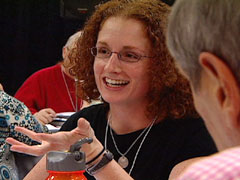

REVEREND DAVID SLOOP (Senior Pastor, Good Shepherd Lutheran Church, Raleigh, NC): It took a while for people to say, instead of “I need to speak to the pastor,” to also say, “Or can I have a Stephen minister?” And that’s a cultural shift, but it did occur, and we’re grateful it did. That old Lutheran concept of the priesthood of all believers—Stephen Ministry helps you live that out.

MONTGOMERY (speaking to trainees): Consider your stewardship of a precious resource: God’s gifted people…

POTTER: To enroll in the program, parishes pay a one-time fee of about $1700, giving them access to materials and leadership sessions like this one in Orlando, Florida, where experienced Stephen ministers and pastors learn how to train more care givers back home.

JACLYN HICKS: I was a care receiver, and I tell everybody, even before I became a Stephen minister, about my experience.

POTTER: Jaclyn Hicks and her husband were struggling with infertility when her pastor at Church of the Savior United Methodist in Cincinnati suggested a Stephen minister.

HICKS: It changed my life. It changed my life just having somebody be there for you, supporting you.

POTTER: After becoming pregnant and having a daughter, Hicks became a Stephen minister herself.

post05-stephenministries
Jaclyn Hicks

HICKS: It’s huge to be on the flip side, to be able to just care for someone during their time of need. It’s been a tremendous blessing, and I get, as a Stephen minister, just as much out of it as I feel my care receivers do.

POTTER: Care-giving relationships are always same-gender, and the program tends to attract more women than men. Rene Anctil of Good Shepherd wasn’t sure at first that he was cut out to be a Stephen minister.

RENE ANCTIL: I tended to rely on myself a lot, and throughout this process I’ve kind of learned that I’m truly the care giver. I’m not the cure giver, and that’s God’s part.

POTTER: While Stephen Ministry relationships are strictly confidential, Anctil’s care receiver, Ed, said we could sit in on one of their weekly sessions. They started meeting more than a year ago, after Ed’s wife died.

ANCTIL: You mentioned that your daughter mentioned to you that she thought you were depressed.

ED: Yeah, oh yeah.

ANCTIL: How did that make you feel?

ED: I don’t think I’m depressed, but you get moody once in a while. Your body wears out when you get old. You always want to do something that you can’t do. That’s the hardest part.

ANCTIL: I think I recognize God in my life a lot more than I had in the past, and a lot of it is because of Stephen Ministry. I see God working not only with my care receiver but with me, which I never saw before.

POTTER: In the 35 years since the program started, half a million people have been trained as Stephen ministers, each one touching at least one other person—and being touched in return.

ANCTIL: I’m not going to go away. I’m going to be there as long as he needs me. I don’t know where the end’s going to be, but we’re going to do it together.

For Religion & Ethics NewsWeekly, I’m Deborah Potter in Raleigh, North Carolina.

Bearing One Another’s Burdens

by Tonya D. Armstrong

Since its inception 10 years ago, the ministry of congregational care and counseling at Union Baptist Church in Durham, North Carolina, has made Stephen Ministry a vital component of its continuum of care.

post01-goodsamaritan
“The Good Samaritan” by James Lesesne Wells (1902-1995)

Union—a thriving, predominantly African-American congregation of about 4500 members—enrolled in Stephen Ministry in the spring of 2000 and sent me to a leadership training course in Orlando. When I returned to North Carolina, I conferred with Union’s pastor, Kenneth R. Hammond, and began recruiting additional Stephen leaders from the church. Six months later, Union’s first Stephen Ministry class began with nine trainees.

One of the most appealing aspects of this model of ministry is its ability to balance attention between both the spiritual and emotional needs of care receivers. Stephen Ministry trainees receive 50 hours of preparation over four months in areas such as listening non-judgmentally, managing care receivers’ feelings, practicing assertiveness, establishing boundaries, observing confidentiality, and recognizing the limits of the care they can offer. These practical skills help to establish a trusting bond between the Stephen minister and care receiver, and they also provide a superb foundation for the care receivers themselves to cope with challenging circumstances in their lives.

Because Stephen Ministry trainees are encouraged to establish prayer-partner relationships with one another, they too are formed spiritually by their work. Specific training on using scriptures when providing care and identifying ways that Christ cared for others augment the spiritual experiences Stephen ministers have as they devote themselves to what is a two-year “calling.” While Stephen Ministry is unapologetically Christ-centered, it allows space to accept care receivers at their specified point of need, which often is not articulated as faith-based. Stephen ministers can openly reflect their own Christian identity without proselytizing.

Stephen Ministry is well-suited to our congregation in Durham for theological as well as pragmatic reasons. It recognizes the inherent value of the laity in ways that have not always been emphasized historically. While traditional models of pastoral care stress the role of the pastor in shepherding the flock, Stephen Ministry complements the pastoral role by equipping the laity to work alongside the pastor and provide care to the hurting. This is especially meaningful to individuals who require ongoing attention in ways that are challenging for pastors, who often must move from one crisis to another. Stephen ministers offer countless hours of care that meet real needs. They embody what they believe is a responsibility for the hurting that is shared by clergy and laity alike.

Shared responsibility is a central scriptural and theological emphasis of Stephen Ministry, which encourages Christians to “bear one another’s burdens, and so fulfill the law of Christ” (Galatians 6:2). Such biblical wisdom runs counter to the messages of North American Christianity and culture, where individualism and autonomy often reign supreme. Stephen Ministry, in training and in practice, teaches the laity valuable skills for how one bears another’s burdens without ever losing sight of one’s own burdens (particularly as lay leaders share them in biweekly supervision sessions and the prayer-partner relationship).

Union’s Stephen Ministry has partnered with other ministries in our own congregation (the diaconate ministry and women’s ministry, for example) to provide education and skills to their members. It has also served our local Durham community well in multiple ways. Whenever we experience a lull in requests for care from members of our own congregation, we are able to assign Stephen ministers to organizations in the broader community. Our church has forged relationships with local homeless shelters, social service agencies, nursing home facilities, and their individual members and constituents. We have established a deeper sense of partnership and community with several local churches, collaborating on Stephen Ministry training for the past five years with Duke Memorial United Methodist Church, St. Philip’s Episcopal Church, White Rock Baptist Church, the Congregation at Duke Chapel, Aldersgate United Methodist Church, and Westminster Presbyterian Church. This ecumenical fellowship has resulted in more efficiency in our training efforts, ready referral partners across churches, greater understanding of and respect for other denominations, and ongoing relationships with Stephen leaders and ministers that extend well beyond the training season. The Triangle Area Stephen Ministry Network has provided resources and continuing education opportunities with our counterparts in Raleigh, Durham, Chapel Hill, and surrounding areas as well.

While there are aspects of Stephen Ministry that can be improved, such as greater multicultural sensitivity in training materials and more attention to meeting the needs of youth (who are not served under the current Stephen Ministry model), we remain convinced that it has greatly enriched the quality and quantity of care we provide to church and community members alike.

One of the most powerful narratives of the New Testament is the parable of the Good Samaritan (Luke 10:25-37), where the “ordinary” Samaritan lay person (rather than a member of the clergy) demonstrated care and compassion for the victimized Jew. Instead of resorting to overly spiritualized discourse, the Good Samaritan responds to the victim’s multilayered needs in a manner that brings healing and provides encouragement. This narrative underscores the importance of meeting the needs of the oppressed and marginalized in tangible ways. It broadens our understanding of who our neighbor actually is and illustrates what it means to show mercy. Most importantly for Stephen Ministry, the parable of the Good Samaritan affirms the tremendous value of the laity in joining God’s healing work, beginning with our immediate communities.

Tonya D. Armstrong is the minister of congregational care and counseling at Union Baptist Church in Durham, North Carolina, and adjunct assistant professor in pastoral theology at the Duke Institute on Care at the End of Life.