
KIM LAWTON: Faith-based groups stepped up lobbying efforts as Congress continues to battle over potential budget cuts. Religious conservatives maintain that addressing the government’s massive debt is a moral issue. Meanwhile, a diverse interfaith coalition urged members of Congress to consider how cuts would hurt poor people in the US and around the world. As part of that effort, several prominent Christian leaders launched a new ad campaign asking “what would Jesus cut?”
Joining me with more on this is Kevin Eckstrom, editor of Religion News Service. Kevin, there’s been a huge mobilization, it seems, from many quarters of the religious community on these budget issues.
KEVIN ECKSTROM (Editor, Religion News Service): Right and you’re seeing it from both the left and the right. From the left, the more progressive side, you see traditional lobbying to keep programs like home heating assistance and school lunches and aid for, you know, women and children, sort of your bread and butter domestic issues. On the right, you’re seeing a lot of action to try to protect the international development assistance, money to buy mosquito nets to prevent malaria and to fight AIDS in Africa, and food for the hungry and refugees and things like that. So you’ve got various groups lobbying for various issues, each hoping that their preferred pot makes the cut.
LAWTON: And a lot of those folks, both on the left and the right, are using moral language and scriptural language, saying, you know, the Bible urges people to care, look out for the vulnerable, the widows, the orphans, and the least of these, and so you are seeing this sort of biblical language.
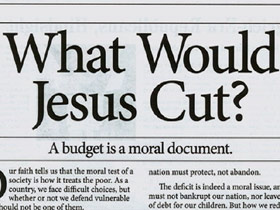
ECKSTROM: Right, and it’s biblical language on both sides. The more traditional churches, Catholic bishops and your mainline churches and your Jewish groups are saying, you know, we have a biblical and ethical, moral obligation to care for people who can’t help themselves. On the other side, from the more conservative side, especially from the Tea Party, you have arguments saying that it’s actually immoral to leave debt to future generations. And they sometimes chafe at the notion of, you know, what would Jesus cut? They say, well, Jesus didn’t have opinions on this, you know, that it’s up to us to sort of make the decisions on what to cut. But you get various moral arguments from both sides, and we’re just waiting to see who wins the day.
LAWTON: Well, I was at the National Religious Broadcasters Convention this week, and one of their keynote speakers was House Speaker John Boehner, Catholic, who used a lot of biblical language in his speech. He had a very receptive, mostly evangelical audience, and he quoted Scripture. He quoted from Proverbs, “A good man leaves behind an inheritance to his children’s children,” and he said Republicans want to not just be hearers of the word, but doers of the word, another scriptural reference there. And, you know, I found that very interesting, that you had the congressional leadership on the right also trying to seize the biblical and moral language on all of this.
ECKSTROM: Yeah, and it’s going on on both sides in sort of different directions, even I think one of the more interesting splits has been within the evangelical community, where you have sort of small-government evangelicals who want to cut, you know—we need to balance the budget, we can’t have this debt. And then you have another portion of the evangelicals who say, well, we can—government can do good things, and government can make a difference in parts of the world where we have interests, and it’s not just moral interests, it’s strategic interests, and so let’s protect the programs that actually work. Let’s not cut from AIDS funding, for example, which President Bush poured a lot of money into. So you get this interesting divide within especially the conservative religious community over their political loyalties and sort of their religious underpinnings.
LAWTON: And some of those moral arguments I’ve been hearing—I’m sorry, the pragmatic arguments I’ve been hearing, in additional to the moral ones, are that it’s in America’s national security, that folks around the world who have food and a decent job and a place to live and have a good, stable social situation are less likely to be recruited by terrorists. Or they also just say America’s reputation as well. I know when I was in Sri Lanka after the tsunami and the US poured in so much help, or Haiti—US poured in so much help. That really want a long way to improving America’s image around the world.
ECKSTROM: Right, I mean, you’ve been to all these places, you can see the difference that it makes when you’ve got these bags of rice that come in with the American flag on it and people look at that and they see us as a good country. But there are sort of national security arguments to be made and think they are fairly effective, that people who are fed, who have good schools, and who don’t have to worry about what they are going to eat that night are less likely to be recruited into extremism.
LAWTON: And we’ll both be watching in the weeks to come. Thank you, Kevin.
ECKSTROM: Thanks.
 (speaking to Mary Karr): Here’s a snapshot of your past, the past that you write about: troubled family life, unstable childhood, alcoholism, divorce, depression, near suicide. Who is Mary Karr today?
 KARR: I’m somebody who really does feel like I was snatched out of the fire and found something in myself that’s luminous and gives me ballast.
 VALENTE: Karr took her son to various churches, a process she dubbed the “God-o-rama.” She would sit with a paperback and a cup of coffee while he searched for God.
 FR. BRUNO SHAH: In the Catholic Church above the altar one sees the cross with the body on it. The body is there. The corpus of Christ is there bleeding, still in the midst of the world, and that’s I think really what got to her—her experience of being a sinner, her experience of being a sinner and recognizing that this does not distinguish her from anybody else in the world.
 FR. SHAH: The fact that this person would turn around so drastically is compelling. She sees all the alcoholics who don’t make it. She sees all the good chances that have been given to her for no good reason, and she asks in wondering thanksgiving to God, why me? And that’s a great testimony to her faith and to the authenticity of her conversion.
 ABERNETHY: Long tradition of support of labor.
 LAWTON: Well, and that’s become a growing issue especially for religious conservatives—talking about these deficits as a moral issue. The Bible says don’t be in debt, and therefore that’s how they’re arguing. You haven’t seen, I haven’t seen a lot of religious conservatives out there right now going against the unions per se, but they are very much focusing their arguments on this, you know—the morality of the budget.
 BRENT MARTZ (Producer, “Not Today”): I had never heard of the Dalits until I went to India, and then to meet them actually and to touch their hands and to be involved in their lives was overwhelming, and to come back and do something about it—that was part of the mission of our church was to get involved outside of ourselves.
 Film crew: Roll camera, roll sound.
 LAWTON: At Calvary Church of the Nazarene in Cordova, Tennessee, optometrist David Evans wrote and directed the church’s annual passion play for 15 years. He says after watching “Fireproof” he came away believing Calvary should make a film.
 MARTZ: This isn’t a Christian movie. It’s a movie about human trafficking that happens to be through the experience of a couple of Christians, a couple of Christians who are really struggling to live a good Christian life, you know?
 LAWTON: She says she wishes conservative Christians would look more closely for spiritual themes in Hollywood’s movies.
 LAWTON: Friends Church intends to deliver Hollywood quality on “Not Today,” and that’s where they have an advantage over other churches. Director Jon Van Dyke spent more than 22 years in the Hollywood entertainment industry, and other Friends members are in the business as well. In addition, the church hired professional actors and crew members.