I didnt want just random drips; I wanted something
that really felt like something you could dance to, something
choreographed
-sounding. So I ended up making this almost computerized
abacus.
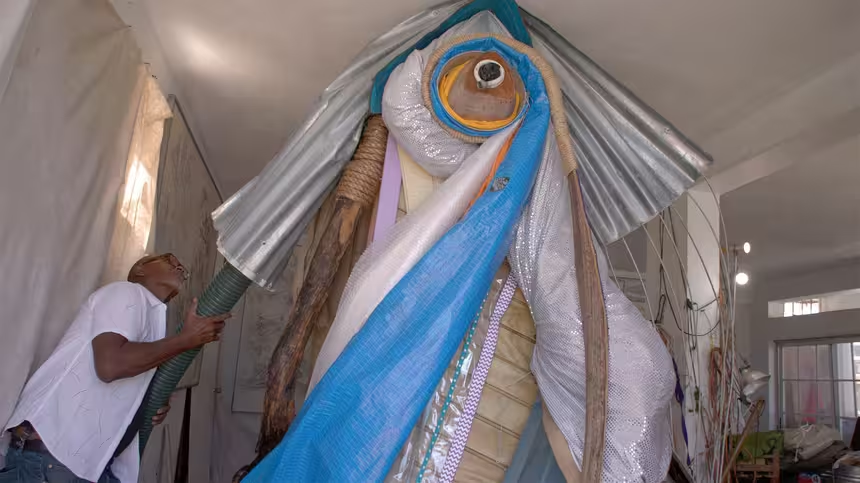
I just kind of saw this creature that was almost like
something that grew in the ocean or in an antigravity kind
of environment where it was growing free form. And so its
like this thing that was dredged up out of the water and
hung up to dry.
I started thinking about imagery and the face and
how any kind of input into the faceno matter how irrational
or unpatternedwould still create something we can
decipher, look at, and read and get some sort of message
from.
What is the inspiration behind
"Drip"? What led you to creating that piece?
HAWKINSON:
Sometimes we do get rain in L.A.
A lot of us arent really prepared. The studio has areas
in the ceiling that sometimes will leak. And it was really
great, just walking into the studio one time, and there were
buckets around, all catching the drips. It just had a great
sound in the space. So I was interested in using dripping
water some way. I didnt want just random drips; I wanted
something that really felt like something you could dance
to, something choreographed-sounding. So I ended up making
this almost computerized abacus. It was a machine that was
sort of a drumming machine. It generated different rhythmic
patterns. It was hooked up to solenoid valves and each time
the valve was triggered, it would allow a drip to drop into
a bucket, creating a resonant plop. Each bucket
had its totally different resonance, so it was a kind of sound
piece.
I was interested in making something that would create this
really rhythmic sound pattern. I downloaded a drumming machine
on my computer and I was trying to figure out how I could
get something that would generate these random patterns but
would still have this choreographed sound to it. And so its
taking random patterns off of the gears and then those are
being chopped up. This turns around and every time it hits
this metallic strip it closes this circuit. One of these little
wires sending a signal from the gear will get triggered through
that. And this is just a way of lining all the signals up
so that they all occur at the same time within. I mean its
spinning really rapidly, so its all within a split second.
Otherwise it sounds really chaotic and this way its
um, more synchronized.
Theres so many variables. This one is really quiet because
its so much closer to the bucket. And when its
installed I imagine these will all pretty much be at the same
height and itll probably be just above eye level because
I like being able to walk underneath them and the precariousness
of maybe getting dripped on once in a while.
I guess formally when I first pictured it, I was playing around
with this wadded and spun plastic and I just kind of saw this
creature that was almost like something that grew in the ocean
or in an antigravity kind of environment where it was growing
free form. And so its like this thing that was dredged
up out of the water and hung up to dry. I know itÖs sort of
a crazy looking thing and I guess to somebody thatÖs not involved
in the process they would be more aware of the humor in it.
But beyond I guess for me itÖs more about different rhythms.
I mean thereÖs this visual rhythm that is carried throughout
the piece, the twists and turns of the material and the pattern
created by the sound of the dripping water.
ART:21:
How did you discover this material?
HAWKINSON
The plastic ...well I think it
was originally just like some Reynolds Wrap that I had twisted
up and I liked the way it took its form. It was just this
free formed, really random pattern that occurred. And so I
was interested in exploring that or trying it out on different
scales.
And I think its important to use with the different
thicknesses of plastic, different heaviness, to get these
different patterns. I guess this form kind of grew out as
a three-dimensional expansion out of some drawings that I
was working on. Just actually using a drill to spin a pencil
or a pen around and I made a device that would open and close
the diameter of the spin, the arc of the spin while this in
motion. So I was able to create larger and smaller kind of
scrawls. There were these drawings that were almost reminiscent
of intestines or worms.
ART:21:
Can you talk a little bit about
"Emotor"another piece that uses random signals.
HAWKINSON:
Its something that emotes,
and its motorized. "Emotor" falls into the
category of body depiction, references to the body like the
bathtub-generated piece and balloon self-portraits that Ive
done. But its much more about mechanics and probably
closer to a piece I did which synthesized voice using really
primitive methods. "Emotor" uses the expressions
of the face that are so cued into reading the face. I took
a picture of myself and cut the features up into little pieces,
like a puzzle, and rearranged the features. And each time
I did it, I created a different emotion, and thats just
something I read into it. Anybody looking at it would read
into this, would reinterpret it, as I think we all pretty
much interpret the same basic emotionsfrowning, smilingbut
I was interested in seeing how much inflection and emotion
I could get out of the face using random input of signals.
I was interested in using random signals, in this case generated
by a television screen. And the screen had lights instead
of switches. So if there was a dark area on the screen it
would turn the signal on and a light signal would shut it
off. Just on and off, nineteen different on and off signals.
There are nineteen wires for the nineteen switches and the
nineteen motors in the face all connected with Velcro.
The initial idea was just taking random input and converting
it into something. Originally I was thinking of making a three-dimensional
realization...this kind of instant bas-relief sculpture. That
was sort of interesting but still too abstract. Then I started
thinking about imagery and the face and how any kind of input
into the faceno matter how irrational or unpatternedwould
still create something we can decipher, look at, and read
and get some sort of message from. Im using my face,
but I dont really consider it a psychological self-portrait
or anything like that. I cant make most of these faces
myself.
I took the photograph with this piece in mind. I use my image
or my body in a lot of the work as my jumping-off point, but
usually the end result is so abstracted that I dont
really feel so identified with it any longer. Using images
of myself or impressions of my body is just a way of using
a universal kind of stand-in for anybody that I hope other
people can identify with. Its not about my identity;
its about our identity and our experiences within our
bodies, and our bodies relationship to the external
world.
A lot of the body pieces that I do are concerned with measuring
the body, or presenting the body in this extremely specific
way. So theyre really accurate in one way, and almost
hyper-realist. But at the same time, that process abstracts
them and brings them away from a normal body so much that
they no longer look like the original form.
ART:21:
Are there similarities you see
between "Drip" and "Emotor"? How do the
two piece fit into your body of work?
ART:21:
There are certain recurring interests
in my work and ways of looking at things, maybe having to
do with the way I get ideas and the way ideas are formed,
really obvious categories. The first thing that I think of
is the human form and using my own body as the reference point,
ways of depicting and referring to that, and re-looking
at that through different eyes. There are also pieces that
deal with time and the way we process time and are aware of
it. There are mechanical interests and kinetic work, a fascination
with moving partsjust the magic of seeing this kind
of animation and making it happen. But then, I also like to
keep a dialogue going with drawing and some painting, and
these weird, quirky drawings that I kind of fall upon occasionally.
A lot of times different interests overlap. For some of the
drawings Ill make a mechanical device that will help
in making the drawing, and stuff like that.
Each piece and each direction have an approach. Theyre
not really rules. Theyre more sorts of parameters or
a processa way of filtering out other things that arent
really concerned with the idea Im working with and I
guessby a strict adherence to the processit creates
a certain distortion. But its also what art isthe
distillation of the idea. What Im shooting for is just
to stick with whatever that idea is and play it out till its
totally this pure form.