"You have to make an artwork so it can be enjoyed
on the most surface level, but I want for the more dedicated
art viewer to be able to get the secondary and third levels
of meaning."
"It’s hard to differentiate between personal
memory and cultural memory...it’s very hard to,
say, disentangle memories of films or books or cartoons
or plays from real experience. It all gets mixed up."
"I really dislike popular culture in most cases. I
think it’s garbage, but that’s the culture
I live in and that’s the culture people speak."
"I’m an avant-gardist. We’re living in the postmodern age,
the death of the avant-garde. So all I can really do now is work with this dominant
culture and flay it, rip it apart, reconfigure it, expose it."
Explain the concept behind your
project "Day is Done."
KELLEY:
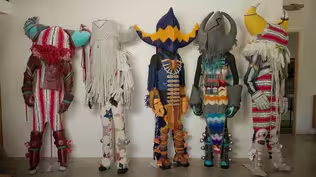
I’m making all these videos
based on very common American performance types. You know,
school plays, children’s performances, Halloween, dress-up
day at work—things like that. But then I’m reconfiguring
them through the tropes of history, like the avant-garde.
In this one, this soundtrack lets you see the performance
tropes more clearly because it de-contextualizes them to
a certain degree. By putting this wrong kind of music to
it, you can see a performance type. So I’m trying to
play with popular or folk forms and reveal their structures—their
performative structures.
ART:21:
And how does this relate to
your earlier work?
KELLEY:
"Day is Done" is built
around the mythos that
relates to "Educational Complex" and the
history of a kind of symbolist attempt
at uniting all the arts. "Educational Complex" is
a model of every school I ever went to, plus the home I grew
up in, with all the parts I can’t remember
left blank. They’re all combined into a new kind of
structure that looks like a kind of modernist building.
I started to think about this structure through the Gesamtenswerk,
the ‘total artwork’, of Rudolf Steiner, where
he tries to combine all the arts and develop a kind of rule
system according to which every art form is related. So the
architectural relates
to the dance relates to the music relates to the writing.
But it’s also a kind of religion. And
so my religion for this structure is repressed memory syndrome.
The idea is that anything you can’t remember, that
you forget or block out, is the byproduct of abuse and that
all of these scenarios are supposed to be filling in the
missing action in these blank sections in this building.
It’s a perverse reading of [Hans Hoffman's] push-pull
theory.
ART:21:
What is your source material
for "Day is Done?"
KELLEY:
All the scenarios for "Day
is Done" are based on images found in high-school yearbooks
in this particular case, though I’ve also done a whole
collection of similar kinds of images from the small-town
newspaper of the town where I grew up. The particular categories
had religious ritual overtones,
but outside of the church
context.
They all looked like they were done in public places, or
they had gothic overtones. So I said, “Okay, I’m
going to work with these particular groups of images and
develop a kind of pseudo-narrative flow.” The rituals
run the gamut from something like dress-up day at work to
St. Patrick’s Day or Halloween, to a community play
or an awards ceremony. So all I have is this image, and then
I have to write a whole scenario for it like a play, and
then do the music and everything. Each one is just based
on the look of the photograph that tells me what style it
has to be done in.
ART:21:
Why use high school yearbooks?
KELLEY:
It’s not because I have
any interest in high school or high school culture, but it’s
one of the few places where you can find photographs of these
kinds of rituals. The only other place would be personal
snapshots, which aren’t accessible. So really the only
place I could get pictures of these kinds of common American
folk rituals are in yearbooks and local newspapers.
ART:21:
It’s almost like working
as an anthropologist.
KELLEY:
Yes, I think of it very much
that way.
ART:21:
Will "Day is
Done" be seen as video work?
KELLEY:
My dream is to perform it live
in a 24-hour period. So the day stands for the year. And
at midnight there would be a grand finale spectacle—a donkey
basketball game. Because I think the donkey basketball game
is one of the greatest examples of American carnivalesque.
It’s all about inversions of power…which is very
typical of folk forms that perform carnivalesque functions—where
you get to break the mold of how you’re supposed to
act or look. In that sense, it’s analogous to the traditional
social role of art in the avant-garde, but it’s a very
restrained one. And I’m just trying to show that relationship
between the traditional avant-garde and the carnivalesque
social function of these folk rituals, as I guess you’d
call them.
ART:21:
How do you expect viewers to
respond to this work?
KELLEY:
I know that people don’t
look at art like that, and I don’t expect people to
know any of this stuff. And I don’t care if they do
or don’t, because you have to make an artwork so it
can be enjoyed on the most surface level, but I want for
the more dedicated art viewer to be able to get the secondary
and third levels of meaning. It has to operate on multiple
levels: it has to be available to the laziest viewer on a
certain level, and then on a more sophisticated level as
well.
ART:21:
Can you say more about the overall
structure of "Day is Done," how the various scenes work together
or compliment each other?
KELLEY:
I was thinking of the Russian
composer Scriabin who, at the time of his death, was working
on a grand spectacle that would last for a week. And there
was a different thing for each day, and that was linked to
some kind of broader natural system. I’m using the
year (a series of 365 tapes) just as a given system, the
rationale tying it to this history of works that relate to
natural cycles, like symbolist artworks. But I don’t
expect to get to 365. I’d like to get to at least fifty
of them. I would like to present one of these late-nineteenth
or early-twentieth century symbolist works as a live theater
work, like the mass spectacles of Meyerhold, or Rudolf Steiner,
or even Wagner.
ART:21:
Or like a Passion Play?
KELLEY:
It’s very much like a
Passion Play, yes. Passion Plays can be folk drama, allegory,
and social allegories, they can operate on multiple levels
like that. The basic premise is that it’s all based
on trauma culture, and that’s a contemporary motivation—like
a basic motivational idea. And I have to undermine that.
I think having something be somewhat ridiculous is a way
of undermining that notion that life is just about trauma.
This is also something that is very much embedded in a lot
of modernist work. Expressionism, and existentialist artworks—that
kind of heavy artist-as-sufferer. I have no interest in that.
ART:21:
Do you find this project humorous?
KELLEY:
I think that’s the joyfulness
of it. But then it’s a black humor, it’s a mean
humor, so it’s a critical joy. You know, it’s
negative joy. (LAUGHS) But that’s art I think—for
me at least. That’s what separates it from the folk
art that I’m going to. I think the social function
of art is that kind of negative aesthetic, otherwise there’s
no social function for it. You don’t need art then.
Television can do the same thing.
ART:21:
And how does the idea of
repressed memories syndrome come into play with "Day is Done?"
KELLEY:
It’s hard to differentiate
between personal memory and cultural memory because, for
example, a lot of what I use in writing is associative and
it comes from my own experience. But it’s very hard
to, say, disentangle memories of films or books or cartoons
or plays from real experience. It all gets mixed up. So in
a way I don’t make such distinctions and I see it all
as a kind of fiction. And if you read a lot about the literature
of repressed memory syndrome the abuse scenarios are often
very standardized. It’s really a form of literature
that’s internalized and then voiced as reality. But
it finds form in a variety of tropes. So if you have a religious
orientation, it comes through Satanic-cult abuse. If you
don’t, it might come through alien abduction. Or a
more typical one is family incest scenarios. And yet the
stories are all quite similar—it’s just the social
bracket that changes. I see this as almost a kind of overarching ‘religion’ in
which the rationale for almost all behavior is the presumption
of some kind of repressed abus..
My own abuse was my training in Hans Hoffman’s push-pull
theory. All the formal qualities in the organization of these
works are patterned on that kind of formalist visual-art
training which I see as a kind of visual indoctrination.
So I’m recovering that. Another aspect of this—besides
my video project of "Day is Done"—is paintings
and drawings done in the manner of my student works. Hoffmanesque
push-pull theory is also the base organizational principle
of the buildings in "Educational Complex," and
even the sculptures that attend them. Everything else is
a kind
of social gloss added on top of that, taken from various
cultural categories.
ART:21:
When did you first encounter
Hoffman’s
theories?
KELLEY:
When I went to undergraduate
school I studied to be a painter and I was taught mostly
by GI-bill artists who studied with Hoffman or other modernists
like Léger. But Hoffman was the primary theorist for
compositional ideas in painting. That’s what I was
taught, but I always had this perverse kind of version of
it. And it was already kind of perversely being done by the
early pop people like Rauschenberg—obviously still painting
in a Hoffman manner. I just replaced the kind of blander
everyday image that Rauschenberg used with more overtly perverse
kinds of imagery because I was looking to the more sub-pop
Chicago-school artists. I was more interested in the kind
of popular material that they were working with, which was
the lowest of the low, rather than New York pop art which
tended to be more mainstream, like Warhol’s Campbell
Soup cans and very standard Americana kind of imagery. I
was more interested in that kind of ‘sub-stuff’.
ART:21:
You’ve always been interested
in Marxism...
KELLEY:
Very much so, yes. Always, my
interest in popular forms was not to glorify them—because
I really dislike popular culture in most cases. I think it’s
garbage, but that’s the culture I live in and that’s
the culture people speak. I’m an avant-gardist. We’re
living in the postmodern age, the death of the avant-garde.
So all I can really do now is work with this dominant culture
and flay it, rip it apart, reconfigure it, expose it. Because
popular culture is really invisible. People are really visually
illiterate. They learn to read in school, but they don’t
learn to decode images. They’re not taught to look
at films and recognize them as things that are put together.
They see film as a kind of nature, like trees. They don’t
say, “Oh yeah, somebody made that, somebody cut that.” They
don’t think about visual things that way. So visual
culture just surrounds them, but people are oblivious to
it.