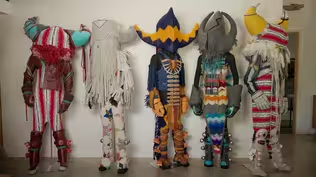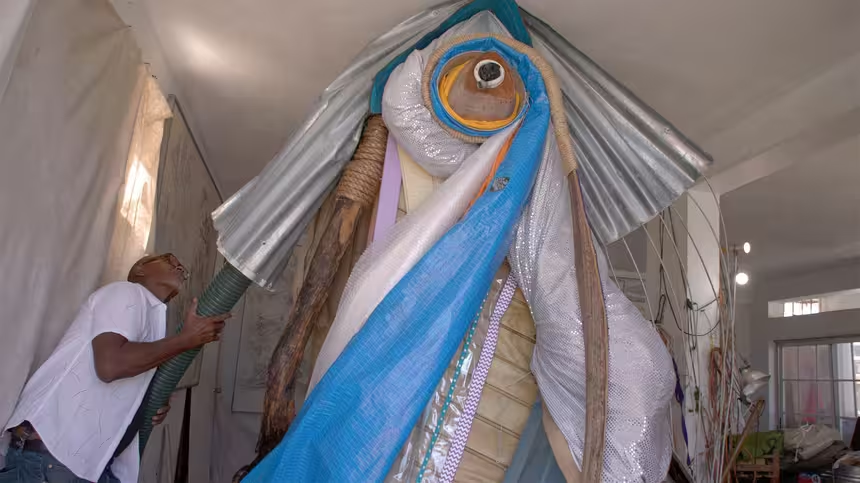
"In my work I don't think that there's one place. I
think there are many places. I often feel that the work
comes from many different perspectives and different angles,
different realities."
"I came in as a squatter, more than anything else,
into the museum world. And my interventions were pretty
much the same way, in storefronts. Space for meit's
not connected. I think that when I go in into the space
it provides its own spirituality."
"...What I wanted to do is to provoke change, not only
socially but physically and spiritually."
How does the size of the installation
and the location effect the work?
OSORIO:
In my work I don't think that
there's one place. I think there are many places. I often
feel that the work comes from many different perspectives
and different angles, different realities. And I guess because
of the complexity, because of the exuberance, because of the
multiplication, the work offers the opportunity for it to
happen in more than one place. What I am trying to do specifically
with my work, or what I was trying to do at the very beginning
with the work in terms of size was, in my own terms in the
'80s a very subversive kind of philosophy. And since I had
gone into isolation in the South Bronx and I was creating
work on my own and presenting it in the context
of community, then I needed to have an open space, a larger
space where the work can be seen. And then in itself, when
people came to look at the work, it became greater than their
size. So therefore it demanded attention, and therefore they
had to deal with the issue.
When it went to the museum the work also demanded the same
size and it demanded the same attention. And I think that
somehow subversively I was thinking not in terms of a museum
as much as in terms of storefronts and places where it had
to be seen before. And it was quite interesting because unlike
the tradition of artists of color at that time, not finding
its place in museum, I was then demanding the largest place
than ever. And for me that was my connection to the space.
I came in as a squatter, more than anything else, into the
museum world. And my interventions were pretty much the same
way, in storefronts. Space for meit's not connected.
I think that when I go in into the space it provides its own
spirituality.
And so then, for me, my interventions with the work, the work
itselfhow can I explain it? It's more like a metaphor
than anything else. The space in itself has a spiritual content.
My work has its own and when it comes in, it just comes together
in one place. It's kind of hard to explain because often,
in terms of space, I go in with one monumental chunk from
any specific community and put it into another place that
it does not necessarily fit in, but it's part of it.
For example, when this piece, "Scene of the Crime" was at
the Whitney Museum, it almost felt as if I had taken a piece
of the South Bronx out of its roots and placed it in the middle
of Madison Avenue, you know? And that's my relation to space.
That's my relation, one of intervening, of intervention, one
of somehow just the position but at the same time trying to
fit in or force it into a location more than anything else.
And maybe that's how I feel with my work, that it goes against
the grain. But somehow because of its spiritual qualities
it flows in itself.
ART:21:
What in your work, specifically,
do you think goes against the grain?
OSORIO:
Against the grains of the aesthetics
of the art canons. I'm very much aware that my work is one
that provides, aesthetically, an uncomfortable reaction in
many people. But I think I also feel that it provides the
right challenges at the right time and at the right moment.
And I'm very comfortable with that and very conscious. It's
interesting because a lot of people ask me, "Do you live like
this? Is this how your home is?" And it isn't. I am making
a very calculated intervention. Not that I dislike what I
do, but I'm very much aware of what I'm doing. And I'm very
much aware that what I wanted to do is to provoke change,
not only socially but physically and spiritually.
ART:21:
And provoking change, in all
these aspects, is what an artist does?
OSORIO:
Yeah, in "Scene of the Crime"
I borrow from the past to deal with the present, and present
tense. I take into consideration a lot of the formal
issues in the arts and apply them to it, to my work. If we
look at the sense of colorcolor is pretty much in it.
I think that form, also, is very much a concern of mine. But
I also feel that, in a lot of the work that I do, somehow
I have resolved that aspect of the work. And there's other
aspects that I feel that I am more inclined to explore, which
are the social, the more ethical
and sociological.
I often feel that I make a lot of new discoveries as I go
along creating work. And in "Scene of the Crime" my greatest
discovery was the connection to color, my connection to the
light in that sense. And those explorations happen at one
level. And then on the other level my mind is working differently.
How do I combine all these connections that I think that we
all have and bring it in a more Popular sense, in a democratic
way that everyone can relate to it in a certain, same level.
And I think that somehow my work also deals with that. It
is simple enough to people who make an immediate connection
as it is complicated enough for the intellectuals who are
interested in looking at the work in a more academic way.
And I think that somehow there is a connection to both places,
because it's exactly where I am. I am in both places. I deal
with the academic. All of a sudden I turn around and I go
into these places that are very forbidden places. And I'm
there, and I'm working, and then I go back. I could be in
77 Madison Avenue, then I go to, I don't know, Longwood Avenue,
to my studio,
and then I work, and then all of a sudden I'm out of there
and I go to another place and I'm somewhere in different locations
in one day. And I think that that's the richness of the work,
because those three different realities I bring in immediately
as I create unconsciously. That for me is more important than
the formal issues in itself, and somehow I guess because I
have taken it for granted.
In "Scene of the Crime" the living room is red. It relates
to the passion. It relates also to the scene, to the crime
scene, to the color red that is so much associated with anger,
that is so much associated with crime, that is so much associated
with passion. And then the dining room, it's white, which
is so much associated with richness and a more contemplated
space. And I'm trying to bring together, in that sense in
"Scene of the Crime" a place that is for meditation, as much
as a place that is for anger. And there is a place for all
of it within one, creating a harmonious balance in between.
And all this, as I said, is very calculated. I'm very much
aware of it, but I just don't get stuck there. I move forward,
because I think that the greater discoveries are the ones
that we think the formal issues provide you. Those are the
challenges, those opportunities that you have to grab and
move on. If I'm stuck there then I just do art for art's sake
and I'm not trying to do that.