“…I draw out all these different motifs, and
then I lay them on top of each other...Out of that, you
can pull this form that turns into the sculpture or the
painting. It’s literally like pulling the narrative
out…”
“I think the question that everyone faces is, how
do you deal with this endless torrent of information, especially
when it can be repeated ad nauseam?”
“How are people making these kinds of discriminations
and distinctions that they’re using to judge contemporary
art?”
“...the theme of my new structure was information,
how do you deal with it?”
Can you explain
the overall concept for "The Universal
Cell?"
RITCHIE:
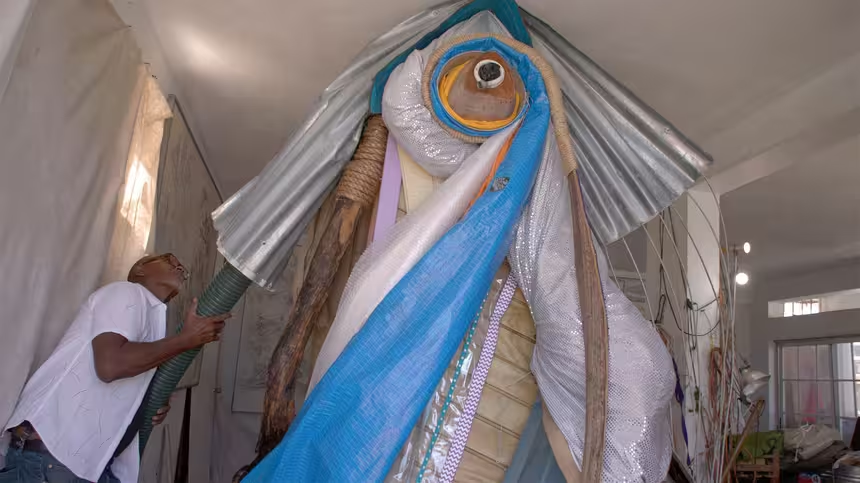
"The Universal
Cell" is part of "The
Lytic Circus."
The São Paulo Bienal asked me to do a piece, and
this was really the only thing I wanted to make. I was
wrapping
up this project that I’ve been working on for seven
or eight years—a kind of narrative that, collectively,
is an encyclopedia of information, a manual of how to deal
with information (all the information you could possibly
take on). And as I worked through it (I dealt with physics,
gambling,
religion, thermodynamics), I kept postponing dealing with
evil.
One of the things that became really clear to me was that
as a culture we’ve defined evil in one particular way
which is why we build structures to contain it. No matter
what bad thing you’ve done, you go to jail. Every crime
has the same punishment. And I was thinking about that and
then, in a larger sense, how the context of information defines
everything. So in a way each of us is in our own prison. You
bring it with you—the prison of your biology, your social
structure, your life. And that is both a challenge and an
opportunity. So I wanted to build a structure that felt like
a cell, your cell in the whole universe. If the universe is
a prison, this is your cell—this is where you’re
standing and you drag it with you wherever you go.
ART:21:
Talk about your drawing process.
RITCHIE:
I start with a collection of
ideas...and I draw out all these different motifs,
and then I lay them on top of each other. So I have piles
of semi-transparent drawings all layered on top of each other
in my studio and they form a kind of tunnel of information.
Out of that, you can pull this form that turns into the sculpture
or the painting. It’s literally like pulling the narrative
out of overlaying all of the structures. That’s how
I end up with this structure. It’s derived from a series
of drawings that I scan into the computer and refine through
various processes...and send to the sheet-metal shop down
the road where it’s cut out of metal and assembled into
larger structures which are too big for my studio.
So I was thinking about the idea of the cell. In biology,
it’s the sacred unit of measurement; the whole body’s
built out of the cell. And the thing that ruptures the
cell
is a virus that escapes. The name of that process is lysis
(thus, ‘lytic’ in the work’s title).
So when a cell is ruptured by a virus building up inside
it’s
burst open. And I kept thinking of this as a kind of a prison
escape....And then there was another motif that I’d
been working with for a long time—structures derived
from ceremonial magic—ritual mechanisms (originally
designed in the seventeenth and eighteenth centuries
to allow
people to get out of their bodies for astral projection)
that ended up being incorporated to some extent into
voodoo, another
interest of mine.
And there was this idea again! How do you escape the pattern
that’s imposed on you by the physical order of the universe?
How do you make the imaginative leap?
ART:21:
Explain the role of the prison
as a model for this project.
RITCHIE:
There’s the great Shakespeare
quote, “I could be bounded in a nutshell, and count
myself a king of infinite space...” I was in Alcatraz
a while ago with a friend of mine. We were both struck by
how incredibly perfect the cells were. It was almost like
you wanted one for yourself because it was so pure. Of course
you would want it for a day. (LAUGHS)
Robert Hooke discovered and named the cell around 1780. He
was really thinking about it as a chamber. He looked into
the body, saw all these little rooms, and imagined that these
animalcules living inside had this whole civilization. So
I’m very interested in questions of scale, how big or
small does something have to be to feel confining? And on
what level this cell will be put inside another cell—a
larger room which has a window that continues the drawing
out into the larger world around it. It’s like Sao Paulo’s
just another little cell inside a larger cell—the earth
that’s inside the solar system. Each of these things
are nested inside each other, but that doesn’t necessarily
mean there’s a limit. The limit is how you choose to
perceive your agency inside of that.
The United States has the most people in prison of any country
in the world. For the series of drawings that I did for São
Paulo I researched these prison layouts—everything from
the Colorado Florence super max prison, to the very first
prison built in the United States. I was thinking in terms
of larger, universal ideas. They’re very geometric,
they’re very pure, like platonic solids. People who
build prisons are very interested in this idea of geometry,
which has nothing to do with the crimes. From space you would
see all these perfect triangles, circles, heptagons, and hexagons—like
a secret writing placed over the surface of the earth—trying
to control evil by the imposition of this rational geometry.
It’s like, we’ll make the walls really beautiful
and straight and somehow the evil will be kept inside because
it’s a hexagon.
ART:21:
Can the viewer intuit these things
in the work?
RITCHIE:
My work deals very explicitly
with the idea of information being on the surface. And in
a way, information is the subject of my work. So for people
who are accustomed to thinking about visual art as purely
visual...this is a source of friction. You can always analyze
visual art in terms of content or appearance. It’s a
game to separate them; they’re indissolubly linked.
Everything in the material world around us has a narrative.
To classify visual art as the one medium that shouldn’t
require effort to understand—to just be able to look
at it as pure sensation and walk away—relegates it to
the level of a rollercoaster ride. I’m saying, “Open
your eyes and enjoy the ride!” Because it’s much
more exciting if you are thinking and questioning and you
don’t know what it is—and it’s full of questions
and statements that you can’t possibly grasp. That is
a truer reflection of just how extraordinary reality is than
something that neatly ties it up in a bow, like, “Look
at that, be at peace, go home.” I’m more interested
in something that leaves you asking questions.
ART:21:
Is this a radical change in making
art?
RITCHIE:
I don’t think so, but I
would say it’s a given that you need the visual language
to understand anything, even the most purely spectacular art.
You need to have some kind of context or it just appears like
a random object. If you’re from a different culture
and you come to the west and look at a Jeff Koons, it’s
going to look like something from a street fair maybe. I mean
that’s an argument made by a lot of people smarter than
me—that all art requires a context.
It’s sad that the art world feels obliged to defend
its depth, intelligence, and enormous history of creating
provocative and rich cultural objects. It’s sad that
we should even sit around worrying about the mythical viewer—who
by the way has never actually shown up at any of my shows.
I tend to get people just showing up and saying, “Oh
it’s great, I love all the angels and all that.”
People have such a desire to come to visual art. This strange
fear that we’ve all been worried about—not getting
it—I see that as such a marginal question being produced
by a very specific subgroup of the art audience, mostly the
right wing.
ART:21:
How do you think art making is
different now than it was several years ago?
RITCHIE:
I think in my lifetime I was
the last generation in school to be taught how to use a
slide
rule. The kids after me all got to use calculators. There
was a culture preceding my generation of people who, I guess,
came out of an entirely different world. The children of
computers have unleashed this tide in an obvious way—through
mass media they’ve really unleashed it—they’ve
changed everything in my lifetime. And a project like this
is impossible without computers. I think the question that
everyone faces is, how do you deal with this endless torrent
of information, especially when it can be repeated ad nauseam?
Why is "The Matrix" interesting
but
"The Sistine Chapel" difficult?
How are people making these kinds of discriminations and
distinctions
that they’re using to judge contemporary art? How do
you make an art form that deals with all that and presents
it in such a way that it can be understood as a unifying
aesthetic experience rather than just a big pile of stuff?
When I was in art school in the ’80s there was a generation
of artists who had specialized in dismantling what was called
“the master narrative of the west.” They took
it all apart told everyone how brilliant they were. People
like David Salle, Julian Schnabel—they were really the
last artists of the master narrative. This was a great moment
because it set everyone after that free. I feel like my generation
of artists were like “Wow, that means we’re not
under this obligation to perpetuate or dismantle, we can just
go off and start to build new structures.” And for me
the theme of my new structure was information, how do you
deal with it? As a person is it possible for you to grasp
everything and see everything? You’re presented with
everything and all through your life you’re trying to
filter it out, you’re really just trying to control
that flow.
The way my work works is I’ve tried to build a model
that can incorporate as much as it possibly can. It’s
like this constantly expanding information structure that
can just keep theoretically soaking up everything—but
inside a way of seeing so it doesn’t just become this
barrage. There are trillions of particles being discarded
and bombarding our bodies right now, everything in this space
has a meaning, a history, a story. We have to bank it all
down, but I’m interested in, okay we’ve banked
it all down but now can we bring it up a little, can we turn
the volume up just a little more? Can we listen to everything
a bit more loudly at the same time rather than selecting parts
of the pattern? Can you tolerate, just for a few minutes,
not just the physical information but the cultural information,
the theological information, everything coming up together?
I’m interested in describing a kind of armature for
that.