overview
Lesson 1 | Summary
Activity Pages
|
|
 |
|
|
 |
|
 |
lesson
1 | describing the real
language arts | grades 9-12
How might the visual terms abstraction and realism be related to
the literary terms fact and fiction? Contemporary artists commonly
draw inspiration from the past and the present to express a particular
idea or point of view in much the same way that writers find sources
of inspiration and create narratives that intertwine the real elements
of daily life with imaginary ideas and make-believe. This lesson
will look at how historic events and facts are reconsidered and
understood through point of view, interpretation, and opinion by
visual artists. Poetry, novels, memoirs, and epic stories will be
explored through the visual counterparts—still-life, portraiture,
and historic representations in art.
activities
The following activities can be implemented individually or collectively
as a longer unit of study.
Describing Abstraction & Realism
Students will compare work by the artists Elizabeth
Murray, Walton
Ford, and Martin
Puryear to explore the relationships between
abstraction, realism and the literary parallels presented by
Modernist writers
such as Gertrude Stein and James Joyce.
The Language of Abstraction
This activity explores different approaches to the idea
of abstraction by the artists Susan
Rothenberg, Hiroshi
Sugimoto,
and
Arturo Herrera. Students create a
visual vocabulary that inspires written and visual narratives.
Image & Text
The artists Raymond Pettibon and Josiah
McElheny employ
distinct ways of integrating the visual and the written in their
work. Making stylistic connections to the Beat Poets, students
will use collage and assemblage techniques to create a new composition
that brings together visual and textual elements.
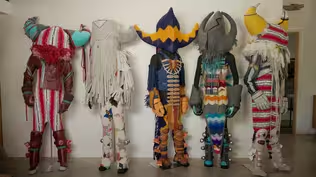
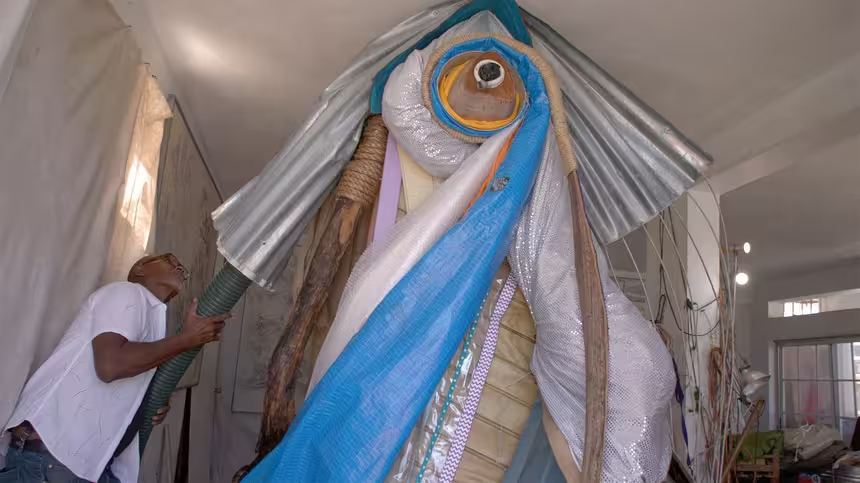
Describing History and Magic
This activity introduces the genre of Magical Realism and explores
the work of artist Pepón Osorio.
After considering how fact and fiction are used by visual artists
and writers, students create their own writing piece, based on actual
and fantastical events.
Memoirs & Portraits
This activity is inspired by the work of Eleanor
Antin and Mike Kelley who use
fictional autobiographies to construct new identities that tangle
fact and fiction. Oscar Wilde’s “The Picture of Dorian
Gray” suggests a literary counterpoint for considering how
portraiture in constructed and read.
Visual & Literary Epics
This activity focuses on two artists, Kara
Walker and Matthew Ritchie, who
are influenced by literary sources and construct vast visual stories
of their own. Students create a temporary classroom installation
that reflects an existing or newly imagined literary epic.
objectives
| • |
Students will explore
the terms ‘abstraction’ and ‘realism’
in visual art as well as ‘fact’ and ‘fiction’
in literature. |
| • |
Students will look
at the work of visual artists and compare and contrast the
idea of abstraction and realism, fact and fiction in comparable
literary works. |
| • |
Students will define and use
the terms 'sign' and 'symbol' and use them in a work that
conveys information visually. |
| • |
Students will create their own
representation using signs and symbols to convey information. |
| • |
Students will learn about the
genre Magical Realism and related visual art that combines
real and imagined stories. |
| • |
Students will create their own
works of creative writing and visual art that incorporate
factual and fictional, abstract and realistic elements. |
critical questions
| • |
How are abstraction
and realism used in contemporary visual art? |
| • |
How do writers use
abstract and realistic language in writing? |
| • |
What are the similarities and
differences in literary and visual systems of description?
|
| • |
What are the differences between
signs and symbols? |
| • |
Are facts always true? Is fiction
always untrue? |
| • |
What are different ways that visual
artists and literary authors incorporate abstraction and realism
into their work? |
reflection & evaluation
| • |
Have students articulated
an understanding of the terms abstraction and realism as well as
fact and fiction in literary and visual art? |
| • |
Have students looked at
the work of visual artists, comparing and contrasting the idea
of abstraction and realism in relevant literary works? |
| • |
Have students created their own writing
that incorporates abstract and realistic elements? |
| • |
Have students created visual compositions
that reflect literary narratives and stylistic choices? |
national standards: language arts
| #1 |
Read print & non-print texts |
| #2 |
Wide range of literature |
| #3 |
Comprehend, interpret, evaluate & appreciate
texts |
| #4 |
Communication strategies |
| #5 |
Writing strategies |
| #6 |
Create, critique & discuss |
| #12 |
Use spoken, written & visual language
in tandem |
| |
Find out how this lesson plan correlates to
your state’s education standards by following the link
to PBS’s TeacherSource. |
going further
This lesson uses the terms 'abstraction' and 'realism' to address
means of representation in visual and literary art. To create a
longer unit or lesson on the idea of representation, the construction
of identity, and the inclusion of interpretation and point of view
in presenting fact and fiction, this lesson could be combined with
other lessons such as:
about this lesson
This lesson was written by Art:21 Director of
Education & Outreach Jessica
Hamlin. The lesson was first published on this Web site September
2003, and was revised September of 2005. For questions and/or comments,
please contact curriculum@art21.org
|
|