|
|
 |
|
 |
|
 |
|
|
 |
| How is the self defined?
How do innate qualities and external influences make us who we
are? How do we make connections with others by identifying ourselves
as part of social, familial, or spiritual communities, cultural
groups, or neighborhoods? Identity is a constant conversation between
individuality and conformity, between being and belonging. The
lessons in this topic explore ideas of how we relate to others
and how we understand ourselves both as individuals as well as
members of collectives. Whether it be through the representation
of living people or through the invention of fictional characters,
contemporary artists probe the nature of the self in all its aspects. |
|
 |
|
|
 |
characters & caricatures
Subject Area: Language Arts
Artists: Antin,
Charles, Hancock, Kilgallen, Walker
This lesson will explore the similarities and differences between
characters and caricatures in art and literature. Drawing from the
work of contemporary
artists, poets, and playwrights, students will create their own cast
of characters and bring them to life through a screenplay that illuminates
their individuality and their relationships to each other. The resemblance
of characters to historical figures and heroes as well as contemporary
stereotypes will be explored. |
|
 |
|
 |
yearbook
tribes & nomads
Subject Area: Social Studies
Artists: Schorr, Suh
Yearbooks are a common representation of the high school experience, changing
in subtle ways over time to reflect the era in which they were published.
Looking at the changes that reflect different social standards and expectations
over time, students will investigate how the concept of tribes and nomads
relates to the creation of public documents that express who we are.
Students will examine group portraits, image archives, and the role of photography
in creating a collective memory. |
|
 |
|
 |
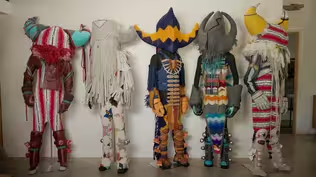
the alter-ego saves the day
Subject Area: Visual & Performng Arts
Artists: Antin, Barney,
Hancock, Pettibon
Many artists make work that incorporates an alter-ego or stand in for
themselves. In this lesson students will create their own alter-ego as
a heroic, tragic, or sinister protagonist in a story of their own devising.
Students will create a costume as well as a comic book narrative where
the fictional events of their alter-ego are brought to life. Probing conventions
of the self and creativity, students will create art work as their alter-ego. |
|
 |
|
 |
I
used to think that I didnt have a self. I didnt
have a self that was mine and I literally decided on being
an actor when I decided if I dont have a self of my own
I can borrow other peoples...
Eleanor
Antin
Often, people, even critics, think
that my work is about individuality disappearing into anonymity.
But its not. I dont think anonymity exists actually.
Its just a convenient way to describe a certain situation.
It's our problem not to see difference or individuality.
Do-Ho
Suh
|
|
 |
|
|
 |
 |