Visit Your Local PBS Station PBS Home PBS Home Programs A-Z TV Schedules Watch Video Support PBS Shop PBS Search PBS
art:21
art in the twenty-first century the series the artists education events discuss

teaching materials:
search the online lesson library:
Social Studies
Contemporary artists grapple with local, national and international events in their work, bringing creative perspectives to age-old issues and current concerns. Sometimes controversial and often provocative, artists engage ideas that range from the implications of technology, to the issue of collective and individual identity, to the purpose of public memorials and monuments. Relevant to the study of history, geography, psychology, government, and economics, living artists present compelling ways to rethink the stories that define who we are.

NATIONAL STANDARDS
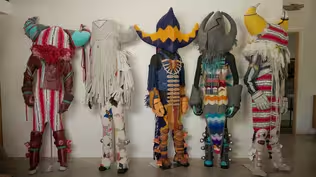
detail of Marshall's "RYTHM MASTR"
Cartoon Commentary
ABSTRACTION & REALISM
cartoon commentary

Topic: Abstraction & Realism
Artists: Ford, Marshall, Pettibon, Walker
In Cartoon Commentary, the medium of political cartoons is used to explore the way symbolic systems incorporate both realistic representations and abstract imagery and language to convey ideas. Students will research the history and technique of political cartoons and create their own cartoons that convey political or social issues of their time. The contemporary artists in this lesson explore the cartoon genre, incorporating elements of satire, allegory, and epic narrative in their work.
detail of Sikander's "Fleshy Weapons"
Migrating Viewpoints
HOME & DISPLACEMENT
migrating viewpoints

Topic: Home & Displacement
Artists: Orozco, Osorio, Sikander, Suh, Walker
In an age of global travel and migration, many people identify themselves with multiple cultures, cities, or a diaspora of individuals. The city where a person is born is distinct from those that they travel to later in life or those that represent the distinct cultural identities of their family. This lesson will have students explore the concepts of assimilation, hybridization, translation, and cultural borrowing.
detail of Sikander's "Fleshy Weapons"
Yearbook Tribes & Nomads
INDIVIDUALS & COLLECTIVES
yearbook tribes & nomads

Topic: Individuals & Collectives
Artists: Schorr, Suh
Yearbooks are a common representation of the high school experience, changing in subtle ways over time to reflect the era in which they were published. Looking at the changes that reflect different social standards and expectations over time, students will investigate how the concept of tribes and nomads relates to the creation of public documents that express who we are. Students will examine group portraits, image archives, and the role of photography in creating a collective memory.
detail of Puryear's "Ladder for Booker T. Washington"
Traditional Crafts...
LABOR & CRAFTSMANSHIP

traditional crafts, contemporary ideas

Topic: Labor & Craftsmanship
Artists: Antoni, Mann, Puryear, Sikander, Suh
What do the tools, techniques, and products created in the past or by distant cultures communicate about a society? In this lesson students will consider the way anthropologists study the artifacts of the past in order to create their own social history of contemporary material culture. Traditional forms such as woodworking, weaving, sewing, wet plate photography, and miniature painting will be explored in the work of contemporary artists as a model for students to adopt a past craft in their own writing and art.

detail of Schorr's "Kindling and Deer Feed"
Landscape & Place
THE NATURAL WORLD
landscape & place

Topic: The Natural World
Artists: Celmins, Chin, Ford, Mann, Schorr, Turrell
Historical depictions of the landscape are often seen as a reflection of the social policies and commonly held beliefs about people and their place in the world. This lesson will examine the symbolism of representing people and animals in the landscape. Students will study contemporary images of landscapes and natural settings to create an archive representing their own relationship to the natural world.
detail of Wodiczko artwork
The Face of Fame
PUBLIC & PRIVATE SPACE
the face of fame

Topic: Public & Private Space
Artists: Horn, Pfeiffer, Schorr, Wodiczko
In the 1960s Andy Warhol declared that “In the future, everyone will be world famous for 15 minutes.” In 1979 he told the Washington Post, “I’m bored with that line. I never use it anymore. My new line is ‘In 15 minutes, everybody will be famous.’” This lesson will explore the idea of celebrity and give students the chance to create their own 15 minutes of fame through films and photographic images. Students will examine the way artists grapple with and critique media and the cult of the celebrity.
(Updated for Season Three!)
detail of Lin's "Vietnam Veterans Memorial"
Honoring Heroes & History
RITUAL & COMMEMORATION

honoring heroes & history

Topic: Ritual & Commemoration
Artists: Bourgeeois, Lin, Puryear, Smith, Suh
Who decides who or what deserves to be commemorated? In remembering the past, certain stories and heroes have been selected as part of the larger historical narrative while others have been overlooked. Using local and national public sculptures, monuments, and memorials, students will explore how artists create works that commemorate people & events and how their work relates to more traditional public monuments and statues.

still of Pfeiffer's "The Long Count (Rumble in the Jungle)"
Mediating Media
TECHNOLOGY & SYSTEMS
mediating media

Topic: Technology & Systems
Artists: Charles, Kilgallen, Kruger, Pfeiffer
‘Visual saturation’ and ‘perceptual overload’ are terms we use to describe the way that new technologies and media have become ubiquitous in daily life. With new technologies come opportunities and responsibilities. This lesson explores how artists, politicians, and business interests have addressed the issue of mass media like advertising and popular culture and its relationship to individual rights and identity. Students will explore the connections between art and advertising.
detail of Mann's "Untitled" from the "Deep South" series
War on Film
WAR & CONFLICT

war on film

Topic: War & Conflict
Artists: Korot, Mann, Schorr
Films and photographs on war are often heavily edited, biased, and selective in what they portray: suffering rather than jubilation, winners rather than losers, leaders rather troops, etc. Looking at the way photographs have documented the people and places affected by war, teachers and students will look at photographs and video as the starting point for researching, comparing, contrasting, and critiquing historical and contemporary wartime journalistic and art-based photography.

what do you think?
E-mail your comments on Art:21 educational materials
Submit student art & class projects inspired by Art:21
National Standards for Social Studies

#1 Culture
Social Studies programs should include experiences that provide for the study of culture and cultural diversity.

#2 Time, Continuity and Change
Social Studies programs should include experiences that provide for the study of the ways human beings view themselves in and over time.

#3 People, Places and Environment
Social Studies programs should include experiences that provide for the study of people, places, and environments.

#4 Individual Development and Identity
Social Studies programs should include experiences that provide for the study of individual development and identity.

#5 Individuals, Groups, and Institutions
Social Studies programs should include experiences that provide for the study of interactions among individuals, groups, and institutions.

#6 Power, Authority, and Governance
Social Studies programs should include experiences that provide for the study of how people create and change structures of power, authority, and governance.

#7 Production, Distribution, and Consumption
Social studies programs should include experiences that provide for the study of how people organize for the production, distribution, and consumption of goods and services.

#8 Science, Technology, and Society
Social Studies programs should include experiences that provide for the study of relationships among science, technology, and society.

#9 Global Connections
Social Studies programs should include experiences that provide for the study of global connections and interdependence.

#10 Civic Ideals and Practices
Social Studies programs should include experiences that provide for the study of the ideals, principles, and practices of citizenship in a democratic republic.


State Standards for Social Studies

Find out if this lesson plan correlates to your state's education standards! On PBS TeacherSource do a search for "Art in the 21st Century" and click on the Standards Match icon.
Copyright Art21, Inc. 2001-2006. All Right Rreserved. terms of use site map help credits go to top