|
|
 |
|
 |
|
 |
|
 |
play & contemporary
art
Spontaneous and joyful, subversive or amusing, play can take many
forms in daily life as well as in contemporary art. The Art:21
documentary
Play explores the work
of the artists Oliver Herring,
Arturo Herrera,
Jessica Stockholder,
and Ellen Gallagher, and
concludes with an original video artwork by Teresa Hubbard
/ Alexander Birchler.
special features
See a slideshow of artworks showcased in the Play episode, watch
a video preview of the show, or explore a slideshow of artists from
multiple seasons of Art:21 discussing the theme of power in their
work
|
|
 |
|
|
 |
episode synopsis: play
The artists in Play improvise games,
draw inspiration from dance and music, and employ color, pattern,
and movement to elicit delight. Indulging in process, these artists
transform naïve impulses into critical statements about the
nature of identity, creative expression, and pleasure. Introduced
by Grant Hill, Play was shot on location in Brooklyn,
New York; Berlin, Germany; Santiago de Compostela, Spain; New
Haven,
Connecticut; Houston, Texas; and Austin, Texas. |
|
VIDEO:
|
Introduction by Grant Hill |
|
|
 |
|
 |
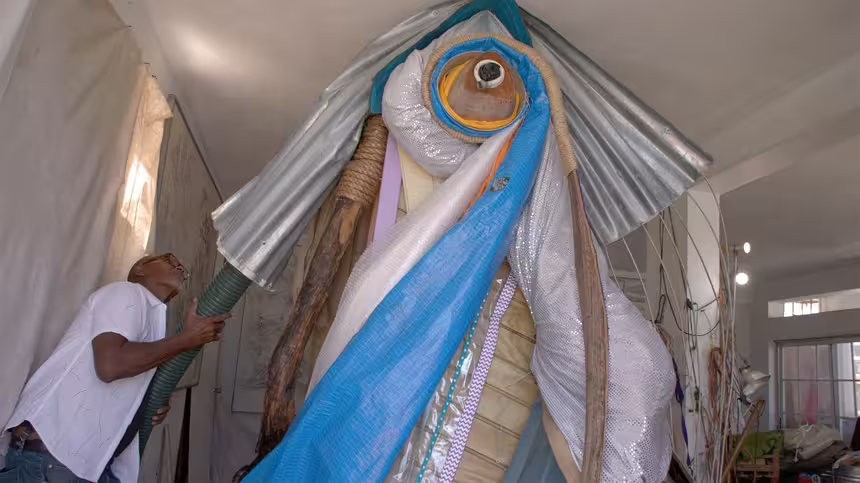
| In the studio Jessica
Stockholder makes sculptures on the scale of furniture, assembling
objects made of brightly colored plastic. “I love plastic.
And I also just love color,” Jessica Stockholder says. “Plastic
is cheap and easy to buy, and my work participates in that really
quick
and easy and inexpensive material that’s part of our culture.” At
the Rice Gallery in Houston where she is working on a large exuberant
installation, Stockholder’s fascination with
systems is evident in the way she arranges mundane objects in playful,
surprising
ways. “I’m interested in how a thinking process can
meander in unpredictable ways,” she says. Like child's play, “learning
that doesn’t have a predetermined end.” |
|
 |
|
 |
| Searching for a release
from his past meditative work of knitting colorless
sculptures with Mylar tape, Oliver Herring began
making fantastical stop-motion videos of himself, and subsequently
of strangers encountered
by
chance. In addition to videos, Herring creates sculptures of
“off-the-street” strangers, using Styrofoam covered
with photographs that
reproduce the skin of the model. He also photographs strangers’ faces
after
they've spent hours spitting colorful food dye over their faces.
The
portraits are intense documents of an unusual kind of intimacy. “I
usually
wait for a moment that brings out some kind of vulnerability,” he
says.
“That’s what I’m after. This personal connection
with a stranger.” |
|
 |
|
 |
| “Being Latin American,
you are made up of so many fragments from different cultures,” says
Arturo Herrera. For the Venezuela-born
artist, collage
is the natural expression
of his mixed identity. Herrera’s collages combine cartoon
elements with abstract shapes to explore the interplay of childhood
memories and adult desires. In his
Berlin studio, he photographs elements of his own drawings and
then develops the film canisters in various liquids,
which seep in and alter the film. “I think there is a potential
for these images to communicate different things to different viewers
in a very touching way,” he explains. “But that experience
is not a public experience, it is very private, and very personal.” |
|
 |
|
 |
| Working with vintage
magazines, Ellen Gallagher explores both the representation of
ethnicity and the essential nature of identity.
In a series of large paintings, she mounts page after page in a
grid so that the viewer relates to the magazines in a spatial rather
than a sequential way. “I’m collecting advertisements
and stories and characters,” she says. “And I see them
as conscripts in the sense that they come into my lexicon without
me asking them permission.” Using an intricate printmaking
process to engrave an image of Isaac Hayes, Gallagher comments“I
think there is a nostalgia in my gathering of this material...yet
in that gesture you’re continually moving forward and continually
seeing the world.” |
|
 |
|
 |
| Each episode for Season
Three concludes with an original work of video art by the artists
Teresa Hubbard / Alexander Birchler.
Known for their haunting video projections, Hubbard and Birchler’s
work alters temporal, cinematic and architectural expectations of
the viewer through the use of looping narratives. For Art:21, their
first commission for television, they have created a series of beautiful
and enigmatic short films. Each film uses the same setting—the
interior of a police car at night—and begins when one officer
brings a cup of coffee for another. Using recurring and non-recurring
characters, interrelated dialogue, and ambient sound, the suite
of films evoke not only the Seaon Three themes of Power, Memory,
Structures and Play, but also sleep, dreams and longing.
|
|
| VIDEO:
|
"Night Shift: Asleep"
(Commissioned for: Play) |
|
|
 |
|
|
 |
 |