|
|
 |
|
 |
|
 |
|
 |
time & contemporary
art
How do artists evoke and transform time in their work? Can a work
of contemporary art be timeless? How does contemporary art relate
to art of the ancient past, to nature, and to the rhythms of the
life? The Art:21 documentary Time explores
these questions through the work of Charles Atlas,
Martin Puryear, Paul
Pfeiffer, Vija Celmins, and Tim
Hawkinson.
special features
See a slideshow of artworks showcased in the Time episode, watch
a video preview of the show, or explore a slideshow of artists from
multiple seasons of Art:21 discussing the theme of time in their
work.
|
|
 |
|
|
|
|
 |
episode synopsis: time
Time is always present in our interaction
with works of art, whether we sit to contemplate a painting, stroll
past a sculpture, or watch a video piece for its entire duration
or cycle. Some works of art are time-based in that the viewer must
experience them through the passage of time, as with music, while
others refer to time through links or references to art history,
our collective human history, or the timelessness of nature. Filmed
on location in China; Japan; New York, New York; San Antonio, Texas;
Cambridge, Massachusetts; and Los Angeles, California.
Tap-dancing is a way of articulating time, and its a long time since
I did it, says pioneering dancer/choreographer Merce
Cunningham in the
introduction to the Time episodecreated by Charles
Atlas. Cunningham speaks of his childhood dance teacher, an early influence,
who made a strong impression with her tap-dancing, including a remarkable moment
when she did it on the side of her foot. I never forgot it. Cunningham
begins to tap while seated, allowing the syncopated rhythms of his dance to set
the
tone for the episode. |
| VIDEO: |
Opening segment by Charles Atlas with Merce
Cunningham |
|
|
 |
|
 |
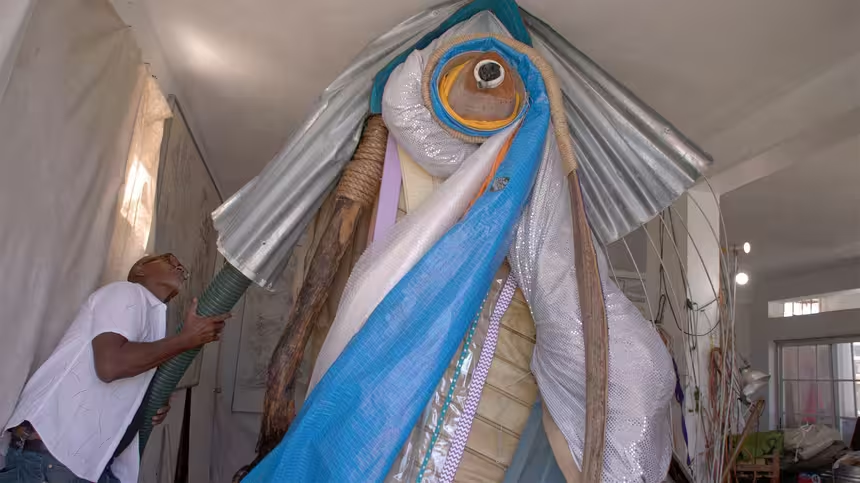
| Martin
Puryears respect for age-old techniques and his
knowledge of woodworking, masonry and non-western crafts are
essential
to the archetypal forms he creates. Im really interested
in vernacular cultures where people lived a little closer to
the source of materials... The artist tapped his carpentry
skills to create "Ladder for Booker T. Washington," a sculptural
country ladder reaching 36 feet into the air. The segment continues
with Puryear on a visit to Northern
California where he built a massive stone folly working with
a team of masons, and to a stoneyard in China and a sculpture
site in Japan, revealing the complex practical and artistic
calculations that go into Puryears large-scale work. |
|
| VIDEO: |
Carving Stone in China |
| VIDEO: |
Stone Architectural Folly |
|
|
 |
|
 |
| Courtside at a San Antonio
Spurs game, Paul Pfeiffer remarks Im
really attracted to images of amazing spectacle." Both Pfeiffers
sensibility and his technique are products of contemporary culture
as he pulls video of sports events, pageants, and newscasts off
television and then digitally manipulates the images to comment
on the frenetic pace and dehumanizing qualities of a consumption-oriented,
media-driven culture. There is a kind of humiliation in that
process of simply becoming objects of admiration or people simply
becoming consumers, he observes. In his "Long Count" pieces, Pfeiffer
explains he worked meticulously, frame by frame, to erase the boxers
from the ring until they are mere shadows. |
|
 |
|
|
| Patiently working at her
easel, Vija Celmins dabs
tiny speaks of paint on a canvas. The object of her attention is
a starry night sky, an image that she has been painstakingly
creating by applying paint, rethinking, sanding it off, and adding
more. This is all part of the work, she says, in
fact, I often now talk about building a painting. A prolific
artist with a long career, Celmins has created sculptures, paintings,
drawings and prints that find a timeless authenticity in natural
forms from stones to waves and spider webs. Its like
something unconsciously seeps into the work, Celmins explains,
discussing her attitude to the labor-intensive process she is well
known for. |
|
 |
|
 |
| Tim
Hawkinson tinkers with everyday materials to build surprising
mechanical art works. I guess it comes from early on in
childhood, a fascination with moving parts and sort of the magical, he
suggests. In his studio, Hawkinson explains how he used gears,
switches, nozzles, buckets, and pie tins to build a drumming
machine that captures random drips of rain, amplifies them, and
organizes them into music. Its not even electronics.
I dont know what it is, he admits. One of Hawkinsons
largest projects, "Überorgan," is an inflatable
installation in a space the size of a football field. For a version
of the artwork the artists created a score for the organ using
old church hymns. |
|
 |
|
|
 |
 |