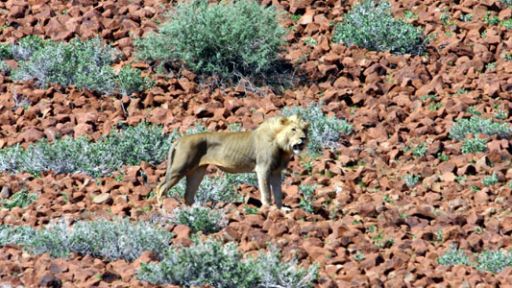
A decade of research on Namibia’s desert lions by carnivore expert Dr. Flip Stander has revealed a family structure and dynamic that is unique among Africa’s lions.
Namibia currently supports a population of up to 900 lions, with about 100 to 150 lions living in the northern Namib Desert near the Kunene River, the region that is the focus of Stander’s studies.
Like other lions, the Kunene lions live in groups, or “prides,” but the harsh desert cannot support large groups of lions. Wild prey is not abundant. As a result, Namibia’s desert lions break up into smaller groups, with between 2 and 10 members, versus about 15 in other parts of Africa. Desert lions also occupy much larger home ranges of 12,000 square miles or more, versus just 50 square miles for the lions living on the Serengeti Plains of Tanzania and Kenya. The animals have also learned to be less dependent upon numbers to hunt successfully; in the Serengeti, several members of the pride will usually be involved in a kill, while desert lions rely more upon stealth and the skills of fewer animals, such as the two lionesses whose cooperative hunting prowess is featured in The Desert Lions.
Lionesses in the desert have an average litter size of 2.8 cubs, somewhat bigger than in other parts of Africa, and, in general, produce a larger number of litters, indicating a more rapid rate of reproduction. The cub survival rate is a stunning 90 percent, far in excess of that seen among other African lion groups.
Among the lions of the Serengeti, young females rarely leave their “home” pride, that of their mother. But in the desert, Stander has found, it is common for females to break away from their mother to hunt independently — as young as 18 months old, 2 years earlier than would a Serengeti lioness. Perhaps even more remarkable is the fluidity of these arrangements. A female may reunite with its mother or sisters, often only to separate once again.



loved the show and the web site. Just one sugestion: It would be good to have a map of the area you are taking about. I was wondering what ocean and what country in Africa and had to look it up here to find the country and an atlas to find the ocean. Thanks for the wonderful Nature shows.
How much is the desert lion and how do I order for one.
hey lions are cute and im doing a informational report maybe you can send me some stuff to help me out thankz
what is the difference between the lions and cheetahs
Watch the show and you will learn about the big cats of Africa. Most interesting and amazing animals. To see then in real life is tryle a blesing and priviledge!
I’m doing research i need ideas
Hello,
It is now possible to join Dr Stander and his Desert Lion Conservation project by the intermediary of Kunene Conservancy Safaris (http://www.kcs-namibia.com.na/).
Follow their activity and desert lions updates on their blog: http://www.csnamibiablog.wordpress.com/
Thank you for your interest regarding this awesome creatures.
Hi
I read today in “Die Burger” about the killing of another dessert lion. How sorry that is and that a hunter may be responsible and then possible through info on your website.
Thanks your for the good work you are doing.
I just sow it on PBS , I loved the program, Great work and time dedication from Dr. Flip Stander.
I feel so bad that great studies and researcher are marginalized in National Geographic, that now is called Nat Geo!, and also from Discovery and Animal planet Chanel.
I liked all the new information and would like to know if the lions has discovered the seal colony ( maybe in a future program) also more information about the male lion role in the satellite prides.
how many donkeys did the lioness kill, and how many days dose an Oryx last before the 2 lioness has to make another kill.
Dr. Flip Stander, I really liked your worked and the new information that you have provided for us.
Thanks
What is the structure of a lion
Just thought it was appropiate under his leadership-. mmorpg hut,mmorpg space,pvp mmorpg
BTW in 1951 2 peaches would supply a persons beta carotein (pre vit A) . Now one would need 53 peaches unless homegrown to get it.