
Add These Math Activities to Your Family Routine


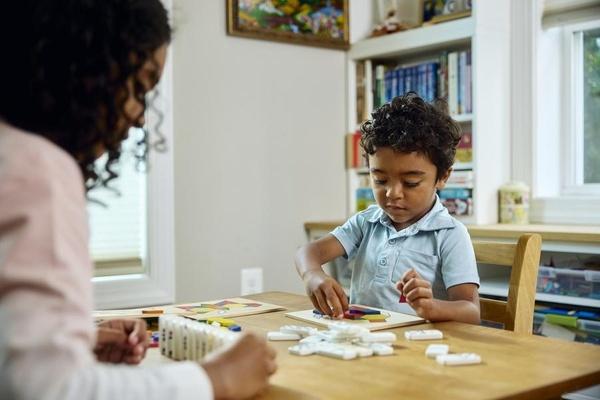
Building early math skills is a key part of learning critical thinking and problem solving for young children. Luckily, these skills can be easily worked on at home as part of your daily routine! Here are simple activity ideas from PBS SoCal and PBS KIDS you can incorporate at home based off of six different types of math skills.
Counting Activities
Your child might be able to count from one to five easily, but then gets a few numbers out of order when counting to 10. This is normal! Fans of "Curious George" may enjoy counting out loud and pointing out numbers often and everywhere. Or you can be intentional with practicing counting by creating your own game with this Family Math Activity: Counting With Fishes. Use art to inspire your child to practice by making a duck necklace. You may “quack” up as you form number sentences and make duck sounds! Or build your child’s deeper understanding of how we use numbers in our everyday lives with these number sense activities.
Sorting Activities
Many preschoolers take pride in knowing how to sort simple items like toys and crayons. Help them practice their sorting skills before kindergarten with easy activities using plastic containers found in your home. For example, you can create a collecting and sorting box of your own that your child can use like Elinor and her friends do on "Elinor Wonders Why." Fans of "Pinkalicious" may be interested in making bead wands while sorting and collecting. You can then try different ways of grouping the items, taking turns guessing how the items in each group are alike.
Pattern Activities
Get hands on when it comes to learning about identifying and creating patterns. Help your child create a loom or use a nearby fence or hamper to weave their own patterns using streamers, paper or fabric. Playing with patterns isn’t limited to what you see. Curious George shows us that you can make movement and sound patterns from clapping and tapping, too. Show your child that patterns — a sequence of things that repeat over and over — are everywhere, including at lunch!
Shape Activities
Reuse old magazines, newspapers or even mail by going on a shape hunt with your child. Have fun flipping through the pages before cutting out the shapes you find and making a colorful shape collage. Not only will your child learn shape names and attributes but you’ll have a gift to share with family members or friends.
After doing this activity, challenge your child to find shapes wherever you go, including at the grocery store.
If your family enjoys making crafts, you can also make a shape mobile from basic materials such as paper, string and cardboard. Your finished decoration can spark a conversation about shapes every time you see it hanging in your home.
Measuring Activities
Measuring objects is an essential principle in early math, especially since there are so many different ways to do it. Introduce your child to the idea of measurement with books before or after you play with weight by making an easy balance scale to compare weights of household objects. You can ask your child, “Which one is heavier — my marble or my teddy bear?”
Or you can practice measuring in a different way with a fun sponge game that will help your child compare and measure objects by length. Not only will they be able to practice using the words “bigger,” “shorter,” or “longer” but the whole family can get into the action. Finally, try using water as a way to practice measuring. Pretend you’re Odd Squad agents and use different containers to explore liquid measurements.
Spatial Reasoning Activities
Help your child grow their knowledge of location, direction and position — such as beside, under, over and behind — through fun activities. For example, you can make a building (or a whole city!) out of newspaper while helping your child develop their spatial sense. As you're rolling and folding the newspaper, talk about its structure. Ask your child questions like, Is it curvy or tall? And as you’re adding pieces to the building you can ask, “Should this piece go behind or next to the other piece?” “Should we put this piece down or across?” If your young engineer wants to keep building, try these bridge activities from Ruff Ruffman and Hero Elementary.
You and your child can practice spatial sense vocabulary while putting away books and toys at home, too. Ask questions like, “Does this item go on the shelf above or the one below?” during cleanup time.
For more ways to unlock early math skills for children ages 2-5, visit PBS SoCal's Family Math page
 Author: