

Supporting Great Communication Skills for Kids


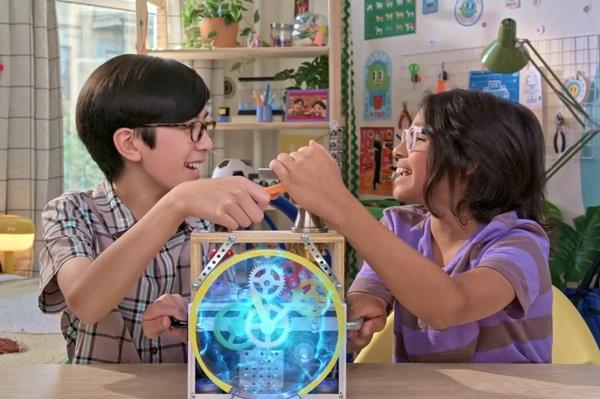
In the new PBS KIDS series “Tiny Time Travel,” best friends Tyler and Tony use a time machine to help them solve problems. As they go back and forth in time, they help friends and neighbors fix misunderstandings and communication mix-ups. The series aims to help kids learn social language skills — knowing how to use different forms of language and communication based on the situation.
Have you ever experienced a moment you told a friend something and they reacted in a way you didn’t expect? By practicing social language skills, we learn to understand the intentions, motivations, feelings, and beliefs of the people we communicate with.
“Social language skills involve communication, understanding social cues, and building relationships,” said Uchikoshi Tonkovich, a professor in the School of Education at the University of California-Davis. Tonkovich is an advisor to the show. These skills are building blocks for healthy connections and strong relationships.
Here are some ways to support your child’s social language skills:
Play together. Tonkovich suggests grown-ups and kids play together to build communication skills. Pretend you are going to a restaurant, library, or birthday party - how would you talk to other people in each of those different situations? Practice non-verbal communication using gestures and body language by playing charades. Read books together and talk about the characters’ feelings, behaviors, and interactions with others.
Make time for social interaction. Kids need the chance to practice real-life social scenarios. They also need lots of examples from the adults in their lives. Make time for conversation and play with your child each day. Try setting a regular “screen-free” time of day to encourage face-to-face interaction. For example, you can watch “Tiny Time Travel” with your child and then shut off the video and discuss what you watched. Bring up what you talked about later when your child needs support in facing a communication challenge.
“Balancing screen time with meaningful, in-person interactions is important to develop children’s social language skills,” Tonkovich said. PBS KIDS shows like “Tiny Time Travel” can be an additional resource to help build social language skills.
Think about others’ points of view. Tonkovich says learning to understand the intentions, feelings, and beliefs of others is important. Seeing from another person’s viewpoint builds empathy and connection and can help us communicate better.
Talking with a variety of people can help your child think about how others see the world. Ask teachers, friends, neighbors, or grandparents about their day. Discuss “Tiny Time Travel” characters’ feelings and choices. Ask each person at your dinner table to answer a “Would you rather…” question. (For example, would you rather be a dog or a cat?) Then, talk about why they made that choice.
When things aren’t clear, learn to ask for help. In the “Broken Dreams” episode, Tony and Tyler try to fix the broken time machine. But Tony doesn't understand what Tyler is asking him to do, and this leads to frustration for both friends. Show your child that it’s OK to ask for help when they’re confused. Give them phrases to borrow when they’re stuck, like:
“Will you say that again, please? I didn’t understand.”
“I think what you’re saying is ______. Is that right?”
“I’m confused. Can you say that in a different way?”
Talk about cultural differences. Cultural differences can impact how we interact with others. Your child’s friends might use another language, practice different faiths, or have diverse life experiences. Building cultural awareness can help kids navigate communication with people from all different backgrounds. Talk about how cultural differences impact the characters in “Tiny Time Travel.” Read books together to explore the characters’ language, beliefs, and behavioral differences. Think about ways your family communicates differently from neighbors.
Understanding cultural differences goes hand-in-hand with showing care and respect for other cultures. In “Dance Contest,” Cammy learns that Evalynn’s family has a cultural belief that she wasn’t being considerate of, so she uses Tiny Time Travel to go back and show more care. Help kids spot clues that show when someone is uncomfortable or there might be a cultural communication mix-up, like getting upset and leaving, as Evalynn does in the episode. Suggest ways to respond when this happens. “Children can simply ask what’s wrong,” Tonkovich said. Or they can share that they don’t understand what upset their friend and then ask for clarification. Once they understand, they can adjust to make sure everyone feels respected.
Try a “rewind.” If your child snaps or says something hurtful, offer them a chance to rewind and restart — a real life “tiny time travel!” Teach phrases like, “I didn’t say that in the way I meant to. Can I try again?”
Many kids also struggle to communicate when they feel misunderstood or frustrated. A restart can be helpful here, too. Offer your child some space to calm down. Then, give them a chance to try again.
A quick rewind can be a kind of tiny time travel — a chance to redo a tough moment with some help.
 Author:
Time travel with Tony and Tyler as they learn how to communicate and solve social problems.