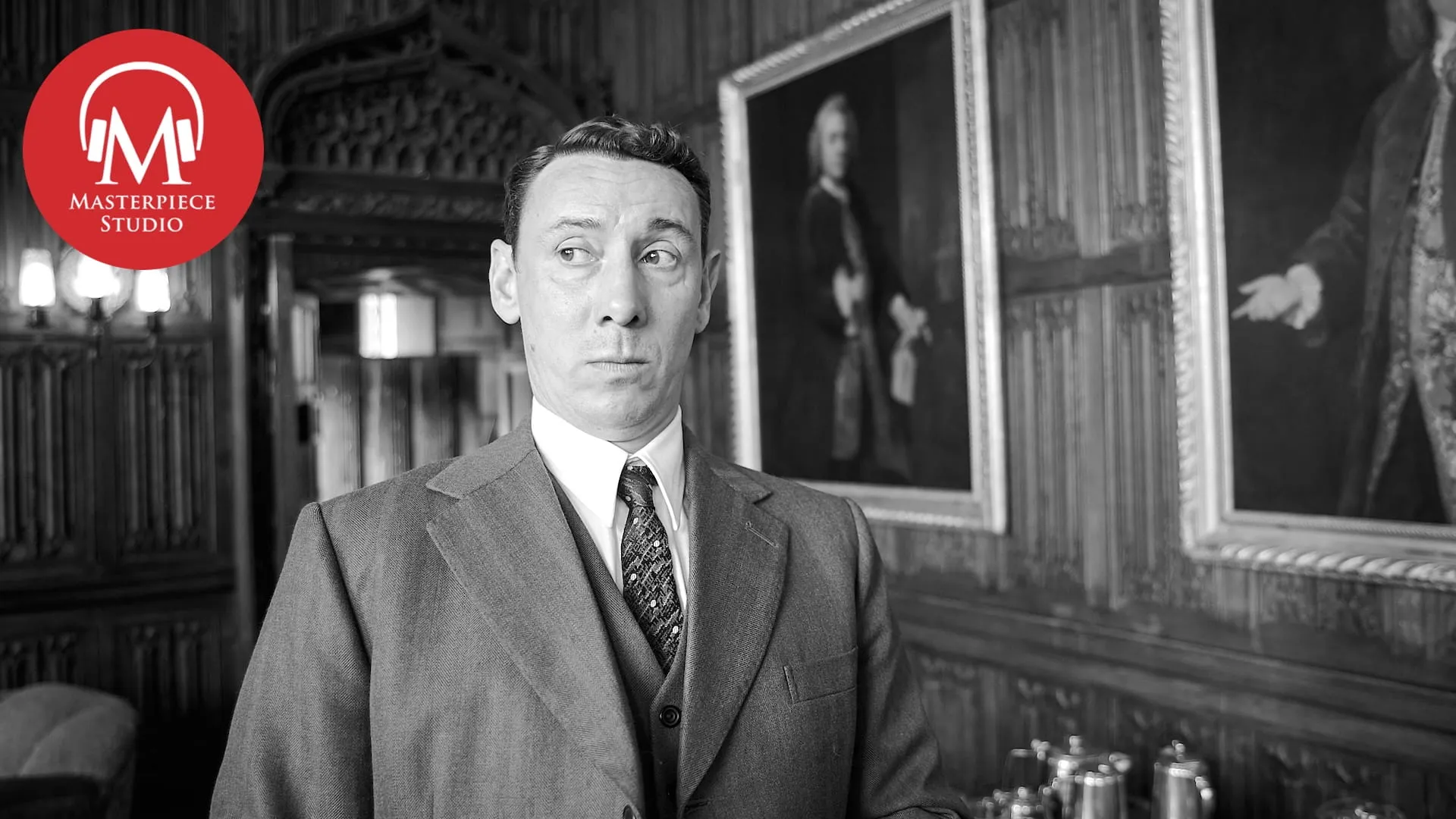
Al Weaver, Grantchester, Season 11
Released July 26, 2026 28:31
WARNING: This episode contains spoilers for Episode Seven of Grantchester Season 11.
Since Season 1 of Grantchester, actor Al Weaver has been combing down his hair, putting on a sweater vest, and transforming into the timid, yet kind and loving, Leonard Finch. In this conversation, Al talks about the early days of Grantchester, sharing car rides to the set with Mrs. C actor Tessa Peake-Jones, and how his character learned to live his truths and embrace his individuality over 11 seasons of Grantchester.
This script has been lightly edited for clarity.
Jace Lacob: I’m Jace Lacob and you’re listening to MASTERPIECE Studio.
If you’ve watched Grantchester from the very start, it’s impossible to forget that scene back in Season 1, Episode 2, when we first meet mainstay Leonard Finch. Timid, with a quavering voice that belied his strong belief in loving all people, he arrived at the vicarage as a mustachioed curate in search of shortbread.
While Leonard’s piety has never been in question, his personal life and relationship with Daniel Marlow has. Although Leonard was defrocked many years ago, by Season 11 he feels called back to the very institution that rejected him, as his faith in God runs deeper than church politics. Leonard knows that his chances of returning to the clergy are slim. No amount of fixation on trivial matters can distract him from his soul’s desire, but that doesn’t stop him from trying.
CLIP
Daniel: How bad do you think it is?
Leonard: The worst I’ve ever seen.
Daniel: The worst?
Leonard: Frankly, I’m doubtful there’s a way back from this.
Daniel: We’re past the point of no return?
Leonard: At best, we’re on the cusp.
Daniel: The cusp of the point of no return?
Leonard: This could mark the end of us here.
Daniel: Because there’s mold in the spare room? What’s really up?
When a crime wave turns this sleepy village on its head, Leonard and Mrs. C take it upon themselves to apprehend the criminal responsible for the recent thefts and vandalism. They catch local boy Raymond stealing biscuits and interrogate him. Despite the fact that Raymond has a knack for kicking Leonard’s shins, Leonard can sense a troubled soul in need of support. Could this provide an answer to Leonard’s recent loss of purpose?
CLIP
Mrs. C: Exhibit A, an empty plate.
Leonard: Once filled with some very good, if rather crumbly biscuits.
Mrs. C: They were meant to be crumbly!
Leonard: That wasn’t a criticism, Mrs. C, just an observation.
Mrs. C: What do you have to say for yourself, young man?
As Leonard and Daniel get to know Raymond, they learn that his father is terminally ill. With no other legal guardian in the picture, Leonard is determined to help secure a stable home environment for Raymond. He turns to Alphy for support, but Alphy is currently navigating a crisis of faith and does not have the capacity to help Leonard.
CLIP
Leonard: Raymond’s going to need full-time care. And very possibly sooner than we think. We need to know where he’s going to end up.
Alphy: Have you informed children’s services? He might need to be in the care of a boy’s home.
Leonard: Those places are awful.
Alphy: Well they were good enough for me!
Leonard: The church should be helping him.
Alphy: Leonard, I’m a vicar, not a social worker. By all means make him yours, but that child is not my problem.
By Episode 7, Leonard has all but given up on Alphy — the man who has the job Leonard wants but isn’t performing in the way Leonard thinks he should. How long can this rift last? And what does this mean for Raymond’s future? Today, we’re joined by actor Al Weaver to reflect on Leonard Finch’s transformation over 11 seasons of Grantchester, and to discuss how Leonard might find a way to do God’s work beyond the walls of the church.
Jace Lacob: This week we are joined by Grantchester star, Al Weaver. Welcome.
Al Weaver: Hi. It’s good to be here.
Jace Lacob: Thanks for coming back.
Al Weaver: Thanks for having me back.
Jace Lacob: I want to go way back, way back now, all the way to your very first appearance on Grantchester, which wasn't the first episode, but was Episode Two, where you turned up at the vicarage as curate Leonard Finch complete with pencil mustache. What did you make of Leonard as a character at that time?
Al Weaver: Well, I guess there were a lot of unknowns because I didn't have all the scripts, but the producers had told me what was going to happen. Yeah, I just knew what was alluded to. I think Pippa Nixon's character said, "This is my roommate, and he teaches at an all-girls school, and he's just passed his..." I'm going to bugger this up, but “his curate exam. He wants to be a curate. He wants to get into the priesthood, and there was a space with Sidney, and he's very effeminate, and I think he likes men.” I guess there was a mini conversation with the producers that he wasn't really sure, and that that was the journey that he was going to go on, that he would discover all of that as the show kind of went on.
But, yeah, I just knew—because most of the stuff was really funny. It was always just kind of comic relief. And then he got roped into the case straight away. And that first day on set, I'm sure I've told this before, but the first day on set, they did my hair and kept the mustache, and honestly, I was in the makeup chair, and I thought I was going to get fired. I was like, oh my god, I look ridiculous. Oh my god. And they put me in a car and went, "Everyone's on set." Harry Bradbeer, who did Fleabag and he's just done Spider-Noir, wheeled me down to set. I came out and walked on, and Emma and Daisy and everybody was there. And I was just like, God, this is it. I'm going to get sent home. And they all just laughed and were just like, "Oh my god, it's Leonard! It's Leonard!" And that was my memories of that, I think. It's a pretty good memory, actually.
Jace Lacob: His first line of dialogue in Grantchester, I think, is entirely fitting. It's, "I've been in search of shortbread."
Al Weaver: Yes.
Jace Lacob: Which I think is so Leonard to a T.
CLIP
Daphne: Leonard, this is Sidney Chambers.
Leonard: I’ve been in search of shortbread. I have recently completed my theological training and consider myself ready for a proper parochial position. You involve yourself in all areas of the community, I imagine? Bible study, fundraising for the missionaries and whatnot.
Sidney: How well do you know Ms. Young?
Leonard: As well as opportunity allows. She’s out most of the time with men. One of them sends her poems.
Sidney: Really? Are they any good?
Leonard: Dreadful. Although I suppose the name Daphne is difficult to rhyme.
Sidney: How was she when she came home last night?
Leonard: In truth, a little tipsy. If you don’t mind me saying, I have never seen a priest make murder his business.
Sidney: As a priest, isn’t everything our business? There’s no part of the human heart that is not our responsibility.
Jace Lacob: Of all the characters in Grantchester, Leonard, whether as curate or just as a person, he does seem to be the most focused on the human heart. And I think we see that with Raymond, whom we'll get to in a little bit, but also with Jennifer Scott, with everyone really, in the village. Do you see Leonard as functioning, ultimately, as the emotional heartbeat of the show?
Al Weaver: I think maybe early on he was, yeah. He was definitely the nicest, I think, of the characters, and he always had good intentions. Yeah, I think me and Tessa always felt that we were both that kind of heart of the show. I think because we do all the home life stuff, all the domestic stuff, you know, they do the crime, and then all our stuff is back at the vicarage or in Grantchester or whatever. And we never met the other casts, like the guest casts and things like that. We were like ships in the night. We just never saw them. And I know Daisy loved writing those scenes. I know she likes writing the crime as well, but I know she really loved writing those domestic, family scenes. And she always wrote them so well.
So yeah, because Sidney always came back, or Alphy, they all came back to the vicarage, and there was always a message to be learned there, I think. So yeah, I think him and Mrs. C, sort of both together.
Jace Lacob: You mentioned Daisy, I think it's clear that both Daisy Coulam and the audience have a real love for Leonard. And he is the character who undergoes perhaps the biggest transformation and experiences some of the most dramatic highs and lows across 11 series; meeting Daniel, but going to prison, losing his curacy, but finding a mother's love in Sylvia Chapman. Is it ultimately swings and roundabouts for Leonard at the end of the day?
Al Weaver: Well, I hope not. I hope by the end of this season, it's not. It’s just always difficult, and the times are changing, but they're not changing fast enough for him. So, he's always trying to strive for a bit more happiness. And I think he's a restless soul who really wants to do good things and change people's lives for the better. When he went to prison and when he had his collar taken away from him, that was a big turning point because he really didn't have a purpose. And I think he finds that again by the end, which is gorgeous. It's such a beautiful end.
Jace Lacob: You mentioned turning points, and I want to talk about turning points. Way back when, in one of our interviews, you described Leonard in those early episodes as almost Basil Fawlty level in terms of his clumsiness. Was there a particular turning point for Leonard? Whether it is, as you say, having to give up his collar, his suicide attempt, breaking off his engagement to Hilary, or his love and care for Sylvia during her cancer treatment? Was there a particular turning point that ultimately changed your perspective as an actor on the character you're playing?
Al Weaver: When Mrs. C, when she became aware of Daniel and allowed him in, and him and Daniel solidified that relationship when he accepted, and didn't care, and was like, "This is what I'm doing." And I think when he admitted to the police that he was guilty. Then I think those sorts of things, like his courage and his moving forward, are big things. I loved all that stuff.
When a character, or you or me or anyone takes ownership of, one, their mistakes, two, their ambitions, the things or true purpose or sexual feelings, whatever it is, it takes courage to be yourself. And I think when he started doing that, then that became really interesting. And it became a lot more... It was less comedic, all the stuff. Each scene then became a bit more meaningful because he'd made these choices and he was on this journey, and he was being his true self. So that was a turn in the character—not just being a comedy foil and hiding something all the time, but actually being someone who speaks his mind, who lives his truth, who does all these things. So that was a different kind of challenge and journey for me to go on. And then Daniel was there all the time as well, Ollie was there the entire time, which was great. And their stuff is just lovely.
Jace Lacob: Pre-pandemic, you and Tessa Peake-Jones, who had been your mentor at drama school, would share a car to the set every day, and you'd want to ride in quiet, and she would talk your ear off. What did those car rides mean to you?
Al Weaver: Just stress. It's just stress. It's noise, stress. No, it's because I get carsick, which I don't know if I ever… I'm sure I've told her this, and I love Tessa, literally like my own family. She's one of the best in the world. I loved those little car trips, but I genuinely was exhausted by the time we got to set. The coming home bit was fine, it was just in the mornings. I like to close my eyes and meditate and get ready for the day, where Tessa's like, she just talks and talks. And I love that, I wish I could do that, but it's not how I am. But I do miss our journeys home, and I miss her. It's weird.
I'll tell you what the nicest one was. The nicest was when we would come back from Grantchester, because we would always share a car, and I would ask to share a car, actually. I'd be like, "Make sure I'm in a car with Tessa on the way back," because we'd have like an hour and a half back to London. And we'd stop at a Waitrose and we'd get a bottle of wine and we'd have wine in the back of the car and we'd chat and it was great. And it was gorgeous. And we'd catch up on each other's lives a little more and just have a laugh.
And I texted her the other day because she offered me some tickets for a play. She always does that. This is what she does, she texts me and says, "I can't do this play because I've got this job. Do you want the tickets?" So I'll go, "Yeah." But anyway, I couldn't. But I said, it's so weird. I said, this is the first time in 11, 12 years that we're not going to work together this year. So weird. You come to expect that, and it just doesn't happen anymore. It's strange. But yeah, you look back and you laugh at these things, don't you? You think aw, yeah, I wish I could share a car with Tessa again.
MIDROLL
Jace Lacob: And we’re back with actor Al Weaver. So, Series 11, Leonard has fallen into a bit of a routine with Daniel. He misses the church and the sense of purpose that his vocation gave him.
CLIP
Leonard: I wish I could come back.
Mrs. C: But you’re doing so well. You’re helping men of sin.
Leonard: That’s not what we call them.
Mrs. C: You’re helping men who’ve made bad decisions to make good ones.
Leonard: It doesn’t feel like God’s work.
Mrs. C: He would approve, I’m sure.
Leonard: I like doing things for God. I’m drifting without the church. Like I don’t have worth.
Mrs. C: You have worth, Leonard. Silly boy.
Jace Lacob: And he begins a doomed campaign to return to the church, asking Alphy to talk to the bishop on his behalf. Why does Leonard want to return to a church that cast him out, that made him feel inhuman? And how does he see his self-worth in relation to the church or God's work?
Al Weaver: I think in a weird way, he probably thinks he can change it from the inside. But I think he still goes to church, he still holds those beliefs that actually, religion at its best, like humans at their best, they're incredible and they change people's lives and they're there to help. And at worst, they are the worst things in the world and they're not helpful and they punish. And even though he was a victim of that, I think, one, he could maybe put aside and blame the bishop and say actually he could have fought more. Two, it was of a time, and I think he understands that the climate of the UK and climate of the world is of a time. And I think he's optimistic that that will change. I think he does think things will change. But I think that his belief in God has not wavered ever.
Jace Lacob: His attempts to reclaim his identity, even in his make-believe of answering the phone and saying, "Reverend Finch," lead him with the help of Mrs. C to try and catch a village thief. And that thief ends up being unmasked as troubled local boy, Raymond, who kicks Leonard in the shin. What does Leonard make of Raymond initially?
Al Weaver: Initially he thinks he's trouble. And I love this, we said, "Can me and Mrs. C do a crime?" and this is what they gave us. I was like, well it’s not exactly what I had in mind, but then it's absolutely brilliant because the interrogation scene is just fantastic. And he kicks me in the thingy and I'm like, "No, I bruise like a peach." And it's so weird, because I actually do bruise like a peach. And my dad is called Raymond in real life. It's bizarre.
I think he's got a lot more patience than Mrs. C. She straight away just like bringing the hammer down on him, and Leonard always has a bit more patience. But I mean, little Jax, little Jax James, he is a movie star in the making, that kid. He is so good. You work with children and you just like, how are you doing that? He is so good, and a joy. Yeah, I don't think Leonard's thinking anything in terms of the path that we go down. I think he sees it and takes them in and then sees the state of affairs when he goes back to his house, and then that's when it kind of all changes and his inner need to help and look after people comes to the fore, because then he can't help but get involved.
Jace Lacob: That scene in particular, he discovers Raymond's father Marcus is terminally ill. And I love that scene, particularly because Raymond takes Leonard's hand and he says, "Thank you, vicar." And Leonard just beams. How does that slip, being called vicar, feel to Leonard, even if it is make-believe?
Al Weaver: I think he feels good about it, because I think in his heart of hearts, he is a vicar. And I think that's, back to the question you were talking about before, like, what an establishment says, in his heart of hearts he is a vicar by all means. He does the things that a vicar does better than most vicars. He's always there for anyone to help. It's definitely a throwback to the past, and it makes him go on this path of talking to Alphy and asking him whether, he's like, "Can you put a word in with the bishop, and is there any way that I could be involved with the church again? Because that's where my heart is, that's where I feel I can make the most difference for the good." He's tried all these other things, but I think being part of that establishment.
And the truth is, I don't know why he feels that from such a young age. I just feel like he probably found comfort when his mom died and his dad was a bit of a bastard, pardon my French. I think he probably found comfort in God and in the scripture, and the community aspect of what the church at its best can be. And he probably still sees that. And he never got to be a vicar properly. He always wanted to be. So, I think if the world's changing, maybe he has a chance of having his own parish one day.
Jace Lacob: As you say, he embraces that notion of being a shepherd, even if he doesn't have his dog collar anymore. And he does shepherd Marcus in Episode Five,
CLIP
Marcus: I’ve done terrible things. Broke commandments left and right.
Leonard: We’re all sinners Marcus. But God loves us anyway. I promise you he forgives. He does. You mustn’t fear death because you’re going home to the Lord.
Marcus: It’s not death that scares me. Who’s going to love my son? There’s no one to watch out for him. To see him safe, to see him happy. It makes me so damn angry.
Leonard: Raymond will be taken care of.
Marcus: You can’t promise that.
Leonard: I bloody well can. And I will. I’ll see he’s safe. I’ll see he’s happy.
Marcus: How?
Leonard: I don’t know. I’ll find a way.
Jace Lacob: And to me, this is Leonard at his best. He is a true man of God preaching, even if he's no longer a preacher. What did you make of that moment and how far this character has come in that journey?
Al Weaver: It’s so well written, I think. I love those scenes. They're just beautifully written. And you can just really say them with complete sincerity. And acting at its simplest is trying to change something or what am I trying to get? Action or whatever it is, "What am I trying to get? How do I get it?" And Leonard at his best is really just straightforward, “How can I make someone feel safe? How can I make them feel better? What can I do to help this person feel okay?”
And it's kind of a beautiful thing because he's so honest with it, and he means it. He really means it, and he hasn't thought about how he's going to do this, but he will find a way, because he can't bear to see people in pain. And I think it's interesting, I think maybe he sees Raymond as a reflection of himself, you know? Not born into a wealthy family, a working-class dad, family's been in and out of, I think there was a line that says they've been in and out of the cop shop many times. I never really thought about it like that until now, but yeah, I'm sure there definitely is some sort of, “I can't let this kid go down a road when I can help and I know I can make his life better. And I don't know how to do that yet, but I know I can do that.” And they're gorgeous scenes, they're gorgeous scenes to act.
Jace Lacob: I love the fact that we have this scene, and then we get a scene between Leonard and Jennifer in the church where she confesses that she's pregnant. And Leonard's advice is,
CLIP
Leonard: I can’t pretend to know the first thing about being a parent. I do know a little about losing a career. Perhaps try and think of it not as what you’ll lose, but what you’ll gain. It’s a gift, Jen. Enjoy it. And perhaps let Larry enjoy it too.
Jace Lacob: Do these two scenes, particularly in juxtaposition, reveal the true faith, the boundless heart and love of Leonard Finch? I feel like there's a reason these are both together.
Al Weaver: Yeah, I think you're right. As well as being that, I think it also opens something in him that he has not even dared to think. He sees Jen, pregnant and scared and whether she tells Larry or not. It's just something that he never would have thought he could have, like love. He never thought he could find love. He never thought he'd have a family that would accept him the way he is. And I think that's another reason he would fight to be part of the priesthood again, is so that he can be part of this community church, which is his home.
That was just such a gorgeous... I love Melissa. I think she's such a great actress. She's just brilliant, and we get on like a house on fire. And she was pregnant while we were filming this, and she's had her baby now. So, it was very, very personal to her. And when you're doing that and someone is pregnant, and playing pregnant, and then you say a line like that, you can make it really personal, like you're just telling a friend, giving a friend advice. Which is quite nice.
Jace Lacob: Marcus surprises Leonard and Daniel by saying he's changing his will and will make Raymond Daniel's ward. What does this decision mean to Leonard, to have a child to care for and to raise?
Al Weaver: I think like we talked about, it's just something that he never thought he'd have. I think he just wouldn’t even dare to dream that he would have a kid. It's like getting to the moon or whatever. It's just not even in his orbit. I'm not sure how many rules we're bending in the show by allowing this to happen. I'm not sure whether this would actually happen. He's kind of like, "I've got a criminal record for being in prison for being homosexual." I'm not sure this could happen in real life, I don't know, in 1963. But that's the beauty of this show, is that actually we can take something that is much more beneficial for the characters and much more beneficial for the story and actually play with that to give the audience a good journey, and a really fulfilling end.
And when I read that, I texted Ollie straight away and just said, "Have you read the script? This is so brilliant." Because he's like, "I'll do it." And you're like, oh, fantastic, and you get your hero moment. And I loved it, and it just speaks volumes about their relationship. But I think it just means everything, absolutely everything. It's like you get something that you never thought you'd have, and all of a sudden you're like, I would do anything not to mess this up or keep this. And they're a proper family. It's incredible. I think it was the perfect ending.
Jace Lacob: You mentioned the notion of the criminal record. Leonard sacrificed everything for Daniel: his freedom, his vocation, his safety, his reputation, to keep him safe. And all these years later, it's that decision that ultimately saves Raymond, as Daniel doesn't have a criminal record, allowing Marcus to make him Raymond's guardian. What would Leonard make of the hand of providence at play here? Would he see this as God's true intent?
Al Weaver: Yeah, I think he might. I think he might. I think fate has a weird way of playing a part in our lives when you don't expect it. I've had it recently in my own life in a really beautiful way, and you have to follow this path. But yeah, I don't think it changes. At the time, he was furious with Daniel. He's like, "You're lying. Tell the truth." But what does it matter in the great scheme of things? What does it matter, because it's played an ace right now, so I think that's all that matters. Sometimes you just let things go, and go here we are, and we've got this. I think it's kind of gorgeous, really, isn't it?
Jace Lacob: It is. Al Weaver, thank you so very much.
Al Weaver: Thank you so very much.
Next time, with Geordie’s shooter, Dexter, still at large, Larry and Alphy pay his uncle a visit to get more information. But time is running out.
CLIP
Les: I told him not to be stupid. I told him to calm down, but he won’t listen. He never listened. He’s going to keep hurting people. He’s not going to stop. You have to stop him.
Join us next week as we talk with the cast and head writer to discuss the final episode of the final season of Grantchester.
Grantchester Podcasts
10 More Podcasts









MASTERPIECE Newsletter
Sign up to get the latest news on your favorite dramas and mysteries, as well as exclusive content, video, sweepstakes and more.