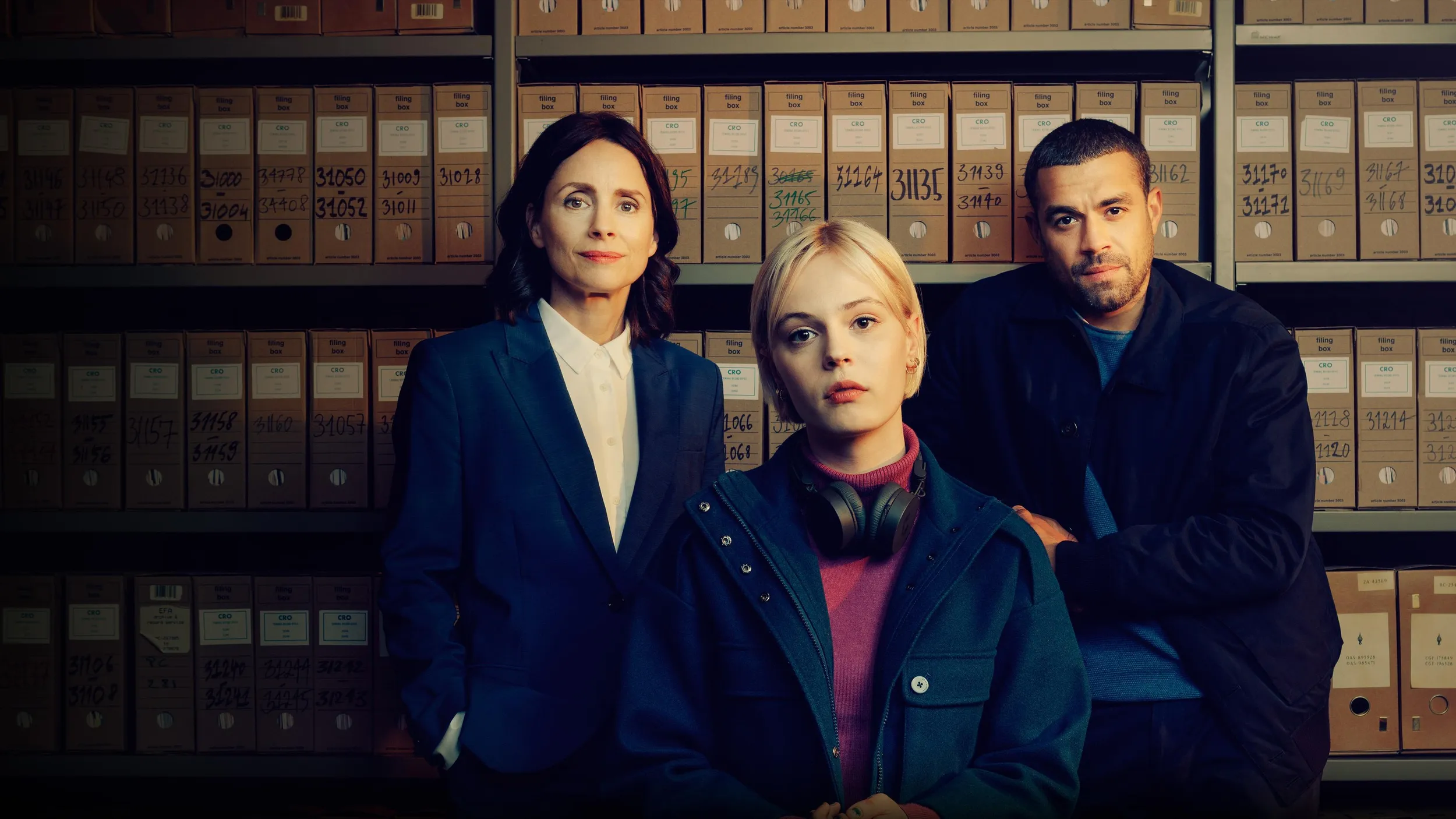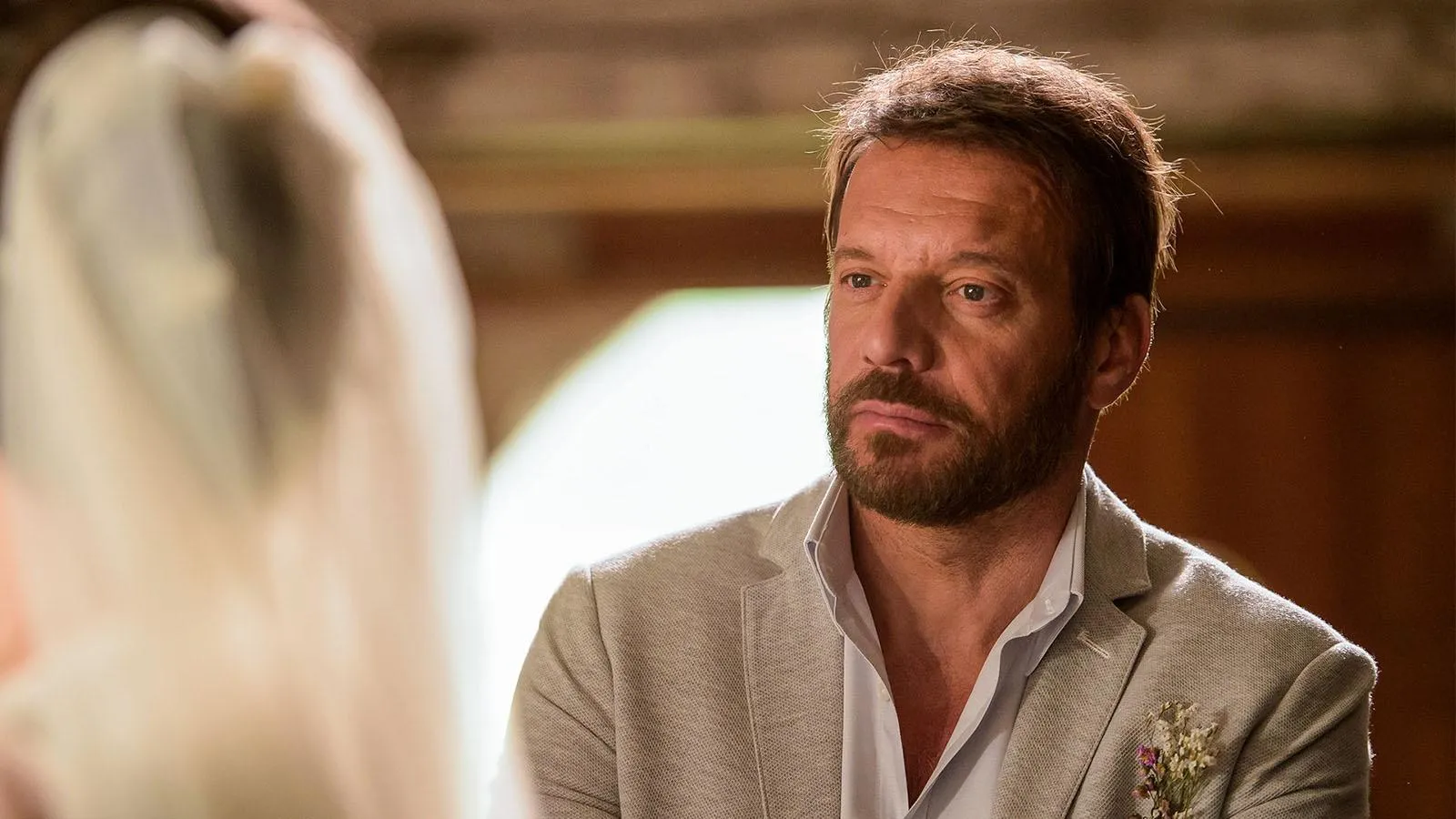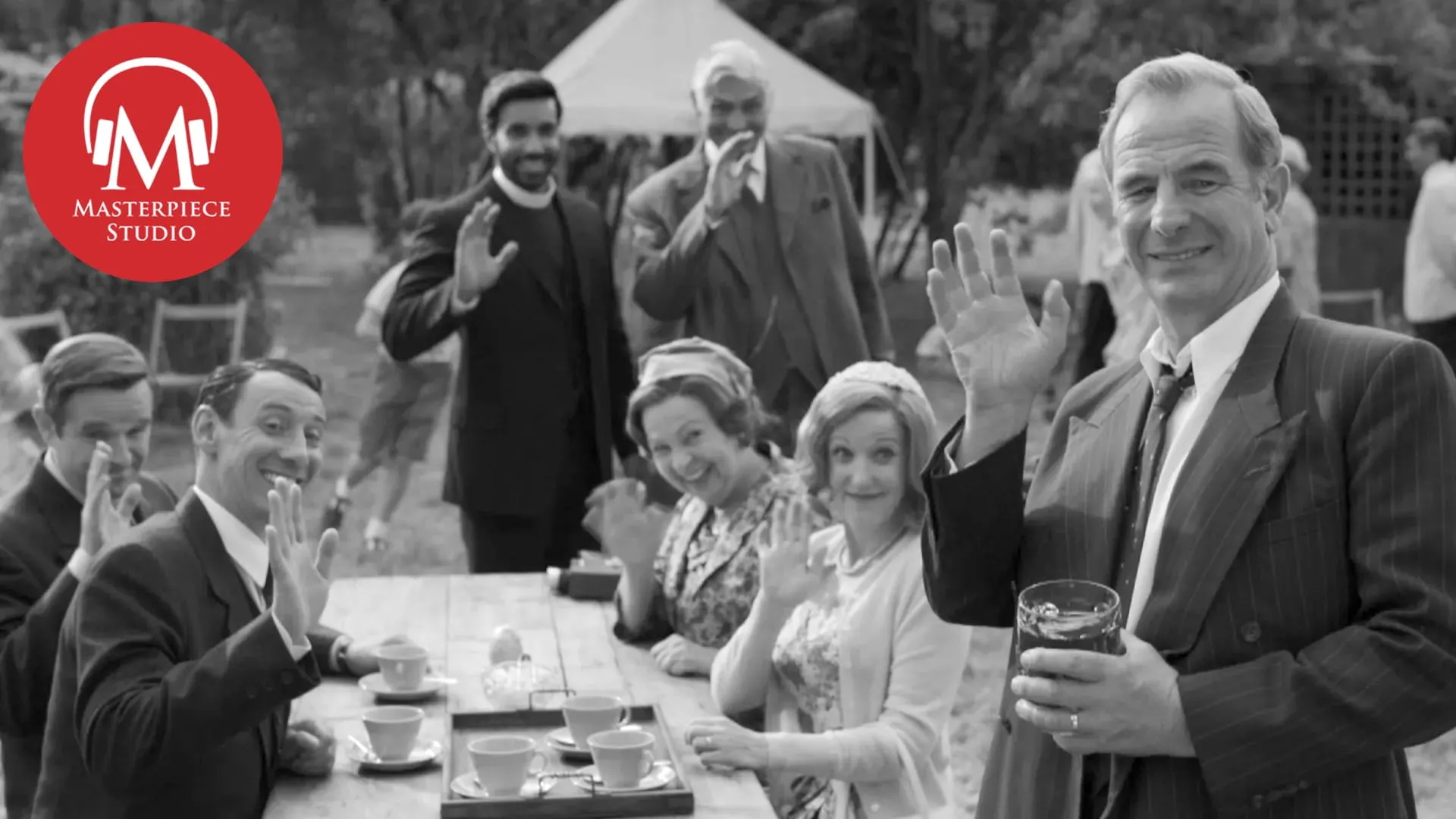
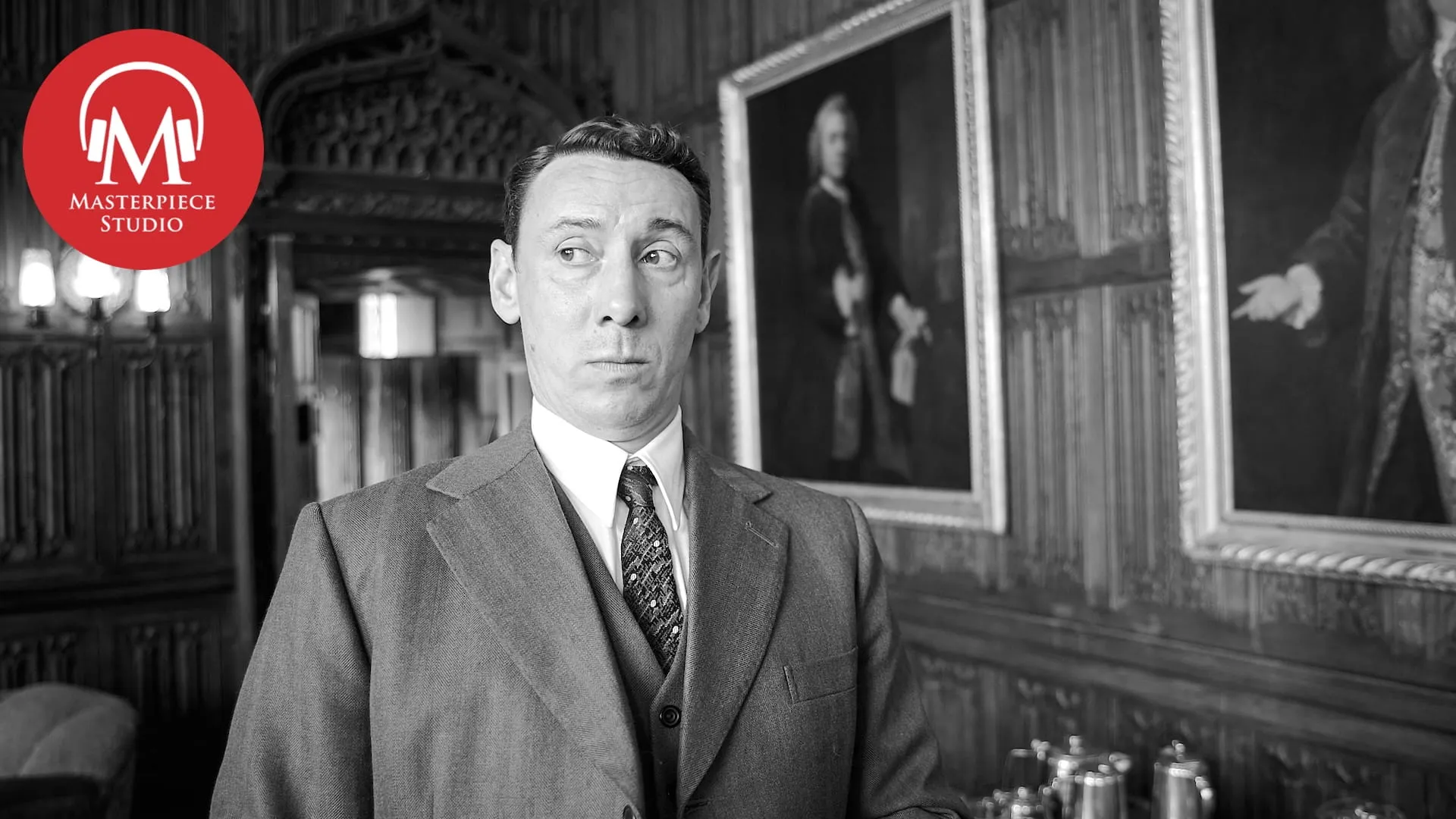
The Cast Says Farewell, Grantchester, Season 11
Released August 2, 2026 44:49
WARNING: This episode contains significant spoilers for Grantchester Season 11.
If you haven’t yet watched the series finale of Grantchester, make sure you do before listening to this episode as we’re about to discuss some significant spoilers. The final episode of the final season of Grantchester begins with many of our beloved characters’ futures hanging in the balance, and many lingering questions. But perhaps the biggest question we’re all wondering at this point is, how will we get by without Grantchester? We’re joined by Daisy Coulam, Rishi Nair, Kacey Ainsworth, Tessa Peake-Jones, Bradley Hall, Melissa Johns, and Al Weaver to bid a fond farewell to this beloved mystery drama.
This script has been lightly edited for clarity.
Jace Lacob: I’m Jace Lacob and you’re listening to MASTERPIECE Studio.
We last saw DI Geordie Keating keeling backwards, clutching his abdomen, and leaning against Alphy’s convertible for support as the life drains out of him. Crimson. The bullet wound from Dexter’s gun left a hole in Geordie that, like a vacuum, pulls Cathy, Alphy, and Larry to his side.
CLIP
Cathy: No, no, no! You listen to me, Geordie Keating…
Larry: Where is the bloody doctor?!
Cathy: …you’re going nowhere! I’m not losing you! Love you Geordie Keating!
Alphy: It’s okay, you’re going to be okay, Geordie. You’re going to be okay!
Episode 8 opens in the hospital with Alphy bringing Geordie the file on his shooter, Dexter. But Geordie isn't out of the woods yet, as he dips in and out of consciousness throughout the day.
In another part of the hospital, Larry and Alphy chase down Dexter who came to finish what he started. They get into a struggle and he slashes Alphy’s arm. Larry manages to wrestle Dexter against the wall and impale him with his own knife, but still, he gets away. Intuition sends Alphy to the church where he finds Dexter bleeding out next to the pulpit. His faith dangling by a string, Alphy contemplates letting karma run its course.
CLIP
Dexter: Thought you had a duty?
Alphy: He was my friend.
Dexter: He was a copper.
Alphy: He was doing his job.
Dexter: Still a copper!
Alphy: He had kids for God’s sake.
Dexter: I’d do it again, you know. Get that smug bastard right in his face this time. Boom!
As we begin the last episode of Grantchester, we’re left with many lingering questions: will Geordie survive? What will happen to Raymond? Will Alphy find his lost faith? What does Jennifer Peters’ future look like? Will Leonard find purpose? How will Cathy and Mrs. C reconcile their friendship and business relationship? And probably the biggest question of all, how will we get by without Grantchester?
To help us find answers to some of these questions, we’re joined by the cast and head writer of Grantchester for one final go-round. In this episode you’ll hear from Daisy Coulam, Rishi Nair, Kacey Ainsworth, Tessa Peake-Jones, Bradley Hall, Melissa Johns, and Al Weaver as they bring this beloved mystery drama to a satisfying conclusion.
Jace Lacob: And we are back once again this week with head writer and executive producer of Grantchester, Daisy Coulam. Welcome.
Daisy Coulam: Thank you very much.
Jace Lacob: So we're talking about the entirety of the series now. Geordie, after getting promoted to DCI, is shot and I feared his death would be how Grantchester would end. Thankfully he survives. Was there ever a discussion about whether Geordie would be killed or simply retire?
Daisy Coulam: The amount of times we've tried to be like, he should die, he should definitely die. And then you're like, no, because you need that moment on the meadows at the end. You need hope and you need joy. He died probably about four times in the story meeting, and we just couldn't do it. Because it's a love story and you need your two lovers alive at the end, I think.
Jace Lacob: It is ultimately, at the end of the day, a story about platonic love and to end this with one of them dead, I think would be a downer of an ending.
Daisy Coulam: Oh my God, it would just be too bleak. I think the teasing that maybe he might, is enough, actually.
Jace Lacob: I think it is. I think it is. I love Geordie leaving the hat with the note for Larry which says “I'm proud of you, son” which killed me, dead. I'm dead.
Daisy Coulam: Yeah, the hat moment, that was we were filming—randomly, it was the day James Norton came to set for a little visit. We were sitting and we said to Robson, what kind of thing would you like to do? What scene do you want? And he said, I think you should give Larry the hat. And we were like, yes, because Emma and I are obsessed with Indiana Jones. And it's basically Indiana Jones, isn't it, putting the hat on. So we were very happy. And I just think Bradley acted his socks off it. He doesn't say anything, but you really… I don't know, you really feel his pride. It's so sweet.
Jace Lacob: It's the thing he's been looking for this entire time, to get that almost parental approval from Geordie, and he gets it. And it's such a beautiful moment. Alphy nearly lets Geordie’s attacker Dexter bleed out but instead apologizes, “Please forgive me”, he says. But is it to Dexter or to God? And does it not matter in that moment?
Daisy Coulam: I think it's to both. I think it is, yeah, it's to God and to it's to him for doubting God. I love that moment as well, because it's again, the words that God said to him when he was a little boy are on that card. And you just realize, oh my God, it all means everything. Everything means everything. There was meaning all along. And so he's apologizing for ever doubting God. He's apologizing to Dexter. I love that moment as well. I love it.
Jace Lacob: I want to talk about the christening. This moment with them in the church together, is this symbolic of a new beginning, even as the series ends, this notion that the story of Grantchester might continue for these people, even if we as viewers don't get to see it?
Daisy Coulam: Yes, we were very keen to say this, I suppose. And that's why we kept Geordie alive, because we wanted to say you could go to Grantchester now and they'll be there sitting in the pub, those two. And you just want that sense that it continues on, that the river flows and the ducks swim and they're still out there somewhere having that chat. Because I think probably it was our safety net as well, that we were quite sad to say goodbye. So we just liked the idea that it's still happening somewhere.
Jace Lacob: In an alternate universe we can maybe tune in, yeah. Like many women before her, Jennifer has had to give up a job she loved to focus on motherhood, but she finds a new path doing the books at CeCe's Boutique. How did you look in this series to use CeCe's as a feminist endeavor, a symbol of the changing role for women in 1960s Britain, and what does this moment say about Jennifer's future?
Daisy Coulam: I think it's solidarity. It's women looking after women. That's what we wanted. We wanted that sense that Cathy and Mrs. C weren't going to abandon Miss Scott in her hour of need. They were going to pull her into their company. And you just think, this is great. She can get to be a mother and a businesswoman and it's a positive thing. That's what we wanted. We wanted a sense that CeCe’s will save them, I think was what we wanted. And it's so nice those three being together.
Jace Lacob: After so many seasons of searching for purpose, Leonard finally finds it in parenting both to orphan Raymond and to new puppy Dostoyevsky. How did you land on parenthood for Leonard as both salve and salvation?
Daisy Coulam: That happened very late again in the series. I think we were halfway through writing it. We were going to do a story about, he finds his purpose ministering to a dying man, and then we're like, oh gosh, this is so bleak. And Emma just said… she finished a meeting one day and he said, Daisy, can I keep you on the line? I was thinking, oh, no, I've done something terrible. She said, I know it probably wouldn't have happened back in those days, but they should be a family. And I was like, of course they should be a family! Of course they should. And we just decided to embrace the fact that it's unlikely in the ‘60s that two men would have been allowed to be alone with the child. But it's so perfect for Leonard because it's meaning and it's family and it's everything. And also it's about that whole community coming together to bring up that child, which again, was that idea that in microcosm, you help each other. So I was so happy. And that little kid is so good.
Jace Lacob: So good.
Daisy Coulam: Yeah.
Jace Lacob: There is a clear sense of book ending in the final episode that mirrors the very first episode: Sidney and Alphy each driving through the village. A vicar getting ready in the vestry. “Backgammon, it's the game.” The Grantchester meadow and that old rope swing. Was there a deliberate effort to mirror that first episode as we close the door on Grantchester for the last time?
Daisy Coulam: Yeah, I went back to this first script, actually, and I also went back to the first episode, which feels so long ago now when you're looking at Sidney and Amanda playing around in a river, you're like, God, I'd forgotten those two. We went back and the director went back and watched it. And actually it's almost shot for shot, that final section is almost shot for shot of the first episode. So it's kind of like an Easter egg for the fans really. And we just loved the idea that the rope swing… I was saying we've got to get the rope swinging somehow. Because yeah, nothing good happens on rope swings, but we know a whole 11 series came out of a rope swing. So it was for us and it was for the fans, I think.
Jace Lacob: I love it. It is crazy to think back about that rope swing and the beginning of Grantchester and that's how the show begins. And I love that it's there at the end. And it all comes down to that rope swing. I love it. It's such a sweet thing. It's such a sweet thing. I'm not going to get emotional. We're left with Alphy and Geordie in the meadow heading for another drink and another chat forever changed from their experiences. We've got family and friendship. We've got identity and acceptance here. What ultimately is the message you hope viewers take away from Grantchester overall?
Daisy Coulam: Friendship, I think. Emma said to me, you realize you tap into loneliness quite a lot in your storylines. That last episode is about a group of people who were once lonely, who found each other and aren't lonely anymore. And I just think kindness, and being kind to people, and friendship, I think that's what it is really is just just be kind, dammit. If we can't be kind, then what can we be, really? And I think that's how I feel about the show as a kind show to work on, and I'm not sure I'll ever get that again really.
Jace Lacob: So for the final time for Grantchester, Daisy Coulam, thank you so very much.
Daisy Coulam: Thank you.
Jace Lacob: And we are joined once again by Grantchester star Rishi Nair. Welcome.
Rishi Nair: Thank you very much for having me, pleasure to be here.
Jace Lacob: So, not surprisingly, Series 11 puts Alphy through his paces as he experiences a crisis of faith after learning that Mira has a family of her own. Episode 4, which depicts the murder of a passenger on a train, brings not only the daily microaggressions that Alphy as a person of color faces, but overt racism. How does that moment on the train where he can't convince anyone he's a vicar further shake him?
Rishi Nair: Yeah, it's a pivotal moment, that, isn't it? Because we all know that someone on that train is the murderer. And when they all start pointing their finger at Alphy and he tries to explain to them, "I'm a vicar," and they don't believe him. I think it's just frustration for him. I also think he's been here before. I don't think it's anything new for him, I don't think he's shocked by it. But equally these kinds of microaggressions, these forms of racism that we see, I think Alphy has dealt with this throughout his whole life and yeah, it's frustrating and he's angry and upset but what can he do really? He's tried to explain himself and they don't believe him and I think it's only after more secrets come out about the train conductor and the other guys on the train that they then start to believe him. There's not much he can do really.
Jace Lacob: Alphy's struggles with drink, gambling, and loss of faith culminate in a hostage situation at CeCe's Boutique and ultimately Geordie getting shot in the gut. And Alphy doesn't pray for Geordie, he didn't even have time to, but there is a question in the air, one that Geordie himself raises: wouldn't a vicar on good terms with God have found the time?
Rishi Nair: I think that's only one of a few things that happened throughout this season where Alphy questions whether he should actually be a vicar anymore. He has a conversation with Leonard during the siege as well when they're outside and Alphy's questioning one, his faith and if he's questioning his faith how can he be a vicar? How can he preach if he doesn't believe in what he's preaching in? And yeah that comment from Geordie is just another comment that cements that thought process and that doubt in him which obviously is huge for Alphy as it's all he's ever known.
Jace Lacob: We come to my favorite moment in this final episode when you deliver a truly stunning monologue about Alphy seeing God when he was 10, one that captures really gorgeously all of his feelings about being a sinner, about being abandoned, and about finally seeing God's light.
CLIP
Alphy: I saw this light, this beautiful white light all around me. It was warm and gentle and all of that pain, all of that loneliness and the anger, it just…it went. Just left me. He spoke to me. It doesn’t matter now what he said but the upshot is now, I’m not seeing Him any more. I’m not seeing the light.
Jace Lacob: What did you make of this monologue and what does it capture about Alphy?
Rishi Nair: It was a really beautifully written monologue. And we spoke about different ways in which we could have played it. Rob Evans, our fabulous director who is so invested in the scripts and into every single word on the script. AndI had a really good conversation with Rob. And we did a couple of different takes on it. And I think the take that we went for in the end was Alphy just just telling the story, just kind of this is it, this is the story I've had and being abandoned and seeing God's light and the reason why I don't have my faith anymore is because I'm not seeing that light. This thing that I've held onto my whole life, this moment that I had when I was younger where I spoke to God, and I became this vicar. And obviously if you feel like you've spoken to God and you've seen the light, you believe it, you have faith in it because it's happened to you. And now if you're not having that anymore, you're not having that experience or you don't believe in it anymore, it all doesn't really mean anything. So yeah, a really huge moment for Alphy.
Jace Lacob: Alphy debates whether to save Dexter who is bleeding out on the floor of the church or to let him die. But Geordie stumbles into the church with a story.
CLIP
Geordie: There was a boy who nobody wanted. He was passed from pillar to post. He was all alone in the world. No one loved him. No one cared. So he lashed out. Stole to get attention. Made himself mean and hard. Because if no one was going to love him, he’d sure as hell give them a reason not to.
Jace Lacob: Which is Alphy and Dexter's story. He says,
CLIP
Geordie: It’s how we pick people up afterwards. That’s what matters. How we help them to stand back up. Love the sinner, hate the sin. What was it God said to you? When you saw him?
Alphy: Even when I feel furthest from you, I am near.
Jace Lacob: Is this moment here in the church the very core of Grantchester?
Rishi Nair: I think so, I think it is. Obviously Geordie stumbling through the door is a shock to Alphy, Alphy thinks he's dead. I think just seeing Geordie and they embrace because he's helping Geordie who's falling to the ground because obviously he's still very much injured. I think seeing Geordie, holding him in his arms, kind of snaps him back into Alphy I would say, into reality of what's happening.
The story that Geordie tells is a story of hope. It's Alphy's story which is also Dexter's story. And I think in that moment Alphy realizes that he could have been Dexter and Dexter could have been Alphy. They're both a product of their environment and they've gone on two different journeys of course and end up in two different places but they essentially come from the same place. And I think that realization for Alphy is a really pivotal moment and we see him have that moment of realization and he runs over to Dexter and asks for forgiveness first from Dexter but more importantly he asks for forgiveness from God. And I think in that moment we see him find his faith again.
Jace Lacob: Rishi Nair, thank you so much.
Rishi Nair: Thank you for having me.
Jace Lacob: We are here once again with Grantchester star, Kacey Ainsworth. Welcome.
Kacey Ainsworth: Hello.
Jace Lacob: A robbery at CeCe’s in Episode 7 turns into a hostage situation and the truth comes out about Switch. Cath had made him a signatory at the bank, which he used to pay off some debts he owed to a consortium. He’s a crook, Sylvia is furious, and Cath says, "It was just nice to be listened to, he was interested." How much is her heart broken here?
Kacey Ainsworth: Oh, I think the shame and feeling so let down and feeling a "patsy" to use an American term, feeling such a fool, feeling such a fool. Just awful. I mean even sitting here now I’m like, "Oh, that would just be dreadful, that would break your heart, wouldn't it?". And I think yeah, she definitely feels like she’s let everybody down. Everybody—Geordie, Mrs. C, Jack, Esme, the kids, everybody. She’s let everybody down and let her ambition overtake her sense of propriety and what’s right from wrong. And that’s never a nice lesson to learn, that’s a very bitter taste.
Jace Lacob: We’ll use a Britishism here; she feels a mug, a right mug.
Kacey Ainsworth: Definitely, yeah. I can say she feels a patsy and you can say she’s a mug.
Jace Lacob: Geordie survives the shooting, and Cath apologizes to Geordie in hospital about Switch and says that this was just a silly fantasy. And I love what Geordie says,
CLIP
Geordie: You don’t pull the wall down if there’s a crack in the plaster, do you? Someone very wise once told me that.
Cathy: Who was that then?
Geordie: Oh, the name escapes me now but she was very beautiful and glamorous.
Cathy: And clever?
Geordie: Cleverest person I ever met.
Jace Lacob: And it is this beautiful callback to Cath’s advice in Series 2. What was it like shooting this scene with Robson?
Kacey Ainsworth: Shooting all of those scenes in the hospital, my God they were difficult but so perfectly written. There was nothing extra that was said, it was all so clear. And that’s what I think happens at times where you come to a point where all bets are off. So when something terrible like that happens, any notion of blame or upset, that just goes because you have to get, again this is where Cathy and Robson or Geordie work—they get to the nub of it, they get to the heart of the point. Which is yes, you don't do that, you don't throw out all of these years because someone’s been foolish, but also don't throw away all of the good stuff that you had as well.
And it is a really beautiful sentiment because we all feel like that—something terrible happens, we all feel the guilt, the pain, we shouldn't have done this, we shouldn't have done that. But the lovely thing is, is that he doesn't berate her. He allows her to have this beautiful compliment about the great things that she did rather than the bad things. And that positivity is probably what got them through, really.
Jace Lacob: What will you miss most about playing Cathy Keating?
Kacey Ainsworth: Everything! Everything I will miss. I’ll miss the cast, the crew, the summer, the excitement of getting the scripts, seeing what’s going to happen with your character, the costume fit which I have adored. Cathy’s clothes are incredible. Louise Page, our costume designer, is—and Louise has been with us for six seasons I think it is—she’s absolutely a stickler for everything being exactly right for the period, but also has made Cathy so stylish over the years. And all of the little finishing touches that she did with blouses. And then obviously when we’re going into CeCe’s it being much more about fashion and what was fashion forward at the time. Just everything I will miss. I will miss the people and I will miss the summer. We know that we’re coming up to a summer where Grantchester isn't going to be for us to film, and that's going to be tough. We’ve always said it’s going to be tough.
Jace Lacob: Looking back, what would you say you’ll cherish as your happiest memory of working on Grantchester?
Kacey Ainsworth: Well, we always say it’s our happy place. So, the most cherished memories are obviously the things that go wrong on set because that’s always quite fun. When the dogs are—well, Dickens is quite good but we have had some dogs that haven't been quite so well behaved. Watching the kids grow up, because obviously a lot of the kids started when they were like four or five and we’ve pretty much kept the same three girls. So watching them grow up and grow into young women in today’s world and then setting them back into the 60s.
But yeah, I will miss the summers, I will miss the summers in Grantchester. And the changes, the changes to the village—I mean, my goodness, if you’ve seen the village when we first went there and what it looks like now. It’s got three pubs, a gin distillery, a coffee shop, and a Michelin-star restaurant. But it’s also still got the beautiful meadows and the cafe there and the river Cam. So it’s really changed a lot. And I again also enjoy going back there because we still see the local people who’ve been there, who’ve lived there the 10 years that we’ve been there. So much to miss, really, but also feel very lucky to have had it.
Jace Lacob: Kacey Ainsworth, thank you so very much.
Kacey Ainsworth: Thank you so much, thank you.
MIDROLL
Jace: We are joined by Grantchester star, Tessa Peake-Jones. Welcome.
Tessa: Hello, thank you for having me.
Jace: Thank you for joining us. After working on an astounding 11 series of Grantchester, having this show become such a huge part of your life for more than a decade, what did it feel like on set for your final day of shooting?
Tessa: Well, it was a complete mix actually. It was very, very sad. But of course, you're working, you're still playing the characters, you're playing the plot lines, it was Episode 8, everything comes to a rather huge head. So, you can't put that aside, you have to get on with the work, even though at the beginning of the day we were all saying, "Oh no, it's the end!" And at the end of the day we said that, but in the bits in between, the job has to be done. So, it was rather lovely because they did make sure that the very last scene of the day all of us were in. So, that was really nice. So, it meant the people who'd started off 11 years ago ended up acting together on the very last afternoon. And we did have a lot of photographs taken, lots of selfies, lots of group hugs. When they finally said, "And that is a wrap," we did all gather together in a group, we huddled and we cuddled, and we all cried because it did feel like the end of a rather marvelous era.
Jace: Family is at the heart of Grantchester, this found family that brings them all together. Mrs. C can't quite wrap her head around Leonard and Daniel raising Raymond.
CLIP
Mrs. C: Two men isn’t a family, Jack.
Jack: But it isn’t just two men, is it? It’s two men and you and me. And Alphy. And the Keatings. It’s the people in the village. Old Mrs. Salter from next door.
Mrs. C: Mrs Salter is a sour-faced trout.
Jack: Maybe not Mrs Salter then. You can teach him to cook. I’ll teach him golf, and medieval history, and how to make a perfect Old Fashioned. Grandpa and Grandmama.
Jace: What goes through Sylvia's mind here?
Tessa: That saying about, "it never takes one or two, it takes a village to raise a person," is absolutely true, isn't it? If you're lucky enough to have that support as a parent, whoever you are, whatever your circumstances, if you're lucky enough to have family around you, people who support you beyond just yourselves, your mum, your dad, whatever, you're so lucky in life. And I think for him to say that, particularly in that period of time, is so advanced thinking, isn't it?
And I think it does make her think. She's very quick to make up her mind about things, and the lovely thing about this is that Jack is able to balance that. He's able to say, "No, but wait a minute, think about this point of view." And instead of, as she probably would have done 10 years ago, "No, no, no," and would have carried on, she listens and she comes to understand that actually, that's exactly what will happen. This young boy will be brought up by everybody, and we will all take great care because that's what we do in this program. And I think that's really, really heartfelt and lovely.
Jace: Your relationship with Al Weaver goes way back beyond the start of Grantchester to being his mentor in drama school. What is it like knowing that for the first time in over a decade, he won't be trying to ignore you in the car on your way to set?
Tessa: Yes, and he'll miss that! Well, he messaged me the other day and said this is the first summer for 11 years we're not going to be acting together. He didn't then say, “or traveling in the car together”, so perhaps that bit he won't miss. Yes, it's going to be really—because I first set eyes on him and watched him acting when he was 21, and he's done so much since, and I can't tell you the joy it's been acting with him each year, and watching him grow, not just as an actor, and a very fine actor as Leonard, but as a director, because he's directed quite a few of Grantchester over the years now, and he's so good at it. So, it's been very lovely, and I feel a bit like Mrs. Chapman clocking away with pride to watch Al developing as a director as well as a very, very good actor.
Jace: Tessa Peake-Jones, thank you so very much.
Tessa: Oh, it's a great pleasure. Thank you for talking to me.
Jace Lacob: And we are back with Grantchester star Bradley Hall. Welcome.
Bradley Hall: Hello again.
Jace Lacob: So by the end of Episode 8, Larry has gotten his happy ending. His marriage to Jen is out in the open, he's a sergeant, he's a father. What do you make of where Larry ends up at the very end of Grantchester?
Bradley Hall: Episode 8 is fantastic. It's pitch-perfect, it's pitched so well, and it's never anything more than it needed to be. It's the group of characters all having these quiet conversations with each other that tie up a lot of the show and sum up a lot of the show. And when it looks like we don't quite know where this will end, all the characters are just there and they're all supporting each other. It was so well done because it's the only episode of Grantchester that I've done, and I think it's probably the only one actually ever, where there's not a murder to work out. It's all of the ensemble regular cast and they're all just concluding their stories.
There's a moment where I think we see Larry and he's in the same station, he's at the same desk, but he's a completely different man now. And the particular moment that they've got in the police station, it was incredibly emotional to film because it was a real moment for Larry to fully show his evolution and to complete. He becomes complete in that last moment. And I think the future of Grantchester is not obvious at that point, but Geordie's taught Larry everything he needs to know, and his life experience within the village, that's taught him how to be the man. So now it's Larry at his same desk, he's a new man, and it's now up to him. Is he going to echo Geordie? We have to hope that he's a fraction of the detective that Geordie was.
Jace Lacob: I love the scene where Geordie, recovered and now retired, leaves a present for Larry and it's his hat along with a note, "Proud of you, son." And I love the fact that Larry puts the hat on and there is such a beautiful, bittersweet happiness that flickers across your face. What went through your head in that moment when Larry puts on Geordie's hat?
Bradley Hall: It felt like such a weighty moment. In the script, it's literally described just like that, it's “Larry puts on Geordie's hat.” So I'm going, "Oh no, there's so many things that Larry would feel in that moment and it's probably going to be reduced to maybe two or three beats of storytelling." I think he's so shocked by it. It's kind of like a rug that's gone from under his feet and his legs have kind of gone a bit wobbly. And it's then, what does this mean? What do I need to do now with this? And it's the full responsibility, I suppose, of the station and of being the man that Geordie wants you to be now, and what the village now needs you to be.
And also he's not going to have Miss Scott to his left on that desk, and he's not going to be looking forward and seeing Geordie in the office in front. It's Larry, and he's the one that's there now. And it's up to him to make sure that the station keeps going. And it's a huge moment of feeling so proud and feeling so hopeful, and also a huge amount of responsibility of, "I've got to make sure that I don't crash this train." That's basically it.
Jace Lacob: Finally, this is a big question but an important one; what will you miss most about playing Larry Peters?
Bradley Hall: It's been a really important job for me and my career. It's my first recurring and regular role. And the amount that Larry learned from the station and from the village, I feel like Bradley learned from the cast and the crew. It was so important for me. And I did feel like a boy when I started that, and I do now feel like I have grown into a far better actor, and I feel like I am ready now for the next chapter.
And I also believe in myself now. I spent a long time not really fully believing in myself. And I feel like this show's enabled me, given me the chance to direct. That was a huge boost for my confidence, and I can do stuff. And I will now take that and I'm so looking forward to the next job where I can use all the stuff I've learned and I'll be a better person from it, and I'll be a better actor because of it. Grantchester, it's been a dream come true.
Jace Lacob: Bradley Hall, thank you so very much.
Bradley Hall: Thank you, Jace.
Jace Lacob: And we are back once again with Grantchester star, Melissa Johns. The final montage of Grantchester shows Jennifer having given up her job at the police station, now overseeing the books at CeCe's. Here, she's got Cath and Sylvia and her baby by her side. Do you see this as the ultimate feminist moment within the show, a community of women from various generations supporting each other in a business that they own and run?
Melissa Johns: Absolutely, with a fourth generation of the baby just there at the side. It's amazing because, as you say, three women that we've watched grow throughout all of these seasons, and we've watched the lives they've lived and the difficulties that they've had to overcome, actually being in such a powerful position of making their own money, and making waves, actually. Not just getting a job that means that they can pay bills, actually doing something that properly lights their fire. And Miss Scott loves a desk. She loves organization. She's going to have that with the baby next to her. But, also in an industry that she clearly loves. Let's talk about the fact that Miss Scott's wardrobe is just incredible. Fantastic Louise, who is our costume designer, is just amazing. And so I think it makes complete sense that, yes, she may not be a fashion designer with a baby by her side, I don't think that's what she wants, actually. But, in an industry where we know she's very good at fashion, because our designer, Louise Page, has made sure that she's very good at fashion.
So I think it's perfect. Once again a reflection from the '60s to 2026. The other day I was in London, I had to go to the Houses of Parliament for a campaign that I'm supporting, and Ottilie, my baby, came to Parliament with me. She sat at the head of the table at one point, which I thought was fantastic. So, it just shows that there have always been women that will make sure they do what needs to be done. And, Miss Scott is that through and through. So that final montage is super special. That was my final scene to shoot, and I was very fortunate that Daisy came for that final day, and Emma, brilliant Emma and Dan, our producer, were there for my final wrap, which was lovely. What a privilege.
Jace Lacob: What would you say you'll cherish as your happiest memory of working on Grantchester?
Melissa Johns: My happiest memory on Grantchester, it's such a hard one, isn't it? Because how do you sum up our happy place? It's something that we all call the show, it's our happy place. It's where we've spent every summer for years. We've filmed from July until November, and it's been our summers. Apart from the love and the laugh and the family and just the most gorgeous team of people working together, I can't say anything other than my relationship with Bradley. He is just one of the funniest, kindest, most wonderful—it's so hard to explain Bradley. You know when you think so highly of someone that the words don't quite do it justice? But there are so many wonderful things that I have got from this show and, as I say all the time, my friendship with Bradley will always be the thing that tops it all. And I will so, so miss not spending my summers with him, not having him knock on my trailer door, not spending our lunches together putting the world to rights. So we're just going to have to make another show that the two of us are in, that's the only way for it, unfortunately.
Jace Lacob: Oh, I can only hope for that. Melissa Johns, thank you so very much.
Melissa Johns: Thank you.
Jace Lacob: We are joined once again by Grantchester star, Al Weaver. Welcome back.
Al Weaver: Hello, hello.
Jace Lacob: With all of the images from this final episode that mirror the beginning of Grantchester, were you ever tempted to reprise your introductory mustache for a scene in the final episode?
Al Weaver: You know what, I did ask. I did ask.
Jace Lacob: Did you? Did you?
Al Weaver: Yeah. Yeah, I did. I did for the final season. I was like, I think he should have a mustache, and they were like, "Absolutely not." I was like, okay fine. So that was that.
Jace Lacob: I would have loved that.
Al Weaver: Me too. I have a mustache. Well, I have more of a mustache-y beard, but yeah, it was a no-go. It was a no-go.
Jace Lacob: Leonard has doubts about being a father. He says,
CLIP
Leonard: When I came here, I had no one. I had nothing. I liked books more than people. I was terrified of people to be honest. But then I found a family and love and you. Perhaps that’s enough.
Daniel: You had no one. I had no one. Soon Raymond will have no one. We were all alone. We all found each other, Leonard. It’s rather wonderful really.
Jace Lacob: What did you make of this gorgeous scene with Ollie?
Al Weaver: Well again, Ollie comes to the rescue. And I think it's very truthful of Leonard, because he does have these, "I'm doing this, we're going to do this, and da da da," and then he'll be like, "Oh god, what have I done? I can't do it." And then he needs assurance that he's not mad, and that he can do it, you know? Like a lot of us, I think it's very truthful, and I think it's just a gorgeous scene about two people who give each other strength. When they lose faith in themselves, they need someone to just go, "You can do it. It's okay." I think that line about "I was alone, he was alone" it's true. I think everyone came to Grantchester, and they were alone. It’s kind of true of everyone, really, isn't it?
Jace Lacob: Then they all made this found family.
Al Weaver: Yeah.
Jace Lacob: He does, he finds this sense of belonging in this found family. And he, Leonard, ends the show with a family of his own, a partner, a child, a dog perfectly named Dostoevsky. And he finds the purpose he's been seeking in parenthood, in caregiving. What did you make of this as an ending for Leonard Finch?
Al Weaver: I honestly thought it was the best ending. I can't think of a better ending at all. I think people will be really, really happy. I think he can be happy now, because finally, even though he's got Daniel, but Daniel's strong in his own right, and he can manage by himself. But, that Leonard can take all that goodness, all that humor and wisdom and idiosyncrasies that he has, and give it to Raymond, I think is just gorgeous. I was so happy when I read that when they told me that that's what we were doing. And then when I saw those episodes, I just thought, you know what, that is the best ending ever. Like, completely just landed the plane. Gorgeous. And it was beautiful to play.
Jace Lacob: So, big question time. Working on the show has anchored the rhythms of your life for over a decade. And in addition to acting, it allowed you the opportunity to direct for television, and explore a whole other aspect of your career. Looking at this holistically, how has Grantchester changed your life?
Al Weaver: Just completely. I think when we started this show, I was a bit of a mess in myself, and by the time we finished it, I grew up. I'd taken ownership for myself, I'd faced things that I didn't dream I'd do, like directing and having younger actors come in and be there for them. And just my whole outlook on life, I think, has changed. My whole outlook on my career has changed. I think it brought me a lot of humility, a lot of gratitude. Just a huge gift, friends that I will have forever. They really are like family. It's a beautiful thing.
And we never would have done that many seasons if it wasn't because of that, if it wasn't because of the people. And everyone felt that. Everyone felt that. If I ever get a job like this again, I would be very surprised. I would be very surprised if all the stars that aligned when we did this show, I would be very surprised if that ever happens again. And Tessa and Robson have had longer careers and this is my first long-running TV show, which I never thought I'd do, but that says a lot about the people and the writing and everything about it. So, I can't say any more than that, apart from it's made me a better person, and I'm very, very thankful for that.
Jace Lacob: Al Weaver, thank you so very much.
Al Weaver: Thank you. Thanks a lot. I really appreciate that.
Join us next time for a special video interview with Grantchester lead Rishi Nair as he looks back at what this beloved mystery drama has meant to him.
Grantchester Podcasts
10 More Podcasts




MASTERPIECE Newsletter
Sign up to get the latest news on your favorite dramas and mysteries, as well as exclusive content, video, sweepstakes and more.