
CHRISTI DEEGAN (speaking to marriage workshop): So one of the topics the church talks about is living together, cohabitating…
JUDY VALENTE, Correspondent: These young Catholic couples in Chicago are attending a marriage preparation workshop required by their church.
DEEGAN: And this is always such a hard topic to talk about, because the church teaches, you know, wait to have sex until you’re married, right?
VALENTE: Despite that teaching, half these couples may already be living together.
(speaking to Catholic couples): No guilt about your decision?
 MAN: No, it never really came into play for me.
WOMAN: We’re both artists, we just don’t have—we can’t support ourselves on our own.
MAN: It’s important to get to know the person as well as you can before you get married.
WOMAN: The priest didn’t say anything bad. They didn’t ever say that we shouldn’t be living together. There was no condemnation.
VALENTE: Sex outside of marriage, divorce, homosexuality. For many Catholics, these no longer hold the stigma they once did. Catholics disagree with the church on a variety of other issues. The vast majority of Catholics say women should be priests, and according to a recent survey 58 percent said abortion should be a personal decision. The bishops keep talking about these issues, but fewer Catholics seem to be listening. What’s a pastor to say to the people in the pews?
REV. PATRICK LEE: It’s like being a parent to be a pastor. You never give up on your children, but you keep holding the ideal and explaining the ideal and hoping people will strive for it, but not condemning them when they fall short.
VALENTE: With so many Catholics going their own way these days, the role of pastor is perhaps more complicated than ever.
 Rev. Patrick Lee |
REV. LEE: When I was growing up, the church was the ideal we tried to change ourselves to match. Now people want to change the church.
VALENTE: Father Lee is the pastor of two parishes in Chicago. Most of his parishioners are highly educated, and they represent a diversity of views about church teaching.
REV. LEE: All authority is being questioned in our times. Some of it selfishly, some of it enlightened. I think Americans are more comfortable in an educated democracy now, and so they want to spread that democracy to the church, which has never really been a democratic organization. I think we have to be open to a dialogue of understanding what the church teaches and really hearing it and not dismissing it instantly. On the other hand, I think the church has to open itself to the wisdom of its laity.
JOE MURRAY: I’m a Eucharistic minister, and I’m a lector and an usher, when need be.
DENNIS KLUGE: I’ve been on the parish council for several years, but also I’m a lector, commentator, Eucharistic minister, and the lead bass in our church choir.
VALENTE: Joe Murray and Dennis Kluge have been a couple for 31 years. They are active members of Father Lee’s parish.
MURRAY: I understand where my pastor’s coming from, and he understands where I’m coming from, and on that topic we do not necessarily agree, but that’s okay because we respect each other.
 Joe Murray and Dennis Kluge |
KLUGE: I think it’s important that Joe and I just approach it as we are just two guys coming to church and we’re just here to worship like everyone else, and we get involved, people get to know us, and so we’ve never, at least personally I’ve never felt excluded.
MURRAY: Women probably have more of a reason to be angry at the church than we do, because we’re not allowed marry, but they’re not allowed to become priests. They’re told that because of their biology, that’s excluded for them.
VALENTE: As at many parishes, women in Father Lee’s congregation aren’t shy about expressing their disagreement, but they remain practicing Catholics nonetheless.
MARY ANN TRAUSCHT: I personally stay in the church because I believe the basic tenets that are taught, and what I disagree with are man-made laws, not what Jesus taught.
VALENTE: What about artificial birth control? Do you know women who’ve left over that?
KATHRYN CUNNINGHAM: Most of the women I know are doing what they need to do and not talking about it.
VALENTE: A good number of Father Lee’s parishioners are divorced and remarried. If they have not gotten their first marriage annulled, the church says they may no longer receive Communion. This is often ignored.
REV. LEE: If they want to receive Communion I explain to them why they’re asked not to receive Communion, and if they make the decision they feel they want to receive Communion, I have to honor their conscience, if their conscience is informed.
 VALENTE: “Informed conscience” is something Catholics are increasingly citing as support for disregarding official teaching. It means, in essence, that one has studied church teaching, reflected on it, and concluded that the teaching can in good conscience be rejected.
(speaking to Rev. Lee): If your conscience is telling you this is not a sin, but the church’s teaching says it is a sin, and you know what the church’s teaching is, then where do you stand?
REV. LEE: If you take exception to a church teaching, you better have a pretty good reason and not just “it’s because I want to do this.”
VALENTE: Reconciliation refers to the sacrament of forgiveness that used to be known as confession. Father Lee waits in the confessional every Saturday. Some days, no one comes.
(speaking to Rev. Lee): Do people know what sin is?
REV. LEE: I think they do. I think our whole being tells us when we’re being sinful. It’s unpleasant to deal with our own brokenness, and yet for those people who are brave enough to take that step, there is such healing in that sacrament that I can’t imagine my life without it.
VALENTE (speaking to Joe Murray): In your view, is it possible to be a faithful Catholic and yet disagree very strongly with some church teaching?
 MURRAY: You can be faithful, and you can dissent. Dissent is challenge, and had we had more dissent, public dissent, we may not have had to have gone through what we’re going through in terms of the clergy sexual abuse.
VALENTE (speaking to Rev. Lee): Is this new round of scandal making it more difficult for you to be a pastor?
REV. LEE: It makes me feel ashamed. It makes me look at that clerical culture of secrecy and say this is unhealthy. It needs to be blown open.
VALENTE: Recent allegations about that culture of secrecy have rekindled outrage at the institutional church. But people make a distinction between the Vatican and their own parish.
KLUGE: That’s the big church. The little church is really where my heart is, alright?
MURRAY: You have to define what church is for us. The church is our parish, so our experience of church is through the parish.
REV. LEE: I think part of it is the strength and beauty of the Catholic culture. I don’t think it’s a religion like some religions. I think it’s in your bones.
CUNNINGHAM: Women and some other people who have left the church come back to the church. Whenever they’re asked why did you come back, they say not having the Eucharist, something was missing. That brings them back. That hunger brings them back.
REV. LEE (preaching to congregation): We see the love of Jesus when he meets sinners in the gospels. He doesn’t condemn them. Instead, he invites them to come and accept healing, to come and accept forgiveness.
It’s certainly an important role to be compassionate, to draw people in from wherever they are into a closer relationship with Christ, and so you don’t achieve that by throwing up barriers and saying you can’t belong, you’re excommunicated. That strikes me as not terribly Christ-like. I’m the shepherd. I have to get the strays and keep nipping at their heels to get them back into the flock, where they’ll be safe.
For Religion & Ethics Newsweekly, this is Judy Valente in Chicago.
 ALLY HOFFFMAN: I tell Scott that I can tell who’s been here longer because it’s almost like watching something flower.
 SEVERSON: He had been just passing through, a backpacking tourist, but within a year he had given up his very lucrative job as a president of a division of Sony Pictures, his multi-million-dollar home, his fancy cars, his yacht.
 SEVERSON: Because so many people need medical care CCF built a clinic not just for the youngsters, but for their families.
 NEESON: These kids are feral. They don’t have a place to stay, so we bring them in and feed them.
 JIM GIANOPULOS: You know, we all want to change the world, and when we approach that effort and try and implement that desire, you know, you realize that it is very difficult to change the world. But what Scott has done is change a little piece of it and completely changed it for these kids.
 SEVERSON: At the awards ceremony Neeson was asked about his recent fund-raising trip to America.
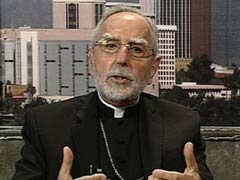 Bishop Gerald Kicanas
 ABERNETHY: Bishop, remind us again of what the church says, what Christian teachings say about the stranger.
 MARY HELEN BERLANGA: No, never, and I think if you look over the 300 amendments you’re going to see that it is pretty much a rewrite of the original book that was given to us.

 SEVERSON: The teachers review committee recommended changing the word “expansionism,” as in American expansionism, to “imperialism.” The board rejected “imperialism.”
 SEVERSON: So board members met with the book publisher and got the title changed from ‘Nightmare at Omaha” to “A Day for Heroes.”
 ZAKIA KHAN (speaking to Bilal): So 5 is closer to 7, or 10 is closer to 7?
 ZAKIA KHAN: Over there we know that everything is Islamic-based, but over here we don’t see Islamic way of life outside the house.
 FAW: Are they getting a good education? Meena excelled in public school before starting home schooling four years ago. She studies totally on her own with the help of a curriculum for home-schoolers. It takes discipline, she says, but she feels she’s doing even better here than she did in public school.
 MIKAEEL JAKA: Today I got my car checked in, and I also got a patch, and I watched a lot of cars go down. It was really cool.
 JUNE CHURCHILL: I can remember you going into your bedroom and a squeal came, “Grandpa, there’s a dead mouse in my shoe.”
 LAWTON: Renol showed me the changes to the mission house. The house sustained only slight damage during the earthquake, including some cracks on the roof, and a small part of the compound walls came down. Renol told me all about my grandpa’s influence on the mission, in big ways and small.
 Elison told me my grandparents had a big influence on him.
 LAWTON: But there were happy stories, too. After my appearance at church, old friends came to say hello. Some remembered when I had come before; others wanted to meet the Churchills’ granddaughter, or as they called me, “petite-petite fille Churchill.” As word of my visit spread, one old friend drove in from Port-au-Prince to see me.
 LAWTON: Immediately after the earthquake, injured people flooded to the clinic from miles away seeking medical treatment, and many patients are still getting follow-up treatment.