
Go behind the scenes with Kim Lawton and the Religion & Ethics NewsWeekly crew as they returned to Haiti to follow up on the aftermath of the earthquake. Photos and video by producer Gail Fendley and cameraman Greg Hotsenpiller.
Author Archives: Fred Yi
Listen Now
Listen to this episode now:
[powerpress]
Arguing CLS v. Martinez
Watch the scene on April 19 following oral arguments at the Supreme Court in Christian Legal Society v Martinez. Listen to comments from Stanford University law professor Michael McConnell, who represented the Christian Legal Society chapter at Hastings College of the Law; Barry Lynn, executive director of Americans United for Separation of Church and State; Mathew Staver, dean of the Library University School of Law; Christian Legal Society president T. Ryan Elder; and Gregory Garre, who represented the University of California’s Hastings College of the Law.
My Jesus Year
BENYAMIN COHEN (Author of “My Jesus Year”): I grew up in the heart of the Bible belt in Atlanta, Georgia, one of eight children, the son of an Orthodox rabbi. I’m the only one that didn’t go into the family business. They are all rabbis or married rabbis.
I was always jealous. I grew up across the street from a Methodist church, and literally my bedroom window looked out at the church parking lot, and every Sunday morning I would see it was packed, and living in the Bible belt there are churches on every street corner, and their parking lots are full every week. Maybe I could go to church—not to convert to Christianity. I wasn’t interested in that. I wanted to go to find out what got people excited about worship, what got people excited about their religion. Maybe I could go and tap into that spirituality and find out the secret that I was never taught growing up, and maybe I could bring that back and apply it to my own Judaism.
Here’s one thing that I learned. I haven’t even walked into a church, and here’s already one thing I could write down and tell my rabbi—first-time visitor parking. I’m not talking about bringing Jesus into the synagogue. It wouldn’t hurt, it wouldn’t kill you to put a little first-time visitor parking sign in the parking lot.
I didn’t know going to church that they talk about the Old Testament. I assumed Jews have the Old Testament and Christians have the New Testament. I didn’t realize they have both, and this pastor got up and started giving an Old Testament sermon, and the way he was describing his interpretation was completely antithetical to what I had learned growing up. What came out of that moment was that I didn’t realize I cared so much about my own Bible.
At this Episcopal church they had a ritualistic service every week, and they had these nice traditions, and I was like that’s such a nice, sweet thing to have traditions and ancient rituals. I was like that sounds familiar. We have that in synagogue, and it kind of made me look at my own rituals with a new, fresh perspective.
Orthodox Jewry and Mormonism have a lot in common. We are both minorities in America. We both have special dietary—they can’t drink caffeine, and we have to keep kosher. They wear special undergarments, we wear special undergarments. There’s a lot of laws that dictate all their lives, and so for me I felt a real kinship with the Mormon community, and I went knocking door to door with these two female Mormon missionaries, and their conviction, these are girls 19- and 20-years-old, and their conviction for their religion was just awe-inspiring to me. I’m sure the woman whose house we were visiting, I’m sure she’s wondering why the Mormons brought their accountant with them. You know, what is he doing here?
I was feeling guilty at the end of the year that I kind of strayed from my own religion, and so I wanted to cleanse myself of that guilt, so I did what any good Jewish boy does, and that’s go to confession. I asked my Catholic friend, Vince, if I could do this, and he said, “No, only Catholics can go to confession, but I will sneak you in.” It was a very meaningful spiritual experience, and an interesting postscript to that whole episode is that the priest, now that the book has come out, the priest actually knows that I went to confession with him, and he called me and thanked me. He is so happy that I had a meaningful experience with him.
I for one feel a lot closer to a religious Christian than I do a non-religious Jew, because we have so much in common. People ask me if I found Jesus in church, and I personally did not, so to speak, find Jesus, but what I did find was true spirituality. That’s what I found in these places: the lack of cynicism, the openness to the experience, and the belief in God, whoever that God may be.
Evangelicals and Nuclear Security
BOB ABERNETHY, host: At a summit meeting in Washington convened by President Obama, leaders of 47 countries promised to take steps to stop the spread of nuclear materials and weapons. This followed agreement earlier by the US and Russia to cut back their deployed nuclear weapons by a third. Many religious groups are active in support of nuclear arms reduction and eventual elimination, and we want to talk about that with Richard Cizik, president of the New Evangelical Partnership for the Common Good. Richard, welcome. There are lots of new organizations around that are trying to call attention to the problem of nuclear weapons. Why now?
RICHARD CIZIK (President, New Evangelical Partnership for the Common Good): Among other reasons, Bob, not simply the outrage that this could happen, that is, detonation of a nuclear device in an American city. That would be enough to motivate anybody, it would seem. But the younger evangelicals and others their age, they grew up post-Cold War, after the fall of the Berlin Wall, and frankly after 9/11. They know terrorism, but they don’t know nukes. But they are optimistic this can be done, the Global Zero movement, but it’s educating a whole new generation that has to be done, who didn’t grow up with it, hasn’t acquiesced to it.
 ABERNETHY: How representative do you think you are in this position of evangelicals in general?
CIZIK: I think I’m very—I’ve changed my mind. I was part of the Cold War, part of the evil empire speech by Ronald Reagan, who by the way advocated the virtual elimination of nuclear weapons. So I have changed my views on these subjects due to both the Cold War and 9/11, but I think all evangelicals—
ABERNETHY: But there are evangelicals, aren’t there, who don’t agree with you.
CIZIK: Not everyone is there, but the younger evangelicals do. They know that this is real, and it’s their lives.
ABERNETHY: For a long time there’s been the theory that we needed a deterrent because that was the only way to prevent attack against us.
CIZIK: Mutually assured destruction was the nuclear paradigm.
ABERNETHY: Yes, yes. Well, don’t we still need a deterrent?
CIZIK: Well, yes, we do, but that’s not prohibitive of us virtually eliminating over time in a gradual process. We’re not for unilateral disarmament. None of us are. But we do know that the longer this goes on, the possession of these weapons without a lock-down, without reducing, the chances of a detonation in an American city go up.
 Richard Cizik |
ABERNETHY: From terrorism.
CIZIK: From terrorism.
ABERNETHY: Now what can nuclear weapons do about terrorism? Where does that fit together?
CIZIK: Well, frankly, we’re talking about reducing strategic weapons in this START treaty, but there’s also the lock-down of nuclear materials and the rest. That’s what has to happen, and frankly terrorists can get these weapons through nuclear materials from Russia and elsewhere, and we know it’s going to happen. The question is can we stop it?
ABERNETHY: Yeah, well, that’s my question. What is your recommendation about how to prevent that?
CIZIK: What most policy analysts in this town aren’t doing is talking about engaging with religious groups internationally—Muslim leaders where I’m going, to Morocco this week to do just that, for peace-making purposes. In other words, engaging with religious actors and communities is what’s absolutely necessary. In American foreign policy that has never been done, and it has to be to stop this from happening.
ABERNETHY: The Senate probably will be taking up the START treaty.
CIZIK: Sixty-seven votes are needed.
ABERNETHY: Sixty-seven votes are needed.
CIZIK: Eight Republicans.
ABERNETHY: Can you predict how that’s going to happen?
CIZIK: Well, I can say this. If younger evangelicals, who are disproportionately conservative, yes, get engaged on this issue they’ll change those Republicans who are resistant. Now some of this opposition is simply loo-loo, you know, looney tunes, the kind of talk that “we need peace through strength.” Now look it, strength is doing this—Global Zero. That is real strength.
ABERNETHY: Richard Cizik of the New Evangelical Partnership, many thanks.
CIZIK: Thank you.
Christian Legal Society v. Martinez
TIM O’BRIEN, correspondent: The Supreme Court is asked to consider thousands of appeals every year. The justices end up taking about one in a hundred, usually difficult cases that divide the lower courts. But few cases present the head-on collision of constitutional principles and other precious values as the case of Christian Legal Society v Leo Martinez. Martinez is the dean and acting chancellor of the Hastings College of the Law in San Francisco and the defendant in this case, after his law school refused to give official recognition to the Christian Legal Society, thereby denying it funding and any right of access to school facilities.
Headquartered at this office building outside Washington, DC, the Christian Legal Society is a national network of lawyers who are guided by their Christian faith. There are student chapters at law schools across the country. The chapter at Hastings opens its meetings to all students, but members are asked to sign the Christian Legal Society statement of faith: “Trusting in Jesus Christ as my Savior, I believe in: One God, eternally existent in three persons, Father, Son and Holy Spirit.” If you don’t sign the statement of faith, you cannot vote or hold office.
 Members must also accept the society’s sexual morality standards, which state that any “sexually immoral lifestyle” is grounds for disqualification, including “all acts of sexual conduct outside of God’s design for marriage between one man and one woman.” That was enough for Dean Martinez to deny the Christian Legal Society official law school recognition.
LEO MARTINEZ (Dean and Acting Chancellor, Hastings College of the Law): We are a public institution. When we admit students, we tell them we will admit you regardless of your beliefs, regardless of your race, regardless of whether you’re striped or not, and I think part of our promise when they come here is that they are allowed to share in the full educational experience of Hastings, and I think it’s a terrible thing that we would have to do to say, “Yes, we will admit you. Oh, but by the way there are certain groups where you’re not welcome.” And to the extent we’re a public institution and we’re using public money to fund our student groups, I think we simply can’t do that.
O’BRIEN: To Martinez, it’s a simple case of discrimination, and the law school doesn’t have to support it.
GREG BAYLOR (Attorney, Christian Legal Society): This is not discrimination. This is about shared beliefs.
O’BRIEN: Attorney Greg Baylor says requiring the Christian Legal Society to allow nonbelievers to vote and hold office strikes at the society’s very identity—its core mission.
BAYLOR: It makes no sense for a public university to force the Republicans to have a Young Democrat as their leader. It makes no sense for the environmentalists’ group to be forced to have a lumberjack who’s out there cutting down trees to be the messenger for it. The Constitution is clear about this. It protects the rights of groups to come together to articulate their messages and to choose their messengers.
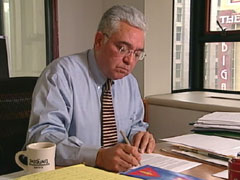 Leo Martinez |
O’BRIEN: California, and especially San Francisco, where the law school is located, has shown great tolerance of the gay and lesbian lifestyle. The city was among the nation’s first to adopt an ordinance prohibiting discrimination based on sexual orientation. For the Christian Legal Society, to deny membership to students who are gay not only violates the law school policy, it may also violate local law.
(speaking to Greg Baylor): This is discrimination based on sexual orientation.
BAYLOR: It’s not discrimination based on sexual orientation.
O’BRIEN: Well, it is—if those who are gay cannot join, and those who are not gay can join, that’s discrimination.
BAYLOR: What Christian Legal Society cares about is a person’s belief in, and commitment to, its Christian ideals. Christians traditionally have believed that sexuality is reserved for the relationship of marriage between one man and one woman. It’s not discriminatory. Christian Legal Society allows all people to come in to participate in its meetings, to be there, to witness what happens. What we’re talking about here is the ability of a group to preserve its message, and it doesn’t make sense for a public university to say to a private student group you have to give up your Christian faith in order to get the same privileges that other groups have.
O’BRIEN: The teachings of the Christian faith dominate the meetings. At this meeting at a law school in Virginia, students brainstormed over whether their faith required them to adhere to a higher ethical standard than the profession itself requires.
 CHRISTIAN LEGAL SOCIETY STUDENT: In addition to being lawyers we’re Christians, and we have standards as Christians we want to live up to.
O’BRIEN: The signature activities of CLS chapters are weekly Bible studies, which in addition to discussion of the text usually include prayer and other forms of worship.
O’BRIEN: Would a student chapter of, say, B’nai B’rith, a Jewish Anti-Defamation League, have to admit Muslims?
MARTINEZ: The short answer is yes.
O’BRIEN: A black group would have to admit white supremacists?
MARTINEZ: It would.
O’BRIEN: Even if it means a black student organization is going to have to admit members of the Ku Klux Klan?
MARTINEZ: Yes.
O’BRIEN: You can see where that might cause some consternation?
MARTINEZ: Well, there’s a Spanish saying to the effect that “the thinnest of tortillas still has two sides,” and the other side of that is that with any other regime we would be forced, using public money, to subsidize the discriminatory practices of a particular group.
O’BRIEN: This case reaches the Supreme Court at a time in the nation’s history when our society and our law are much more supportive of inclusion than they are of exclusion. Laws have sprung up in cities and states against discrimination that go far beyond anything the Constitution might require. Yet the First Amendment also guarantees freedom of association, a fundamental right to gather with whomever we choose and collectively express ourselves. The danger in this case is that it may be impossible for the Supreme Court to reconcile this dispute without compromising one of those cherished principles.
For Religion & Ethics NewsWeekly, I’m Tim O’Brien at the Supreme Court.
Eradicating a Global Scourge
FRED DE SAM LAZARO, correspondent: The trademark smile is undiminished by the years or by a long, punishing journey to this remote village in Southern Sudan, a grateful community, said the area’s Anglican bishop.
BISHOP MICAH LEILA DAWIDI: I want to thank you for having been courageous to come and bear with us all the suffering of our people.
DE SAM LAZARO: Jimmy Carter is in the final stretch of a global campaign he’s led to eradicate a tropical disease called Guinea worm.

JIMMY CARTER: The bishop has described the travels of the chosen people out of slavery in Egypt and into the Promised Land and the fact that they prayed and worked hard and had faith and God gave them water.
DE SAM LAZARO: Similarly, the former president said, the world will soon be delivered from a scourge that dates back to biblical times. His methods and approach have been praised as an effective model for how to tackle entrenched poverty and disease.
CARTER: We’ve been working on it now for more than 20 years. We’ve reduced the incidence from more than two-and-a-half-million cases down to about 2500 cases in the whole world, and the last major holdout will be here in Southern Sudan.
DE SAM LAZARO: In war-torn Southern Sudan, clean water is a rarity for many people, and of all the diseases from unsafe water few are more disabling than Guinea worm.
DE SAM LAZARO: Worm larvae enter the body and grow up to three feet, crippling the human host. The only cure is to slowly, painfully extract the parasite as it emerges through skin blisters. To relieve the burning pain, patients dip these blisters in water, typically open ponds, and that’s when the worm spreads new larvae, and that starts the whole cycle again.
 CARTER: There’s no question about it that we’ll be free of this plague throughout Southern Sudan if the people remain to have their faith and also work hard to make sure that no one with Guinea worm ever goes into a pond where you get water from the pond. It’s very important that you not let them go into a source of drinking water, because they spread the disease from themselves to many others.
DE SAM LAZARO: The Atlanta-based Carter Center has trained thousands of field workers and volunteers. They’ve taught how Guinea worm is spread and distributed simple tools to prevent it: a personal filter used like a drinking straw or a treated cloth which can keep the parasite out of water people gather from ponds. Today, field workers like Simon Taban are tracking down some of the last cases, trying to protect ponds to contain the spread of the larvae and break the transmission of the worm.
How has this campaign succeeded unlike so many aid projects in the developing world? The epidemiologist in charge pays much credit to Jimmy Carter. He’s motivated by faith but does not proselytize. He’s opened doors and raised some $225 million for the cause. Most critical, the Carter Center approach is not prescriptive or top-down, but respectful and collaborative, says Dr. Don Hopkins.
DON HOPKINS, M.D. (Epidemiologist, Carter Center): People are very, very astute at picking up condescension, and unfortunately there’s a lot of that, especially with Westerners coming into the countries, and I think you have to approach people with the idea that ‘we’re here to help you and no, we don’t have all the answers. You know your own community far better than we ever will, but here’s this information. Use it to help yourself get rid of this disease.
 DE SAM LAZARO: As one example, former President Carter says they’ve used local religious beliefs to reinforce what science calls for. For instance, some communities didn’t like the idea of spraying ponds with chemicals to kill the guinea worm larvae.
CARTER: In fact, their ponds of water were looked upon as sacred. If that particular rain-filled pond hadn’t been there, they wouldn’t have existed. They wouldn’t be alive. Of course, we said that the pond was in fact sacred, but there was a curse on that pond, and if they would just help us remove those Guinea worm eggs from their pond or from the drink of water that they took out of that pond, then that curse could be removed from their pond and their village forever. So we had, you might say, a not only philosophical but also a theological explanation to make.
DE SAM LAZARO: They’ve also had to deal with the political realities, and here, Dr. Hopkins says, having a former head of state personally involved helped smooth out many complications.
HOPKINS: He’s always willing and available to call, to write, physically meet with heads of state. The protocol really doesn’t allow him to write directly to a minister of health. I can write to a minister of health, but when he comes in at that level it helps enormously. He’s also been very helpful in having that same kind of approach to leaders of international agencies, the WHO, UNICEF, various donor agencies as well.
 CARTER: We have to recognize and acknowledge that corruption exists in many parts of the world still. Not just in Africa but in many countries, even some developed countries as well.
DE SAM LAZARO: The former president said the Carter Center works directly at the local level to treat people and to break the transmission of Guinea worm, bypassing governments plagued by corruption without offending them.
CARTER: Some of the ministers of health in African countries, for instance, obtain their positions as a minister just because they were heroic fighters in winning freedom from the colonial powers in Europe. So we honor them, but we don’t ever derogate or condemn them, even when we know corruption exists, and we don’t let them impede the Carter Center’s policy of going directly into the jungles and into the desert areas, directly to the villages where we know the disease needs to be eradicated.
DE SAM LAZARO: He says his work in public health—focusing on Guinea worm and other neglected tropical diseases—was inspired by his late mother, Lillian Carter, about whom he wrote one of his eleven books. Lillian Carter worked with leprosy patients in India long after what many would consider retirement age.
CARTER: She epitomized, in my opinion, what a human being ought to be. She was in India when she was 70 years old. She was looked upon then as an untouchable, because she dealt with blood and human feces and so forth. But that was a transforming experience in her life, even at that age.
DE SAM LAZARO: Jimmy Carter is now 85, and he may well live to see the eradication of a disease from the planet for the first time since small pox was eliminated in the early 1970s.
For Religion & Ethics NewsWeekly, this is Fred de Sam Lazaro in Juba, Southern Sudan.
Listen Now
Listen to this episode now:
[powerpress]
Anthony Shadid on Iraq
Originally broadcast October 14, 2005
BOB ABERNETHY, anchor: In Iraq this weekend, the long-awaited countrywide vote on the new constitution.
There were celebrations in Baghdad after last-minute changes in parliament designed to win support for the constitution from the minority of Sunni Muslims. As copies of the proposed constitution were distributed, Shiite Muslims and Kurds seemed overwhelmingly in favor. Sunnis were said to be divided.
Analysis now of the situation on the ground from Anthony Shadid — an Oklahoma-born, Arabic speaking, Pulitzer Prize-winning reporter for THE WASHINGTON POST. Shadid has written a moving new book, NIGHT DRAWS NEAR, about everyday Iraqi life – and death.
In our interview, Shadid spoke of two influences on Iraqis — guns and the major types of Islam.
Watch Anthony Shadid read excerpts from his book NIGHT DRAWS NEAR |
ANTHONY SHADID (Foreign Correspondent, THE WASHINGTON POST and Author, NIGHT DRAWS NEAR): Guns, obviously. There is a culture of violence. There is a sense of men with guns determining politics in Iraq. I think just as important, perhaps more important, is that role that religion plays in Iraqi society. It’s almost the exclusive axis on which politics, on which resistance, on which protest revolves, and that’s something new in Iraq, I think. Among the insurgents it’s very, very — it can become a very militant ideology. It can legitimize any kind of resistance against a perceived enemy.
ABERNETHY: Once, says Shadid, Shiite Muslims and Sunni Muslims in Iraq got along so well it was an insult to ask someone which sect he belonged to. Now the differences are sharper.
Mr. SHADID: I think there [are] growing signs of a hardening of this ideology, of what you might call a religious absolutism that’s being increasingly embraced by more and more people. It’s hardening the lines between sects and ethnicities, between Shiites, Sunnis, and Kurds, and it’s sometimes hard — it creates a gap that’s hard to bridge. It’s harder and harder to see a voice that is national, that speaks for all Iraqis.
ABERNETHY: Shadid says extreme fundamentalist Islam is used by the insurgents as what he calls a “cloak” to justify the killing they think will force American troops to leave.
 Mr. SHADID: It’s a very tactical move by the insurgents. They understand that they’re not going to defeat the American military on the battlefield, that it is impossible. They do think they can defeat the Americans in the realm of perceptions, that they can create this perception of failure. And you create this perception of failure by inflicting more carnage, you know, creating an image of chaos, of anarchy. And it’s a spectacle, and you have to keep creating the spectacle, and to keep that spectacle you have to keep killing more people and more people.
ABERNETHY: But how do the insurgents explain using Islam to justify the killing of innocent people?
Mr. SHADID: My understanding of it is that, you know, I think in — that religion in itself is one message. The interpretation of that religion is another thing, and I’ve seen, just as a reporter in the Middle East over the past decade, that Islam is very pliable in that sense. It’s very flexible, and it can be adapted very easily to local movements, local demands, local fights and wars. I think we see it in Palestine, I think we see it in Lebanon, I think we see it most spectacularly in Iraq.
ABERNETHY: Even after this week’s changes in the proposed constitution, Shadid is concerned that violence will continue whether the new document is approved or rejected.
 Mr. SHADID: It all hinges on the Sunni Arab reaction to this constitution, the Sunni Arabs being the community that’s probably most involved in the insurgency. You know, if the constitution is approved, it will probably deepen Sunni Arab resentment and in a way deepen the insurgency. You have them probably feeling even more disenfranchised than they are today. If it’s rejected — there already is a civil war under way in Iraq. We haven’t maybe acknowledged it as such, but when you look at competing agendas, the competing factions, the — you know, rivalries between communities and within communities, it already is a civil war. I guess the fear is that you would intensify that civil war.
ABERNETHY: So should or should not American troops be brought home? Shadid acknowledged the fear that if U.S. troops were to leave there would be more chaos. But he says he hears more and more people in Iraq calling withdrawal the key to stability.
Mr. SHADID: It’s hard for me to see the political process, as it is now, working. I just don’t see how it works unless you have some kind of move toward reconciliation. How do you bring the Sunni Arabs into the political process? And it’s difficult to see that happening as long as they view an occupation in place. And I guess the only way to end that occupation is either through a timetable for withdrawal or withdrawal itself.
ABERNETHY: I told Shadid the situation in Iraq, as he described it, sounded hopeless.
Mr. SHADID: You know, I tell you, I — and sometimes I personally, just as a person, as a person, as a reporter there feel bleak. But then I think back, you know, there is a quality that I think Iraq is really remarkable for, and that’s resilience. And I think we’ve seen that resilience time and again. Their resilience is being tested, there’s no question. I think, you know, good friends of mine who’ve been the most optimistic are sometimes very bleak in their comments. But I think it’s still there. I think it’s the best hope for the country as it tries to get past this.
Ginghamsburg Church and Darfur
KIM LAWTON, correspondent: Sudan’s Western Darfur province is considered one of the bleakest places on the planet. A state of humanitarian emergency has been in effect for more than seven years, since conflict broke out between the Sudanese military, government-backed militias, and various rebel groups. Hundreds of thousands of Darfuri civilians have been attacked, raped, and killed in what many in the world consider a campaign of genocide. Millions have been displaced. The Sudanese government has expelled most international relief groups. But dotted along Southern Darfur’s dusty terrain there are signs of ongoing aid, surprisingly, from a United Methodist church half a world away called Ginghamsburg.
REV. MIKE SLAUGHTER (Lead Pastor, Ginghamsburg Church): We see the purpose of the local church of going out into the world, being the hands and feet of Jesus to the hurting, the oppressed, the poor, and being the empowering center in that local community.

LAWTON: Ginghamsburg Church is located in Tipp City, Ohio, a predominantly blue-collar suburb of Dayton. The church has partnered with the United Methodist Committee on Relief, or UMCOR, for its humanitarian work in Darfur, and since 2004 the congregation has committed $4.4 million to those projects. Ginghamsburg lead pastor, Mike Slaughter, says his congregation members felt morally compelled to get involved.
SLAUGHTER: Often the church remains silent in the face of injustice, whether it’s slavery, segregation, genocide. I don’t have time as a pastor to just do religious services where people come and feel better about themselves. I want to lead a movement of people who want to make a difference, a God-difference, in the world.
LAWTON: About 4,500 people come to the Ginghamsburg Church every week. Their donations have built 173 schools in Darfur. Those schools serve about 22,000 students. They’ve also sponsored a sustainable agricultural project, which has now helped to feed an estimated 80,000 Darfuris. They’ve built water systems to provide clean water and sanitation to more than 60,000 people, and they’ve begun micro-enterprises, such as a brick-making factory, to help fund the projects. The programs are run by local staff on the ground. Most Darfuris are Muslim, but Slaughter says his church is not there to convert them to Christianity.
SLAUGHTER: Compassion doesn’t have any strings attached. You serve people because they’re human beings created in the image of God, loved by God.
LAWTON: Still, he admits, his church members don’t hide what motivates their work.

SLAUGHTER: People ask us why sometimes, and at that point I share because I do this out of my faith, that I believe this is what it means to follow Jesus.
LAWTON: Because of the security situation, it’s difficult for outsiders to get in. But Ginghamsburg tries to send groups as often as possible to see the work firsthand. Slaughter led a delegation there late last year.
SLAUGHTER: I share with my own family that I need to do this kind of experience. I need to get into where these people are, you know, in dangerous places, about once a year for my own soul-health, and I really come back and realize what’s important.
LAWTON: Slaughter believes the Sudan work has had a profound impact on the Ginghamsburg congregation. When he proposed the first Darfur project at Christmastime in 2004, some people were apprehensive.
SLAUGHTER: I said, “Hey, Christmas is not your birthday. It’s Jesus’ birthday,” because Christians have made Christmas one of the biggest, hedonistic kind of self-focused, materialistic feast. What would Jesus really desire? So I said, “Whatever you spend on yourself, bring an equal amount for this agricultural project we’re going to do in Darfur.”
LAWTON: They raised $318,000, and in the following year it yielded 18 bags of food for every seed planted. Slaughter says his people learned what a difference they can make. It’s a lesson they begin learning here at an early age. The children’s programs hold special projects not just to raise money, but to teach about life for kids in Darfur.
NICKOLAS STEFANIDIS: It’s rough. There’s a war going on, and some of their parents are dead, and they have to live by themselves and take care of their younger siblings.

HAYDEN HARTMAN: They walk many miles to get their water, but it still might not be very clean.
HANNAH BINGHAM: It’s just nice to help them, because they don’t have all that stuff that we have.
LAWTON: This past December, the church’s “Christmas Is Not Your Birthday” campaign raised almost $700,000 for Darfur. Slaughter was especially impressed because the community, which was heavily dependent on the automotive industry, has been hard hit by the recession.
SLAUGHTER: These people are serious in their commitment to follow Jesus in sacrificing for the needs of others.
LAWTON: The work in Darfur is not done at the expense of helping people locally. Unemployment in the Dayton area is about 15 percent. Ginghamsburg runs two community food pantries, and Slaughter says while they were serving about 300 people a week last year, now the number has jumped to about 1,500 people a week. The church also has a nonprofit arm called New Path that includes a car ministry, in which donated vehicles are fixed up and given to the needy. There’s Anna’s Closet, which provides used clothing and shoes and actually makes money to support the work by selling items to those who can afford them. And there’s JJ’s Furniture, which provides household goods especially to women coming out of domestic violence situations. In all of it, the operating philosophy is that everyone has something to give.

MARCIA FLORKEY (Director, New Path Ministries): So we’ll have folks who come to us for needs, but then they see what this does and how it has impacted their lives and then they come back to us and volunteer. So it’s a really neat cycle to see people who are the receivers become the givers.
LAWTON: Slaughter believes it’s a holistic view of helping your neighbor, wherever that neighbor may be.
SLAUGHTER: So you need to look at the needs in your local community, your city, your county, your country, and then out into the world as events continue to unfold in places like Darfur.
LAWTON: For Slaughter, helping people in Darfur is more than just hands-on humanitarian work. He also supports an interfaith coalition that advocates for Darfur at the national and international levels. Christians, Jews, and Muslims are all part of the effort which has been pushing the US Congress and the Obama administration to do more to intervene in the situation.
SLAUGHTER: So it’s very important that the faith community keeps reminding our governments, our economies, that there are moral mandates that we have as human beings toward the treatment of other human beings.
LAWTON: Many in the coalition worry that Sudan’s upcoming elections will not be fair. They fear it could result in even more violence and instability. Slaughter has another worry as well: that in the face of so many seemingly intractable problems, people will grow weary.
SLAUGHTER: But it’s for churches, synagogues, mosques, people from clubs or organizations to really focus on a place of great need and become involved with that place and stay in that place, you know, until we begin to solve some of the world’s problems.
LAWTON: From the devastating earthquake in Haiti to the ongoing problems after Hurricane Katrina, there are many places of need competing for the world’s attention. But Slaughter says Darfur must not be pushed to the backburner.
SLAUGHTER: There’s much still to be done in the Gulf, but the work’s not done, yet money is running out. Haiti? There’s going to be a need in Haiti for years. So you know, again, compassion fatigue is what we have to fight in our own life. Faith is not easy. It is hard work.
LAWTON: Hard work, he says, that cannot be abandoned.
I’m Kim Lawton in Tipp City, Ohio.
