Though giant, lumbering blue and humpback whales may seem to have little in common with leaping, cavorting porpoises and dolphins, they are in fact closely related. Indeed, dolphins and porpoises are just small members of the whale “family,” which includes nearly 80 species.
Whales, dolphins, and porpoises are called “cetaceans,” seagoing mammals that have hair, breathe air, are warm-blooded, and bear live young that drink their mother’s milk. There are two basic kinds of cetaceans: toothed whales and baleen whales. As their name suggests, the toothed whales, including all porpoises and dolphins, have teeth. Dolphins and porpoises have different types of teeth: dolphins’ are sharp, while porpoises have flatter, shovel-shaped teeth.
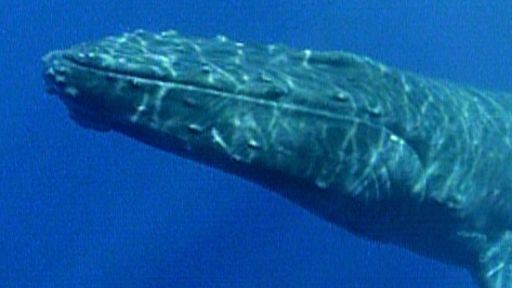
Baleen whales, in contrast, have giant comb-like structures on their jaws that are used to sift food, such as shrimp-like krill, from the water. Humpback and Blue whales, for instance, are baleen whales.
 Humpback whales are underwater crooners. Humpback whales are underwater crooners. |
Baleen whales can eat up to 9,000 pounds of fish and krill daily. In part, the hearty appetite is due to the fact that they don’t eat all year round. They usually feed about half the year in the cold, nutrient-rich waters of their summer feeding grounds. They store huge amounts of fat, or blubber, to get them through the breeding season.
Here are some other big and little whale facts:
- The largest whale is the Blue whale, which can grow up to 100 feet long and weigh up to 190 tons.
- Several whales lay claim to being the smallest, including the Hector’s Dolphin, the Chilean Dolphin, the Vaquita, and the Finless Porpoise. All are about 3 feet long and weigh less than 100 pounds.
- The unicorn-like Narwhal has the longest cetacean tooth — a spear-like tusk that can grow to be more than 9 feet long.
- The deep-diving Sperm whale can go down 5,000 feet and stay down for more than an hour.
- Orcas, or killer whales, are the fastest cetaceans, capable of swimming to speeds of 30 miles per hour.
- The Humpback has the longest flippers — they can be more than 15 feet long.