Visit Your Local PBS Station PBS Home PBS Home Programs A-Z TV Schedules Watch Video Support PBS Shop PBS Search PBS

June 26th, 2009
Religion and Health Care Reform

To view this site, you need to have Flash Player 9
or later installed. Click here to get the latest Flash player.

BOB ABERNETHY, anchor: As President Obama pushed health care reform a coalition of religious leaders joined the effort with a rally and interfaith prayer service in Washington. The event brought together Hindus, Muslims, Christians, and others who called for universal and affordable health care. The group said health care is a moral issue and called the nation’s current situation too immoral to tolerate. One of the participants in that interfaith coalition is Sister Simone Campbell, executive director of NETWORK, a national Catholic social justice lobby. Her order is the Sisters of Social Service. She is also a lawyer. Sister, welcome.

Sister SIMONE CAMPBELL (Executive Director, NETWORK): Thank you.

ABERNETHY: In that coalition, your number one priority is expanding health care for everyone. Talk about that.

Sr. CAMPBELL: It’s a shocking outrage in our country. It’s a moral outrage that we have almost 50 million people without coverage, without access to a doctor, and we have even hundreds of thousands more that can’t even use the coverage that they have. That’s wrong. We have to change it.
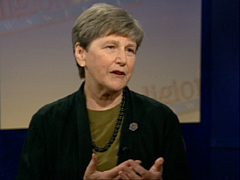
Sister Simone Campbell

ABERNETHY: Hard as that is, perhaps, to change, even harder is trying to figure out how to pay for what we’re doing.

Sr. CAMPBELL: Well, we have to be responsible and pay for it, but there’s lots of savings in the system. There’s administrative savings, streamlining processes, electronic filing. There are controls of costly expenditures, planning for where high capital equipment gets installed, and there’s ways of saving on expenditures for services, also.

ABERNETHY: Let’s talk about that — especially for older people. We read that there is just a whole lot of stuff that is prescribed and ordered that, at least in retrospect, looks as if it wasn’t really necessary and that the biggest savings are in what’s done for people in the last part of their lives.

Sr. CAMPBELL: Well, that is a significant area of savings. There’s a lot of evidence that the fear of dying keeps us holding on to life in such ways that extraordinary means get used on a regular basis, and that makes it really challenging for limiting costs. There are other places where cost savings can be obtained, too, but that’s a big one.

ABERNETHY: You have said that we need to “get real” about dying. Is that what you’re talking about — accepting it?

Sr. CAMPBELL: Yes.

ABERNETHY: Now how can you expect somebody to do that? You know, maybe another procedure will help.

Sr.  CAMPBELL: And maybe it will, and that’s the hard part, but culturally as a nation we do not see death as integrated with living. We see it as something that’s to be feared. We’re getting better at it, but—with the hospice programs and other programs—but we as a culture need to accept dying is part of living, and it’s integrated. It’s one piece. And I as a person of faith know it’s not the worst thing that can happen to you.

ABERNETHY: It’s pretty hard to convince the family of somebody who’s very sick that you shouldn’t do everything possible to help them.

Sr. CAMPBELL: I think there’s a question between quality of life and what does it mean to do everything possible. When you see your loved one in pain — yes, it’s hard, but what are the choices? I think we have to be responsible in making those choices and that just because it can be done doesn’t mean it must be done.

ABERNETHY: And do you think it would be better off if doctors were on salary rather than fee for service?

Sr. CAMPBELL: There’s a lot of evidence that there are better health outcomes, that patients are happier when doctors get a salary and don’t have the incentive to prescribe additional treatment or to do just one more test. The real issue — health care is about nurturing the whole person, making the whole person well, and doctors need to take that into consideration, not just the money they make.

ABERNETHY: And, very quickly, are we going to get a bill this year? Are we going to get a law change this year?

Sr. CAMPBELL: I think we’ve got a great chance. It’s moving, but it’s going to be up to us, we the people, to insist that it happen. We’ve gone too long without it. We need to make it happen now.

ABERNETHY: Sister Simone Campbell, many thanks.

Sr. CAMPBELL: Thank you.

bookmark    print    email    comment/s (15)

(11 votes)
Loading ... Loading ...

Comments

15 comments

#1

It is long past time that we have a comprehensive
Universal health care coverage in the Uited States, it is a national disgrace we don’t.

#2

It would be a lot better if people like Sister Campbell knew what they were talking about. Does she hink that a government run health system will be any more successful than most government run systems such as bankrupt Medicare and Medicaid? Government systems as implied by her comments will lead to restriction on both treatment and availability – see Canada. Uner the rubric of quality, as she proposes, the government will just refuse treatment to those with insufficient quality. Does she know that the proposed new plan by congress will exempt congress people from needing to use it? Existing health providers will need to show a profit but the government plan won’t – it can always dip into tax money to bolster its deficiencies. Obama clearly wants the government to control everything. He even dodged the question put to him of whether he would look to a non-government system or his private wealth if treatment for his daughters were denied under government plan system. How come he and congress aren’t pledging to adopt coverage under the government plan they are proposing for the have-nots. Finally, if you are going to do interviews be sure that they are with hard hitting and not feel good questions.

#3

I see a trend in Sr. Campbell’s philosophy of death. True, that death is a part of living, but it’s the END of living on earth. Even though most of us believe in a life after for the soul, life here on earth is still precious to us. I don’t like to hear that death is a PART of living. Death is the antonym of life. Giving expensive health care to the seniors or seriously ill people will require a judgement, either to life or to death, which is NOT the medical profession’s nor the government’s judgement to make. It seems to me the philosophy that President Obama and Sr. Campbell share is to rid our society of the elderly and possibly others who are infirm and require expensive care in order to save wealth. The sanctity of life is being lost.

I am VERY concerned that the end result will be the intentional extermination of seniors by the government and others who hold this philosophy. Wouldn’t that be geronticide? Shame on us!!!!

#4

The dear sister is right on the mark…it’s disgraceful that political hacks keep objecting to reforming the system, all the while receiving excellent coverage themselves. Some would ask why this is a moral issue. We believe that the moral question is on several levels. One is what Sr. Campbell spoke of, our attitude about death. Another is the moral responsibility that our elected leaders have to the collective good, not to the corporate financial interests who pay for their election. And a third is the immoral priorities to which our nation is committed…we can spend millions on fighter aircraft which the military doesn’t want, but the pandering Congressional members will fund, but then when it comes to the humanitarian ussie of caring for our citizens, they can’t seem to find the funding.

When Americans finally wake up to how poorly their elected leaders are serving them there will be hell to pay! We pray that reason and compassion will prevail in Congress!

#5

What Sister Simone Campbell had to say about the elderly and dying is outrageous.

#6

No thanks Ms. Campbell. I will decline your attempt to force me to allow placing government bureaucrats in control of my health care.
You may wish to meet your god without a fight, most of us reject that option. You will not force your desire to die on us.
Furthermore, the “50 million” you claim are without access to health care include 10 million illegal aliens, millions more who are changing jobs and thus betweeen coverage, as well as people who because they are young choose not to buy insurance.

#7

The French healthcare system was named by the World Health Organization as the best performing system in the world in terms of availability and organization of health care providers.

Expenses related to the healthcare system in France represented 10.5% of the country’s GDP and 15.4% of its public expenditures. In 2004, 78.4% of these expenses were paid for by the state.

Current estimates put U.S. health care spending at approximately 15.2% of GDP, second only to the tiny Marshall Islands among all United Nations member nations.
Jean de Kervasdoué, a health economist, believes that French medicine is of great quality and is “the only credible alternative to the Americanization of world medicine.” According to Kervasdoué, France’s surgeons, clinicians, psychiatrists, and its emergency care system (SAMU) are an example for the world. However, despite this, Kervasdoué criticizes the fact that hospitals must comply with 43 bodies of regulation and the nit-picking bureaucracy that can be found in the system. Kervasdoué believes that the state intervenes too much in regulating the daily functions of French hospitals.

Furthermore, Japan, Sweden, and the Netherlands have health care systems with comparable performance to that of France’s, yet spend no more than 8% of their GDP (against France’s spending of more than 10% of its GDP, or about 34 billion euros).

Forgive me for commenting twice or citing experts,but so many American’s seem so ill informed on this subject!The American system is expensive failes to cover 40 million people and is far from being the highest quality, it isn’t even close!There are faults to a Partially public system, or a regualted system, but to say that any governement intervention makes a system “Socialist” and inferior, is terribly ignorant, this is issue like most is very complex there are many different policies and programs to compare to ours some governement run, some like the Dutch almost entirely private, but all nearly universal in there coverage of their populace, the quality of these systems also vary but most in many ways exceed ours in the quality of care given.

#8

[...] their oversized presence in politics they’re getting in the way of all the religious people clamoring for nationalized health care, or perhaps they’re getting in the way of the religious people arguing against nationalized [...]

#9

As a full time hospice chaplain and a former parish pastor, I would argue that death is indeed a part of life. How so? Every illness seems to me to be a mini-death. The again process itself is about coming to terms with gradual limitations, particularly physically. I agree with the Sister that we in America are very fearful of death and ambivalent about the whole dying process. Yet all the major religions of the world face death head-on and offer ways of confronting death with courage and candor.

#10

If we reverence life, we should have health care available for all human beings who live peacefully in USA. This means planning for low and high options, with freedom of choice, in a federal single payer plan (which would save the administration bureaucracy), but let all insurance companies that meet the federal care standards have the option of participating as well as having private clients.

#11

I agree that Americans are afraid of dying, yet we do not lead a healthy lifestyle-but expect that the medical community do everything, regardless of expense to save us, ie liver transplants for the alcholic. I believe that the time has come for Americans to except responsiblity for our own health. It is a known fact that obesity can lead to hypertension, diabetes and cardiac disease but yet look at todays childrens.
Also no one has said that the elderly should just die-but when the quality of life is poor and the expectation for recovery is poor, patients and family’s need to look at what is truly in the patient best interest. I think that everyone, regardless of age should have an “advanced directive” outlining the individuals wishes should the time come. Lets face it there are only two guarantees in life Taxes and Death-you have no say with taxes but you can have a say so in how you want to die.

#12

As a hospital chaplain, I understand from where Sr. seems to be coming. Like Brad McIntyre, I too believe that too few of us appreciate the ‘mini’ moments throughout our lives where we are given the opportunity to die to self and thus ‘practice’ for our final curtain-call.
However,the language Sr. offers is far different than Brad McIntyre (#9) and Frank Sullivan (#2)in the comments they offer. There comments seem much more well-rounded, informed and reflective of Catholic moral teaching and the rationale that holds it firmly affixed to reality.
Being a spokesperson for a ‘Cathloic advocacy(lobbying)social network’ would indicate that perhaps citing or referring to recent scholarly AND Catholic ethical dialogue may have been worthwhile.
It is unfortunate that no reference is made in this short interview to the still-relevant contribution being made to the medical world by scholarly Catholic bio-ethicists. Reference to well-formulated ethical guidelines (ERD’s)that uphold the dignity of the human person–from the cradle to the grave–would have illustrated how continued and consistent ethical principles (as a guide in addressing complex medical situations) are very possible.
If speaking about concerns such as Louis DeCou in comment(#3)go unaddressed by our ‘advocates,’ then our system(s)-Governmental and Healthcare– that do appear to be moving in a ’socialized’ direction, will have the same flaws as referenced by Frank Sullivan (essentially inaccessable specialist care–cf. the comment about Canada) and Louis DeCou regarding the proclivity toward an ‘extermination of seniors.’
Awh…what’s the difference?
Let’s just go with the Nationalized ‘everything’ approach and hope that the socialized(ism) system we adopt won’t have the component that has consistently accompanied every other model–this being LESS FREEDOM for good old hoi polloi.
None of the current administration (nor any other previous administraion)will use the program they are setting up as Frank Sullivan states. Why?
Because it is inferior to what option(s) we presently have. Essentially, this plan will ensure that the wealthy continue to purchase the necessary specialized care they or their family needs and hoi polloi will, yet again, get the shaft.
The only difference now will be that people like you and me will be FORCED to be part of this governmental healthcare system in approximately 5 years–no other options. No more having your employer pay for health coverage.
If the present healthcare proposal goes through without significant changes (and it likely will because not enough time is being permitted to consider the entire 1000 page+ document to be properly looked at)then in five years my wife and children and I will have a sorely inferior healthcare plan than we do presently.
This is the ‘change’ we hoped for? Not me.

#13

Dear Sister Simone,

I write this to you with respect.

When was the last time you held the hands of a dying patient younger than thirty-five years of age or desperately compressed the chest of an eigthy four year old who had a zest for life, or intubated a patient gasping for air, or comforted family members who are shocked at the news of impending death of a loved one, or managed hysterical family members while giving nursing care to the critically ill patient?????

I always lean on the promises of Jesus Christ and not on my judgement as a human being. Life is precious, Sister, and it is up to God and the dying person to negogiate when life on earth will cease as we know it and eternity begins!!! The angels among us in crucial moments are REAL! And, Sister, as we all know, for all this talk of letting someone die, the dollars pinched, the doctors involved… it is us, THE NURSES, that witness the last breathe, listen for the silence with our stethescope, smell the sickening sweet odor of death, and grieve in an unnoticeable way. We evaluate the quality of our care, the gentleness of our words, the hope that our nonverbal body language was not insulting to family as we implement our nursing skills to keep their loved one alive. Inevitably, Sister, we find a quiet place in the hospital unit to cry. The remainder of our shift is emotionally working through the memories of the failed code.

You see, everyone has opinions of how we should die, who should die and when. But how many of you actually see the dead on a regular basis? How many of you are truely with the dying? How many of you have actually held and comforted for six languishing hours the murdered/aborted, abandoned, dying baby boy with Down’s Syndrome wrapped in bloody blankets found in the hospital laundry room??? It is always someone else who has to complete the task for the politicians and pundits surrounding life and death.

As for me and my household, Sister, we choose life!

Love,
Mary Signorino RDH, RN
VHM Associate

#14

#13 said it well. It seems as though Ms. Campbell does not want to be bothered by the cost or the care of the sick and elderly. She lacks mercy and compassion as does this health care plan. It is not about universal coverage. It is about killing the vulnerable and refusing care to the elderly. Did anyone who watch that video want Ms Campbell holding their hand if they were seriously ill? Let God decide when it is time to die. Not everyone who has a will to live is afraid to die. Some people want to live for Christ and bare witness to the truth with their last breath. Don’t be so anxious to snuff out their opportunity to give others a chance to love and see the face of Christ.

#15

Ms Campbell why in the world would you want Universal Health Care, haven”t you seen enough from other Countries. It is sad you want to take our tax dollars to fund abortion, shame shame on you

Post A Comment


Please note that the THIRTEEN editorial staff reserves the right to not post comments it deems to be inappropriate and/or malicious in nature, as well as edit comments for length, clarity and fairness. No solicitations or advertisements will be allowed. Users may link to other Web sites relevant to discussion, but most often links to commercial Web sites will not be permitted.

Submit

In This Episode

Facebook Watch Now YouTube Listen Now

Produced by THIRTEEN WNET New York    ©2009 Educational Broadcasting Corporation. All rights reserved.

Funding for RELIGION & ETHICS NEWSWEEKLY is provided by Lilly Endowment. Additional funding is provided by individual supporters and by Mutual of America Life Insurance Company, The Henry Luce Foundation and The Corporation for Public Broadcasting.