
Hillary's "Woman Card"; Millennial Voters; #MoreThanMean
4/29/2016 | 26m 22sVideo has Closed Captions
Trump attacks Clinton, young voters & government waste, and fighting online abuse.
Hillary's "Woman Card": Donald Trump says Clinton's only asset is "the woman card." Millennial Voters: Kristin Tate on government waste and what young voters want. #MoreThanMean: Combating the abuse female journalists must face from online trolls. PANEL: Zoe Carpenter, Sabrina Schaeffer, Anushay Hossain, Jennifer Higgins
Problems playing video? | Closed Captioning Feedback
Problems playing video? | Closed Captioning Feedback
Funding for TO THE CONTRARY is provided by the E. Rhodes and Leona B. Carpenter Foundation, the Park Foundation and the Charles A. Frueauff Foundation.
Hillary's "Woman Card"; Millennial Voters; #MoreThanMean
4/29/2016 | 26m 22sVideo has Closed Captions
Hillary's "Woman Card": Donald Trump says Clinton's only asset is "the woman card." Millennial Voters: Kristin Tate on government waste and what young voters want. #MoreThanMean: Combating the abuse female journalists must face from online trolls. PANEL: Zoe Carpenter, Sabrina Schaeffer, Anushay Hossain, Jennifer Higgins
Problems playing video? | Closed Captioning Feedback
How to Watch To The Contrary
To The Contrary is available to stream on pbs.org and the free PBS App, available on iPhone, Apple TV, Android TV, Android smartphones, Amazon Fire TV, Amazon Fire Tablet, Roku, Samsung Smart TV, and Vizio.
Providing Support for PBS.org
Learn Moreabout PBS online sponsorshipED BY THE EVELYN AND WALTER HAAS, JR. FUND.
ADDADDITIONAL FUNDING WAS WAS PROVIDED BY: THE PARK FOUNDATION IN SUPPORT OF A CLEAN AND HEALTHY ENVIRONMENT; THE ARTHUR VINING DAVIS FOUNDATIONS, DEDICATED TO STRENGTHENING AMERICA'S FUTURE THROUGH EDUCATION; THE NATIONAL PARK FOUNDATION, THE OFFICIAL CHARITY OF AMERICA'S NATIONAL PARKS; THE PETER JAY SHARP FOUNDATION; THE PEW CHARITABLE TRUSTS; BY GENERAL MOTORS; BY THE CORPORATION FOR PUBLIC BROADCASTING; AND BY GENEROUS CONTRIBUTIONS TO THIS PBS STATION FROM VIEWERS LIKE YOU.
THANK YOU.
FOR OVER 100 YEARS, azz AMERICANS HAVE ENJOYED THE MOST BEAUTIFUL PLACES ON EARTH THROUGH THE REMARKABLE EFFORTS OF OUR NATIONAL PARK SERVICE.
BANK OF AMERICA IS PROUD TO SPONSOR "THE NATIONAL PARKS: AMERICA'S BEST IDEA."
WE SHARE WITH KEN BURNS THE BELIEF THAT BY CONNECTING TO OUR COLLECTIVE PAST, WE CREATE THE POSSIBILITY FOR A BETTER FUTURE.
MAN: One learns that the world, though made, is yet being made, that this is still the morning of creation, that mountains long conceived and now being born brought to light by the glaciers, channels traced for rivers, basins hollowed for lakes.
When we try to pick out anything by itself, we find it hitched to everything else in the universe.
The whole wilderness in unity and interrelation is alive and familiar.
The very stones seem talkative, sympathetic, brotherly.
Everybody needs beauty, as well as bread, places to play in and pray in, where nature may heal and give strength to body and soul alike.
This natural beauty hunger is made manifest in our magnificent national parks... nature's sublime wonderlands, the admiration and joy of the world.
John Muir.
PETER COYOTE: They are a treasure house of nature's superlatives, 84 million acres of the most stunning landscapes anyone has ever seen... including: a mountain so massive it creates its own weather, whose peak rises more than 20,000 feet above sea level, the highest point on the continent... a valley where a river disappears into burning sands 282 feet below sea level, the lowest and hottest location in the hemisphere... a labyrinth of caves longer than any other ever measured... and the deepest lake in the nation with the clearest water in the world.
They contain trees dead for 225 million years that are now solid rock... and trees still growing that were already saplings before the time of Christ, before Rome conquered the known world, before the Greeks worshipped in the Parthenon, before the Egyptians built the pyramids, trees that are the oldest living things on Earth and the tallest and the largest.
They encompass a mile-deep gash in the ground, where the Hopis say the first people emerged from the underworld and where scientists say a river has patiently carved its way to expose rocks that are 1.7 billion years old, nearly half the age of the planet itself... and an island where a goddess named Pele destroys everything in her path while she simultaneously gives birth to new land.
They preserve cathedrals of stone gaily ornamented by cascading ribbons of water... Arctic dreamscapes where the rivers are made of ice... and a geological wonderland with rivers that steam, mud that boils amidst the greatest collection of geysers in the world.
They became the last refuge for magnificent species of animals that otherwise would have vanished forever... and they remain a refuge for human beings seeking to replenish their spirit, geographies of memory and hope where countless American families have forged an intimate connection to their land and then passed it along to their children.
MAN: I think that deep in our DNA is this embedded memory of when we were not separated from the rest of the natural world, that we were part of it.
The Bible talks about the Garden of Eden as that experience that we had at the beginnings of our dimmest memories as a species, and so when we enter a park, we're entering a place that has been--at least the attempt has been made to keep it like it once was, and we cross that boundary, and suddenly, we're no longer masters of the natural world.
We're part of it, and in that sense, it's like we're going home.
It doesn't matter where we're from.
We've come back to a place that is where we came from.
MAN: It is the preservation of the scenery, of the forests, and the wilderness game for the people as a whole instead of leaving the enjoyment thereof to be confined to the very rich.
It is noteworthy in its essential democracy, one of the best bits of national achievement which our people have to their credit, and our people should see to it that they are preserved for their children and their children's children forever with their majestic beauty all unmarred.
Theodore Roosevelt.
COYOTE: But they are more than a collection of rocks and trees and inspirational scenes from nature.
They embody something less tangible yet equally enduring, an idea born in the United States nearly a century after its creation, as uniquely American as the Declaration of Independence and just as radical.
MAN: What could be more democratic than owning together the most magnificent places on your continent?
Think about Europe.
In Europe, the most magnificent places, the palaces, the parks, are owned by aristocrats, by monarchs, by the wealthy.
In America, magnificence is a common treasure.
That's the essence of our democracy.
COYOTE: "National parks," the writer and historian Wallace Stegner once said, "are the best idea we've ever had."
MAN: It's not the best idea.
The best idea came from Thomas Jefferson, that all human beings, irrespective of the accident of their birth, are entitled to enjoy the aspirations of being fully complete and free human beings.
That's America's gift to the world, but right up there are the national parks.
Jefferson, I think, would say if you go out into the heart of America and see this continent in its glory, it will embolden you to dream about the possibilities of life, that American nature is the guarantor of American Constitutional freedom, that if you don't have a genuine link to nature in a serious, even profound way, you can't be an American.
COYOTE: Like the idea of America itself, full of competing demands and impulses, the national park idea has been constantly debated, constantly tested, and is constantly evolving, ultimately embracing plas that also preserve the nation's first principles, its highest aspirations, its greatest sacrifices, even reminders of its most shameful mistakes.
Most of all, the story of the national parks is the story of people, people from every conceivable background, rich and poor, famous and unknown, soldiers and scientists, natives and newcomers, idealists, artists, and entrepreneurs, people who were willing to devote themselves to saving some precious portion of the land they loved and in doing so reminded their fellow citizens of the full meaning of democracy.
From the very beginning as they struggled over who should control their national parks, what should be allowed within their boundaries, even why they should exist at all, Americans have looked upon these wonders of nature and seen in them the reflection of their own dreams.
MAN: One of the things I think we witness when we go to the parks is the immensity and the intimacy of time.
On the one hand, we experience the immensity of time, which is the creation itself, it is the universe unfolding before us, and yet it is also time shared with the people that we visit these places with, and so it's the experience that we remember when our parents took us for the first time to these and then we as parents passing them on to our children, a kind intimate transmission from generation to generation to generation of the love of place, the love of nation that the national parks are meant to stand for.
[Birds chirping] [Water running] COYOTE: Early in 1851 during the frenzy of the California gold rush, an armed group of white men was scouring the western slopes of the Sierra Nevada, searching for Indians, intent on driving them from their homeland.
They called themselves the Mariposa Battalion, and late on the afternoon of March 27, they came to a narrow valley lined by towering granite cliffs where a series of waterfalls dropped thousands of feet to reach the Merced River on the valley's floor.
One of the men, a young doctor named Lafayette Bunnell stood there transfixed.
MAN AS LAFAYETTE AS BUNNELL: As I looked, a peculiar, exalted sensation seemed to fill my whole being, and I found my eyes in tears with emotion.
I said with some enthusiasm, "I have here seen the power "and glory of the Supreme Being.
"The majesty of His handiwork is in that testimony "of the rocks."
COYOTE: Bunnell's enchantment with the scenery was not shared by the rest of the Mariposa Battalion, who busied themselves setting fire to any Indian homes they found.
Before the Battalion moved on, Bunnell convinced the others that as the first white men ever to enter the valley they should give it a name.
He suggested Yosemite because he thought that was the name of the tribe they had come to dispossess.
Later, scholars would learn that the people living in the valley called it Ahwahnee, meaning the place of a gaping mouth, and they called themselves the Ahwahneechee.
Yosemite, it was learned, meant something entirely different.
In the native language, Yosemite refers to people who should be feared.
It means they are killers.
4 years later in 1855, a second group of white people entered Yosemite Valley, this time as tourists, not Indian fighters.
They were led by James Mason Hutchings, an energetic Englishman who had failed miserably as a prospector during the gold rush.
Now he hoped to make a fortune by promoting California's scenic wonders through an illustrated magazine.
When a report about the Indian campaign in the Sierras mentioned a waterfall more than 1,000 feet high, Hutchings rushed to see it for himself.
Word and images of Yosemite quickly spread.
Other tourists began showing up to witness its beauty firsthand.
The trip required a two-day journey from San Francisco to the nearest town and then, with no wagon road into the valley, a grueling 3-day trek by foot or horseback up and down steep mountainsides on narrow, rocky paths.
But for most, the scenic reward was worth the hardship.
"Looking at the majestic cathedral rocks "and cathedral spires," wrote a Massachusetts newspaperman, "made it easy to "imagine that you are under the ruins of an old gothic "cathedral to which those of Cologne and Milan are "but baby houses."
Upon seeing Yosemite Falls, the highest free-leaping waterfall on the continent, another visitor began quoting The Bible.
"Now let me die," he told his companions, "for I am happy."
15 miles south of Yosemite Valley, the Mariposa Grove of giant sequoias contains the largest living things on earth, trees nearly 3,000 years old.
When Horace Greeley, editor of the "New York Tribune," saw them, he boasted to his readers that they were "of substantial size when David danced before the Ark."
Soon, the celebrated painter Albert Bierstadt arrived and produced a series of masterpieces.
One of them would command a price of $25,000, equal to the highest amount ever paid for an American work of art.
While Bierstadt painted, his friend Fitz Hugh Ludlow wrote dispatches that appeared in "The Atlantic Monthly," the nation's most prestigious magazine.
MAN AS FITZ HUGH LUDLOW: We did not so much seem to be seeing from that crag of vision a new scene on the old familiar globe as a new heaven and a new earth into which the creative spirit had just been breathed.
I hesitate now, as I did then, at the attempt to give my vision utterance.
Never were words as beggared for an abridged translation of any scripture of nature.
JENKINSON: Jefferson looked across America from the portico at Monticello, and he saw wilderness all the way out, so he couldn't conceive of a national park because, for Jefferson, America was a national park.
This country is Eden, and we Americans had this glorious opportunity to see the world in its infancy so that America in a sense had been kept as a symbol of what the world once was.
COYOTE: As Thomas Jefferson's nation had grown, the country's sense of itself and its possibilities had grown, as well, not only in the political sphere but in the arts, literature, and in its citizens' relationship to God.
MAN: At the gates of the forest, the surprised man of the world is forced to leave his city estimates of great and small, wise and foolish.
The knapsack of custom falls off his back with the first step he takes.
Here is sanctity which shames our religions and reality which discredits our heroes.
Here, we find nature to be the circumstance which dwarfs every other circumstance and judges like a god all men that come to her.
Ralph Waldo Emerson.
COYOTE: The transcendentalist writer Ralph Waldo Emerson had been telling Americans for years that God was more easily found in nature than in the works of man.
His disciple, Henry David Thoreau, had called for "little oases of wildness in the desert "of our civilization."
CRONON: What emerges in the middle of the 19th Century is this idea that going back to wild nature is restorative, it's a way of escaping the corruptions of urban civilized life, finding a more innocent self, returning to who you really are, returning to a kind of authenticity, and if you want to know God at firsthand, the way to do that is not to enter a cathedral, not to open a book, but to go to the mountaintop, and on the mountaintop, there you will see God as God truly is in the world.
COYOTE: But it was all in danger as the nation, in the name of manifest destiny, marched inexorably across the continent, systematically dispossessing Indian peoples from their homelands and transforming the land to new uses.
The artist George Catlin worried th the vast herds of buffalo and the Indians who depended on them would someday be gone forever, and he called for the creation of a nation's park to save them both.
No one listened.
By the 1860s, the country's most famous natural landmark, Niagara Falls, had already been nearly ruined.
Every overlook was owned by a private landowner charging a fee.
Tourists could expect to be badgered and oftentimes swindled by the hucksters and self-appointed guides who swarmed the railroad depot and carriage stands.
European visitors publicly belittled Americans for allowing such a majestic work of nature to become blighted by commercial development and offered it as further evidence that the United States was still a backward, uncivilized nation.
CRONON: Americans feel that the United States is somehow inferior to Europe, where the United States doesn't have the ruins of Rome or of Greece, it doesn't have the Acropolis, it doesn't have the Parthenon, and so it seems like we're an inferior nation, and yet the one thing we do have is a nature that looks closer to the new morning of God's own creation, closer to paradise than anything that Europe has to offer, and so the thought is that if we're to preserve anything that stands for the glory of America, then these overwhelmingly beautiful, sacred spots are the ones we ought to preserve.
COYOTE: On May 17, 1864, in the midst of the Civil War, with Union casualties averaging 2,000 a day, the junior senator from California, John Conne to destroy his nation.
MAN AS JOHN CONNESS: I will state to the Senate that this bill proposes to make a grant of certain premises located in the Sierra Nevada Mountains in the state of California
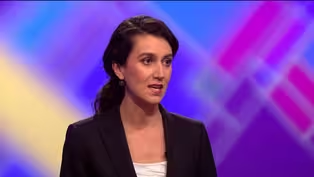
TTC Extra: Pay Gap Expands for Young Women
Clip: 4/29/2016 | 5m 7s | The pay gap is expanding for young women straight out of college. (5m 7s)
Providing Support for PBS.org
Learn Moreabout PBS online sponsorship
- News and Public Affairs

Top journalists deliver compelling original analysis of the hour's headlines.

- News and Public Affairs

FRONTLINE is investigative journalism that questions, explains and changes our world.












Support for PBS provided by:
Funding for TO THE CONTRARY is provided by the E. Rhodes and Leona B. Carpenter Foundation, the Park Foundation and the Charles A. Frueauff Foundation.