
1 in 4 Chicago Adults Have a Disability: Report
Clip: 2/19/2026 | 7m 7sVideo has Closed Captions
The most common types of disability were cognitive and mobility disabilities, the report found.
The report found disability is more prevalent among Black residents than among Latino, White or Asian residents in the city. Disability is also more prevalent among LGBTQ+ residents compared to cisgender heterosexual adults.
Problems playing video? | Closed Captioning Feedback
Problems playing video? | Closed Captioning Feedback
Chicago Tonight is a local public television program presented by WTTW
WTTW video streaming support provided by members and sponsors.
1 in 4 Chicago Adults Have a Disability: Report
Clip: 2/19/2026 | 7m 7sVideo has Closed Captions
The report found disability is more prevalent among Black residents than among Latino, White or Asian residents in the city. Disability is also more prevalent among LGBTQ+ residents compared to cisgender heterosexual adults.
Problems playing video? | Closed Captioning Feedback
How to Watch Chicago Tonight
Chicago Tonight is available to stream on pbs.org and the free PBS App, available on iPhone, Apple TV, Android TV, Android smartphones, Amazon Fire TV, Amazon Fire Tablet, Roku, Samsung Smart TV, and Vizio.

WTTW News Explains
In this Emmy Award-winning series, WTTW News tackles your questions — big and small — about life in the Chicago area. Our video animations guide you through local government, city history, public utilities and everything in between.Providing Support for PBS.org
Learn Moreabout PBS online sponsorship>> One in 4 Chicago adults live with a disability.
That's according to a recent report from the Mayor's Office for People with Disabilities and the Chicago Department of Public Health which found a higher percentage of disabled people living on the south and West sides.
And compared to Chicagoans without a disability.
The report found those with disabilities experience having more environmental concerns, a harder time accessing resources like transit and fresh produce less trust in law enforcement, greater fear of crime less of a sense of belonging.
Joining us now, our Amber Smock, vice president of advocacy at Access living and to both use Gordon Junior, co-founder of Chicago and Disabled people of Color, Coalition and research associate at USC's Institute on Disability and Human Development.
Welcome back.
Welcome.
Thank you for joining Thank Amber, starting with you.
What do you think is at the crux, the court, some of these disparities that we just named?
>> Well, I think both to dream and public be is a mixture different Cup come June definitely public.
And I mean, I think that's fairly obvious answer to anybody looking at different community.
But I think when you mix that in in and also those core out The things that make it more difficult to get by.
fortunately, I think what happens people with disabilities concert, we knew against what you things are going to be cheaper.
I was old we've had some interesting insights about those kinds but concentration yes, well, get.
>> And we'll talk is let's get to you because the most common type of disabilities down in Chicago were mobility and cognitive disabilities.
for those who might not be familiar, what does it mean to have to navigate a cognitive disability?
>> So with having a cognitive disability, also have the process ation, instance, you may need playing when material to understand the gist of what's going on is jargon or 83 research?
E. You may need be-all aids as well to navigate.
You may People.
They help you with paperwork.
So those are examples of accommodations he would conduct a disability or what I like to call knew it.
I get a new diversion people on the autism spectrum.
For example, those.
>> not necessarily always disabilities that people may not quite always recognize.
Amber, you previously spoke with many people with disabilities in Chicago, not living in housing that feels accessible to them.
What is that reality look like for Well, I think reality of ducks you know, >> you just drive down any street and Chicago, you will see just years after stairs after stairs in front of houses.
And so you can see just by them the best.
But that's not welcoming to people with disabilities, House you know, is one of our top can tune into Texas that than one percent.
All the available housing, the city of Chicago is accessible for people with this police.
What looks like on the ground is people getting killed, lead up and up and down the stairs, dragging themselves up and down the studio.
And you have to ask yourself and what you really want for your family everybody should have a state and team on accessible homes, especially when it comes down to push >> What might a more accessible home look like?
Obviously easy getting in and out.
Start so it could look like you couldn't have a new 0 step entrance.
It can look like having a bathroom that is accessible on the first floor.
>> It can look like you certain country DS inside the first foot.
You visible House is not the same thing only accessible house.
Fully accessible means a whole entire thing critical based double means being able to access the first floor.
And you know, the reason that nice she things like no, you want to have to do have fun entrance.
It cost is not just about people might think I'm talking about older folks, but I'm not.
I'm talking about being able to welcome children to home during trick-or-treating time.
You know, so a lot of kids with disabilities don't get the same kind of social opportunities shows trick or treating the same that kids with not without discipline.
So short, all to both the U.S.
But what are the barriers that people disabilities might face living on the south and west sides?
>> It could be maybe fat days.
It could be the fact that >> a lot of the fully accessible housing is actually on the.
North side.
But that's because it's an affordable is festival that to me, if affordable.
Also and to play a lot of the resources says foods.
Or clinics or 80 of pencils.
North side.
Whereas West South sides, mostly food as as you may have to drive by to get the resources that you some like access to grocery stores and healthcare.
>> Yeah, can be more difficult.
Amber, how should the city use the findings in this report?
So these findings, a weak start to talk about other things such as >> You know what?
If you have one map you over.
Another map showed that much of that with a about how many people in different neighborhoods of the Chivas aside.
How many people in different neighborhoods may be impacted by the criminal system.
How many people different neighborhoods all, you know, may have disability categories that not necessarily call food with.
Then the survey itself, what I think the city needs to do and when I say the city, I don't mean just the city of Chicago and Mean City Council used to think about how prioritize, you know, different things right?
But disability and always has to be a priority for everybody making things accessible as a benefit to everybody.
And I think that the mean matches of the conversation that this reporter Scott.
>> To most.
Yes.
What change do you hope to see as a result of this report?
>> Hope to see change in how we accessibility, not only from.
A common people with physical disabilities, but also those with more invisible disabilities, accessible disabilities as well.
As the mayor's they we supposed to be the most accessible city in the world with this report.
It will help us make sure that we
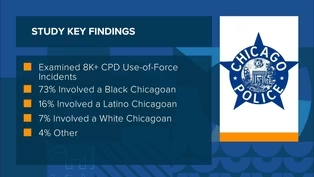
Chicago Police Disproportionately Used Force Against Black Chicagoans: Study
Video has Closed Captions
The first-of-its-kind study was commissioned by the Chicago Police Department. (2m 35s)
State Lawmakers Weigh in on Pritzker's Budget Proposal
Video has Closed Captions
Pritzker denounced the Trump administration during his annual State of the State speech. (10m 36s)
Providing Support for PBS.org
Learn Moreabout PBS online sponsorship
- News and Public Affairs

Top journalists deliver compelling original analysis of the hour's headlines.

- News and Public Affairs

FRONTLINE is investigative journalism that questions, explains and changes our world.












Support for PBS provided by:
Chicago Tonight is a local public television program presented by WTTW
WTTW video streaming support provided by members and sponsors.