
1 October Anniversary
Season 9 Episode 13 | 26m 46sVideo has Closed Captions
1 October memorial gets underway. Training center helps police better prepare.
Nine years after the mass shooting at the Route 91 Harvest Festival, a groundbreaking for the memorial to those killed is set. Metro Police are using a state-of-the-art training facility to be better prepared for events like the 1 October shooting.
Problems playing video? | Closed Captioning Feedback
Problems playing video? | Closed Captioning Feedback
Nevada Week is a local public television program presented by Vegas PBS
1 October Anniversary
Season 9 Episode 13 | 26m 46sVideo has Closed Captions
Nine years after the mass shooting at the Route 91 Harvest Festival, a groundbreaking for the memorial to those killed is set. Metro Police are using a state-of-the-art training facility to be better prepared for events like the 1 October shooting.
Problems playing video? | Closed Captioning Feedback
Where to Watch Nevada Week
Nevada Week is available to stream on pbs.org and the PBS app.
Providing Support for PBS.org
Learn Moreabout PBS online sponsorship-Nine years after the One October mass shooting, a groundbreaking on a memorial at the site is finally scheduled, plus... (Casey Clarkson) We always like to say in police work: It's not if, it's when.
And we wanted to make sure we had all the training space necessary to address those threats.
-...how the Joint Emergency Training Institute is preparing local law enforcement to stop active assailants, that's this week on Nevada Week.
♪♪ -Support for Nevada Week is provided by Senator William H. Hernstadt and other supporters.
-Welcome to Nevada Week.
I'm Amber Renee Dixon.
Nine years have now passed since shots rang out at the Route 91 Harvest Music Festival on Las Vegas Boulevard.
Police say a lone gunman firing into the crowd from the 32nd floor of Manodalay Bay killed 58 people.
A ceremonial groundbreaking on a memorial in their honor is scheduled for October 2nd, known as the Forever One Memorial.
It will be built on the festival grounds.
Where the memorial should be located is one of several difficult decisions Tennille Pereira faced in order to reach this point.
She's the executive director of the Vegas Strong Fund, the nonprofit that's raising money for the memorial, and she met with Nevada Week at the site.
Tell me about this site where we are right now.
(Tennille Pereira) We are at the site of the future One October Memorial, which is named the Forever One Memorial.
It's going to be a beautiful, beautiful space, but it was about nine years ago when something awful happened here, and we are here to reclaim this space.
-And this specific area is considered sacred ground to some.
Why?
-Because 58 lost their life on this ground.
You know, others have died in the aftermath after that.
But also, 22,000 people's lives changed forever, and this city will never be the same.
So it is monumental what happened on this property.
-And this part specifically is where people fled to safety?
What happened here?
-Yes.
So, people were fleeing.
And there weren't a lot of exits, so it was climb the fence or run to an exit.
On top of that, we had the medical tent was back here in the corner, and so people were carrying injured, you know, survivors and victims over to the tent.
So it kind of was, I guess, a safe, safe area.
-A safe area in what was a very scary, dangerous place at the time.
As we speak, we can see Mandalay Bay in the background.
But when this memorial is complete, those who are visiting here will not be able to see it.
Why?
-Well, we did a very widespread community engagement campaign before we came up with the design, and we heard loud and clear they did not want the sightlines to include that, you know, for valid reasons, because it can activate the trauma of that night.
Some will find it hard to come back on the space.
But what we also heard is that it had to be here, so we designed it in a way that it wouldn't activate trauma but really be a place of healing.
-So how do you do that?
How do you hide the skyline?
-Well, I kind of wondered the same thing.
We have had amazing professionals work with this on this project, and they were able to do it.
So, as you walk through, you really shouldn't see it.
-And then you said it had to be here.
So the design was already in place, site already in place.
This was donated from MGM, correct?
But then you find out that the A's Stadium is going to be constructed here.
It's in front of us.
We'll show a shot of it.
But what did you think about that?
-I actually was very positive.
It will reinvigorate this area.
It will make sure that the area is, you know, is a nice area, and it will also increase foot traffic.
It will increase parking availability.
We are very excited to welcome visitors here and to explore what Vegas did in the aftermath of One October.
Our memorial is not just about the awful thing that happened.
We acknowledge it and we honor those that passed away, but we also celebrate what the community did in the aftermath.
And that's the true spirit of Las Vegas.
So what an amazing thing for visitors from all over the world to come and see.
-And so then visitors here will see educational elements as well.
What will be included, and was that hard to figure out what to include, what not to include?
-Oh, it was so hard.
There is so much to learn from what happened and the aftermath.
Throughout the design, there will be different reminders of different things that either families of the victims did in the aftermath, different nonprofits and efforts, but also what the Las Vegas community did.
We had LVMPD go to great lengths to change kind of shortfalls that they identified in their after-action reports.
We had the Resiliency and Justice Center set up that continues to this day.
You know, a number of infrastructure things, but also individual things.
So we really kind of went by groups and have captured those to the best of our ability throughout.
-So the Resiliency and Justice Center, that is how you initially became involved in all of this.
For our viewers who may be new to Las Vegas, will you explain your path to where we are now?
-Yeah.
So when One October happened, I was an attorney.
Everyone in Las Vegas, and I'm sure that you can remember this as well, felt the need to do something.
This was our community that this happened in, and we pulled together in an amazing way.
Well, what do I do to provide help?
You know, I'm not a doctor or responder, so I was able to go and provide legal services at the Family Assistance Center through Legal Aid Center of Southern Nevada.
Well, that turned into the Resiliency and Justice Center, and we have established a victims center for all victims of violent crime now in our community, but also continue to serve all those impacted by One October.
So eventually I was asked to be on the committee that Clark County set up and was able to lead that process.
-In order to get this memorial?
-Yes.
And it was, you know, we developed a process of community engagement, and that led to a design.
And that design belongs to the community, and so we are bound and determined to build that design.
-How has fundraising gone?
-You know, it's been-- it's been good and it's been rocky.
You have the days where you get a yes, and then you have the days where you get a lot of no's.
We've really set out to make sure that anyone that wants to participate has an opportunity.
We set up a paver campaign, which we heard from the survivors they wanted to be able to purchase a paver and put a piece of them in the memorial.
You know, the whole memorial honors all of them.
And no one has to buy a paver to be honored here, but it gives them an opportunity.
So it's kind of we have a lot of grassroots efforts going on.
We took a lot of survivors and families up to the legislature last session, which was really amazing to see them advocate on their own behalf, very empowering.
And then, of course, we've gone to the larger donors, and we got a lot of support from, you know, our local area.
Clark County stepped up and gave us 10 million for construction; LVCVA stepped up, gave us 5 million for construction; and MGM, on top of donating the land, they gave us $5 million to go to construction.
So, you know, we've been out there and trying to move that needle, but we were able to get to a place in our fundraising of 27 million that we're able to do a complete design without one of the elements.
So we continue our fundraising to get that last element built, which is called the Tower of Light.
It's a big part of the memorial.
But we'll be able to open at the 10-year mark is our goal.
So we're very excited.
-How much are you short?
-So we need to hit the 34 million.
So we're 7 million short.
And it seems like a big number, but I know this community is going to step up.
I know they will.
This is such a special project for our community.
-And when you went to the legislature, that was to request funding, which was denied.
And I wonder, is that almost a reintroduction of trauma when you're denied money for something like this?
-It is.
It can aggravate, you know, especially families and survivors who have lived this on a granular level every day since it happened, where others sometimes will question, you know, why is this still a thing?
Something like this doesn't go away.
It doesn't go away.
So we can choose to make something beautiful of it and continue learning the lessons and, you know, teaching our children all the lessons; or we can try and forget, and we can let that trauma live in our community and be unaddressed.
So, you know, we've chosen to memorialize and celebrate our community.
-And it's both ways, right, of some people saying, why is this still a thing that they have not gotten the money they need?
And others who are saying, why is this still a thing that we need to remember this?
How do you rationalize all of that?
-You know, a lot of it is about carrying the torch, being positive, really knowing the heart of our community.
We really do have a lot of philanthropic, you know, individuals, groups in our community.
And so we just have to keep carrying the hope of this will happen.
And on the other side, for me, that's the hardest part.
When you come into contact with someone who doesn't see the importance of this, you know, we basically educate and we share the stories and we show the design.
This is a beautiful thing.
This is not a sad thing.
This is not memorializing the trauma.
It's about memorializing the individuals that lost their life and how they lived their life and honor them and memorializing the good things that came out of it.
So while there are areas that will be a solemn space of remembrance, that in itself is not about the trauma.
-What's at risk if this is not built?
What power can it provide?
What can it do?
-It would be devastating for the impacted community.
It absolutely would be devastating for them.
One of the most difficult things when someone goes through a mass violence incident is when they feel forgotten, and so what happens is they feel very isolated and the trauma actually gets worse.
When a community comes together and remembers, it makes them feel that they are not alone, that they are surrounded by support, and they feel safe to come out and express their trauma, express what they went through, which helps them process.
So memorials are actually very important spaces when you have a mass violence incident.
-There was also a point that was difficult in this journey in the design because there are others who have died post that date.
Can you explain how that's possible, what those circumstances were, and how you went about addressing that situation and who was memorialized here?
-Yeah.
So we did have a couple that were declared by a coroner to have died as a result of their gunshot wounds from here.
It was about two and a half, three years after the incident.
So what we had was a community of families-- -After the incident?
-Yeah.
- --died from gunshot wounds two years, two to three years later?
-Yes.
-Wow!
-So they had a long battle, you know, with their health.
And, unfortunately, they lost that battle.
And so, you know, they were declared to have been murdered by the perpetrator.
But we also have other individuals who were survivors, and then they were not survivors from different impacts of what happened.
And we did have 58 families that never had a survivor to go hug, right?
There was no survivor coming home.
There was no survivor for the next birthday, the next holiday.
So we really felt that it was appropriate to honor that experience in and of itself, but we also have to honor the other, you know, the others.
And where do you draw the line?
We have the two that died of physical gunshot wounds, but we had others that died of other wounds.
And to not-- It's important to not invalidate that, to not say this is a less wound than the physical wound.
And so we decided we're going to honor them appropriately.
We are naming the two that passed from gunshot wounds, but we're also providing in where we honor them, a way to honor all of those that have lost.
You know, all of the human loss are life lost.
And the ongoing impact--we will never be able to measure what the impact is, and so we wanted to include that in the memorial as well.
-Tennille, what has it been like for you to make these hard decisions and to approach people for funding and sometimes get it, sometimes not?
-So making those decisions was the hardest.
My brain worked on that issue before we came to a final conclusion, probably for four, four years.
It has been an issue that we've had to address since the very first public committee meeting.
We had to start working through that, and it's so hard.
You-- I feel for every single one of them.
I feel for every single mother, father, brother, sister, you know, and want to honor their experience appropriately.
And I want to validate what they've been through.
So you know, we-- It was tedious.
And I hope that at the end of the day, even if it's not what they would have wanted, they know that they were thought of, that they were cared for, and that we have done our utmost best to honor their loved ones and the experience.
-You now have an official groundbreaking ceremony set.
You have broken ground already.
What was it like as you walked up here and looked around?
-I didn't recognize it.
I've been here so many times over the years.
And to see the pavement coming up and this becoming a reality, it's amazing.
It's amazing to see where we are, thinking of where we started.
-And then the country just acknowledged 25 years since 9/11 happening.
There is that Ground Zero Memorial for it.
And so many people have gone to it from around the world, people who were not even born at the time that it happened.
And so I'm wondering, what are your hopes for this memorial 25 years from now?
-That we will be here and we will be-- we will be honoring and we will be celebrating the Vegas community, that it will stand here as a permanent place to honor those that passed away so that they continue to live on.
Their lives were cut short, and they will continue to live on through the lessons and through all of the good things that will come out of what happened.
You know, it-- The sixth, the sixth step of grief is actually identified as making purpose.
And the gentleman that actually wrote that book came up with that not long ago.
He revisited and said there is a-- there is another step that I missed, and it's making purpose.
And that is where the healing comes in, when you make purpose out of tragedy.
-And that's what this is.
-Yes, this is making purpose out of tragedy.
-Tennille Pereira, thank you so much for joining Nevada Week.
-You're welcome.
-Another example of making purpose out of tragedy can be found at the Joint Emergency Training Institute in the Northeast Valley.
The Las Vegas Metropolitan Police Department says the One October shooting highlighted the need for the state-of-the-art reality-based training campus.
It includes a tactical training village, which opened about a year ago.
Metro Lieutenant Casey Clarkson, who was shot while responding to the One October shooting, now runs the training village and gave us a tour.
-This is what we call our Joint Emergency Training Institute, also known as the JETI.
This is where we train not only Las Vegas Metropolitan Police officers, but also other departments around the Southern Nevada area, so including North Las Vegas, Henderson, the University Police, our marshals, and even our Nevada State Troopers.
-Lieutenant Casey Clarkson takes pride in preparation.
The tactical training village he helps oversee is designed to prepare law enforcement and first responders for the settings... -We have a gas station in the back over here.
We have motel, hotel, and a restaurant.
- ...and high-stress scenarios they'll likely face.
-Every year, multiple times a year, we'll put on bigger scenarios to where we provide our officers that stress inoculation, right?
So we'll have role players that'll be running out.
We'll simulate darker rooms.
We'll have loud noises, whether it's people screaming, crying, music going on, something to create that extra stress, because a lot of times, even in Route 91, there was music on, there was a lot of screaming, couldn't hear the radio between a lot of people trying to get on it, and there's a lot of background noise.
So we have to be able to adapt and overcome.
-On October 1, 2017, Lieutenant Clarkson was shot in the neck while responding to the Route 91 shooting.
(Casey Clarkson) I felt a burning sensation; but when there's a threat somewhere else, you're kind of focused.
-He received a Purple Heart for his injury, and Metro Police put this video together in honor of that recognition.
His experience on One October inspired the work he now does.
-Is there something at this training village that would have helped you that night?
-Yes.
I think, I mean, we now, for some of the officers-- Well, for me personally, I was working the grounds of the event, but some of the training that we did and learned on better communication, how we communicate, setting up incident command, some of those little things that we could do in the field to help kickstart the event a little faster, for that part of it.
But I would say with this facility, with how we respond to hotels and casinos, if we had to, if there was an active assailant inside shooting at an elevated position, we would definitely have the tools necessary now in this facility alone to be able to assault and take that suspect down quickly.
During Route 91, obviously, we had to make entry into the Mandalay Bay to stop a threat.
Our sheriff wanted to make sure we had the best equipment necessary and the best communication with our hotel properties, and a lot of our hotel properties came down through and looked at what we need.
So you'll see slot machines.
You'll see table games.
You'll see this is our lobby.
We have a security room.
We actually have a room back over here that we can create hotel rooms and like hotel hallways if we needed to respond that way as well.
-An active assailant, mass casualties, and domestic violence--Clarkson says officers can train for all of them here.
-All of these rooms are completely modular.
If we have an incident that's a trend going on in the nation that we feel we need to move this around--like, hey, we want to make this a school, we want to make this an office, we want to make this like we would see in like conventions, like just different spaces for their shows--we can do that here.
-The Tactical Training Village even has a nightclub, hence the disco ball.
And Metro says when its officers are training here, the lights are low, the music is loud, and there's even a fog machine.
-So we give them scenario after scenario so that they comprehend what it is that we're teaching them.
We use ammunition rounds to make a little bit more stress.
We can change the lighting here.
We can change the sound.
We can have fire alarms to try to essentially throw every curveball at an officer we can here so if they ever do encounter it on the street, that they know how to respond, they have that repetition of training that they can go right into muscle memory and act.
-That repetition, says Clarkson, also helps officers switch their mindset from crime fighter to war fighter, a skill he considers crucial for local law enforcement.
-It's Las Vegas, right?
And will there ever be an active assailant that happens on our Strip again?
Maybe.
We hope not.
But as we always like to say in police work: It's not if, it's when.
And we wanted to make sure we had all the training space necessary to address those threats.
-The Joint Emergency Training Institute, as a whole, opened in 2024.
And Metro says a $35 million fundraising campaign through its foundation paid for most of it.
For more information on the training institute or the Forever One Memorial, go to vegaspbs.org, and we'll see you next week on Nevada Week.
♪♪♪
Video has Closed Captions
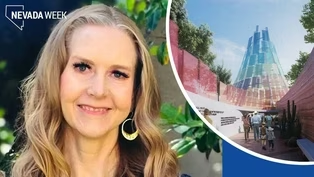
Clip: S9 Ep13 | 20m 12s | The Forever One Memorial honors victims and survivors of the Route 91 Harvest Festival shooting. (20m 12s)
Metro Police Establish Reality-Based Training Center
Video has Closed Captions
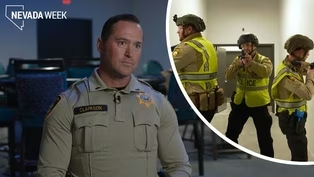
Clip: S9 Ep13 | 5m 2s | A training center built after 1 October helps first responders prepare for mass shootings. (5m 2s)
Providing Support for PBS.org
Learn Moreabout PBS online sponsorship New Episode
- News and Public Affairs

Top journalists deliver compelling original analysis of the hour's headlines.

- News and Public Affairs

Today's top journalists discuss Washington's current political events and public affairs.

 New Episode

 New Episode


 New Episode


Support for PBS provided by:
Nevada Week is a local public television program presented by Vegas PBS