
1 October First Responders and Mental Health
Season 5 Episode 14 | 26m 46sVideo has Closed Captions
How are first responders doing five years after the 1 October mass shooting?
Five years after the tragedy of 1 October, how are police, firefighters and other personnel who responded to the tragedy doing? We check in with efforts to make sure they get the mental health services they need.
Problems playing video? | Closed Captioning Feedback
Problems playing video? | Closed Captioning Feedback
Nevada Week is a local public television program presented by Vegas PBS
1 October First Responders and Mental Health
Season 5 Episode 14 | 26m 46sVideo has Closed Captions
Five years after the tragedy of 1 October, how are police, firefighters and other personnel who responded to the tragedy doing? We check in with efforts to make sure they get the mental health services they need.
Problems playing video? | Closed Captioning Feedback
How to Watch Nevada Week
Nevada Week is available to stream on pbs.org and the free PBS App, available on iPhone, Apple TV, Android TV, Android smartphones, Amazon Fire TV, Amazon Fire Tablet, Roku, Samsung Smart TV, and Vizio.
Providing Support for PBS.org
Learn Moreabout PBS online sponsorshipFive years after the nation's largest mass shooting, Southern Nevada's first responders come together to heal.
(Patrick Crayne) Well, this one's actually my first, like, real meaningful tattoo.
-How the art of tattooing is helping them cope with the trauma of 1 October.
♪♪♪ Support for Nevada Week is provided by Senator William H. Hernstadt.
-Welcome to Nevada Week.
I'm Amber Renee Dixon, and this week we are on the road coming to you from Clark County Fire Station 25.
This is a working fire station, so the crew here could be called out at any time.
We're hoping for no emergencies; but just in case, a heads up.
Ahead we are going to be showing you how tattooing has been part of the healing process for some first responders.
But first, we want to discuss how our local first responders are doing five years after 1 October.
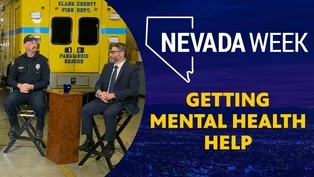
And joining me for that discussion are Tiffany Oba, with the Vegas Strong Resiliency Center; Travis Haldeman, a County Fire Engineer and a 1 October survivor; and Steve Riback, Director of Metro's Police Employee Assistance Program.
Thank you all for joining us today and taking the time.
Travis, you were off duty at the concert with your wife at the time when the shots were fired.
You jumped into action and began saving lives.
How are you doing five years after?
(Travis Haldeman) I think I'm doing a lot better than I was.
I certainly struggled there for the weeks and months post-October 1.
I feel like I probably still have a little ways to go.
I know I wouldn't be in the spot I'm in today if it wasn't for, you know, my friends and family-- my wife especially who stepped up tremendously --and seeking out the therapists and the counseling that I received over the course of the last five years.
They definitely deserve the credit for getting me where I am today.
-In what ways were you struggling after 1 October?
-Right after the event, I really felt guilty that I didn't do more that night.
I felt a sense of shame.
I made a couple of mistakes.
I'm very fortunate to have helped the people that I got to help out, and I hope that I had a positive impact on their lives since.
But really that should-have-done-more feeling was probably the hardest to overcome.
-I want to get back to that.
But Steve, you were a sergeant at the time within Metro.
What was your role in the response to 1 October, and how are you doing five years later?
(Steven Riback) So five years ago, I was overseeing an investigative squad.
And so we were tasked to go with myself and five of my detectives to one of the local hospitals.
We interviewed the survivors that were there.
We had to identify the victims that were there, the several deaths, and, overall, I think I'm doing pretty well.
I mean, it's being in this role that I'm in right now, overseeing our peer support program, it has its therapeutic values where you get to help people, but you also have to walk the walk and talk the talk.
And so making sure that I'm okay and I'm doing well physically, mentally is an important component and one that I take very, very seriously.
-Travis, I was surprised to hear that you felt guilt.
Why?
-You know, I really-- 58 people lost their lives that night, and I felt like I was responsible for the number being that high.
I felt like had I done more and maybe made a different decision, that number would have-- would have been less.
And so seeing that number--and it was everywhere--really, really made me feel guilty for allowing it to get that high.
And it was through a lot of therapy and conversations between my wife and I that I realized, you know, I wasn't responsible.
I'm not the one that did that terrible thing that day, which sounds so silly to say out loud because, obviously...
But that breakthrough moment, you know, I had really was a one-two punch with, you know, the help that I received through therapy and the conversations that I was able to have with my wife.
-Tiffany what is your role with the Vegas Strong Resiliency Center, and what kind of issues have you found first responders dealing with, in the aftermath?
(Tiffany Oba) So my role is responder wellness coordinator.
So I help coordinate mental health services for our first responders and their families.
And my responsibility is just to let them know the services and the resources that are available to them, to their families, significant others, and make them known and let them know that it's okay to ask for help, it's okay to come to me, it's okay to seek services--there's no judgment here--and it's a place where you can come and get the things that you need.
-And what are you hearing from first responders?
What are they dealing with, in terms of 1 October?
Your position was created after 1 October because of it.
-Yes, my position was created after the 1 October tragedy.
And some of the things that I do here, like Travis said, it's some of the guilt, some of the, I wish I could have done something.
I wish I would have done something differently.
And a lot of depression, PTSD, it still affects the first responders, even today.
-Why is five years significant, the five-year mark?
Steve?
-From our police perspective and the PTSD, the five year mark is significant to us because we've learned from several studies, and one specifically, that PTSD can manifest itself sometimes after that five-year mark and sometimes in the window of five- to seven-year mark.
And so we just literally surpassed that five-year mark.
And so we're concerned from an agency perspective that our employees are okay and that their physical and mental well being is being taken care of.
We had almost 1,000 employees in some way, shape, or form that were involved in 1 October.
And so we're an agency of almost 6,000 employees.
So it's quite a big number, and almost 20% of our-- of our agency was involved.
So we want to make sure that we're doing our part and doing our best in order to get anybody affected by it the help and the care that they need.
-How has Metro gotten ahead of this five-year mark?
-So I'd like to think we're, you know, we're doing our best to get ahead of it.
You know, we're doing our best in terms of building resiliency, educating, having programs like this, or getting the word out with the Resiliency Center, or Travis coming forward and explaining their experiences, and with therapy, and that there's resources, and that the help is available.
That is something that we all piggyback, and we want the best for our employees.
And so in presenting these options and my position as with peer support, we're able to let people know you're not the only person.
You're not an individual in this.
There's many people that were affected, and there's a brotherhood and a sisterhood in law enforcement as with all first responders.
So we have this duty and obligation to look after each other.
-Tiffany, you had mentioned "no judgement" when you are interacting with first responders.
What is the judgment that first responders think they may face?
-So there's a lot of stigma that come from the first responder, community that if I ask for help, I'm going to get judged.
People are going to think that I'm not able to do my job.
They feel that they're gonna get talked about.
People are going to know everything that's going on with them in their personal life, which is not true.
So it's my responsibility to help take down some of those barriers and let them know it's okay to not be okay.
It's okay to ask for help.
It's okay to get help for you and for your family.
-How prevalent is that stigma, Travis?
-Yeah, it's definitely there.
Speaking for myself, you know, it's something I struggled with.
I remember feeling like, I don't want this to affect me.
I want to be that strong person, then let this roll off my back.
Obviously, that wasn't the case, and it's not the case for almost anyone that was there.
I think that identifying, self-identifying some of those problems was really big for me.
Not all of us have that pleasure, and so I think listening to our loved ones, our family members, our coworkers, our crew when they say, Hey, I think it might be time to go talk to someone, a professional about this.
And I think it's our responsibility to do something about it.
We hear oftentimes, It's not okay-- It's okay to not be okay.
And to take that one step further, I don't know it's-- If you feel that way, you know, it's not okay to not do anything about it.
And so taking that first step, the Vegas Resiliency Center is really a great launching pad for that first step.
They'll provide you the resources and kind of organize things a bit for you, make sure that you're connecting with the right individual, too, for you.
-Steve?
-I think Travis hit a very good point of, you know, it's not okay to do nothing.
And so there are real world consequences for doing nothing.
And as Tiffany talked about with some of the repercussions-- From the job side of it, within Metro, we're really good at getting people the help that they need and then getting them back to work, getting them back to work in their positions that they were in.
They don't get the repercussions.
They're not given, you know, wooden guns and rubber guns and put in the back to file paperwork or, you know, menial tasks.
They're out there and have that ability to promote and do whatever it is they were doing, because the sole focus is to get them back to work.
But when we don't go out there and take care of ourselves, and we try to just pack it in and compartmentalize it and handle it on our own, then, unfortunately, a terrible statistic is that more officers kill themselves by taking their own lives than they get killed in line of duty.
And it's a disgusting statistic, but it speaks to the problem of not getting the help that you need.
And so also, there's statistics that show that the average police officer lives almost 22 years less than the average human being.
And that's-- It's disgusting.
You spend it, you know, a whole career.
And I'm sure it's with all first responders.
It's not just something unique to police officers.
But this specific study that I'm aware of speaks directly to law enforcement.
And it's-- We have to take better care of ourselves, because you shouldn't go through a career where you take that oath, you raise your right hand, you want to protect people and take care of people, but yet you're not taking care of yourself.
And it's just-- It's terribly unfortunate.
And we have to drive that number lower and lower to get us close to the average age of anybody else.
-Travis, I think you said 13 years in the fire department?
-Yes, ma'am.
-What have you learned about how prevalent or not prevalent suicide is among firefighters?
-It's just like Steve said over here.
More firefighters die every year than die in the line of duty-- that get killed in the line of duty.
And so we do a lot to prevent us from being injured, critically or not, on a fire, right?
We wear our PPE, or we're wearing our SCBAs inside of fires or medical gloves.
We're running medical calls.
And that's all to prevent physical trauma from happening to any of us.
We aren't doing enough to prevent that emotional mental trauma that happens.
And it may not seem like it's happening on every critical call, but it's that constant drip throughout a 30-year career.
I think that can really sneak up on you.
I gotta say we're much better in the short 13 years I've been on this department than we were when I came on.
It's a lot more normal for someone to say that they're seeking out help or going to therapy, talking to other people.
We have this peer support team in place now that can really push out the resources that we feel the person may need or the person is asking for.
There's a lot more out there for first responders than there was some time ago.
And so there's no excuse to not take care of yourself, both physically and mentally.
-Any ideas on what more can be done to help our first responders?
-I think just getting the word out there and letting them know that we do have the resources for you.
The community cares about you, and we want you to be okay.
The first responders take so much on their shoulders, because they are trying to help everyone, saving lives, taking care of their families, but it's okay to take care of yourself first.
It's okay to reach out and get the services and the resources that we are trying to provide for you.
And I want to be able to help take down that stigma and break down that barrier that, If I ask for help, I'm going to be judged or I'm not going to be presumed to be okay.
Because it's not true.
-It's not true.
I mean, there are repercussions for notifying someone, Hey, I need help?
Steve, could you speak to that?
-Yeah.
I mean, there certainly are repercussions.
I mean, we're in PEAP for Metro.
We're a confidential unit with two exceptions: If somebody is committing a crime, we'll break confidentiality.
If somebody is a danger to themselves or others, we'll break confidentiality for that.
So I mean, the repercussions are we don't want our employees to fall victim to suicide or to drug addiction and alcoholism, any of the residual effects that affect that almost 22-year-less lifespan.
We have to educate.
And it's programs like this.
And it's Travis coming out and explaining this to everybody that, you know, Look at me.
And you know, I think it's very commendable.
It's very brave to step out from the shadows, because we are, as first responders, we're a very insular group at times, you know?
We're very welcoming to each other.
But when we see others, I believe, that are going out there and getting the help, it's only going to motivate and inspire other people.
And so it's, it's a-- It's great what you're doing.
It's much appreciated.
-I feel like it's the easiest risk-benefit analysis you're ever going to do.
You're risking an hour of your day to go talk to a professional, right?
And that's going to do one of two things: It has a small chance of not doing anything for you, right, or it has this tremendous chance of helping you and getting you on the right path of emotional and mental well being.
And that benefits you not only at your job, but that makes you a better parent, a better spouse, a better brother, sister, whatever, right?
It makes you throughout your life, not including your career, it makes you this better person.
And so to me, it's just a no-brainer, right?
And there's a lot of benefit in that professional seeing you if you're not at your worst.
There's a lot of benefit of them seeing you that way, so they have a baseline for you for when that call happens.
Or when that incident comes, then they know what you're like normally, then they know how bad off you really are right now.
-Something special about the Vegas Strong Resiliency Center and what you do deals with who you connect first responders to.
What are you looking for in a therapist, for example?
-I think we're looking for therapists and clinicians who are culturally competent, and that-- -What does that mean?
-That means finding a clinician that understands what it means to be a first responder.
They understand the lingo.
They understand the lifestyle.
They understand some of the difficult things that first responders see on a daily basis.
And being able to connect the two, I think is huge because when you go to therapy, you want to go to someone that you feel comfortable with.
You want to go to someone that you feel like understands the things that you're saying, the things that you're going through.
So the Resiliency Center takes great effort in to finding, like I said, culturally competent responder clinicians to match the responders with.
-Earlier you mentioned family.
What role does family play in all of this?
-Family plays a huge role in this.
My husband is a first responder.
So I definitely know what it feels like to be that significant other, kind of picking up the slack of your first responder; understanding that sometimes they don't want to talk, sometimes they're not going to open up; and being able to kind of gently nudge them to get the help that they need that they may not recognize in themselves.
-And you can recognize that as a spouse, for example?
-You can definitely recognize that as a spouse, yes.
-Did you find that with your wife, Travis?
-Absolutely.
I wouldn't be sitting here today if it wasn't for my wife.
She intervened in some really critical moments there in the weeks and months post-October 1.
And without her, I don't know where I'd be today.
-How are our first responders doing in Southern Nevada five years after 1 October?
I know it's a difficult question.
You don't know all of them.
Where can we begin though, Steve.
-I think we're making inroads.
I'd like to think we could do better; we could do more.
We could always do better and always do more.
So it's just continuing to chip away one employee at a time, one person that we're able to affect positively and help out at a time.
But it's very difficult to quantify because we are-- You know, Tiffany hit it with, like, the stigmas, and it's-- You know, we are, as from the police side, we're the ones who are looked upon as when you need help as a community, we are the person you call.
And so it's difficult at times to say, Ah, you know what?
Okay.
Now I need to make the call to somebody else to get some help.
So it's truly difficult to know, but I think we're getting better and we're chipping away.
-What do you think?
-I think it's getting better.
Definitely not perfect, but I do see a shift.
I do see a change.
I do see more people willing to talk about how they're feeling and ask for the help.
-What more can be done, Travis?
-I think our department has really stepped up to the plate.
I think they're helping out the peer support team.
Our union and our management are working together, really, to get us out and into the stations and talking to people.
I think something that we could do on an individual level is sharing some of these experiences with our crew.
Talking, it's sucks.
I'll be honest.
Sometimes it's hard to be vulnerable, especially with the people you care most about.
But I think that is how we can really have one of the most biggest impacts, you know, on our community.
-Tiffany, Travis, Steve, thank you all for taking the time today and sharing your insight.
In terms of healing from trauma, there are multiple methods that one can pursue, which Nevada Week learned when we recently visited the event venue, The Space.
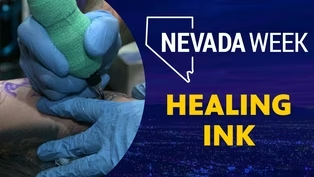
That is one where the program Healing Ink, which serves victims of mass violence, worked with local tattoo artists to provide 1 October first responders with free, customized tattoos.
Paramedic Patrick Crayne has tattoos; however, this one-- -It's a paramedic badge with the Route 91 symbol in the middle.
- --is different.
(Patrick Crayne) This one's actually my first, like, real meaningful tattoo.
It's going to be a reminder, aside from the memories of it.
But now I can look down and say, you know, I'm continuing on, you know, just to do my best for everybody.
-On October 1, 2017, Crayne responded to the Route 91 Harvest Country Music Festival in Las Vegas, the deadliest mass shooting in modern history.
- It's hard.
It's hard to put into words because initially, it just-- It was a reaction.
I just did what I had to do.
And then it wasn't until, like, a day or two later when it actually fully hit me about what I went through.
And, yeah, it was a struggle.
It's been up and down, you know?
The nightmares, you struggle with sleep.
Some days are better than others.
Like I haven't gone down to the memorial thing downtown.
I've tried, and I end up walking away.
I wanted a tattoo for a few years now, but I just never found that one that I wanted until I met him, and I said, This is this where I'm going.
-"Him" is Tattoo Artist Jeremy Hill who Crayne communicated with as part of the Healing Ink program in order to design this tattoo.
(Jeremy Hill) And if I can help him through that by, you know, gifting him something like this as, you know, a stepping stone to growth and, you know, doing better, then of course I want to do that.
You know what I mean?
And thankfully, as a tattooer, I get to do this a lot.
(Craig Dershowitz) Artists have been giving charity and doing philanthropic humanitarian work for so long.
Forever we've heard all these terrible stories about what tattoo artists were.
But the truth is they've been doing mastectomy tattoos.
They've been doing reconstruction tattoos.
So it's not unusual to them.
They really become part of the people they tattoo.
This is a lot more intense, but they have the tools within them already.
(Edson Cano) I think if I can help someone through my craft, I'm always willing to do so, you know?
And when the opportunity came about, I was more than ecstatic to be doing it, you know?
-Edson Cano is Ashli Zeidman's tattoo artist.
The Advanced EMT was also on duty during 1 October.
(Ashli Zeidman) We got the call for one victim shot.
On our way there, the radio just kind of started blowing up.
And lost in translation was that we were supposed to hold short and not go in.
Which "hold short" means Metro needs to clear the scene so that everyone is safe.
When we pulled in, he was still shooting.
And we could still hear, like, the gunshots and everything.
It's been better now, now that I've gone to therapy and kind of worked through everything.
But for a while, it was really bad PTSD.
I still don't like fireworks on Fourth of July because it sounds very similar.
So I don't go out.
Crowds have been a big problem for me since then.
So I don't like going to big events.
If I do, I have to have someone with me that I can literally hold onto.
-And when she's alone, it's her dog she holds onto, the subject of her personalized tattoo.
-His name is Petey.
I named him after the Little Rascals dog.
He's just always been there.
I was single, living at home by myself and, you know, you get trapped in a dark hole.
And he was there.
He'd be excited to see me when I came home from work.
He'd get in the car, drive around with me when I didn't want to see anyone or talk to anyone.
At night if I had nightmares, he would wake me up and sit there and cuddle with me until I was ready to go back to sleep.
Anytime I have a dark day or a bad call or feel like giving up, like, I can now-- I don't have to pull up my phone or have to have Petey right next to me.
Like, I now have him on my arm to show like all right, I still got to take care of him, and I have him no matter what happens.
-There is so many ways that we, thankfully as people who haven't experienced it, don't understand.
It's someone cares about me.
It's I have control.
I did this to my body.
I'm not controlled by the events that happened before.
I now have agency over who I am and how I express myself.
It's just a matter of, I don't see the scar.
I was expecting to look and see the scar, and now I don't.
I see this beautiful creation.
-And those scars, both physical and mental, are familiar to first responders, says Crayne, who urges others in the same field to ignore stigmas and seek the help they often need.
-You're a first responder.
You're-- You signed up to see the worst of the worst, right?
And you're expected to just deal with it.
That's not-- That's not how it works.
You know, you can't just-- You have to talk.
You have to figure some outlet, because it will get to you eventually.
We can only be tough for so long.
-A big thank you to our first responders and to you for watching this week's edition of Nevada Week.
For any of the resources discussed on this show, go to vegaspbs.org/nevadaweek.
And if you or someone you know is in crisis right now, please call or text the National Suicide Lifeline at 988.
Video has Closed Captions
Clip: S5 Ep14 | 19m 44s | Panelists discuss why it can be so difficult to get first responders to seek mental health (19m 44s)
Video has Closed Captions
Clip: S5 Ep14 | 5m 35s | Southern Nevada first responders find healing through tattoo art. (5m 35s)
Providing Support for PBS.org
Learn Moreabout PBS online sponsorship
- News and Public Affairs

Top journalists deliver compelling original analysis of the hour's headlines.

- News and Public Affairs

FRONTLINE is investigative journalism that questions, explains and changes our world.












Support for PBS provided by:
Nevada Week is a local public television program presented by Vegas PBS