
100 Years of Hard Work and Family Pride
Season 5 Episode 10 | 26m 46sVideo has Closed Captions
David Potack talks about what it means to run his century old family business.
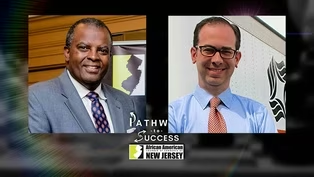
Host John E. Harmon, Sr., Founder and President/CEO of the African American Chamber of Commerce of NJ, talks with David Potack, President of Unitex, a 102 year old family owned healthcare laundry service business. He talks about what it means to run a legacy business. Produced by the AACCNJ, Pathway to Success highlights the African American business community.
Problems playing video? | Closed Captioning Feedback
Problems playing video? | Closed Captioning Feedback
Pathway to Success is a local public television program presented by NJ PBS
100 Years of Hard Work and Family Pride
Season 5 Episode 10 | 26m 46sVideo has Closed Captions
Host John E. Harmon, Sr., Founder and President/CEO of the African American Chamber of Commerce of NJ, talks with David Potack, President of Unitex, a 102 year old family owned healthcare laundry service business. He talks about what it means to run a legacy business. Produced by the AACCNJ, Pathway to Success highlights the African American business community.
Problems playing video? | Closed Captioning Feedback
How to Watch Pathway to Success
Pathway to Success is available to stream on pbs.org and the free PBS App, available on iPhone, Apple TV, Android TV, Android smartphones, Amazon Fire TV, Amazon Fire Tablet, Roku, Samsung Smart TV, and Vizio.
Providing Support for PBS.org
Learn Moreabout PBS online sponsorship- Support for this program was provided by Horizon Blue Cross Blue Shield of New Jersey.
- Hello, this is John Harmon, founder, president, and CEO of the African American Chamber of Commerce of New Jersey.
Welcome to Pathway to Success.
Today's guest, his organization makes sure that there's clean linen and healthcare facilities and to hospitals.
I speak no other than Dave ak, president of Ute Tech.
Welcome to Pathway to Success.
- Thank you, John.
Appreciate it very much.
- So we're delighted to have you here, but let's start with a little bit about you, where you're from, small family, big family, and then we'll talk about what you've done professionally leading up to your involvement with UN Tech.
- Sure.
I was born and raised in Westchester County, New York.
I have two brothers, one who works in the business with us, and one who is a physician who had a dream to be a physician from a very young age and, and does an amazing job.
My family currently resides in Westchester County as well.
I, I lived there with my wife, our two kids and our dog.
- So where, where were you educated?
- I went to Washington University in St. Louis as an undergrad.
Spent four years there and came back to work in the business in the mid 1990s.
- So why out to the great Midwest for education.
- And my parents felt like it was important to see a different part of the country.
Both of my brothers also were educated in the Midwest.
Everyone came back to New York 'cause I think we're New Yorkers and North Easterners at heart, but it was a really great experience.
Met a lot of people from all over the country.
- So, Dave, speak to some of the things you did professionally before joining Unex.
- So I worked briefly at another organization.
We felt like it was important that as much as, you know, we, my brother and I both had a real interest in working in our company to get some exposure to an outside firm, see how things are done differently.
It was in a completely different industry.
And after a short period of time, you know, I really wanted to commit to being a, a part of our family company.
We're incredibly proud of the fact that we still operate today as a family company.
My great-grandfather Max founded our company in 1922, so we're celebrated our 102 year anniversary last week, and that brings a lot of pride to what we do every day.
It also brings a lot of responsibility.
- Speak to the mission and, and some of the core values.
- Unex is the largest family owned healthcare laundry company in the United States.
We process over 1 million pounds a day of healthcare linen and uniforms for all of our clients throughout the healthcare space from the largest to the smallest.
So our company is rooted in service.
So we, we have a, an incredible responsibility to provide clean linens, uniforms to healthcare institutions on a daily basis, whether it be an acute care hospital, an extended care facility, an outpatient medical facility.
Patients deserve that dignity and, and our clients really put a lot of trust and faith in us that we're able to provide the volume of product, the quality level that it needs to be on a daily basis.
So from a core value, we talk about service, we also talk about service to our own teams.
We have an incredible level of trust with our clients, but that mirrors the trust we have with all of our teams.
We're very fortunate as operators of a, of a business to have as many committed long-term team members as we do.
And so the mission of service is a word that that moves in several different directions and applies in different ways.
At the end of the day, we have a responsibility to everyone who puts their faith in us to make good decisions, to treat people with dignity and respect, and also to provide opportunity.
We we're really proud of the fact that we promote a significant amount of our team members from within to new and expanded roles as our company continues to grow.
And that's also part of, of the mission of providing opportunity and recognizing talent and letting it, letting it really assist the organization and also assist in people's personal growth.
- I think that is fantastic and it's nothing like giving people something who come to work every day, something to aspire to.
- Sure.
- And I think that's fantastic.
- Yeah.
- Now take us through a little bit of the history.
Give us a little - Chronology.
Sure.
So my great-grandfather was in business with two of his uncles also in New York City.
They formed a company in 1915 called US Code and Apron Supply Processing uniforms and linens for, for local businesses.
And after seven years, he decided that he really wanted to be in business on his own.
I think he learned a lot of valuable lessons from the older generation, but had a real entrepreneurial spirit and decided that it was something he wanted to take on as a new responsibility.
In July of 1922, he served really whatever was launder at that time in a fairly close proximity.
It was quite literally a horse and wagon operation.
We found some journals from March of 1923 in my great-great aunt's handwriting.
And the first expense disbursement was to Oakley stables to lease the horse and wagon to make our deliveries.
So invariably, the, the delivery radius was, was quite small for the way in which we were operating, but we were providing linen service to local restaurants, to local butcher shops who might need a, a uniform.
It was in the age of before Pampers.
So we were providing home diaper service to people who resided in the neighborhood where our processing facility was located.
And the companies evolved over many years.
My grandfather got involved in the business and moved the business to Brooklyn and then to the Bronx in 1947.
We operated a facility about 10 blocks north of Yankee Stadium from 1947 until two three.
And that was really the springboard to the growth in our company.
And so it's, it's with a lot of pride, as I mentioned, and and responsibility to work in a legacy company.
We continue to, to grow our business and, and sustain very long-term relationships with clients and with team members.
- Here we are today, 2024.
Share with us the footprint today.
How many locations, how many employees?
Give us a sense of where you are today for where you, you've come from.
Yeah.
- Currently our company has 2100 full-time team members across 13 laundry processing facilities.
The facilities are located in New York, New Jersey, Connecticut, and Massachusetts.
We have clients from northern Delaware to Central Maine, and we launder on average about 1 million pounds of linen per day.
So they become very large, very automated operations, incredibly energy efficient, credibly, environmentally friendly, and how all the processes have evolved over time compared to certainly, you know, prior decades and periods.
- You know, when I read over a million pounds a day, I thought that was just, I was just trying to put that in perspective.
- So a million pounds of laundry a day effectively is between 125 and 140 full tractor trailers of linen processed every single day delivered to our clients throughout the northeast United States.
- But I often think about as, as you're talking about your family's trajectory up to the present day, just speak to that a little bit.
Sure.
Because sometimes people don't really appreciate what it takes to grow, sustain the business, but also be a business that's a part of society.
- Yeah, absolutely.
And you know, we, we take our role as corporate citizens on a very local level, very seriously.
So we're, you know, very engaged locally and whether it's community activities like community cleanups, we do a lot of work with certain larger philanthropies as well, like the American Heart Association, the Ron McDonald House Boys and Girls Club, and various people on our management team and, and among the family are involved with being on local boards and participating that way as well.
Trying to lend whatever benefit we think we can bring to the table, but also to learn about what's important in our local community so that we can be as responsible as we should be.
- Take us a little bit behind the walls in terms of the process.
Walk us through that so we can kind of visualize what what happens.
- Sure.
Everything happens really on a somewhat grand scale, if you will.
So when we talk about laundering over a million pounds of laundry a day combined in our 13 facilities, we have a fleet that drives about 11 million miles a year to do all of those pickups and all of those deliveries.
So basically this service runs for our largest accounts on a seven day basis where we own all of our inventory, we rent it to our clients, we launder it for them, we're picking up the product on a daily basis in some, for some of our largest accounts, we're making those deliveries and pickups multiple times per day with full tractor trailer loads of clean linen ready to be used by the patient population, as well as being used by all the caregivers in the form of lab coats or scrub suits or any type of clinical uniform that's required.
We're laundering the product in our facilities that also operate seven days a week.
Our facilities operate 362 days per year because we're in a 365 day year business with our clients.
We're picking up product.
We have a highly automated system in how product is sorted out, cataloged before it's laundered.
We are operating washing machines that are almost a hundred feet in length that can launder about 8,000 pounds of laundry per hour per machine.
So as I mentioned, the scale and scope of what we do is, is probably not typical.
We host an incredible amount of plant tours with current and prospective clients, and it's a real eye-opening experience.
It's great for our management team to interact with clients and prospective clients, but it also lends a a vastly different perspective.
Most people who come and visit with us don't necessarily anticipate what they're going to see.
And we get really incredibly positive feedback both on the cleanliness of the facility, the organization, and the thought that has gone into the automation.
So when we built our laundry facility in Mount Vernon, New York, my dad, who was really the driving force in the business and still remains that today, thought to himself and mentioned to all of us, we need to give perspective to our clients on what we do.
And at the end of the day, we provide laundry service.
So what better way to do that than on our washing machines that are a hundred feet long to install quarter slots on the outside of the machine to remind people that if they're overwhelmed on a plant tour, at the end of the day, it's just laundry.
We have to make sure we're incredibly consistent For our clients.
They cannot do without our product.
So we need to make sure that we have very clear and deliverable processes internally so that we're able to repeat what we need to do on a daily basis for our clients.
We have other clients that are using less linen, more in the outpatient space where that is a different delivery model, different product model.
But nonetheless, that same level of quality, reliability and consistency is absolutely paramount in what we do.
And having so many long-term team members in all of our facilities is really, really important to be able to maintain that consistency.
- Mm.
- We're not retraining people all the time.
We're not asking people to relearn things.
We have a lot of members of our management team, transportation team, frontline production team with 15, 20, 25 years experience with us.
And that comes in, in it's incredibly helpful on a daily basis.
- Well, you know, the other day I washed two loads.
I should have just brought them out to you guys.
- Happy to help any way that we can.
- So at this time, we'll take a break here on the Pathway to Success.
I'm here with Dave Poach, president of unitech.
Back in a moment.
- The African American Chamber of Commerce of New Jersey is your pathway to success.
We encourage you to visit our website@www.accnj.com or call us at (609) 571-1620.
We are your strategic partner for success.
- Welcome back to Pathway to Success.
This is your host, John Harmon, founder president CEO of the African American Chamber of Commerce of New Jersey, and having a great conversation today with Dave Ack.
He's the president of unitech.
And so we're excited to have this conversation today.
And leading up to the break, you, you really got into how the sausage was made day in and day out.
So my question to you, during the pandemic COVID-19, how did the process change?
- Our company was directly affected as all companies were, but so were our clients.
We had to make sure that we were maintaining safe operating facilities, we were providing extra gloves, we were providing extra masks for people to take home.
We were educating people around hand hygiene and how to maintain themselves in a safe way at home.
Like we were helping them to maintain a safe work environment at Unex, as well as trying to manage through very, very significant increases and decreases in demand.
We had certain aspects of our business where volumes were down 30 to 40% and certain aspects of our business where volumes were up 30 or 40%.
And so trying to manage through that, a decision we made as a family owned company was that we would have no layoffs, no furloughs and no reduction in salaries.
Our, our team members are loyal to us.
We need to be that way for them.
We had incredible performance from our teams during the peak periods of the pandemic where we had equal to, if not better attendance in the spring of 2020 than we did in the spring of 2019.
We're able to maintain everything that our clients needed from us and grew the business from there.
- So 2024.
Now what is a typical day?
- Typical days are hard to come by, but what I would say is one of the things that I really focus on is working with our clients and working with our account executives and business development teams in both looking at new future op new and future opportunities for client relationships, as well as spending an incredible amount of time on the maintenance and meeting exceeding expectations of current clients.
And so we spend a lot of time in thinking about how we're measuring and managing that, how we're making sure we're meeting expectations, evolving our products, evolving our services, hearing from clients what their needs are and, and hopefully there's a match.
Maybe there's something that we don't offer today that we might be able to offer in the future that satisfies a need that they have that they bring to our attention.
- No, I think that's fantastic.
So what are some of the keys to recruiting, retaining and engaging the talent within your organization?
- Sure.
So I, I think from a retention standpoint, a lot of it is around recognition.
Both recognition of a particular positive that may have happened, building a, an environment of camaraderie, recognizing operational performance by a certain team or safety performance by a certain team.
Again, promoting from within and, and having people see that there's opportunity from a culture of really managing by walking around and giving people feedback and, and really getting to know everyone on our teams.
It's something that we take a lot of pride in, focus a lot on and get a lot of good feedback on.
And I think that's led to a lot of retention of our teams, which then invariably lessens the recruiting activities if we're able to retain a high level, high number of our team members.
- We spent a lot of time talking about the business, the people.
I wanna focus a little bit on you now.
- Okay.
- In 2016, you became the 63rd chairman of the Textile Rental Service Association, you know, what did that mean to you?
- It was, it was really humbling to be asked and it was really an honor to serve our, our company over many decades have have been very involved with our National Trade Association.
They do a terrific job nationally as you would expect, but they also get very engaged on local and state issues, regulatory issues, legislative issues.
They provide incredible support to members around the country and around the world in terms of how we evolve our companies, how we evolve the way in which the industry operates, the way in which the industry is perceived.
And so as a board member for many years, to be asked to be chairman was incredibly rewarding.
The TRSA staff does an incredible job and to work side by side with them was, was a great experience.
- So as chairman, was there anything specific that you sought to accomplish?
- You know, one of the things I was really focused on was member engagement, making sure members felt like they were getting value as being a member.
And that was both expanding the programming that was offered, expanding training that was offered, looking at legislative support and having members feel that the trade association was really fighting for them on the legislative and regulatory fronts, both nationally and, and more locally.
And I think we accomplished a lot of that.
I think there's a lot of forward momentum and there was momentum before I got there and hopefully momentum after I left in that role.
But that's something that I was really focused on that we wanted people to want to be members and feel like it had a lot of value for them as businesses, whether they were a large business or a small business, we wanted to make sure that we were speaking to and providing value for their membership, and we were able to grow the membership during that time and also expand the programmatic offerings that I think people had a lot, companies had a lot of value in.
Earlier - Are, we talked a little bit about pre enterprise and just running a, a large business or business in general in today's society.
Yeah.
What has been some of your, I guess, approaches, if you will, to engaging legislators to, to strike that, that, that balance?
- Sure.
I, you know, we, we've spent a lot of time at the national, local and state level in interacting with legislative officials, regulatory officials, really to promote our company, to promote our industry more importantly, and to really help people understand what we do.
I think it's an industry that can be somewhat anonymous, if you will.
It's not an industry that people really think about necessarily.
They, a lot of people don't personally interact with us because it's a B2B type of service.
And so really to educate legislatures, we've, we've done plant tours with, with legislators who are just blown away by the scale and magnitude of the facilities, understanding the amount of jobs that we create, but really understanding the value that we bring.
You know, John, as you mentioned, businesses sometimes in certain narratives can be viewed in a certain way.
Really educating people and getting engaged and showing people what we do, inviting them in, in a very transparent way has had a lot of value and provided a lot of pers added perspective to how legislators and regulators think about our industry.
And it's been overwhelmingly positive.
We spend time in Washington DC meeting with members of the house representatives and, and senators and their staff as well as meeting locally.
And it's also been great for our team members to meet these officials who come and take a tour of our plant or get invited to a meeting.
It, it makes what they do more real to our team members and, and adds to that understanding also.
- So the next five years, what can we expect?
- You know, I think we continue to grow and expand and try to innovate.
We try to be really good listeners with our clients to understand as their needs evolve, how we can help satisfy those needs and, and exceed their expectations.
You know, we're excited about the opportunities in the market, continuing to reinvest in new facilities, always looking for new technology to make a, a process more efficient, whether it's more efficient from a productivity standpoint, more efficient from an environmental standpoint, which is critically important.
We're excited about the future, we're excited about the business climate.
We think that there's a lot of opportunity for us to provide value to current clients at a higher level and, and provide value to, to new clients and to earn new relationships as well.
- Speak to this whole environmental aspect of, of what your organization does and how you are very conscious about that in executing the services you provide.
- Sure.
You know, our industry, our company and, and the greater industry are inherently a sustainable industry.
We provide a reusable product that can be laundered 50, 60, 70, 80, a hundred times as opposed to a single use alternative that's a plastic or a paper alternative that goes into a landfill.
And so it's something that is really embedded in, in the, the fabric, no pun intended, of what we do.
And so it's something that we focus on a lot.
As we continue to grow and evolve our company and build new facilities, energy consumption is drastically reduced.
We had a facility in the Bronx, I I referenced earlier that my grandfather built that the amount of water we use today to wash a pound of linen is one seventh of the amount of water that we used in that facility that closed in 2003.
Wow.
So in just a short period of time, 20 years is not a long period of time.
We've made that kind of progress in reduction of natural resources in our process.
Inherently we're going to have some, but to reduce it to the level that we have to look at more energy efficient equipment that uses half the natural gas that it may have used 20 or 25 years ago.
You know, to power our large scale dryers or other part, other pieces of equipment in our operations.
One of the things we're really proud of on our sustainability initiatives is the fact that we recycle all of our plastic, all of our cardboard, a lot of our clients will return soiled linen into us in plastic bags.
We recycle all of that plastic.
Wow.
As a company, last year we recycled 1.8 million pounds of plastic that 30 years ago would've gone into a landfill.
- Wow.
- So it's these kinds of innovations and things we wanna take advantage of once we learn about them and can make them real part of our process.
So we're excited about what the next level of all of those initiatives can become and hopefully having a greater impact.
- Oh, I think that was, that was a phenomenal response and I'm sure our viewers would, would appreciate the efforts that you all take to be an environmentally friendly corporation.
That's refreshing.
Sure.
In 2024, my, my last question speaks to you are members of the African American Chamber of Congress of New Jersey.
We appreciate the membership and I'd like for you to speak to that as well as enlist you as an ambassador to encourage some of your vendors to give us a shot.
- Sure.
You know, it's, it's been a great experience for us.
We're, we're incredibly proud to support the mission, which is not only building relationships that we want to try to build with local service providers in our communities where our facilities operate, but really supporting the mission around the, your legislative agenda and around initiatives regarding equity and legislation around tax issues and around promoting entrepreneurship.
And hopefully, you know, meet, meeting with smaller companies that, that hear our story and hopefully are positively affected by it and inspired to continue to move forward and, and grow their own businesses and seek out their own opportunities.
So it's something that we're very proud of in terms of being a member, I think more importantly, to support the mission.
- At the end of the day, it's all about value and or mutual benefit.
So I'm just delighted that we've had a chance to chat today.
We're here with Mr. Dave Ack.
He is the President of Unex and thank you for being a part of Pathway to Success.
- John, I really enjoyed it and really appreciate the opportunity and look forward to a lot more good things going forward.
- Same here until the next time.
This is John Harmon, founder, president, and CEO of the African American Chamber of Commerce have a great work.
Today's message is tipping point in our quest to attain unity and respect and our collective ability to leverage the value that each of us bring to the table every day.
This is where we are.
We're at a tipping point in society.
We're all at home at our televisions cheering for the home team.
We just witnessed another amazing demonstration of talent from these United States, from people of different backgrounds, different social economic status, just different life experiences.
But they came together for one purpose and one purpose only to represent the United States with excellence.
I would encourage you to continue to remain committed to that sense of camaraderie, that sense of team, that sense of family, that sense of community, because that's gonna be the differentiator as we go through society.
Today's message is, you know, don't let this tipping point tip in the wrong way to the riverside.
Let's keep it positive, let's keep it encouraging, but we're better together.
As you look at your family, look at your community, look at your state, and look at your country to remember, we're all in this together.
Let's try to live together through the lens of excellence.
Thank you.
- Support for this program was provided by Horizon Blue Cross Blue Shield of New Jersey.
100 Years of Hard Work and Family Pride Preview
Video has Closed Captions
Preview: S5 Ep10 | 31s | David Potack talks about what it means to run his century old family business. (31s)
Providing Support for PBS.org
Learn Moreabout PBS online sponsorship
- News and Public Affairs

Top journalists deliver compelling original analysis of the hour's headlines.

- News and Public Affairs

FRONTLINE is investigative journalism that questions, explains and changes our world.












Support for PBS provided by:
Pathway to Success is a local public television program presented by NJ PBS