This Is Minnesota Orchestra
100 Years of Radio Broadcasting
Clip: Season 5 Episode 4 | 12m 20sVideo has Closed Captions
MPR colleagues discuss 100 years of broadcasting Minnesota Orchestra concerts.
YourClassical MPR host Melissa Ousley talks with retired music librarian and music director John Michel, Minnesota Public Radio Technical Director Michael Osborne, and former YourClassical MPR host Brian Newhouse about the 100 years of broadcasting Minnesota Orchestra concerts.
Problems playing video? | Closed Captioning Feedback
Problems playing video? | Closed Captioning Feedback
This Is Minnesota Orchestra is a local public television program presented by TPT
This Is Minnesota Orchestra
100 Years of Radio Broadcasting
Clip: Season 5 Episode 4 | 12m 20sVideo has Closed Captions
YourClassical MPR host Melissa Ousley talks with retired music librarian and music director John Michel, Minnesota Public Radio Technical Director Michael Osborne, and former YourClassical MPR host Brian Newhouse about the 100 years of broadcasting Minnesota Orchestra concerts.
Problems playing video? | Closed Captioning Feedback
How to Watch This Is Minnesota Orchestra
This Is Minnesota Orchestra is available to stream on pbs.org and the free PBS App, available on iPhone, Apple TV, Android TV, Android smartphones, Amazon Fire TV, Amazon Fire Tablet, Roku, Samsung Smart TV, and Vizio.
Providing Support for PBS.org
Learn Moreabout PBS online sponsorship- I'm so excited to talk to the three of you about the 100th anniversary of Minnesota Orchestra Broadcast.
John Michel, Brian Newhouse, Michael Osborne.
Okay if I call you Ozzy?
- That's fine.
- Okay.
John Michel, let's start with you because you really know about the history.
When was the first radio broadcast?
- Well, I wanna say I wasn't there.
(Melissa laughs) It was 1923, March 2nd, 1923, to be exact.
So we're a hundred years ago.
And radio was so different than it is today.
Totally different.
It was like a brand-new thing.
Think like iPhones or the internet.
People were just gaga about radio.
There was just like a handful of radio stations and then suddenly, there were hundreds.
And one of them was a startup called WLAG that broadcast the Minnesota Orchestra on March 2nd, 1923.
- Maybe you could just paint quickly a picture of what the technology was like back then.
- First of all, of course, it's AM broadcasting.
FM wouldn't come in for decades.
This was a 500-watt station.
You could hear it practically across the country because there weren't a lot of stations on the air.
And that was powerful enough.
(orchestra music) The station was started up by a group of wealthy Minneapolis businessmen who kind of bought time on the station to pitch their goods.
And one of them was the Donaldson Department Store.
They spent a fortune, $80,000 in our money.
It was $5,000 back then to lay cables from their broadcast studio in the Oak Grove Hotel in Loring Park to basically here, 11th and Nicollet where the old Minneapolis Auditorium stood.
And that was where the Minneapolis Symphony played.
We're talking five months after they first went on air they do this live broadcast.
It's like insane, but you know, why not?
(Melissa and John chuckle) - And what do we know about that broadcast?
What did they play?
Who was conducting?
- Oh, we know quite a lot.
It was a odd year for the orchestra because their founding Music Director, Emil Oberhoffer, had resigned.
And so they had a whole season of guest conductors.
And by chance, the guest conductor for the first live broadcast of the orchestra was Bruno Walter.
He was a legendary name, a German conductor, a friend and protege of Gustav Mahler.
You know, Bruno Walter conducted the premiere of Mahler's Ninth Symphony, for example.
Anyway, he was one of the guest conductors and by chance, he was on the podium for the first broadcast.
- [Melissa] Were any other orchestra's broadcasting in the early twenties?
- I think the very first was in 1921 so two years before our orchestra.
That was actually in Madison, Wisconsin.
It was a super experiment.
The physics department of the Madison University set up an amplifier in the the UW Madison Armory because the Cincinnati Symphony was on tour and they were giving a performance there and they were, what the heck?
Why don't we just like see if we could broadcast this orchestra on this new gizmo?
And sure enough, they did.
It was a big success.
- And did People have radios?
Were they pretty common?
- It just took off like crazy.
I mean, if you look at old newspapers back then, there's like full pages in the newspaper advertising radios and how to set up your equipment and where to put your antenna and where to buy pickle tubes.
- So Ozzy, when you hear these stories from John Michel, are you thinking, oh, I wish I would've been there back in the 1920s?
- Mm, yes and no.
I mean, it would've been exciting probably to be able to say that you were gonna do the first broadcast of a major symphony on your radio station.
But the technical feats to do that as John had mentioned, about laying that cable and to think about the reliability of the equipment in that era, I mean, a lot of that equipment was being built basically by hand.
So these engineers were incredibly talented in being able to produce things probably on the spot that they were gonna use in a month or two to do something like that.
- [Announcer] The Minneapolis Symphony Orchestra is assembled today upon the stage of its home theater Northrop Memorial Auditorium on the University of Minnesota campus in Minneapolis.
(orchestra music) - Ozzy, so much of what you do is behind the scenes, setting up the microphones.
Then there's creating this beautiful mix that you do.
Can you say a little bit more about that?
- Well, one of the things about micing a symphony orchestra that you have to think about is that it's all acoustic by and large.
Most of the orchestra these days is still almost an entirely acoustic genre.
Violins, violas, you name it.
And the conductor is the one who really sets the sound of the orchestra in terms of the dynamics and the volumes.
And what I'm there to do is to try to capture the, some people refer to it as the best seat in the house.
And so I have some microphones that are at the front of the stage which get the overall sound of the strings.
And then I work further back towards the woodwinds, then back to the brass and the percussion.
And then there's other instruments that sometimes need just a little extra sweetening, as we say, just to bring them out a little bit like the harp and maybe bass or something that needs to come out.
And then if it's a piano concerto, then we'll put a set of mics on that instrument just to kind of add a little bit of presence.
My mind is always thinking about balance because that's what the conductor's thinking about.
I'm always thinking about that in the same realm.
- The hoops that a great engineer like Ozzy would do some of which I knew about, and some of which I just never learned until after the fact.
He'd tell me like, did you know what happened?
And it all happens seamlessly and visibly and with no drama, 'cause that's one of the key things of live broadcast.
You cannot have drama in the control room and on the broadcast booth 'cause it has to be about the audience experience.
And you can't have somebody freaking out in the background, especially the guy with his hands on the controls.
(laughs) - So when was the first NPR broadcast?
- 1971.
And I think Arthur Hayne or the late Arthur Hayne sadly, an old colleague of some of us was the the host of the first broadcast.
And notoriously, he said, you know, "Ladies and gentlemen, our National Anthem."
And then instead, Scrovachevsky went straight into the Flying Dutchman Overture by Wagner so.
Right.
- Oh, for his first broadcast.
- Things happened, you know.
Well, it was live.
- What about television?
- There were some very early TV broadcasts in the 1950s, you know, just like radio TV was hot just as radio in the 1920s was the thing.
So TV suddenly became the thing in the early 1950s.
So the Minnesota Orchestra got involved or Minneapolis Symphony as it was back then.
And there were several TV broadcasts with Antal Dorati conducting in the 1950s.
And I think some visual record of those still exists over in the Elmer Anderson Library.
So might be fun to look at those one of these days.
(doo-wop music) - [Melissa] These stories make me think a little bit of what I've heard the two of you Brian and Ozzy talk about when you went to Cuba, not all that long ago in 2015.
Brian, can you describe what that was like?
(speakers chuckle) - Yeah, well, first off, the context for it, 2015, we have no diplomatic relationship between these two countries.
The two presidents say, let's try to thaw these relations.
It was really a kind of a fraught and new moment.
There was this energy and excitement and nervousness about the whole enterprise, the orchestra going to Cuba.
And right up until the downbeat of the first concert, it was a question, would the Minnesota Orchestra play the National Anthems of both countries live on that stage, live in an international broadcast and with the Cuban authorities?
Remember this is a communist country.
Would they allow it?
Would they completely just pull the plug on it?
Good evening, everyone.
This is Brian Newhouse at the Cuban National Theater in Central Havana, 2,600 seat hall- I got word about 20 minutes before the broadcast that Osmo had decided and our Board Chair at the time had supported this decision that they were indeed going to start the concert.
The downbeat was gonna be the American Orchestra from Minnesota playing the Cuban National Anthem.
- [Announcer] That applause for Osmo Vänskä here in front of the sold-out house, Cuban National Theater as our concert begins live from Cuba.
(orchestra music) - When that happened, I just happened to look over to our translator who was Cuban American, and she burst into tears and she just said over and over again, "I cannot believe this is happening."
(orchestra music) So that moment will always stay with me.
That instant of this is history being made.
You just feel awfully lucky to have been there.
(orchestra music) (audience claps) - So you tell that story as someone who was working for Minnesota Public Radio at the time and now you're working for Minnesota Orchestra and I wonder how your experience in those concerts impact the work you do now.
- Yeah, so I work in the development department along a really wonderful team of folks who help raise philanthropic revenue for the orchestra.
It's fascinating in that all the years that Ozzy and I were doing broadcasts, there was nobody else in the room.
It was just him and me.
And you know, the task of the host is to imagine a listener.
Imagine a bunch of listeners, but at least imagine one and then talk to that person.
And, but you know, they were never there in the room.
So I got used to thinking, is anybody listening?
(laughs) Because it was just Mike and me.
- We had a joke sometimes that our, we knew our mothers were listening.
- Yeah, mothers.
(Both speakers laugh) And then in the years since, now that I'm talking with folks who are fans of the orchestra, almost every conversation starts with, oh, I love Friday nights when I listen to you.
And now I listen to Melissa.
The orchestra broadcast especially during the pandemic and these TV broadcasts, and they used the word lifeline a lot.
(audience claps) - Welcome to Orchestra Hall in Minneapolis for a live broadcast with the Minnesota orchestra.
I'm Melissa Ousley.
The house is full tonight and the program looks great.
We have music- - In our careers, we have watched city after city, broadcaster after broadcaster stop doing its live broadcasts of its local orchestra.
There's very few doing it now, but these Friday night broadcasts haven't stopped since the mid-seventies.
And I think there's something about that, that in Minnesota that we have this statewide network that gets the signal out to Walker and Nevis and Grand Marais and all over.
And there's an appreciation for that that I hear about all the time.
Yeah, we were listening up at the lake or we were listening at our daughter's home down to Rochester.
There's a value in being able to share this experience that is perhaps uniquely Minnesotan.
(orchestra music) - The privilege to work on the Minnesota Orchestra Broadcast every week.
There's nothing quite like it.
It's one of the finest orchestras in the country, maybe the world.
And to hear it in a great concert hall like that, it's a privilege.
- For a hundred years.
- Amen.
(audience claps) (speakers chuckle)
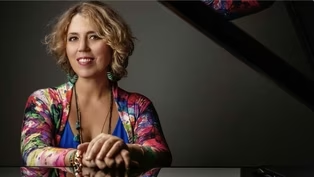
Meet Guest Artist Gabriela Montero
Video has Closed Captions
Clip: S5 Ep4 | 4m 25s | Venezuelan-born composer and performer Gabriela Montero discusses her Latin Concerto. (4m 25s)
Providing Support for PBS.org
Learn Moreabout PBS online sponsorship

- Arts and Music
The Best of the Joy of Painting with Bob Ross
A pop icon, Bob Ross offers soothing words of wisdom as he paints captivating landscapes.













Support for PBS provided by:
This Is Minnesota Orchestra is a local public television program presented by TPT