
118th Congress and the Legacy of Paul R. Williams
Season 5 Episode 30 | 26m 46sVideo has Closed Captions
Rep. Mark Amodei and Rep. Susie Lee talk about their plans for 118th Congress.
We talk with Rep. Mark Amodei and Rep. Susie Lee about their plans for the 118th Congress. We also take a look at an exhibit at the Nevada State Museum that examines the legacy of groundbreaking architect Paul R. Williams.
Problems playing video? | Closed Captioning Feedback
Problems playing video? | Closed Captioning Feedback
Nevada Week is a local public television program presented by Vegas PBS
118th Congress and the Legacy of Paul R. Williams
Season 5 Episode 30 | 26m 46sVideo has Closed Captions
We talk with Rep. Mark Amodei and Rep. Susie Lee about their plans for the 118th Congress. We also take a look at an exhibit at the Nevada State Museum that examines the legacy of groundbreaking architect Paul R. Williams.
Problems playing video? | Closed Captioning Feedback
How to Watch Nevada Week
Nevada Week is available to stream on pbs.org and the free PBS App, available on iPhone, Apple TV, Android TV, Android smartphones, Amazon Fire TV, Amazon Fire Tablet, Roku, Samsung Smart TV, and Vizio.
Providing Support for PBS.org
Learn Moreabout PBS online sponsorshipThis week on Nevada Week , Nevada Congressman Mark Amodei and Nevada Congresswoman Susie Lee share their visions on the debt ceiling, immigration, and more.
Plus, a look at the local legacy of trailblazing African American Architect Paul Revere Williams.
♪♪♪ Support for Nevada Week is provided by Senator William H. Hernstadt.
Welcome to Nevada Week .
I'm Amber Renee Dixon.
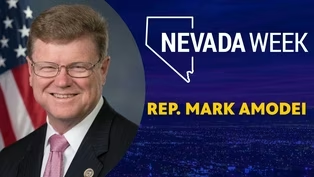
We begin up north where in November, Nevadans elected Republican Mark Amodei to his seventh term in Congress.
This session, he was appointed Chairman of the House Appropriations Committee's Legislative Branch Subcommittee and is responsible for overseeing Congress' budget.
As such, we started our conversation with where he stands on whether to raise the debt ceiling.
(Rep. Mark Amodei) So separating the wheat from the chaff is the first step in that.
And then once you know you're dealing with those actual facts, Amber, then it's like, Okay, so let's see what we can do here in terms of the right thing, because as we know, the cost of the national debt, because interest rates have gone up a heck of a lot, is a big deal now, as opposed to just a few years ago when everybody liked interest rates.
-Would you vote to raise the debt ceiling if no cuts were made?
-Well, you know what?
Here's the problem: I think it's time for an honest look that 75% of every federal dollar spent is what is called "mandatory spending."
Now, that's Social Security, Medicare, Medicaid, interest on the debt are the big ones.
But when you say no cuts were made, it's like, Well, we shouldn't be looking at cuts that pull the rug out from under people who are already in those programs or close to eligibility.
But in a prospective sense, Amber, it's time to look at that.
And also, when you take a look at the last two years, four years in general, there were many items of spending that were put into mandatory spending, which means Congress has no discretion.
And so the answer to your question is this: I will vote for what I think is responsible in terms of keeping the federal government from crashing financially and continuing to stack up debt.
-Where do you stand on cuts to Social Security, Medicaid, and/or Medicare?
-You can't pull the rug out from under people that are already receiving those benefits.
Then for people who are responsibly planning their retirement, you can't say, Hey, even though you're three years away, guess what, everything's different.
So I think that's part of the legislative process where you evaluate: Are we going to change eligibility, are we going to change benefits to some extent, and when--that's a very key word--"when" would those take effect?
And so a public discussion on the record with full transparency would be a healthy thing to that process, and see what we learn as a result of that.
Nobody's even considered it because it's, you know, it's like, Oh, my God, it's political suicide; the campaign people will murder you.
And all that other sort of stuff.
It's like, Well, guess what?
There's a lot of folks that are gonna get murdered if we keep heading down this thing and just going, Eh, the deficit doesn't matter.
I'll tell you this: I am a person who does not think that the deficit doesn't matter.
-So let's say you are a few years away from retirement and collecting Social Security.
You may not have to worry if Mark Amodei has his say.
But if you're, let's say-- -Well, I think-- - --40 years old and decades away from retirement, you may have to start making different plans.
-That's a, that's a fair categorization.
I think generally, that's accurate.
-Okay.
You did bring up Kevin McCarthy.
And I'm wondering with the House majority that you have with Republicans, slim majority, what would you tell Americans about how well you think House Republicans will be able to work together after the discord that we saw in electing him to House Speaker?
-Well, a couple of things.
First of all, I think that process, and you may go, you may give me a funny look, but I think that process served to unite Republicans more than they were before the process in terms of talking about those issues in the process that were more important in terms of transparency, amendments, all that sort of stuff.
So I think actually, it feels stronger than it did after the first vote, you know, after 15.
The other thing you have to look at, Amber, is what are those big principles that Republicans had said they would concentrate on--the border, energy, the economy, education, oversight, all those things?
And I don't think there's much-- I don't think there's much discord amongst the troops, if you will, as far as those issues go.
I expect Republicans to stay united on that.
There will, there will be some issues that come up from time to time, which because Republicans love intramurals, there will be some issues that come up from time to time, which will test that.
But I think for the most part, it's been a healthy process.
We've come out the other end stronger, and I look forward to getting along with the agenda.
The first week on the floor, in terms of the IRS agents and anti-violence against Right to Life locations and stuff like that, were not hard votes, I think, for any Republicans.
Matter of fact, you had some Democrats join in some of those.
So we'll see.
-With the makeup of the House and the slight majority that Democrats have in the Senate, of your priorities this session, what do you think is most likely to become law?
-Let me answer you this way: Nevada is a state that is phenomenally unique in the Union in that it is owned, like 80 to 85% by the federal government.
That's not in and of itself a bad thing.
But where you're sitting in Las Vegas, that town is completely surrounded by federal land.
Henderson is.
Tonopah is.
Winnemucca is.
Reno is.
Everybody.
And so when you talk about economic development in Nevada, whether it's, whether it's Southern Nevada, whether it's Western Nevada, or whether it's rural Nevada, you have to go treat with the federal government regarding the real estate in order to do that.
And so the biggest example is the Southern Nevada Public Lands Management Act, which is 22, 23 years old now, something like that.
Very few people realize that that authorized the disposal in and around Las Vegas of 70,000 acres.
And do you know how much has actually been disposed of after two-plus decades?
About half.
And the reason I tell you that is the cliches of, Oh, my God, irresponsible growth, you know, by the Clark County Commission, the Las Vegas City Council, the Henderson City Council.
It's like, Well, when you look at over 22 years, 35,000 acres, that's not exactly, Yeeha!
Warm the bulldozers up and start knocking down desert tortoise habitat.
So I say-- when you say "priorities," it's like Clark County and the Southern Nevada Public Lands Management Act are both due for an update.
-That's a great example of bipartisanship, because that Bill you're talking about, the Clark County Lands Bill, was the work of Senator Catherine Cortez Masto.
Here's another example, but maybe not so much bipartisanship.
And you can help me understand why not.
The topic of immigration.
We recently had her on, and she talked about, Both of these things can be accomplished: You can enact protections for Dreamers, and you can also bolster border security.
And that sounds similar to what I've read you talk about when talking about fixing the immigration system.
But what is the difference here?
Why isn't there comprehensive immigration reform happening, then?
-Well, actually, it's because both sides are addicted to their political talking points.
And there are exceptions, but for the most part, both sides have been afraid to stick their neck out and go, Hey, enough is enough.
The last time we did immigration was when Ronald Reagan was the President 30-some-odd-years ago.
And so you're sitting there going, A few things have changed in over three decades that we should react to.
There are answers to immigration which don't let anybody align, don't mean that you can have gang members and felons and all that other sort of stuff being given green cards or whatever.
The problem is one side says, screams amnesty every time you do it, and the other side says the Republicans hate your guts.
And as a practical matter, what we're lacking here from both sides is the political courage and the leadership to go, We got to do something about this.
Because when you do nothing, you have what we have at the border right now.
-Do you think you differ from Catherine Cortez Masto and her stance on immigration, then?
-Probably not a lot in terms of the nuts and bolts.
It's like, I mean, I signed a discharge petition a couple of Congresses ago to get the Dreamers Bill to the floor.
And it was a responsible proposal.
But you know, you get the commentator culture and the culture of cliche, and it's like, if you, you know-- Well, you know.
You've read this stuff.
But it's like, it's not helping us.
And it is Congress' job to establish a system of naturalization, which is immigration.
And we've been asleep at the switch for over three decades.
-To see Nevada Week 's full interview with Representative Amodei, including which Pro Life measures he's supporting, go to vegaspbs.org/nevadaweek.
And that's also where you can find our full interview with Democratic Congresswoman Susie Lee, who's serving a third term in Congress, yet her first in the minority.
"This divided Congress," she says, "must act with a sense of urgency to raise the debt ceiling."
(Rep. Susie Lee) Ultimately, we have got to come to an agreement.
But basically holding the worldwide economy hostage for something that Congress has dealt with time and time again, I think, is very dangerous.
And so I believe that we're going to have to work together to address this issue.
And it's coming up very quickly.
-How soon would you like to address it?
-Well, I mean-- -Or would you entertain-- -Well, I think before June is really when we're going to have to do it.
-Okay.
Would you entertain some of the Republican's desires to make spending cuts?
-Well, listen.
You know, it depends where they want to.
I'm hearing Medicare and Social Security, which I am opposed to.
So we're going to have to see what those proposals are.
But it's going to be a tough negotiation.
-What bipartisan legislation are you working on currently?
-Well, listen.
You know, in the 117th, I was most proud of our Bipartisan Infrastructure package, which came out of the Problem Solvers Caucus, which is a caucus that I'm a member of.
And in April of '21, that Bill was deemed dead.
And we got together and really put that framework together.
And ultimately, that's what's passed.
That included my Large-Scale Water Recycling Bill, which is freeing up federal funds to support large-scale water recycling projects, like the one that the Southern Nevada Water Authority is going-- is entered into an agreement with LA Metro, where LA Metro builds the facility, and we keep the water in Lake Mead.
And so that is my opener to say that drought is my number one issue.
You know, we have members from Utah, from Arizona, from Colorado, California and Nevada, Wyoming.
And so it doesn't matter, lack of water is not a Democrat or Republican issue.
That is something that is at a crisis level, and Congress is going to have to step in and help out.
-What can be done by Congress in that area?
-Well, listen.
This year we have the Farm Bill up for reauthorization.
And we know that some of the pressure on water is through agriculture use, some of it not the most efficient use.
And so I do believe there's opportunities in that Bill to do some conservation funding to support some transferring of maybe crops and things like that.
And I do think that we have to continue to work to conserve and to make sure we're looking at our best alternative uses.
-On the topic of immigration, what, in your opinion, is preventing Democrats and Republicans from coming together and enacting meaningful reform?
-I think the biggest barrier is people draw their red line first, instead of trying to figure out where are the areas where we can, we can agree.
And so you're never going to come to an agreement if you, you draw your red line and say, I'm never going to pass; I'm never going to cross it.
And I think the other thing that trips us up as well is, you know, when you talk about a comprehensive package, you know, whether you're talking border security-- we know border security is so important.
You know, we have Dreamers and DACA recipients who have been living in fear for years and with the lack of security.
And so when we get to a certain point, you know, people just feel like maybe it's easier just to deal with one of these issues, right?
Like maybe we'll just peel this issue off.
But it's such a, it's such a intertwined, complicated system in that you really can't deal with one issue without dealing with the other.
And so I think that we have to start out with sort of, These are the common things we're going to work on, and work out from there.
And, you know, and just be committed to completing it.
And because this country needs it.
We need it for, you know, to honor what this country is about.
We need it economically as well.
-It's interesting because Representative Mark Amodei was on and said the same exact thing about drawing red lines and really just sticking to one side and not willing to negotiate.
But then at the same time, he and Senator Cortes Masto have said, Yes, we believe it's possible to both bolster border security and to enact protections for Dreamers.
So if they can both agree on that-- -Right.
- --I don't understand what is the sticking point.
What are some of the sticking points that you see?
-Yeah, I mean, you know, what ends up-- I mean, it really, to me, it is a matter of looking at everything, and looking at visas and looking at enforcement and, you know, we just-- people get stuck on one thing and say, If this isn't included, you can't have my vote.
And then if you don't have their vote and then you include something else and someone says, If that's included, you don't have my vote.
And then the deal falls apart.
And so ultimately, people have to, I think, hold their gunpowder until we get the full framework.
And it's hard.
I mean, it's-- it's hard negotiation, but we have to do it.
-What have you learned in your time as one of the most bipartisan members in those negotiations?
-Listen.
I, you know, I think that, in general, you get things done with people you have a relationship with.
And you don't have a relationship with someone if you don't talk to them and find those opportunities to build that relationship, find out their kids' names, know what they like to do in their spare time.
I'm the chairwoman-- or the co-chair of the Women's Bipartisan Caucus, which is, you know, obviously an opportunity for Democrats and Republicans really to just, you know, work on issues that are very important to women.
It doesn't matter if you're Democrat or Republican.
But also take that time to learn who your fellow members are.
So when there is an issue-- You know, I passed the Mobile Health Care Act.
This is a Bill that alleviates-- or allows funding to be used for mobile health units.
And before this Bill was passed, if you got money from-- for the new access point, it could only be used for a building.
I paired up with Richard Hudson from North Carolina.
He represents a rural district.
And then I went and met with all of the Energy and Commerce members who-- Republicans, to ask them about this Bill.
It doesn't cost anything more.
It's just really a way of changing the criteria for funding.
But it frees up money that will be so impactful here in Nevada, where we have such deserts, for people and lack of transportation, where we can bring health care to people.
But it's also important to rural districts, like Richard Hudson's in North Carolina.
So just, you know, finding those opportunities on some of these issues where, you know-- you know, we don't represent nearly anything that looks the same as a district, but we struggle with some of the same issues in terms of access to health care and how can we find some common sense solutions.
-And last question for you.
Your district includes Laughlin.
And according to the Las Vegas Convention and Visitors Authority, visitor volume there is down 30% from pre-pandemic numbers.
What can you do to help in that area?
-Yeah, listen.
You know, Laughlin, obviously, is an area that relies heavily on the river, on recreation off of the river.
People are having trouble launching because of the lack of water.
There's uncertainty with respect to the dam and their releases, et cetera.
It's having a major impact on them.
And so, number one, work on the drought, which I have done and will continue to do.
You know, I led the fight to make sure that we designate Avi Kwa Ame as a national monument.
That has potential for some economic benefit from tourism in the area.
And continuing to work to make sure we're doing everything we can to bolster that economy.
And then, of course, we, you know, passed the Inflation Reduction Act with major investment in renewable energy.
And that corridor is obviously a major asset to our state and to our country in terms of potential for development of renewable energy.
-Again, our full interview's with Representatives Susie Lee and Mark Amodei can be seen at vegaspbs.org/nevadaweek.
We turn now to Black History Month.
Starting February 12, right here on Vegas PBS, tune in to see the inspiring documentary, Hollywood's Architect: The Paul R. Williams Story.
-Concerned that White clients might be uncomfortable sitting next to him while he illustrated his ideas, Williams developed a unique skill that would become his trademark.
-I spent hours learning to draw upside down.
Then with a prospective client seated across from me, I would begin to sketch the living room of his house.
Invariably, his interests would be excited by this trick.
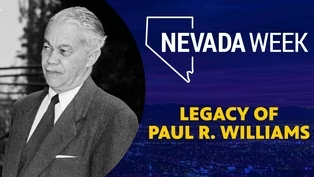
-Paul Revere Williams was the first Black architect to become a member of the American Institute of Architects.
He was known as the "Architect to the Stars" but, because of his race, was not allowed to frequent the buildings he designed.
Nevada Week 's Maria Silva joins us now.
And, Maria, Williams designed nearly 3,000 buildings, several of them right here in Nevada.
(Maria Silva) Amber, how lucky are we?
We can actually find some of his fascinating architectural designs all over our state, the entire state of Nevada, Northern and Southern Nevada.
In fact, Mr. Williams was first commissioned to design a home in Reno for a Mrs. Luella Garvey back in 1934.
The Garvey House still stands today.
Here in Las Vegas back in 1949, he designed the first African American Housing Development in historic Berkley Square neighborhood.
He also designed a seashell-shaped motel and a cathedral on the Las Vegas Strip.
(Carmen Beals) This exhibition is called Janna Ireland on the architecture legacy of Paul Revere Williams in Nevada.
-These stunning black and white photographs adorn the walls of the Nevada State Museum.
A celebration of Mr. Paul Revere Williams' work in both Northern and Southern Nevada.
-Not only would he build these luxurious homes, hotels, commercial properties, but he had a mindset of actually developing homes just so that people of all socioeconomic levels, all colors and classes, can enjoy the comfort of their own call.
-Carmen Beals, associate curator and outreach director with the Nevada Museum of Art traveled with Janna Ireland as the talented photographer captured these breathtaking images.
-My favorite place that's a go-to for everyone is the Historic Westside.
There you can see Berkley Square where he developed 148 single story homes.
-Mr. Williams' work in Nevada spans from the 1930s through the 1970s and includes the Guardian Angel Cathedral, built in 1963.
[organ music] - A-framed mid-century modern cathedral that is a must-see, and it stands right on the Strip.
-The Guardian Angel Cathedral, one of several structures Mr. Williams designed on the Las Vegas Strip.
(Aaron Berger) Le Concha was the lobby, the reception area for the Le Concha motel that was right across from Circus Circus on the Strip.
It was built in 1961 by Paul Revere Williams, and it's a great example of Googie architecture.
-It was that futuristic style of architecture influenced by car culture and Space Age that Aaron Berger, Executive Director at the Neon Museum, says allowed the La Concha to compete with the grandeur of the other Strip properties.
-La Concha is Spanish for "the shell" or "seashell."
And if you look at the building and the design, it does.
It's exactly like this kind of "Venus on the half-shell" sort of look to it.
-The Neon Museum went through great lengths to preserve this iconic piece of Las Vegas architectural history.
-If you can, imagine kind of slicing it like an orange and cutting it into eight pieces, putting those eight pieces onto a series of flatbed trucks, and then reassembling it here as our Visitor Center.
-Back at the Nevada State Museum, you'll be able to experience the exhibit until May 30.
A beautiful tribute not only highlighting Mr. Williams' work in Nevada and the legacy he leaves behind.
-Those homes have been passed down from generation to generation.
-Here, you'll also learn more about his incredible life story.
-He was known as the "Architect to the Stars," but racial covenants would not allow him to live in that area.
-The exhibit, open to all ages, all in hopes of inspiring future generations of architects.
-Right now, less than 5% of architects are people of color.
So just to have this option and show kids of all colors that this is a career choice that's available to you, that is what warms my heart.
-And speaking of inspiring our future architects, the Neon Museum is holding a very special event on the 18th.
Kids will learn more about Mr. Williams, and they'll even get to create their very own dream home blueprints.
How fun would that be?
Now on the 17th, Nevada State Museum hosting Through The Lens: Honoring the Architectural Legacy of Paul Revere Williams where you will be able to meet the photographer, Janna Ireland, and we have all the information on our website.
It's so great that we're honoring this great man.
-And then also February 18th marks what would have been Williams' 129th birthday.
I understand the State plans to proclaim that day Paul Revere Williams Day.
And there's another special event that day in Berkley Square, which you mentioned in your story.
-Yeah, the Nevada Preservation Foundation.
They're hosting a 45-minute guided walking tour through Berkley Square.
That neighborhood, it's so historic and, as we heard there in that piece, it's so special again that those 148 homes, a lot of them have been passed down from generation to generation.
-He designed both for the wealthy and the average person.
How neat.
Thank you so much, Maria, for that story.
-Thank you.
-And thank you for watching.
For any of the resources discussed on this show, visit vegaspbs.org/nevadaweek.
♪♪♪
Video has Closed Captions
Clip: S5 Ep30 | 6m 19s | Paul R. Williams the architect who designed building in Hollywood and Las Vegas (6m 19s)
Video has Closed Captions
Clip: S5 Ep30 | 9m 47s | We talk one-on-one with Rep. Mark Amodei about his plans for the 118th Congress. (9m 47s)

Video has Closed Captions
Clip: S5 Ep30 | 9m 28s | We talk one-on-one with Rep. Susie Lee about her plans for the 118th Congress (9m 28s)
Video has Closed Captions
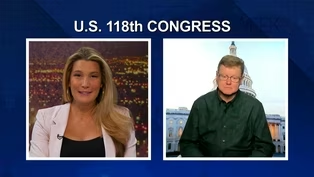
Clip: S5 Ep30 | 20m 31s | Rep. Mark Amodei (R) talks about his plans for 118th Congress and his new chairmanship. (20m 31s)

Video has Closed Captions
Clip: S5 Ep30 | 14m 50s | Rep. Susie Lee (D) talks about his plans for 118th Congress. (14m 50s)
Providing Support for PBS.org
Learn Moreabout PBS online sponsorship
- News and Public Affairs

Top journalists deliver compelling original analysis of the hour's headlines.

- News and Public Affairs

FRONTLINE is investigative journalism that questions, explains and changes our world.












Support for PBS provided by:
Nevada Week is a local public television program presented by Vegas PBS