WEDU Arts Plus
1207 | Episode
Season 12 Episode 7 | 26m 19sVideo has Closed Captions
Sphinx Virtuosi |Climate change via photos | Sci-Fi in cinema | Yoga for young adults
The Sarasota Orchestra hosts the Sphinx Virtuosi, a self-conducted chamber orchestra from Detroit comprised of diverse musicians. Artist Tina Freeman uses photography to reflect on the effects of climate change. A film series at the Cleveland Museum of Natural History explores the world of science fiction in cinema. A non-profit organization in Reno, Nevada, brings the art of yoga to young adults.
Problems playing video? | Closed Captioning Feedback
Problems playing video? | Closed Captioning Feedback
WEDU Arts Plus is a local public television program presented by WEDU
Major funding for WEDU Arts Plus is provided through the generosity of Charles Rosenblum, The State of Florida and Division of Arts and Culture and the National Endowment for the Arts, and the Hillsborough County Board of County Commissioners.
WEDU Arts Plus
1207 | Episode
Season 12 Episode 7 | 26m 19sVideo has Closed Captions
The Sarasota Orchestra hosts the Sphinx Virtuosi, a self-conducted chamber orchestra from Detroit comprised of diverse musicians. Artist Tina Freeman uses photography to reflect on the effects of climate change. A film series at the Cleveland Museum of Natural History explores the world of science fiction in cinema. A non-profit organization in Reno, Nevada, brings the art of yoga to young adults.
Problems playing video? | Closed Captioning Feedback
How to Watch WEDU Arts Plus
WEDU Arts Plus is available to stream on pbs.org and the free PBS App, available on iPhone, Apple TV, Android TV, Android smartphones, Amazon Fire TV, Amazon Fire Tablet, Roku, Samsung Smart TV, and Vizio.
Providing Support for PBS.org
Learn Moreabout PBS online sponsorship- [Narrator 1] This is a production of WEDU PBS, Tampa, St. Petersburg, Sarasota.
(light upbeat music) - [Narrator 2] Funding for "WEDU Arts Plus" is provided by the Community Foundation Tampa Bay.
- [Gabe] In this edition of "WEDU Arts Plus," a diverse chamber orchestra visits Sarasota.
- [Thierry] All this trouble that each person had makes us stronger.
And when we share these struggles, we unify our strengths.
- [Gabe] Photographs with a purpose.
- [Russell] She really wants people to see these beautiful images of the wetlands, and then also at the same time, see something that is threatening their existence next to it.
- [Gabe] Highlighting scientific elements in film.
- [Joe] Real science is an attempt to engage the public with our curators who have knowledge about particular kinds of science that ties into movies.
- [Gabe] And the art of yoga's ability to heal.
- [Hannah] We're giving them tools to digest their experiences in a healthy and a safe way.
- It's all coming up next on "WEDU Arts Plus."
(jazzy upbeat music) Hello, I'm Gabe Ortiz, and this is "WEDU Arts Plus."
Based in Detroit, the Sphinx Organization transforms lives through the power of diversity in the arts.
The Sphinx Virtuosi is a dynamic chamber orchestra that serves as the organization's flagship performing entity.
In this segment, the Sarasota Orchestra hosts as they pay a visit to Sarasota, Florida.
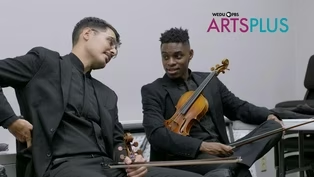
(curious orchestral music) - [Joseph] The Sphinx Virtuosi is an 18-member ensemble of musicians of color and Latinx, and they speak the language of today's composers.
When the opportunity came along, we thought, absolutely, it made great sense for us to be a host presenter because of the wonderful tradition of the arts here in Sarasota.
- [Bill] The Sphinx Organization was founded in 1997 by Aaron Dworkin.
At the beginning, it was just the strings competition, the Sphinx Competition.
- [Meredith] It was really the first to showcase African American and Latinx string players in this country.
It was always an opportunity for these musicians to be heard, to network, to be able to meet other musicians of color, which is huge, because in this industry, you stand out.
- [Aaron] We were looking at the idea of founding Sphinx and beginning this work in this field, which didn't really exist.
It was how can we bring about systemic impact.
- [Bill] Some of the statistics that we've seen from the League of American Orchestras have shown that there's 1.8 to 2.5% representation of Black and Latinx musicians in American orchestras.
- [Alex] I think that a lot of the ways music has been presented has turned it into a bit of a closed off medium, when in fact the communicative power of music is quite vast.
- [Meredith] I don't think I realized how much I stood out until going to Sphinx because you're just conditioned, this is just how it is nine times out of ten.
So to find that one time out of ten where all of a sudden it's like, oh, you look like me.
That's great.
- [Bill] A performance by Sphinx Virtuosi is not like any other orchestra performance.
There's for one, we are a self-conducted string ensemble.
We use that word intentionally, self-conducted, not un-conducted, 'cause each one of us is our own conductor.
It's a hyper democratic process, our rehearsals.
- [Thierry] Every single person shares something.
I never played in anything like that.
I was very shy in the beginning.
They said, "Thierry, what do you think about this?"
And I was like, "Really?
They really want to listen to my opinion?"
- [Meredith] Balancing 18 ideas and personal opinions can be tricky, but I think what's so amazingly unique about this group is that we do it.
It's peaceful, it's respectful, and in return, the performances we give, they're live, and the audience I think really enjoys to see the way that we communicate on stage.
- [Bill] When we get together at the beginning of our tours, there's no real ice breakers.
When I perform with other groups, other orchestras, other places, you kind of have to have small talk.
You talk about the weather, you talk about traffic, all that kind of boring stuff.
Here we drop all of that because we already know why we're here.
- [Meredith] It is truly a family.
You'll hear everybody say that, like la familia, but it's true.
We are the crazy family.
We are the Thanksgiving that gets out of control every night, and it's just because it's constant laughter.
We love each other.
We take amazing care of each other, and happens on stage and off.
- [Bill] We feel represented in each other because we've had to climb over similar obstacles to be at the level that we're at.
- [Thierry] What makes a family is sharing good moments and bad moments.
All the struggle that each person had makes us stronger.
And when we share these struggles, we unify our strengths.
(soft emotional music) - [Joseph] Music in Sarasota's been a long tradition here.
In fact, the Sarasota Orchestra is the oldest continuing orchestra in Florida.
I've been here at the orchestra 22 years, so I've seen this evolution of the institution, the ability for us to serve a broader and larger demographic region.
It's really been fun to be part of a community where you're part of the growth and the evolution of the art scene, and that's exactly what's happened here over the last several decades.
(thoughtful violin music) - [Vickie] It means a lot having this group come to our Sarasota community and bring their passion and their love for the music and their love for all people.
- [Lauren] That's really the key is really making sure that we bring organizations like the Sphinx Organization to these communities so they can see what is possible.
- [Thierry] For me I have a mission with music, to encourage people from my country that they can pursue what they dream.
By Zoom I teach students that are very far from the big cities, and my goal in life actually, is to do a similar organization in Brazil.
- [Bill] Our community is not just Detroit or Michigan.
We've embarked on this global mission that is the entire world that identifies with our goals.
So if the Sarasota Orchestra or whomever can identify that there are people who can be impacted by having a more global reach and effort in our goals of inclusion, then you shouldn't just stop at your town or your neighborhood.
You should be able to go all the way.
(audience applauds) (light music) - [Gabe] To learn more, visit sphinxmusic.org.
Using the medium of photography, artist Tina Freeman takes images of the earth's landscapes and reflects on climate change and its effects.
We head to New Orleans, Louisiana to get a closer look.
(soft pensive music) (rain pattering) - [Russell] Tina Freeman Lamentations is an exhibit of landscape photographs taken both here in south Louisiana and on both polar ends of the globe, in the Arctic and Antarctic regions.
And in the exhibition, you'll see each of the works is actually a pair of images, one from here, and one from one of those places.
And the idea is that the exhibition tells a series of stories about global sea level rise and the relationship between regions that are really far away in the Arctic and the Antarctic, and what's happening here in our backyards as flooding increases and as we lose some of the coastal protection in the form of our wetlands.
The images are in pairs, or in the art history world, what we would call a diptych.
And a diptych is just a pair of pictures that belong together in some way.
The question that we pose to the viewers, whenever anybody comes through the exhibition, I always suggest that if they walk through with only one question on their mind, it should be as they're standing in front of each of these pairs, why are these two images together?
And I think everybody will come up with their own answer, but that's an important part of this project.
In some cases, Tina has paired these images because they are formally similar.
It looks almost as if, for example, that a hole in the ice in one picture could be filled with a little patch of wetlands in the other, as if they're a negative and positive together.
And then in other cases, there is a little bit more of a conceptual relationship.
For example, in the room we're in right now, there's a great pair of pictures, both shot from airplanes, one in Iceland, and one in south Louisiana.
And in each of those, you see something moving through something else.
In Iceland, it's water carving its way through sand and silt, and in Louisiana it's sand and silt carving its way through water as the Mississippi deposits it at the end of it journey.
So there are a lot of relationships to tease out, and some of them are obvious, and others are not.
Tina Freeman has said that the goal of the exhibit is first and foremost to demonstrate the beauty of the Louisiana wetlands.
She is born and raised in south Louisiana, and grew up going out on boats into the wetlands and the bayou regions.
And she really wants people to see these beautiful images of the wetlands, and then also at the same time, see something that is threatening their existence next to it.
As these polar ices melt and add water and volume to the oceans, of course, sea level is rising.
And as we know here, storms have been increasing in intensity and reaching further inland, partly because we've lost the buffer of the coastal wetlands.
So as they're disappearing, Tina wanted to produced this lamentation for the loss of these Louisiana wetlands.
In addition to being a visual photographer, Tina is very invested in the information that these photographs can provide.
And at the beginning of the exhibit, you see two charts, one from 1934, and one from 2018.
And they show the relative loss of the coastal wetlands.
And then next to that, you see a list of place names that have been removed from those charts.
And in fact, the last time they did that project was in 2011.
They haven't looked back at the charts to see what other names might have needed to have been removed since then.
But if you look closely at the place names, almost all of them are bodies of water, ponds or bays or bayous.
And of course, for something to be a body of water, it has to have land surrounding it identifying it as a body of water.
And a lot of that land is what has disappeared over the years.
So there is in the title lamentations, an implication that something is lost or being lost.
And you see that right at the beginning of the exhibit.
In one of the pairs of images, you see, for those of us here in south Louisiana, something very recognizable, big liquid containment storage units.
And next to it is a form that looks similar, but is old and rusted, a group of tanks that are actually from a place called Deception Island in Antarctica.
And one of the other links between these areas separated by thousands of miles that we might not expect is the oil industry.
So obviously, in south Louisiana, those are oil tanks.
But on Deception Island, those tanks were designed to hold whale blubber, which of course, amongst other things, was rendered into oil.
In another pair, which I think is one of the most powerful, it's one of the largest in the show, on the left you see this incredible ice cave that's in Iceland, and on the right hand side, you see an old abandoned pumping station near Morgan City in Louisiana.
And on the left, their forms are similar, which is why they're paired together.
There's almost this nautilus shell spiraling out in both of the pictures.
But on the left, that glacial ice cave is actually enormous.
And if you look in the lower left corner, you can actually see a fairly large, four or five-person raft that is very small in the picture.
So we're looking at an ice cave that is 20, if not more, feet high, looking out.
And on the right is this abandoned pumping station, which demonstrates how long we've been aware in Louisiana of the problem of controlling water, and also how long we've tried to control it.
That pumping station dates to around the turn of the century in 1900, and so it's now left there.
It's not in use, but it was once a way that we tried to control that water.
And then in yet another pair, there is a glacial landscape on the left with the bones of a muskox visible in the foreground, and it's an enormous skeleton.
It almost makes Iceland look like a prehistoric landscape, as if these were the bones of a dinosaur or some extinct species.
But I think the symbolism there is important, extinction and the possibility of the loss of this ice in glacial regions.
And next to it you have an old abandoned gas pipeline canal with a fallen tree that, as it's on its side with its branches splayed out, echoes the form of the ribcage in the muskox next to it.
So both of them become skeletal presences, as if they are representing the specter of loss, of death.
There is some heavy symbolism in the show.
While the work is beautiful, there is a really powerful message to the show that a lot of people have been hit with when they come in here.
The world is not that large and that things are interconnected, and that what happens in one place affects people in another place.
And yes, the world is changing in both of these locations, the polar ends, or us here in coastal Louisiana.
These places will not look the same in the future.
I think the real question is, is it too late to change or to reverse these effects?
Or another way that people have interpreted that question, what's the meaning of all of this, is what can I do?
What should I do?
Should I be inspired to help save the earth in some way, to prevent sea level rise?
This selection of 27 pictures was conceived of as an exhibition, and the publication that we produced includes the exact same 27 pictures.
And we do have hopes for this to travel.
In fact, a number of institutions have expressed interest in showing this exhibition in places as far away as Iceland and Utah.
So we're looking forward to working with other institutions to present this.
Obviously, they recognize that even though this is, in some ways, Louisiana's story, it's a story that almost anybody can understand on a coastal level.
(light music) - [Gabe] To see more, go to noma.org.
Up next, we take part in real science.
Produced by the Cleveland Museum of Natural History and Cleveland cinemas, this film series explores the world of science fiction and shows how directors incorporate scientific details into their films.
- [Reporter] Exterior, desert in New Mexico, day.
A New Mexico state police plane soars across the cloudless sky.
- [Joe] But they don't show New Mexico terrain.
It in fact was filmed in southern California, and I knew that terrain.
(bouncy music) Quiet.
There we go.
My name is Joe Hannibal, and I am the curator of the invertebrate paleontology at the Cleveland Museum of Natural History.
I love movies.
I like old movies.
I like movies that have giant bugs in them.
And I especially like the movie "Them" because it is the mother of all bug movies.
- [Narrator 3] There is no word to describe them.
(dramatic orchestra music) (daughter screams) - [Reporter] In the seminal creature feature from 1954, giant mutant ants reek havoc on an suspecting public.
Humanity's only hope lies in the bumbling Dr. Medford and his bombshell daughter, both of whom are myrmecologists, ant specialists.
It might sound hokey, but the film is crawling with charm, according to Dr. Hannibal.
- [Joe] Number one, the music.
It's spectacular music with crescendos of information.
I like the noises made by the ants.
(ants trilling) Okay, they're not too accurate, but they are cool.
And it does have a series of very accurate observations in it.
- [Reporter] These accurate observations were in the spotlight at the Capitol Theater last week, as moviegoers retreated to a special screening of the sci-fi film, along with a post-film chat with Dr. Hannibal.
- [Joe] It's called arthropleura.
- [Reporter] It's part of the Real Science Film Series, a collaboration between the Cleveland Museum of Natural History and Cleveland cinemas.
- [Joe] Real Science is an attempt to engage the public with our curators who have knowledge about particular kinds of science that ties into movies.
- [Reporter] And Dr. Hannibal's past study of giant prehistoric arthropods, a filum that includes insects like ants, makes him uniquely qualified to uncover the real and not so real science of "Them."
- [Joe] Well, you might say that the ants are not the most accurately reproduced ants in the movie business.
In fact, well, they're funny looking ants.
But heck, there's such big kernels of truth in the movie, it's amazing.
Okay, there are no big ants like that, but there could be big arthropods like that, and there were in the past.
There was an animal about eight feet long.
This is a giant arthropod.
They made track ways in the sand and mud during the Coal Age about 300 million years ago.
In pieces parts of them are found all over the place.
A lot of my studies have been about fossil arthropods.
And among these arthropods are rather large ones, including supposed giant millipedes, and even bigger giant millipedes.
And in the movie, they actually replicated what I did in my particular study, and that is based upon a part of an animal, they figured out how big the animal was in its entirety.
- Over 12 centimeters, 12.
- That would make the entire- - About two and a half meters in length.
Over eight feet.
- [Joe] So that's plausible.
So they really did their research.
- [Reporter] Audience members at the Capitol screening were pleasantly surprised that the film received a stamp of approval from a bonafide giant bug expert.
- [Susan] I thought it was pretty cool that the stuff in the movie was fairly accurate, and he was able to confirm that, which I thought was pretty neat.
- [Reporter] But of course, there was also a healthy dose of skepticism.
- [Patricia] It's kinda hard to relate to giant ants in the desert when you live in Cleveland.
(laughs) (daughter screams) (light music) - [Gabe] For current exhibitions at the Cleveland Museum of Natural History, head to cmnh.org.
The Urban Lotus Project is a non-profit organization in Reno, Nevada that brings the art of yoga to young adults.
While learning to master this craft, participants encounter the mental and physical benefits of this ancient practice.
(bright music) - The Urban Lotus Project is a nonprofit here in Reno, Nevada, and we contract with yoga teachers in the community to bring yoga, specifically trauma informed yoga and meditation practices to different agencies that serve at-risk or underserved youth and young adults here in the community, specifically those kids that are afflicted or impacted by addiction, violence, incarceration, homelessness.
- [Hannah] It's a preventative program.
We're getting to them before they make that bad decision, or even after they do, or even after they've had their trauma.
We're giving them tools to digest their experiences in a healthy and a safe way, so that they can reclaim ownership of their bodies, they can reclaim ownership of their lives before they step into adulthood.
And to date, since we started, we've served about 14,000 students.
- [Kimberly] The trauma informed yoga is to help ease them into a new way of exercising and becoming mindful of their breath and how they can learn to adjust and cope with stressors in life.
And I like to do a yoga nidra where it's focusing on each body part and taking them through slowly to become more mindful of their breath and their body.
So actually focusing on each body part, walking them through it, relaxing them, and then finding stillness in shavasana, which is corpse pose.
(chuckles) And just laying still and letting them let thoughts come in their mind, and then letting them go.
- We are always looking for strong relationships and partners with yoga studios and yoga teachers in the community.
And one of the Urban Lotus Project's longest standing partnerships in town has been Yogahood yoga studio.
They've graciously offered their space so that we can host our free community classes there.
And the co-owners there have both served Urban Lotus in the past in different capacities.
- [Heidi] Our children need support, and this is one way that I can give back, that we can give back as business owners.
In its whole form, yoga offers us ways of living that help us to be happy and healthy in our bodies, in our minds.
Every time we come to the mat, every time we take a deep breath (inhales) and relax our bodies, we're communicating with our nervous systems that it's okay to relax, it's okay to just be who we are in the world and express ourselves in the world, and that's really golden for these young adults that we're working with.
- [Nicholas] We're taking what we know from the science about how it works with regulating the nervous system, and we're emphasizing those aspects of the practice so that the student can learn what those changes feel like in the body to develop a little more self awareness and a little more centeredness in the present moment.
And hopefully, the end goal with that is to maybe inform more mindful decisions and behavioral choices in the moment.
(calming music) - [Kimberly] It brings such joy to my life because I've been doing yoga since I was 25 years old, and I found it through my own trauma, which brought me into yoga, and it changed my life.
And it's amazing to see the transformation in a student, just even from one class.
- [Hannah] It's a completely new way to look at treating trauma, and I can't wait to watch it grow.
(light music) - [Gabe] To learn more, visit urbanlotusproject.com.
And that wraps it up for this edition of "WEDU Arts Plus."
For more arts and culture, visit wedu.org/artsplus.
Until next time, I'm Gabe Ortiz.
Thanks for watching.
(low upbeat music) - [Narrator 2] Funding for "WEDU Arts Plus" is provided by the Community Foundation Tampa Bay.
(flourishing music)
Video has Closed Captions
Clip: S12 Ep7 | 6m 27s | The Sarasota Orchestra hosts the Sphinx Virtuosi, a diverse chamber orchestra from Detroit (6m 27s)
Providing Support for PBS.org
Learn Moreabout PBS online sponsorship

- Arts and Music
The Best of the Joy of Painting with Bob Ross
A pop icon, Bob Ross offers soothing words of wisdom as he paints captivating landscapes.











Support for PBS provided by:
WEDU Arts Plus is a local public television program presented by WEDU
Major funding for WEDU Arts Plus is provided through the generosity of Charles Rosenblum, The State of Florida and Division of Arts and Culture and the National Endowment for the Arts, and the Hillsborough County Board of County Commissioners.