WEDU Arts Plus
1210 | Episode
Season 12 Episode 10 | 26m 45sVideo has Closed Captions
Geometric painter | All-in-one art space | Pipe organ | Scrap metal furniture
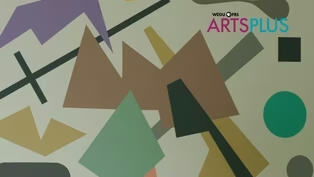
Abstract artist Juan Jose Hoyos Quiles of Clearwater creates colorful, geometric paintings. Take the Corrales Art and Studio Tour in New Mexico to meet the talented artists located all in one place. Learn about the Casavant Organ, a pipe organ at the Westminster Presbyterian Church in Dayton, Ohio. Welder Cindy Wynn shares how she makes furniture out of scrap metal in Key West.
Problems playing video? | Closed Captioning Feedback
Problems playing video? | Closed Captioning Feedback
WEDU Arts Plus is a local public television program presented by WEDU
Major funding for WEDU Arts Plus is provided through the generosity of Charles Rosenblum, The State of Florida and Division of Arts and Culture and the National Endowment for the Arts, and the Hillsborough County Board of County Commissioners.
WEDU Arts Plus
1210 | Episode
Season 12 Episode 10 | 26m 45sVideo has Closed Captions
Abstract artist Juan Jose Hoyos Quiles of Clearwater creates colorful, geometric paintings. Take the Corrales Art and Studio Tour in New Mexico to meet the talented artists located all in one place. Learn about the Casavant Organ, a pipe organ at the Westminster Presbyterian Church in Dayton, Ohio. Welder Cindy Wynn shares how she makes furniture out of scrap metal in Key West.
Problems playing video? | Closed Captioning Feedback
How to Watch WEDU Arts Plus
WEDU Arts Plus is available to stream on pbs.org and the free PBS App, available on iPhone, Apple TV, Android TV, Android smartphones, Amazon Fire TV, Amazon Fire Tablet, Roku, Samsung Smart TV, and Vizio.
Providing Support for PBS.org
Learn Moreabout PBS online sponsorship- [Announcer] This is a production of WEDU PBS, Tampa, St. Petersburg, Sarasota.
- [Announcer] Funding for WEDU Arts Plus is provided by the Community Foundation Tampa Bay.
- [Narrator] In this edition of WEDU Arts Plus, a Clearwater artist creates colorful abstract paintings.
- I am kind of a precise artist and I like geometry.
I'm attracted to it - [Narrator] Touring the studios of inventive creators.
- There's that opportunity for the direct relationship with people that come in curious to see how you work, where you work, and what you have.
- [Narrator] A pipe organ that resonates.
- The most unique feature of it would be its size and to be able to have the variety of sounds, soft and loud.
- [Narrator] And scrap metal furniture.
- Furniture can be art.
It's not, you know, the functionality, people think, "Oh, well, if it's functional, it's not art."
But I really think it is.
- It's all coming up next on WEDU Arts Plus.
(bright jazz music) Hello, I'm Dalia Colon and this is WEDU Arts Plus.
Like a lot of artists, Juan Jose Hoyos Quiles spent years working a day job before he pursued art full-time.
The former New Yorker now lives in Clearwater where he devotes his days to painting eye-catching abstract works.
(lively piano music) - My name is Juan Jose Hoyos Quiles.
And I'm an abstract, hard-edge geometric painter.
That term, I think, started in the early 1930s by an artist called Theo Van Doesburg, who coined a term called Concrete Art.
And what that means it's non-objective, and it usually involves flat colors, some kind of geometry, and it's totally abstract and refers to nothing but really itself.
Right now I'm working on a painting involving triangles of many different colors.
I've tried making figural paintings, so more fluid paintings, Expressionist paintings, but they just don't work out for me.
I am kind of a precise artist and I like geometry.
I'm attracted to it.
What I want people to get when, oh, they see my work is good composition.
The colors might evoke things that the person has lived with.
Anything from the color of the kitchen when they were a kid or the color of a landscape or a tree or a flower.
- Well, I have three pieces in the house.
The first one actually was a gift for some things that I had done.
And I picked it because the essence of it was pretty simple with a white background.
And then the geometric figures were so intriguing that I just wanted to hang it up and look at it and see what it talked to me or how it made me feel.
And actually, it actually got me through a rather rough period in my life.
I was recovering from surgery and Covid at the same time, and that painting hung over the bed where I was recovering, and it gave me a lot of time to focus and meditate.
(upbeat music) - I was born and raised in Brooklyn, New York.
I've always drawn since a child.
And from grades one through six, I was introduced to a lot of the arts, theater, and music.
I went to the School of Visual Arts in 1979 through the early '80s.
Keith Haring was attending at the same time, and his career skyrocketed from there.
Keith Haring was what you might call a later-day pop artist.
At that time, there were a lot of storefront galleries that opened up in the Lower East Side, which was a part of Manhattan, which was very gritty, drug-driven.
And there were a lot of abandoned buildings.
There was a lot of people, a lot of artists actually squatting in these areas.
I had a loft where I did my work with my fellow artist, we split the rent.
And that's how my art career started.
I went to School of Visual Arts for three years.
Throughout that time, I was working, I was putting myself through school, and money got tight.
I did not have enough money to finish and get my degree.
And New York being a very expensive city, I had to find a way to support myself, so I worked for a good 30 years in management.
My transition to Clearwater, Florida started in 2014.
My husband and I decided that we wanted to go somewhere warmer.
(upbeat music) I start with a blank canvas.
I re-gesso the surface, which already come with a coat of gesso, which is a light plaster, because I find that the extra layer of gesso helps in that adherence of the tape.
Sometimes I outline a composition directly on the canvas.
Sometimes I don't.
Sometimes I start with a circle or a square somewhere and just build off from there.
As far as the colors are concerned, that's kind of intuition also.
I use acrylic paint.
What I usually do is add a little gesso, a little matte medium, and a little water when I'm mixing the paint.
And that gives it a completely matte finish.
It doesn't have a shine to it.
The reason why the lines come out so perfect, that's where the term hard-edge comes from, is that the tape that I use is very sticky, number one.
When I apply the tape, I use a spatula to actually press this tape into the surface of the painting so that I make sure it adheres and none goes underneath the tape.
What I would say to a person who is stuck in a job, who has to support themselves for any reason and has loved the art previously as a child or teenager or early adult, and then you have to find yourself that you have to work, is to never give up.
Once you're an artist, you are always an artist.
You might not be making a physical work, but you eventually, if you're really want to do it, will get back to it, just like I did.
(gentle music) - To see more, visit juanjosehoyosquiles.com.
The Corrales Art and Studio Tour in New Mexico offers visitors a unique opportunity.
Guests get to enter the artist studio and gain a greater understanding of how a creative vision comes to life.
- Oh, my goodness.
You can't throw a stone without hitting an artist in Corrales.
(chuckles) (upbeat music) I love the tour, the Corrales Art Studio Tour because it's a great opportunity for the public to connect with the artists.
- This is my first year doing the studio tour in Corrales.
I've been a patron of it for, gosh, for as long as I've been growing up.
My mom and I would come to the garden tour, and we would do the studio tour just about every year.
There's nothing to not like about Corrales.
- Art is a frame of mind, you know?
And if you can relax and let that energy come out, and you're an artist, no matter what your medium is, you're gonna create something that's really cool.
And people feel that when they come to Corrales.
- It's a great place to be an artist.
There is so much support.
- Corrales has a long and deep art and cultural history.
The San Ysidro Church was built in 1868.
These historic facilities still today host a hub of cultural and artistic activity.
- I think that's part of what drives me is a need to connect with others.
And the way I do it is through my art.
(upbeat music) I've heard before a phrase that you can't take the art out of the artist or the artist out of the art.
And I think back to when I was a little girl and my Aunt Vera, who I loved dearly was, we were taking a walk and I did something not nice, I don't know what it was.
And she scolded me and said, "You are a very bold young lady."
And I said, "Aunt Vera, what does bold mean?"
And she explained.
And I remember saying, "Yes, I am bold."
(chuckles) And I think that comes through in my artwork.
I look at colors and I exaggerate them a little bit.
Even though my colors aren't realistic, there is red in a green tree, there's blue in a green tree, not as much as I put in it.
So I tend to exaggerate and I'm bold, and I'm loud.
(chuckles) (upbeat music) - Basically, my house is my studio.
I have my studio in the middle of the living room.
And then if the people have access to my house, they have access, not just my studio, it from my life.
It's open your space, and open a little bit of you to other people.
When I start to make pieces on the wall, I discovered that the wall was part of my piece, not just the place where I hang the piece.
And composition even is part.
And then that wall represent or boundaries, cross the boundaries.
Try to be free, try to express ourself.
One principle border for me is a cultural transition than my country to this country.
To discover that each human is different universe, and we need to cross our fears and try to express ourself, and discover that the other people think maybe similar but it's different than other ways.
It's important try to be transparent or try to cross that wall emotional or cultural wall for really know each other.
(upbeat jazz music) - I love the studio tour because there's that opportunity for the direct relationship with people that come in curious to see how you work, where you work, and what you have.
(birds chirping) This is the art of everyday life.
Gratification for me comes from handing the bread wall to say, you know, I can think of specific people, mothers that have bought things for their daughters.
And, you know, when you go to a museum somewhere in the world, oftentimes you're looking at pottery.
And I like to think that at least some of my pieces will make it a hundred years, you know.
And that'll be, "Oh, my great grandmother made, you know, this recipe of bread in this bowl."
It's so, you know, sacred thing.
These objects that get passed down from one generation to the next often are made from clay.
I like to work in series.
And the one that is exactly like the drawing and the vision is usually not my favorite piece.
It's the one that went off from that.
You know, the inspiration comes from working.
(upbeat music) - For me, it's about this mystery that happens when simplifying the landscape that it kind of allows you to wander within it.
I like capturing landscape because I get to experience it again in a way.
It's, you know, when you're in the studio making, you kind of remove yourself from that.
So it's amazing to have a piece and be able to take that landscape with you, especially in a more non-representational way for me.
This series, particularly, is I've noticed I make a piece and there is no scrap to making these.
There is a piece that can be utilized again that is a different type of landscape.
They almost seem to have been generating themselves.
For me, it's therapy.
I think there's not enough to build for me.
I never want to stop building.
And I'd love, I love what happens when something new comes along from working with your hands.
It brings me a great deal of satisfaction.
That's why it's important for me to be an artist.
(upbeat music) - The Corrales Art and Studio Tour is a great venue for artists.
It brings everybody together in an exceptionally well organized event, an advertised event.
It brings together our best artists, I mean, the top-notch people who really produce in Corrales.
And for two days, you know, art patrons get to come to Corrales and experience Corrales, and go from venue to venue and see artists in their space, right?
And they get to see what comes from that artist in that space.
And it's just so cool 'cause, you know, the weather's really great usually, and everyone has a great time, the patrons and the artists.
(gentle music) - Visit corralessocietyofartists.org/studio-tour to find out more.
If one enters the doors of Westminster Presbyterian Church in Dayton, Ohio, they will get to experience the Casavant organ dedicated in 1963.
This pipe organ contributes to the church's strong musical history.
- [Narrator] Located on the corner of Wilkinson and 1st Street, Westminster Presbyterian Church is home to a unique part of Dayton history.
The Casavant organ, known for its array of sounds, colors, and pitches, is the largest remaining pipe organ in the city.
It is deeply rooted in the church's musical history.
- The first organ was put in in 1926.
It was an E.M. Skinner organ of about 3,000 pipes.
It lasted until 1962.
It was evidently a very encased organ.
The sound did not get out well into this large room, and they made the decision to completely buy a new organ.
Casavant has always been, through the years, one of the top organs built.
There are lots of builders who make beautiful instruments.
At the time they purchased this Casavant organ, looked into other companies and they just felt that this was the best made at the time.
- [Narrator] Robert M. Stofer, Westminster's organist and choirmaster at the time, traveled to the Casavant factory in Quebec.
Working closely with the company, Mr. Stofer auditioned the organ, making sure everything met the church's specifications before it was shipped to Dayton.
- And so the organ was installed in 1962, dedicated in January of 1963.
It's comprised of two organs.
The chancel organ, which is up front, it's in the choir loft.
That's the main organ of four keyboards for the hands, one for the feet.
And then one keyboard back in the balcony or the gallery as we call it.
Two keyboards for the hands, and then a pedal board for your feet.
And all the pipes, front and back, can be played from up front.
But back in the gallery, only the gallery organ can be played.
The first organ had 3,000 pipes.
The Casavant, 7,000 pipes.
- [Speaker] This is one of the original stops from the original organ.
- They're arranged in what you call ranks.
A rank is a set of pipes that has a particular sound, particular color, particular pitch.
And they're arranged in 122 ranks in this organ.
The most unique feature of it would be its size.
And to be able to have the variety of sounds, soft and loud, and really loud sometimes.
You actually make an organ sound by piling pitch upon pitch.
Eight-foot pitch, which means that the pipe is going to be eight foot in length, makes the same pitch as if you went to play the same note on the piano.
Four-foot pitch, playing the very same note, automatically plays it an octave higher.
Two-foot pitch, two octaves higher, and so forth.
There are 220 stop knobs that one uses to pull out to make sounds.
There are then buttons that can be preset with those knobs so the organist can readily make a change quickly.
There are 32 notes that you play with your feet, usually the bass part, but not always.
Sometimes there are higher pitches, and you play the tune with your feet.
The largest pipe are 32 feet long, and they're actually on their side in a chamber.
And the smallest pipe would be the size of your pinkie.
There's a great big fan or a great big blower in the front, in a room that receives filtered air.
And there's also another fan or blower in the balcony, in the gallery.
And that blower runs air through the lungs of the organ called reservoirs.
And then the air is up underneath every single pipe of the organ.
And all you have to do is press a key and there it is, plays.
The instrument has pipes that are cantilevered out into the choir loft which makes the sound of the organ very clear and crisp.
And then there are shutters in rooms behind those cantilevered pipes.
And you can control expression with those by the means of a pedal that we use, the organist uses, that opens and closes shutters like you would open and close a venetian blind.
In 2002, a new console was placed in the choir loft.
And renovations have gone on for a long time with this instrument.
It's a large instrument and always in need of something.
We have capable organ technicians that are always on call and here frequently, because, you know, the bigger the house you live in, the more you're gonna have go awry.
And the same thing goes with the organ.
Either in tuning or some mechanism isn't working quite right.
(organ drones) (indistinct) - You gotta lower it.
- They tune it by changing the length of the pipe.
Certain pipes have a little collar at the top, and so they have a mechanism they use to make the collar go up or down and they tune it.
They have a beating read inside the pipe.
And there's a wire that is up against that reed.
And they raise the wire up or down to detune.
Impact that the organ has on the church is extensive.
The people are delighted to have an organ that has substance to it, that has variety to it, and also an organ that will attract nationally-known organists to play.
And also, we use our local organists to play noonday recitals in October and May.
And so it's had a wide impact on this community and the church.
(gentle music) - To find out more, visit westminsterdayton.org/music.
From chairs to tables to lamps, welder Cindy Wynn creates furniture out of scrap metal in the Florida Keys.
Fascinated by 18th century design and science fiction, Wynn goes to the scrapyard, gathers pieces, and welds together a distinct finished product.
(upbeat music) (sparks buzzing) - I'm Cindy Wynn.
I've been making furniture for the last 30 years.
I build furniture out of scrap metal.
I have probably about 200 to 250,000 pounds of scrap metal.
My welding studio.
Then I have an idea or the scrap metal gives me an idea, and I go out and I start collecting parts.
And I keep at it until I have the whole design.
Usually, I design about 10 to 12 pieces at once.
So there's pieces and parts everywhere that have a future as furniture.
Either lamps, tables, or chairs is usually what I make.
Furniture can be art.
It's not, you know, the functionality, people think, "Oh, well, it's functional, it's not art."
But I really think it is because it changes people.
You know, when people, just because you can touch it and sit on it doesn't mean it's not art.
I first got started in college.
I took all the basic classes, drawing, painting.
And then I glommed onto ceramics for about three years, which is six semesters.
At the end of the sixth semester, our ceramics teacher said, "You guys get all your stuff out of here."
And I thought, "Well, I'll just take a break and I'll take Sculpture two, which was welding.
I learned how to weld really easily, and I was frustrated 'cause I hadn't made anything creative.
So I just made my partner a chair as a joke.
And it's like, my brain lit on fire.
An idea can come from the materials or it can come from my head, and then I squeeze the materials into my idea or vice versa.
But I study all kinds of furniture, especially 18th century.
18th century furniture has a really, a lot of amazing details.
I use some glass, some wood, but mostly it's all scrap metal.
I go out into either, if I'm up north, I go out into a real scrapyard.
Or if I'm down south here, I go out into my own scrapyard and I look for parts.
I do a lot of welding, a lot of cutting with a grinding disc, and a lot of cutting with the torch.
And then welding is the most fun step.
And then the final step is to put a final coat of lacquer on it, and take it down to the gallery.
The grinding is still rough, but the cutting, I love cutting, and I love welding.
I love putting stuff together.
I love the hot metal.
Even when it burns me, I don't mind, you know, I feel happy.
I'm working on a number of projects.
So what I'm gonna show you today is the end of a, it's a series called Wrench Chair.
And I've learned a new thing about spring steel.
You can't really weld it, so I catch it in a little cage.
So that's the final step on this Wrench Chair.
So it'll still have movement with the spring, but it won't be in danger of breaking.
My most recent commission, I did the headboard on commission.
I have four panels to carve the headboards all complete, except putting it together and carving the last three out of the four wood panels.
And for speculative, I usually do pedestals, console tables, end tables, a lot of chairs.
Chairs are my favorite 'cause chairs are really where I think the art is in my work.
Because I make them so that people are very trepidatious when they see them.
And then when they sit down, I can see for an instant, everything kind of evaporates, and they're back into a childlike state and they start laughing 'cause it moves and it's comfortable.
And it's usually down here, it's hot, and the chair is cool.
I just like that moment when it changes their perception of what furniture is about.
You know, it makes them feel differently about furniture and the way people interact with furniture changes when they see my stuff.
(gentle music) - Check out more of Wynn's creations at iamfurniture.com.
And that wraps it up for this edition of WEDU Arts Plus.
For more arts and culture, visit wedu.org/artsplus.
Until next time, I'm Dalia Colon.
Thanks for watching.
(dramatic music) Funding for WEDU Arts Plus is provided by the Community Foundation Tampa Bay.
(bright music)
Video has Closed Captions
Clip: S12 Ep10 | 6m 27s | Clearwater artist Juan Jose Hoyos Quiles creates colorful, geometric abstract paintings. (6m 27s)
Providing Support for PBS.org
Learn Moreabout PBS online sponsorship

- Arts and Music
The Best of the Joy of Painting with Bob Ross
A pop icon, Bob Ross offers soothing words of wisdom as he paints captivating landscapes.










Support for PBS provided by:
WEDU Arts Plus is a local public television program presented by WEDU
Major funding for WEDU Arts Plus is provided through the generosity of Charles Rosenblum, The State of Florida and Division of Arts and Culture and the National Endowment for the Arts, and the Hillsborough County Board of County Commissioners.