WEDU Arts Plus
1213 | Episode
Season 12 Episode 13 | 26m 34sVideo has Closed Captions
Natural bodybuilding | Plein Air painting | Hot air balloon | Hand-painted glass design
Find out what it takes to be an athlete in a natural bodybuilding competition (produced in partnership with St Petersburg College). Plein Air painter Kelly Pennington recreates the natural landscapes in Ada, OK. An unconventional public art project takes Doug Aitken upward in a hot air balloon. Debbie Baudin creates hand-painted glass designs for her customers in Stock Island, FL.
Problems playing video? | Closed Captioning Feedback
Problems playing video? | Closed Captioning Feedback
WEDU Arts Plus is a local public television program presented by WEDU
Major funding for WEDU Arts Plus is provided through the generosity of Charles Rosenblum, The State of Florida and Division of Arts and Culture and the National Endowment for the Arts, and the Hillsborough County Board of County Commissioners.
WEDU Arts Plus
1213 | Episode
Season 12 Episode 13 | 26m 34sVideo has Closed Captions
Find out what it takes to be an athlete in a natural bodybuilding competition (produced in partnership with St Petersburg College). Plein Air painter Kelly Pennington recreates the natural landscapes in Ada, OK. An unconventional public art project takes Doug Aitken upward in a hot air balloon. Debbie Baudin creates hand-painted glass designs for her customers in Stock Island, FL.
Problems playing video? | Closed Captioning Feedback
How to Watch WEDU Arts Plus
WEDU Arts Plus is available to stream on pbs.org and the free PBS App, available on iPhone, Apple TV, Android TV, Android smartphones, Amazon Fire TV, Amazon Fire Tablet, Roku, Samsung Smart TV, and Vizio.
Providing Support for PBS.org
Learn Moreabout PBS online sponsorship- [Narrator] This is a production of WEDU PBS, Tampa, St. Petersburg, Sarasota.
- [Narrator 2] Funding for WEDU Arts Plus is provided by the Community Foundation, Tampa Bay.
- [Gabe] In this edition of WEDU Arts Plus, muscle and dedication collide in the ultimate natural bodybuilding journey.
- [Marcus] All you have in natural bodybuilding is food, exercise, and rest.
- [Gabe] Landscape oil paintings.
- [Kelly] I like to be outside.
Any reason to get me outside and be close to nature, that just fits like a glove.
(metal clangs) - [Gabe] Art that flies.
- It's a very rogue project.
In the end, you know, it's kind of about improvisation.
It's about the sense of openness and we don't really know what's gonna happen tonight or tomorrow.
And I kind of love that.
- [Gabe] And hand-painted glass.
- [Debbie] There's not very many of us that do the hand painting on the glass because it's such a process.
- It's all coming up next on WEBU Arts Plus.
(upbeat music) Hello, I'm Gabe Ortiz and this is WEDU Arts Plus.
This first segment was produced by students at St. Petersburg College in partnership with WEDU.
Dive into the world of natural bodybuilding, as a group of dedicated athletes share their secrets behind their training and nutrition.
Join us on this captivating journey to the Captain's Cup where strength, discipline, and passion, take center stage.
(upbeat music) - And natural bodybuilding is a lot different from enhanced bodybuilding, where people are doing performance enhancing drugs and cutting agents.
All you have in natural bodybuilding is food, exercise, and rest.
When you have performance enhancing drugs, the body may not adapt in the way that you expect it to because the drugs are, you know, carrying your body a different way.
A lot of people are gambling when they take the enhanced route for bodybuilding because you don't know the cards that you have.
You don't know how resilient your body's gonna be.
The natural side, food is food.
You see the things week after week happening in the same systematic way.
There is no press the goal or hit the boost button on fat loss, which is what cutting agents in the performance enhancing world can do.
You don't know if the drugs are cutting you faster than what's expected.
You don't know any of those things.
In natural body building, you can make that strong prediction.
It's healthy on your body.
And after post competition, you can go back to a normal way of eating and your body's not gonna make that drastic change and shift in body composition.
- I'm old school, bodybuilding.
My main thing, diet, and exercise.
Diet and exercise.
That's what works.
You have to experiment 'cause you're a scientist to your body until you die, meaning you're constantly, you know, experimenting what works for you 'cause everybody is different.
When I got up on stage and I started doing this walk and a whole crowd just jumped up, yo, go ahead do it, superfly.
That's when I really got into it 'cause that pumped me up.
As you age, your body changes and trying to keep the body fat down low.
That's the hardest part right there.
So you have to straighten up on your diet, drink water from the day, from the time you wake up until you go to bed because you gotta keep your system flushed out.
I power walk for an hour every morning and then I warm up 15 minutes before my workout in the afternoon or evening.
It's just harder as you age, you know, trying to keep the body fat low.
You just have to work twice as hard and discipline.
It's all up here.
You have to be totally disciplined 'cause if you're not, you know, you're gonna step up on stage, you know, and not go too far.
- [Announcer] 60 years old, check that out.
(crowd cheers) - For training, every day there's a certain muscle group and then there's some days that are specifically for cardio.
Day one would be back and chest and day two would be quads and calves.
Three would be all arms, so delts, biceps, triceps, throw in some abs.
And then day four would then be hamstrings and glutes.
I try to look at it the night before and then just kind of reiterate to myself while I'm doing my warmup, okay, what am I doing?
Cause I like to know where I'm gonna go and have a pathway when I'm walking in the gym.
And then rest days are amazing.
Those are the days for massages and manis and pedis.
- [Announcer 2] Make some noise, ladies and gentlemen!
Pose down!
- You don't have to pose a hundred, you don't have to squeeze.
You can't make more muscles pop by squeezing hard.
That make sense?
Posing is super important in the world of bodybuilding because it's the art part, the art form of of bodybuilding.
Obviously you have the physique, but your posing is going to give the judges the criteria to judge you on, making sure that you're hitting every single angle in the same exact way every single time is what I refer to as disciplined posing.
When you're posing, you go on stage as if it's like a playbook.
So that playbook will allow you to get into your poses the same exact way and give the judges exactly what you want them to judge you on and see.
- What was really important for me from my first show is I went into that not so much to succeed on stage but to get over all the mental stressors, that everything was brand new for me at that point.
Check in was new and just to get used to that and embrace it.
First show I did not do well managing my anxiety.
Upper body felt great, but my legs went immediately.
Since then, I just listen to music and zoned out and kept my body calm, kept my mind calm.
Everybody else was frantically pumping up.
I was just vibing, you know, listening to chill music and relaxing.
And all the hard work's done, dude.
Then at that point, it's just a celebration and just go have fun.
Like I, now they say dance like no one's watching.
That is not how I live.
I dance like everyone's watching, and we're all having a good time.
- I want to be the best.
I'm a competitor first, so I compete on stage and I'm competing as a promoter.
I want to be that show in the area that everybody wants to be a part of.
- To learn more, visit ocbonline.com.
Artist Kelly Pennington works outdoors.
Based in Ada, Oklahoma, she focuses on natural landscapes, painting the fields, mountains, and trees that surround her.
(keys jingle) (footsteps clack) - I used to love putting makeup on and looking good, my hair all fixed.
Now it's just get up, throw everything in the truck, and go work.
(bag rustles) I'm living the dream, and I do not take it for granted.
(trunk slams) (gravel crunches) Oh, this is a beautiful day.
I see lots of pretty shadows.
I'm working in the fields a lot now.
I would've never thought I'd say I'm in the hayfield, you know, I'll call you later.
That's not very common for someone my age and a lady.
(engine idles) I'm Kelly Pennington.
(door slams) Come on, come on.
I'm an artist from Ada Oklahoma who paints landscapes outdoors.
I paint a lot of out back of my car.
That's where I, my office is.
Of course, I set up my easel, set up my paint box, put my new canvas on, and I might just walk around and look at different angles.
You walk out into a pasture, you think, golly, you know, there's, it was overwhelming to me when I first started, but if you have that viewfinder, it'll simplify it down.
This is gonna balance this, and this direction's gonna go this way.
Okay, we're ready.
Growing up, I was always outdoors.
I'd be out walking cattle trails and walking the dirt roads.
We stayed outside, and that's where I felt comfortable, safe.
And I was very observant as a kid.
Quiet, shy.
So I was half deaf.
I could only hear with one ear, of course, and maybe that's why I didn't talk much.
(birds chirp) And so I connected to my environment, and then in seventh grade, we had art full-time, and that's when I felt a part of school.
And that kind of built my confidence up.
When I was 25, I decided to go back to school to teach art and then taught art for 17 and a half years in public school.
And I enjoyed it.
I started thinking that if I'm gonna be an artist, I need to do it now because I'm not getting younger.
I think when I first reconnected with art, which was about seven years ago, when I thought, okay, this is what I wanna do, that was probably the lowest time in my life, and it helped me cope.
Plein air is just a French term for painting out in the open air.
You have to be on your game when you're plein air painting.
I like to plan for the week and I have a list.
I have to look at the list to make sure I've got everything packed, and I have to have my sleep.
I mean, I really have to be sharp mentally 'cause you only have about two, two to three hours to get it done.
You have to get it right.
There's so much I have to depend on.
Nature, Mother nature's unpredictable.
Oakley is my painting buddy.
He loves to go with me.
He's a good boy.
He's spoiled though.
He's, he's a spoiled dog.
It's exciting to get out of state and see other landscapes and then when you come home you think, wow, Oklahoma has some pretty places.
(car rumbles) When I'm scouting for locations to paint, I'm always looking.
If I'm just going to the city to run errands, I'm always looking.
The Ada cement plant has always been an Ada icon.
It just always intrigued me as a young child looking out the car window, seeing that large structure.
And so I thought, you know, I wanna paint that.
The reason why I chose representational art is that again, I like to be outside.
Any reason to get me outside and be close to nature.
It just fits like a glove.
(metal clangs) This pasture belongs to my uncle.
He was so kind to give me a key to roam because he knows that I like to look for landscapes.
It speaks to me because I, this is where I grew up.
It's where we spent most of our time.
I did not know that you could be a fine artist.
I grew up in a working class family that it's just, it was beyond anything I could have ever imagined.
My dream is to have my studio in my house and have it where I can just step out my back door and paint the same thing over and over because it just changes.
You'll never get the same.
I've never painted the same.
The reason why I became an artist is because I wanted to see where I could get.
There was always that mystery.
How good could I be if I mastered something?
That's what keeps me coming back and back and back.
- To see more, head to kellypenningtonfineart.com.
Centered around a glistening hundred foot tall hot air balloon, Doug Aitkin's New Horizon is an unforgettable project.
Inspiring observers statewide, this artistic wonder travels across Massachusetts and leaves a lasting impression.
- [Doug] Good morning, Lawrence traffic, hot air balloon 869 uniform sierra.
Do you have me this morning?
- [Reporter] For this story, we'll begin at the end.
On Monday, we've been taking a pretty serene ride over Andover, floating above the treetops in a hot air balloon designed by artist Doug Aitken, a shimmering inflatable sculpture he's titled New Horizon.
- I see New Horizon as really kind of a sculpture of time.
It's something which is, it's temporary, it's changing continuously.
When it stops, we can have these kind of incredible communal moments.
- [Reporter] But on this flight, we got communal fast.
The wind picked up and we had to touch down.
After two failed attempts, our pilots spotted a make do landing strip, this small grassy median at the intersection of two busy routes at rush hour.
- [Doug] Bend your knees.
Hang on, hang on.
Right there, hold, hold, hold.
- [Reporter] Suddenly, New Horizon was on the ground, it's silvery skin collapsing In a tired exhale.
Cars stopped, the state police rushed in.
- Behind us there's cars pulling over, diving in, helping, you know.
I think it's just, it's miraculous.
- We had an exhilarating landing.
(Pedro laughs) - [Reporter] Pedro Alonzo is the guest curator of Art and the Landscape, an effort by the trustees of reservations to disrupt the group's historic sites, not with art that's ornamental but art that engages.
Jeppe Hein's Mirrored Labyrinth at World's End in Hingham, Sam Durant's Meeting House at The Old Manse in Concord, and Alicja Kwade's Exploration of Reality at the Crane Estate in Ipswich.
- I'm convinced that the public wants art.
They just don't want to feel intimidated or uninformed when they look at it.
And this is the kind of artwork that people will be surprised, that was art?
- [Reporter] Alonzo also takes a devilish glee in the element of surprise.
Remember the photograph that mysteriously appeared on Boston's former Hancock Tower one day?
That was Alonzo teaming with French artist JR.
They did it again two years ago, installing an image of a child peering over a Mexican border wall into the US.
- That kind of surprise is for me, much more valuable than a programmed event.
- [Reporter] Well, what does it do to plunk a sculpture down in the middle of rush hour traffic?
Literally in the middle of rush hour traffic?
- Oh, it's, well, first people take notice.
(Pedro laughs) You know, people definitely take notice, and I think it's the kind of thing that just changes your day.
You're gonna think very differently about how your day went.
- In a world where everything is so homogenized and so repetitious, you know, we need disruption.
We need moments of kind of a crack in our daily reality.
- [Reporter] Hundreds of feet up in the air before our sudden landing, artist Doug Aitkens says when Alonzo commissioned him to create a piece for Art and the Landscape, he knew zero about hot air balloons.
So he used the idea of the classic American road trip as a point of departure.
- [Doug] It's kind of baked into our DNA, this idea of the other, this idea of disappearance or kind of moving into the landscape, a landscape that we don't know.
You know, I think there's an aspect of this project that's intensely physical.
(engine roars) I couldn't have said it better than that sound.
(Doug laughs) - [Reporter] The California based artist and filmmaker is a big thinker and creator.
He's animated an entire Manhattan block with his piece, Sleepwalkers.
He curated Station to Station, a train that doubled as a light sculpture as across the US.
And in Underwater Pavilions, he submerged giant sculptures off the California coast.
- The idea of community, the idea of these kind of flashpoints across the landscape has been very provocative.
- [Reporter] New Horizon has been popping up, and in our case, floating across Massachusetts for the last two weeks, moving from Martha's Vineyard to the Berkshires.
In daylight, it's a 100 foot tall beacon.
At night, it's a floating light show.
And wherever the balloon goes, people gather, from music, speakers, and conversation in organized happenings.
- [Doug] And they see this object and they, you know, and they track it down and suddenly they're there.
And you know, it's almost like a kind of hallucination.
- [Reporter] It's what we saw too, people coming out of their homes, taking a break from work.
It's from up here that we saw how different our community looks.
In the lushness of summertime, Massachusetts presents as a veritable rainforest.
- Those moments, you know, when you have a kind of awakening, when you really kind of see the mundane and it becomes vital and fresh and real again.
- [Reporter] And New Horizon reminds us that a lot of life, nature, fate, it's all out of our control.
Minutes before our adventuresome landing, Aitken told me he even planned for the unplannable.
- It's a very rogue project.
In the end, you know, it's kind of about improvisation.
It's about the sense of openness, and we don't really know what's gonna happen tonight or tomorrow.
And I kind of love that.
- [Reporter] Especially when a grounded hot air balloon makes you appreciate an otherwise benign traffic median on a whole new level.
- Discover more @ thetrustees.org.
Debbie Baudin is a glass artist.
Using her skills and tools, she creates striking hand-painted glass designs for her customers.
Head to Stock Island, Florida to learn more.
(piano music) - It is a complete original.
I will never make this pattern again.
I wanted it to look like her hair is just fluid, washing everywhere.
I do each individual pattern.
I use vellum paper, so I can see my drawing under here.
That way I can see all the striations in the glass and to what I want it to look like.
Then I get to cut it out.
All I'm gonna do is follow my lines.
And you can see all the scrap.
Mosaic artists love that.
Now, once you have your piece, it doesn't necessarily mean that piece of puzzle is gonna exactly fit.
So you have a lot of fitting to do even after this.
(machine whirs) See that burn?
That's what I'm doing.
I'm just trying to get off what didn't break off.
And when I get this done, then I copper foil it.
See, that's gonna be hair.
And this was this pattern.
So see?
She goes in.
I started out as being a professional ballerina.
Then I messed up my hip really bad.
So I was home maybe a year in retirement, so to speak, and was going nuts and started working on stained glass.
I've taught myself a lot.
I started out with bathroom windows, cabinet doors, transoms, that kind of thing.
I did go to class to learn how to do the bigger pieces.
When you're doing an installation window, those are different.
I knew how to paint and went to a few classes to learn how to do the painting on glass.
There's not very many of us that do the hand painting on the glass because it's such a process.
It's very difficult, it's very time consuming, and very costly.
You have to have a kiln.
You have to have all kinds of equipment to be able to do that.
And it takes anywhere from eight to 12 hours for each firing.
And then if you mess up one little thing, you have to start all over again.
(Debbie laughs) 'Cause it's permanent, you can't just wipe it away like you can on canvas.
Once I started doing that, the churches really started picking up a lot.
I restore church windows.
A while back while living in Louisiana, Katrina hit.
A gentleman that lived in Alexandria, Louisiana, he showed up on my doorstep one day with these two pieces wrapped in sheets.
They were covered in mud and the bulldozer, while cleaning up after Katrina, found these two pieces in a ditch about two or three blocks away.
The story was his great-grandmother had made those two windows.
So because they were so destroyed, he brought me pictures of what they looked like, and I put new glass that matched it as best I could and totally gave him two brand new windows again.
(gentle music) And on this piece, the customer had the back of the house renovated to have three windows across the back of the house.
When the sun goes through the back of her house and it comes around, the sun hits a beveled piece.
And you see there's several in here.
The fish, the shells, it throws prisms and rainbows all over inside the house.
And I think she'll enjoy that aspect of that.
It started out as a little drawing with this and she chose from three or four different ones.
You can see, I give the clients different drawings on what they would look like.
And she chose, of course, the mermaid swimming across the windows.
And then I had to draw it to scale.
You can see my notes all over it.
What goes where?
We have to flip it over, each piece here and solder the back.
Then we have to do the same process again and flip it back around, and then I have to glaze it.
Then you have to polish it and clean it.
And it takes me hours to detail one just because when you put this much into a piece, you want it perfect before it leaves.
(Debbie laughs) - For more, visit d-glassdesigns.com.
And that wraps it up for this edition of WEDU Arts Plus.
For more arts and culture, visit wedu.org/artsplus.
Until next time, I'm Gabe Ortiz.
Thanks for watching.
(drum music) - [Narrator 2] Funding for WEDU Arts Plus is provided by the Community Foundation, Tampa Bay.
(bright music)
Video has Closed Captions
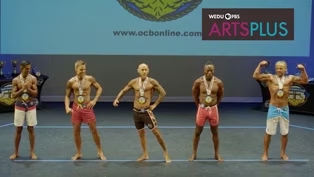
Clip: S12 Ep13 | 5m 50s | Natural bodybuilding -- the art of putting bodies on display. (5m 50s)
Providing Support for PBS.org
Learn Moreabout PBS online sponsorship

- Arts and Music
The Best of the Joy of Painting with Bob Ross
A pop icon, Bob Ross offers soothing words of wisdom as he paints captivating landscapes.













Support for PBS provided by:
WEDU Arts Plus is a local public television program presented by WEDU
Major funding for WEDU Arts Plus is provided through the generosity of Charles Rosenblum, The State of Florida and Division of Arts and Culture and the National Endowment for the Arts, and the Hillsborough County Board of County Commissioners.