WEDU Arts Plus
1214 | Episode
Season 12 Episode 14 | 26m 38sVideo has Closed Captions
Griffith Davis | Hand-dyed clothing | 15th-century painting techniques | John Waters
A pioneering photographer captures Black life in America and abroad. Fashion brand Brightlytwisted creates colorful, hand-dyed clothing in Detroit, Michigan. Classically trained French painter Stephane Cellier uses 15th-century techniques with modern subjects to create his works. See the provocative visual works of artist and filmmaker John Waters at an exhibition in Columbus, Ohio.
Problems playing video? | Closed Captioning Feedback
Problems playing video? | Closed Captioning Feedback
WEDU Arts Plus is a local public television program presented by WEDU
Major funding for WEDU Arts Plus is provided through the generosity of Charles Rosenblum, The State of Florida and Division of Arts and Culture and the National Endowment for the Arts, and the Hillsborough County Board of County Commissioners.
WEDU Arts Plus
1214 | Episode
Season 12 Episode 14 | 26m 38sVideo has Closed Captions
A pioneering photographer captures Black life in America and abroad. Fashion brand Brightlytwisted creates colorful, hand-dyed clothing in Detroit, Michigan. Classically trained French painter Stephane Cellier uses 15th-century techniques with modern subjects to create his works. See the provocative visual works of artist and filmmaker John Waters at an exhibition in Columbus, Ohio.
Problems playing video? | Closed Captioning Feedback
How to Watch WEDU Arts Plus
WEDU Arts Plus is available to stream on pbs.org and the free PBS App, available on iPhone, Apple TV, Android TV, Android smartphones, Amazon Fire TV, Amazon Fire Tablet, Roku, Samsung Smart TV, and Vizio.
Providing Support for PBS.org
Learn Moreabout PBS online sponsorship(upbeat music) - [Announcer] This is a production of WEDU PBS, Tampa St. Petersburg Sarasota.
- [Host] Funding for "WEDU Arts Plus" is provided by the Community Foundation Tampa Bay.
In this edition of "WEDU Arts Plus" a pioneering photographer captures black life in America and abroad.
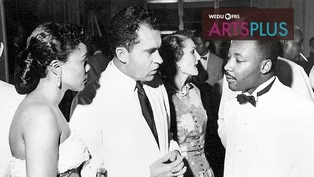
- Probably the most famous photo although nobody knows about it is the one of the first meeting between then Vice President Richard Nixon and Martin Luther King Jr. - [Host] Tie dye designs.
- I hope it makes them feel good about themselves that the style fits them just right.
The color compliments them and I hope they feel really like an individual.
- A classically trained painter from France.
- It's just a conversation with your soul.
You are with yourself and you want to have a message in that painting.
- [Host] And the subversive work of John Waters.
- I'm trying to kind of discover all the stuff, the insider jokes of what can go wrong in show business, the art world and editing and mistakes.
I started by just taking pictures off the TV screen.
You can't get lower tech than that.
- It's all coming up next on "WEDU Arts Plus."
(upbeat music) Hello, I'm Dalia Colon and this is "WEDU Arts Plus," the late Griffith Davis was a renowned photographer, journalist, and US foreign service officer.
Among his friends were giants of the Civil Rights Movement, and with his lens, he captured many of their public and private moments.
Griffith passed away in 1993 but his legacy lives on through his daughter St. Petersburg resident Dorothy Davis.
(upbeat music) - My dad, Griff Davis, was born in Atlanta, Georgia during segregation or Jim Crow era.
He was born in 1923 and he passed away in 1993.
He started photography in high school in Atlanta and that's where he met the professor or the teacher who taught him about photography.
And then he became the student campus photographer and that's kind of how he started.
(soft music) He was a Buffalo soldier in World War II, in Italy with the 92nd Infantry US Army.
And he was the photographer for the infantry.
He always said that's what spared his life essentially that he was the photographer.
In any case, when he came back to finish his studies at Morehouse, he took a class with Langston Hughes who was the visiting professor at what's now known as Clark Atlanta University.
And they struck up a friendship.
And then when my dad graduated, he needed a job and Langston Hughes was working with Ebony.
He was doing stories for Ebony at the time.
And one day he was at a World's Fair where John Johnson, the owner and publisher of Ebony who was asking him, do you know anyone I can hire because I'm looking for a roving editor for Ebony?
He said, "Oh yeah, I got the right person for you."
And then my dad was hired and became the first roving editor for Ebony.
- Ebony Magazine was a monthly periodical that was published about African American life and lifestyle.
For so many African American families, it was a reference point for everything that was great about being in the black community.
- He covered all kinds of stories like Nat King Cole's honeymoon.
I think it was 1948.
(upbeat music) Probably the most famous photo although nobody knows about it, is the one of the first meeting between then Vice President Richard Nixon and Martin Luther King Jr. And their respective wives, Coretta Scott King and Patricia Nixon in Ghana during Independence Day celebrations in March, 1957.
That photograph was featured in Tampa Bay Times January, 2020 when I opened an exhibition at the Florida Museum of Photographic Arts.
And it was the first time that it had been publicly published.
The reason is that at the time Martin Luther King and Coretta had just finished the bus boycott.
And so the US government did not really want that photograph to be publicized.
And it just so happened that dad grew up with Martin Luther King in Atlanta.
They were Atlanta boys and they went to college together at Morehouse.
So it was a real personal and professional moment.
- The uniqueness of this photographer was that he had this connection in two very different lives and one was his connection with politicians, politicians here in the United States, but also in Africa.
He was very close with the government in Ghana, in Tunisia and he was very well respected there and parallel with this, he had a very close relationship with poets and writers and actors who represented the top of intelligence in Afro-American culture.
Typically, people who have these artistic connections are not very much connected with politicians.
And so this opened his horizon to photography journalism that is unparalleled by any different journalist.
- As someone growing up with a photographer father it was a pain in the neck because every five seconds is another photograph, so I now understand he was using me and then my brother as subject to figure out the lighting and the this and the that.
So he did take me to different settings and I did meet a whole lot of different celebrities I guess you would call 'em or historical figures but I didn't know that they were historical figures.
I just thought, "Oh, that's dad's and mom's friend," that's it.
- There's a photograph of a Sidney Poitier with Griffith Davis standing next to him.
And what's so magical about it is that it is the presence of two men of African descent standing proudly and powerfully in their craft.
So you get an idea of the influence of Griffith Davis because at that point Sidney Poitier had an acting career and was being recognized as a great actor.
- The winner is Sidney Poitier.
- And there he is side by side with Griffith Davis.
It was a great moment to capture.
- [Analyst] His work was very pioneering.
I think that now is the perfect time to bring it back to our attention.
- We need to be informed about our history and sometimes that information is uncomfortable but it's also important.
So in the case of Griffith Davis, what's so wonderful is that he fills in the blanks.
- He is bringing light to our existence in a multi-dimensional way and I think he's like painting us back into the picture.
(upbeat music) - To learn more, visit griffdavis.com.
Brightly twisted, creates colorful tie-dyed fashions, home wears and accessories out of their production center in Detroit, Michigan, these patterned pieces become works of art and the creative possibilities are endless.
(upbeat music) - No matter who you are, you're welcome in Brightly Twisted, it's artwork being put onto clothing, people have ideas in their head of what tie day looks like and it looks really different than what we make.
A designer here in Michigan came in and just looked at our things and she says, "Oh, it's everything and nothing like tie-dye."
And I thought it described our process perfectly.
We use rubber bands, we use all the processes but we have just a different way of looking at it.
My husband Greg, is the originator, so I started with him and then I joined him and we did it for about a year together.
And then we hired our first employee, which was Zach and then Alex has been with us the full 10 years.
We just moved to Detroit, Michigan in Corktown.
We're trying to keep it so that you get a sense of Detroit when you're in here and that we become a real stop when you come to visit.
Each one of us make about 20 to 30 pieces a day.
We all die about six hours and then the business comes after that.
- We have an arrangement of different products that we provide here, all the way from just your basic accessories like socks, scarves, headbands to higher end clothing.
What we've said from the beginning is that it's uncommonly pretty.
And for me that reads as anyone can wear it.
I don't think a lot of people think they can wear tie dye and then they see our pieces and it doesn't read to them as tie dye.
They're like, oh, this isn't tie dye, this is hand dye.
Like this is artwork that you're wearing.
What we've done is we've created different designs and different colors and made it more accessible.
One of the most important things were fabric and the kind of fabrics that we choose, and the hand always is soft and has a good drape so that the apparel starts out as a great shape.
And then we just amplify it with beautiful dye.
The designs we're known for are the snake skin print.
Zach actually created it all on his own.
It was the first design that he did.
But what we're really known for more is our color.
We've just escalated the color Barefoot is one of those colors.
It's all different kinds of creams and tans and that has been one of like our most popular.
And then we have one that's like completely contrasting it's called stately and it's all black and it has bright colors at the bottom.
Everything has a little bit of difference and I think that's important in the world that we're living in is just to keep that individuality.
And I think that's what really draws people to what we do.
I hope it makes them feel good about themselves that the style fits them just right.
The color compliments them and I hope they feel really like an individual.
- So, hi everybody, I'm Zach.
Thank you all for coming to our little dye workshop.
- So part of why we started doing the classes is we wanted to get to know the community and we wanted to work with them and hear their opinions and value what they have to say about our line.
You get to come in, you get to dye four pieces, two pieces you donate, two you keep, one of the donations, it's a dog bandana.
The other piece is a scrap piece of fabric which your entire class is a scrap gets turned into a quilt and then we donate those quilts.
- I don't think any of us understood or realize how much we are gonna love working with people.
Now there's people coming in and we're engaged with them.
They're enjoying the process.
It's been really inspiring to us.
- For me, the tie-dye has actually been much more of a therapeutic process at the end of a really stressful day, to get back there and just to let go and dye and not think about anything else has been the best gift for me.
(soft music) Earlier in 2018, in February, I told my team that I was one of the survivors of Larry Nassar.
I saw him when I was 11-years-old to the time I was 15.
And so it's been a very intense last year.
Not just for me, but for the three people that I work with that had to take on my absences.
Part of the physical manifestation from my trauma from him was I have endometriosis.
- When Larry Nassar was arrested, I mean, she was the first person I called and she said she hadn't had anything happen.
And as she kept getting more sick then I started to sense that that wasn't true.
- I wasn't gonna come forward at all.
The idea of having to put something on my family that I had been dealing with for 14 years that I knew was incredibly hard.
It seemed selfish to put onto someone else to have to deal with.
And then after the trial when the woman spoke, it was one of those things where I was like, I can't be quiet.
And it's brought us all a lot closer.
- I was relieved to know so we could get into therapy.
So when we were opening the store, I was very sick so we were trying to come up with stuff that I could do to still help.
And one of my mom's ideas, she was like, well why don't you do the window display?
So I decided I was gonna make a dress out of all of our own material.
I've always loved butterflies.
And then I read a quote by Maya Angelou and it was I'm not gonna say it correctly, but it's we rarely acknowledge the work that it takes to get to the beauty that a butterfly is.
And I realized, I was like this is exactly what my last year has been.
It started with one idea, with one butterfly and then it just, I needed hundreds to make it happen.
And that's sort of what happened as with all of us girls it started with one woman being willing to share her story and then hundreds just started coming forward to acknowledge a real change that needs to happen in our country.
And they did it.
And it doesn't mean that it's over.
There is so much work that we have to do.
But what happened in this process of creating a dress is that I was able to kind of let go a little bit of the trauma that I had been through and start healing.
And so it became very powerful.
- And I got to watch her begin to heal.
It was an absolute healing process.
So art therapy, there's a lot of validity to it.
- There are over 300 butterflies on the dress each one representing one of the sisters.
Each one is different.
And then they come together to create one piece.
My hope is that it just shows that there is a place that you can get to beyond the dark.
And so what I hope is that this dress you can look at it and say, okay, I can get there.
I can get to that beauty.
I can get to that comfort of being like this happened to me, this isn't me but I'm here now because of it and I'm in a better place.
- I think a butterfly flying just kind of describes these women, they're just flying out of cocoons and they're just starting their lives again.
And it's beautiful.
- Because of the women that came before me, I've been given the ability to be able to feel that confidence that I felt as a young gymnast and to now feel it again as an adult is something that I don't think I could say thank you enough to any of them.
And that the dress is for them.
And that's important.
(upbeat music) - Check out brightlytwistedtiedye.com for more info.
The classically trained French painter, Stephane Cellier melds past and present in his art using a technique from the 15th century, he paints eye-catching modern subjects, head to Virginia City, Nevada to find out more.
(upbeat music) - I am Stephane Cellier and I'm an artist.
I'm a painter.
I came from France like it was seven years ago now because I love United States.
So I sold everything I had in France and came here.
So I paint, I used technique from the master of the French master from the 15th century, like the glazing I'm using on that one.
The multiple glazing with transparency.
So like the rizza, I painted black and white first and add the colors on the top with transparency some different kind of techniques like that.
I work on wood panel and usually I paint subjects that are more modern with classical techniques.
So it looks really classical but when you take the time to watch it it's a little bit different.
I get that training in France when I was in the French National Fine Arts School.
(upbeat music) The real first step, it's the creation of the design.
So I've got some images that appears in my brain.
That's why my wife think I'm nuts.
She's probably right.
I look at pictures, I try to find pictures to see how I can create my composition.
And first step it's to create the design.
So I can create my design.
And after that, I start to draw.
I just draw and painting, painting, painting.
So I will start with a dead layer to put the very quickly, the light and shadow or it'll look.
And after that I will add layers and layers and layers.
And I built the painting, you built almost like a sculpture.
You add layers and layers and layers to build the shape.
Because everything we see, it's because of the light.
So the shape is created by the light.
So you need to add layers and layers and layers to create all the small differences in the light that create the shape.
It's a long, long process.
I will add layers with transparency.
A little bit like when you use sunglasses, different kind of colors.
So they will blend together like filters and you change till you obtain the transparency and the texture of the skin.
Sometime there is like this one, there is around 50 different layers to create the texture on the skin and the transparency, the light inside.
(soft music) It's hard to stop because when you are in this process, you are in another world.
There is nothing else around you.
And you work with the inside of yourself, of your deep thought.
It's just a conversation with your soul that's all.
You are with yourself and you talk to yourself and you want to have a message in that painting.
You want to put the emotion you feel when you paint on the palette and on the painting, it's really a meditation process.
(upbeat music) In my painting, I try to express something that disturbed me or something I like.
And sometime what I like, it's when the people who will, the viewer who will see the painting, they will try to find a message about me, but usually they will find something about themself.
That's what I like.
So it reflects more what people think about it, about the message.
I really put in that because my vision is completely different probably, all the viewer will have an opinion, different opinion of that painting.
That's my goal.
So it's more like mirror.
They can see how their real deep thought and how they are.
So I want people to feel something, even if they don't like it and they say, "Oh, it's disgusting."
It's okay.
There is an emotion, it works.
So yeah, that's what I want.
(upbeat music) - View more of the artist's work at stephane-cellier.com.
Artist John Waters is unlike any other, in his art, he tells a story in a provocative, subversive way.
We visit the Wexner Center for the Arts in Columbus, Ohio to see an exhibition of his visual work.
(upbeat music) - John Waters is someone who the Wexner Center has been friendly with since 1999.
He was here in his guise as a filmmaker.
I had heard, I knew vaguely that he also was kind of venturing into the art world as a visual artist.
- Yeah, a lot of my fans have no idea I did this.
And I very purposely kept it separate.
- And he's very modest about the very kind of love, real low tech means of production.
And so for him, it's all about telling stories.
- I'm trying to kind of discover all the stuff, the insider jokes of what can go wrong in show business, the art world, and editing and mistakes.
I started by just taking pictures off the TV screen.
You can't get lower tech than that.
(upbeat music) - [Official] He's always said he works from the aesthetic of a fan.
He only makes work about things he likes but the things he likes are the things he makes likes making fun of, which are movies, the art world, celebrities, gossip, things like that.
- I do make fun of celebrity art.
I hate it too, Justin, who I met and liked and he'd draw my mustache once when he was in London.
This is in LA.
People start getting facelifts when they're really young.
And I try to imagine, why would you do that?
'cause they all just look like surprised aliens.
They don't look old though.
Joan Rivers didn't look old.
She looked bizarre, but she didn't look old.
But why would you want to look like 20?
That's really scary I think.
(upbeat music) The only mean-spirited one here at all, it's not that mean is the one that just says starring Melissa Rivers.
Now, there has never been that shot that's made up 'cause that would mean she would have top billing.
And that has not happened yet.
But I like to imagine that movie sort of, the scariest piece in the whole thing is called 9/11, but all it is, it's the shots of the most forgotten movies, "Dr. Doolittle 2" nightmare.
Those were the movies that were playing on the planes on 9/11 but they never got to even put 'em in so they would've been seen.
So that's at least positive, they weren't watching them.
So that's what I'm always trying to do to get you to look at something in a completely different way.
(upbeat music) The first thing I always do is what would make me laugh.
- His kind of breakthrough film was called "Pink Flamingos."
And it was kind of notorious for what bad taste it was in.
And a couple years ago he gathered a group of children in Beverly Hills into a table reading by children of the script of "Pink Flamingos."
So that's in the show.
- Well, there's one whole series I did called "Marks" which is when I was making a film called "Pecker."
I notice it every day in every movie.
The crew puts down tape marks right before you do a shot where the actor has to hit that to stay in focus.
You never see them in a movie because the camera cuts off there.
So when everybody cleared the set before we moved on, I saw them there and realized they were drawings basically.
But someone did for me without knowing it.
So I started photographing them.
So they were movie stills that what was in it was the only thing that can't be in a movie still.
Can art be funny?
We all know contemporary art is witty, but can it be funny?
And I have a piece that sort of satirizes some museums that when they have a collector that what they lend the piece is so valuable they put an insurance tape on it.
So if you get near it goes buzz or something you get get to near it, we might squirt you in the face.
(upbeat music) There's one that says, contemporary art hates you.
It does, it hates the right people to work.
My kids should have done that.
Well, stupid they should have done.
'cause it just sold $8 billion.
Who's the fool?
I'm seeing them hanging the show and everybody has some gloves and stuff moving.
This thing I had in my house, I thrown in a closet.
So I find that delightful.
I make fun of it with love because I think it's great that it's somehow, it's magic that thing that I found on a thrift shop, I finally did it here.
I sold in a gallery and now it's in a museum.
That's a magic trick that I'm proud and I planned it.
And I think the reason I do get away with it is 'cause I make fun of things I like, if you like my movies, you'll like this.
I mean, it's the same kind of humor.
It's just a different way for me to tell stories.
I think hopefully.
(upbeat music) - [Host] Find out more at wexarts.org.
And that wraps it up for this edition of "WEDU Arts Plus."
For more arts and culture, visit wedu.org/artsplus.
Until next time, I'm Dalia Colon, thanks for watching.
(upbeat music) - [Announcer] Funding for "WEDU Arts Plus" is provided by the Community Foundation, Tampa Bay.
(upbeat music)
Video has Closed Captions
Clip: S12 Ep14 | 6m 53s | The legacy of the late Griffith Davis. (6m 53s)
Providing Support for PBS.org
Learn Moreabout PBS online sponsorship

- Arts and Music
The Best of the Joy of Painting with Bob Ross
A pop icon, Bob Ross offers soothing words of wisdom as he paints captivating landscapes.












Support for PBS provided by:
WEDU Arts Plus is a local public television program presented by WEDU
Major funding for WEDU Arts Plus is provided through the generosity of Charles Rosenblum, The State of Florida and Division of Arts and Culture and the National Endowment for the Arts, and the Hillsborough County Board of County Commissioners.