WEDU Arts Plus
1216 | Episode
Season 12 Episode 16 | 26m 45sVideo has Closed Captions
Alex Harris | Deaf Storyslam | Emily Reid | Chesterwood
Renowned R&B and soul vocalist Alex Harris inspires a new generation of musicians by opening the Arts Conservatory for Teens in St. Petersburg. A nonprofit in Wisconsin helps members of the deaf community artistically share their stories. Artist Emily Reid creates bright animal portraits in Reno, Nevada. Tour sculptor Daniel Chester French's home, studio, and gardens in Stockbridge, Mass.
Problems playing video? | Closed Captioning Feedback
Problems playing video? | Closed Captioning Feedback
WEDU Arts Plus is a local public television program presented by WEDU
Major funding for WEDU Arts Plus is provided through the generosity of Charles Rosenblum, The State of Florida and Division of Arts and Culture and the National Endowment for the Arts, and the Hillsborough County Board of County Commissioners.
WEDU Arts Plus
1216 | Episode
Season 12 Episode 16 | 26m 45sVideo has Closed Captions
Renowned R&B and soul vocalist Alex Harris inspires a new generation of musicians by opening the Arts Conservatory for Teens in St. Petersburg. A nonprofit in Wisconsin helps members of the deaf community artistically share their stories. Artist Emily Reid creates bright animal portraits in Reno, Nevada. Tour sculptor Daniel Chester French's home, studio, and gardens in Stockbridge, Mass.
Problems playing video? | Closed Captioning Feedback
How to Watch WEDU Arts Plus
WEDU Arts Plus is available to stream on pbs.org and the free PBS App, available on iPhone, Apple TV, Android TV, Android smartphones, Amazon Fire TV, Amazon Fire Tablet, Roku, Samsung Smart TV, and Vizio.
Providing Support for PBS.org
Learn Moreabout PBS online sponsorship- [Announcer] This is a production of WEDU PBS, Tampa, St. Petersburg, Sarasota.
- Funding for WEDU Arts Plus is provided by the Community Foundation, Tampa Bay.
- [Announcer] In this edition of WEDU Arts Plus, impacting young lives at the Arts Conservatory for teens.
- [Narrator] What I desire for students to gain who participate in the Arts Conservatory for Teens Curriculum.
number one, I want them to gain confidence, two, resilience, and three, a conscious of hope.
- [Announcer] A stage for the deaf community.
- When someone is telling a story and someone else is listening, the brainwaves of the speaker and the listener actually sink up.
It's actually the way in which we build relationships and connect to each other.
- [Announcer] Vibrant animal portraits.
- As a kid, I always loved animals, and as an adult, always enjoyed art.
- [Gabe] And the artist's workspace - To come to a studio where the work was actually created and to see the process, you get a real sense of the immediacy of this is where it actually happened.
- It's all coming up next on WEDU Arts Plus.
(upbeat music) Hello, I'm Gabe Ortiz and this is WEDU Arts Plus.
Alex Harris grew up with little resources in rural Georgia.
Now he's a renowned RnB and soul vocalist, actor and philanthropist.
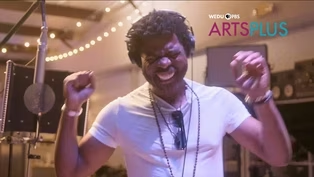
In 2012, he started the Arts Conservatory for teens in St. Petersburg, turning his passion for music into a passion to inspire students.
(dramatic music) - From a little small town, Manchester, Georgia, and one of eight children, five boys, three girls, I'm in the middle.
And music, faith, education, family where the four pillars are of our family.
♪ Take me to heaven ♪ ♪ Never return ♪ I see the gift of music beyond entertainment but also something that is part of our human experience.
All of us, we are creative beings, we are sound, we are rhythm, we are melody.
Therefore, we easily influenced our impacted and can be healed by that which we that makes part of our existence.
I want to leave that stage, place, that microphone in its stand with a feeling that I have seized this moment and in utilizing my gift to facilitate an experience for someone that's listening to feel the best they've ever felt in that moment.
They're in touch with their inner self.
(lighthearted music) My music is so important to me, it's part of who I am.
I always say that is it found me, I found it or we found each other.
I think too, it's inseparable of my existence.
♪ They say love is more precious than gold ♪ I think that I should also share that experience, and the experience can be shared in so many different ways, and for me it comes through the sharing and the development of a curriculum that we call the Arts Conservatory for Teens that help others who are looking for that platform to develop that discovery as I discovered.
So we started the Arts Conservatory for Teens, the team and I that I assembled to launch this in 2012.
And with the focus to help these students who you know that was in the neighborhood, and to pursue their dreams and to become successful.
What I desire for students to gain who participate in the Arts Conservatory Teens Curriculum.
Number one, I want them to gain confidence, two, resilience, and three, a conscious of hope that there is hope for achieving their highest dreams is when it comes to success.
What is an opportunity if there is an abridge to get to it, when there is a bridge presented to get to it there needs to be accessibility to resources to help me cross that bridge, right?
And we do all of that.
We not only provide the opportunity, but we provide accessibility, we provide the resources through the generosity of those who believe in our vision, to help those students cross that bridge that we have been so grateful to create for the students.
- I remember the exact day that I met Alex Harris, we walked into the Royal Theater and there was Alex Harris big as life and I'll never forget he just was an amazing presence.
And I knew right away just chatting with him and what his vision was to help young people in the south side of St. Petersburg to finish middle school and high school and go on to college with the support of the arts.
I look back on the 10 years of what Alex has created the number of students who might've run into a dead end act was their opportunity to continue to pursue their dream, to go to college to attend college through the arts.
So it's an extraordinary program, and one that resonates with a whole lot of young people today.
He's a great inspiration and a role model.
- My experience in this program has been amazing.
I have been open to many new genres and I've met many new people and teachers as well.
I've grown as an artist and I'm just so excited to return to college with all the things that that I've learned.
- My experience in Act has been amazing.
We've gotten to learn from people who have been in Broadway about acting, dancing, and singing.
- 100% of our students throughout the past, almost 11 years have graduated from high school with a diploma.
90% of our students have gone on to higher education institutions, college universities, trade schools.
(upbeat music) - When you're involved in the Arts Conservatory for Teens you might be a dancer, but you also might be a videographer.
You might be working on set design, you might be working on clothing design.
And so you realize the number of people that are involved in creating this business of the arts, Alex is able to harness all of that to bring it all together.
- And the impact that he has had through the Arts Conservatory for Teens, and the inspiration and the perspiration that he has brought to this.
And Alex Harris I believe is one of the greatest creators at St. Petersburg in the Tampa Bay area has ever seen.
♪ I said that change is gonna come ♪ ♪ Some help is on the way ♪ ♪ Yeah ♪ - I'll never forget when the first time I heard Alex sing, "Same Cook's Change is Gonna Come."
♪ I know that change is gonna come yeah ♪ And you recognize the passion that Alex brings and its infectious.
- With great community and family, and it doesn't have to be biological family, but those who believe, those who love, those who support you, genuinely you can achieve and be the best human being that you can be.
At the end of the day, we want those young people who have participated and those who continue to participate today and will participate in the future to understand their sense of worth.
♪ When the world is going wrong we stay strong ♪ It's about what I'm doing with my gifts beyond the stage, lifting up the consciousness of humanity to raise our human vibrations to vibrate really strongly and really loudly amplify hope, love, and peace for all.
♪ 'Cause baby I got gifts ♪ (lighthearted music) - To learn more, visit artsconservatoryforteens.org.
Wisconsin's Ex Fabula is a nonprofit that embraces the power of personal storytelling through workshops story slams and more.
Up next, we attend one event where members of the deaf community came together to share their stories.
- The great thing about stories is that they reflect the real complexity of our lives.
When someone is telling a story and someone else is listening, the brainwaves of the the speaker and the listener actually sync up.
It's actually the way in which we build relationships and connect to each other.
Ex Fabula is a Milwaukee nonprofit and our mission is to connect Milwaukee through real stories.
We've been around since 2009 and we put on story slams and workshops where people share their true personal stories, and in the process build community, connect with each other and even heal.
We started out with these story slams which are events where anyone could put their name in the hat for the chance to get up on stage and share a true story.
And all the stories are on a theme.
So that hopefully over the course of the night we really just explore all the different human experiences that are out there.
(lighthearted music) Storytelling can look different depending on which group is involved.
We actually discovered that the deaf community doesn't consider themselves to be necessarily a disability community.
That it's really more of a language and culture.
(lighthearted music) - We are have two different American languages here.
We have sign language for us to be able to express ourselves and not only in the signs that we're using off our hands but our full body.
It's everything, it's our facial expression to show our mood our temperament.
And it's kind of like intonation in English, how you speak and how you say certain things and you emphasize certain words.
We are able to do that as well.
(lighthearted music) - Myra and Jose are two community members who have been shaping this particular collaboration.
When we first started the project we knew it would be really important to have people from the deaf community helping to design the project.
(lighthearted music) - Ex Fabula has been a great experience for the deaf community and I think it's gonna be great for the hearing community as well to hear our stories.
Probably something that they haven't heard before.
(lighthearted music) - What really impacts me is this controversial topic of diversity.
- I think a lot of people in the audience will look at that as a label and just, I want them to keep in mind what kind of impact that leaves if you're making an assumption.
- Hello everyone and welcome to our very first deaf story slam.
(audience claps) - The storytellers are gonna be getting up and sharing stories on the theme of labels.
At the story slam, we will have around six people get up on stage and share a true personal story.
Now these stories will be signed, so we'll have interpreters who are interpreting from ASL into spoken English, so that both the deaf community and the hearing community can appreciate the stories.
- A little bit, in that time in the 80s and 90s, it was seen upon that deaf people were almost kind of embarrassing, it was shameful, because we would try to learn how to talk but a lot of people would say that our voice was not as eloquent, or as beautiful as a person who can hear.
We were monsters.
- I wasn't ready to be done working.
I want to work, I have skills, I am capable.
I want to work, but nobody was willing to give me a chance.
- I let them know that I was very interested in this job and I wanted to know they were too.
And they said, yes, we are very interested, you have all the qualifications we are looking for but we do have one concern you can't hear.
And with being able, not hearing, we have safety issues.
(lighthearted music) So hearing that, as you probably all know was a huge frustration, I couldn't believe that that was the one thing that was holding me back from this job that I wanted all my career.
- I should mention that I had a son at the time.
My son's school would sometimes call me, I would step in the hall, take the call five minutes and then go back to doing meal prep for lunch.
And then I got us a warning from this boss saying that I was in violation of the rules 'cause I was using my phone, and I'm like are you kidding me right now?
Because you're on your phone all the time.
You just have it up by your ear while you're cooking and you're talking and you're cooking at the same time.
I can't do that 'cause I'm deaf, I gotta step into the hall and do my business and come back.
Well, I talked today about being an independent woman.
You know, just all the hardships I have gone through to figure out what I needed to do to be successful as I am today.
You know, those barriers are important, they make you who you are, they develop your character.
But you know, I'm very happy to be where I am now.
- But my uniqueness wasn't just a college student trying to find identity.
I was a black deaf man trying to find my way in the world.
My topic, I focus on communication and how to overcome through adaptation.
I wanted to focus on this idea that I didn't want to worry about barriers and how to have other people take control of my story.
When I thought I was going to have to make a change, I wanted to take authority and find that way that I needed to by myself in order to be successful.
(lighthearted music) When I was in college I honestly didn't think that a support system was needed.
I thought independence meant me and myself only.
I thought I could make it by myself meant that I was successful.
But we had to think about making sure you had support if it was teachers or emergency contact or someone who could just ask you if you were all right.
I wanted to make sure that I had that transparency with individuals in my community as well as I had with my family.
I decided that I wanted to make sure that I had a company that supported me in the communication realm, and the expertise that I brought because I am qualified to learning how to communicate with the hearing world.
Am I proud?
Yes, I'm proud to be deaf, I'm proud to be Mexican.
And if you don't like me.
- I want people to be more aware, deaf people have been through a lot.
I want you to acknowledge that we know what we're talking about.
Keep that in mind, as you meet us out in the workforce or in other daily situations.
Be our ally, come alongside us.
- For more info, head to exfabula.org.
Artist Emily Reed loves animals.
She renders multicolored pattern paintings of alpacas, donkeys, roosters and more.
We visit Reed Inner Studio in Reno Nevada and learn more about her artistic process.
(bright music) - As a kid, I always loved animals, and as an adult always enjoyed art.
So I paint animals in acrylic and usually in bright colors and lots of patterns.
(bright music) I paint in the studio in my house, so I'm usually painting right on the floor.
And my house is in my farm, so you know, I got animals all around me, which is kind of funny.
(bright music) Once you get a couple animals, people ask you if you'll take more.
And if I can give them a home that they live harmoniously with the other animals, I usually say yes, I'm a little bit bad at saying no.
I have about 40 animals that live here that were all in need of homes and are all kind of supported by my artwork.
So the animals I live with inspire my artwork, and when I sell my artwork, it allows me to provide a home for my animals, so it's kind of this cool relationship that we share, we help each other out.
(bright music) I have three dogs and a pigeon, I have like 22 chickens and two emus and two alpacas.
I have two donkeys and a mini horse, and I have three mini pigs and three goats.
(bright music) Right now, alpacas were kind of popular and they've got, you know, their crazy little cartoony faces.
So those are good ones to paint.
I've painted the pigeon tubs a couple times and my tortoise, Phineas.
The donkeys have made it into a couple paintings.
(bright music) There's two things that happen when I paint, I either know what colors I'm going to use and I paint the background first, or I know what subject I'm gonna paint and I sketch that out right onto the wood.
And I like to leave all my mistake lines or my contour lines, so I have lots of little shapes to paint and and add pattern to.
And then I guess I just keep painting until it feels like it's done.
(bright music) The energy, I guess, from my artwork is usually a happier when I don't have anything that's too somber and I'm just unable to really paint when I'm, you know, if I'm stressed or if I'm sad or if I'm just a little bit down, so most of my artwork I think just expresses like a more positive energy.
I generally paint in large format, which to me is like four feet by six feet, or three feet by four feet.
But I also painted a large mural, which is really large format downtown for the Reno Mural Expo.
And I'm kind of excited because not everyone buys art and not everyone can buy art but it's a way to kind of get my art into their lives.
(bright music) I feel like the connection that I have to our natural surroundings really influences the way I paint.
Around here, we get colorful skies in the morning and at sunset.
And looking at Mount Rose, the colors on Mount Rose are so amazing.
And also in the desert after it rains, you know, the sagebrush looks extra fresh and the rocks have other colors that kind of pop out.
(bright music) I am just moved by our colors and our natural beauty.
And I don't paint realistically, but I hope that the feelings that I experience seeing these colors that someone might experience them looking at my artwork.
(bright music) - See more of Reed's artwork @emilyreedart.com.
In Stockbridge, Massachusetts sits Chester Wood, the home studio and Gardens of Sculptor Daniel Chester French.
In this segment, we explore the estate learning more about the artist and his artwork.
- We begin in Stockbridge at the home of famed American sculptor, Daniel Chester French.
He created the Abraham Lincoln statue at the Lincoln Memorial in Washington DC, but he didn't just create beauty he wanted to be surrounded by it.
On a hillside in Scenic Stockbridge, Massachusetts you'll find the home of Daniel Chester French, a New England born artist who carved out a reputation as one of the premier American sculptors of the 19th and 20th centuries.
His outsized creations range from the minuteman statue and conquered to his ultimate master work, a seated Abraham Lincoln at the Lincoln Memorial.
- When you tour his studio, you see these models for all these many sculptures that appeared all over the country.
- Michael Lynch has the advisory Council at Chester Wood the home studio and gardens where French spent some 30 summers sculpting and soaking up nature.
- He would come from New York City, escape the hubbub and just relax, and then work 10 to 12 hours a day, he was a driven artist.
- French purchased the property in 1896 and redesigned the barn as a studio with the help of Henry Bacon, his longtime friend and artistic collaborator who ultimately became the architect of the Lincoln Memorial.
The studio and adjacent residence became French's home away from home, where he created some of his most monumental works flanked by the natural beauty of the Berkshires.
- Well, you can virtually hear the sound of chisels in your ear as you're watching.
Looking at these models and listening to the docent explain how the various pieces were created.
- We're standing in Daniel Chester French's studio which he built in 1897.
- Donna Hasler is the Executive Director of Chester Wood.
In this studio, she points out a treasure trove of original sculptures, molds, and references for some of his most iconic works.
The winged spirit of life designed for a public park in Saratoga Springs, New York.
The plaster reliefs of the doors he designed for the Boston Public Library.
There's even a bronze maquette of this George Washington statue, which once reached the 26 foot high ceilings of French's studio.
When the work grew too large, French placed it on custom designed railroad tracks and wield it outside.
- He could push a flat car manually outside and continue to work on his sculpture in the light of the day as well as walk down the hill and get the perspective.
- A highlight of the studio and indeed French's career the models he created for the Lincoln Memorial.
In 1917, the Lincoln Monument Association commissioned French and his friend Bacon to create a memorial to the slain president on the National Mall in Washington DC.
They were a natural choice, French had already collaborated with bacon on a standing Lincoln for the Nebraska State Capitol.
The DC Memorial took eight years to create resulting in a towering 19 foot tall statue, to create something that big French had to start small.
Donna, you, I would venture to say know this monument better than most.
What can you tell us about it even though we think we know it that we wouldn't necessarily realize?
- It's interesting to see the particular work on this scale because you can get upclose and you also see the tool marks in the plaster.
You see a smaller model, he would start small, and then continue to expand and enhance the figure.
And you see some changes whereas the leg yeah, it's a different stance, the hands are a little bit different.
The head is downcast, so he is working his ideas in in three dimension.
- When his daily studio work was done, French retired to his home and gardens only a few steps away.
- This is the French family residence.
Most people who walk into this space, they will say, oh I could live here, which is wonderful.
It's very intimate.
- The family residence is preserved as it was.
He, it turns out, was also something of an interior designer.
The hallway features hand-painted wallpaper that French chose to bring the natural world inside.
It's all original from the sideboard he found at a flea market for $8 to the typewriter on his desk, to the books on his shelves.
- He was about creating beauty in his own life sharing that beauty with others in his work, and also in the gardens that he planted here.
- For French, his gardens were a palate cleanser, and another outlet for his creative potential.
- If he had enough clay or stone dust he could come out here and walk through the garden.
- The landscape provided a quiet and serene escape for one of the nation's most prolific sculptors.
Today, it gives visitors a chance to experience the art and landscape as French did.
- To come to a studio where the work was actually created, and to see the process, you get a real sense of the immediacy of this is where it actually happened.
- And where the man made monuments.
- Plan your visit@chesterwood.org.
And that wraps it up for this edition of WEDU Arts Plus.
For more arts and culture, visit wedu.org/artsplus.
Until next time, I'm Gabe Ortiz.
Thanks for watching.
(upbeat music) - [Announcer] Funding for WEDU Arts Plus is provided by the Community Foundation, Tampa Bay.
(bright music)
Video has Closed Captions
Clip: S12 Ep16 | 6m 52s | Alex Harris inspires a new generation | Arts Conservatory for Teens (St Petersburg) (6m 52s)
Providing Support for PBS.org
Learn Moreabout PBS online sponsorship

- Arts and Music
The Best of the Joy of Painting with Bob Ross
A pop icon, Bob Ross offers soothing words of wisdom as he paints captivating landscapes.










Support for PBS provided by:
WEDU Arts Plus is a local public television program presented by WEDU
Major funding for WEDU Arts Plus is provided through the generosity of Charles Rosenblum, The State of Florida and Division of Arts and Culture and the National Endowment for the Arts, and the Hillsborough County Board of County Commissioners.