WEDU Arts Plus
1218 | Episode
Season 12 Episode 18 | 26m 8sVideo has Closed Captions
Mosaic House of Dunedin | Wearable art | Underwater photo exhibition | Painting outdoors
Meet the creative minds behind Mosaic House of Dunedin, where art expresses life. Virgil Taylor creates wearable art in Detroit, Michigan. Photographer and diver Andreas Franke created an underwater photography exhibition to address the issue of plastic pollution in the ocean. Plein air artist Monika Piper Johnson paints vivid landscapes of the Lake Tahoe region of Nevada.
Problems playing video? | Closed Captioning Feedback
Problems playing video? | Closed Captioning Feedback
WEDU Arts Plus is a local public television program presented by WEDU
Major funding for WEDU Arts Plus is provided through the generosity of Charles Rosenblum, The State of Florida and Division of Arts and Culture and the National Endowment for the Arts, and the Hillsborough County Board of County Commissioners.
WEDU Arts Plus
1218 | Episode
Season 12 Episode 18 | 26m 8sVideo has Closed Captions
Meet the creative minds behind Mosaic House of Dunedin, where art expresses life. Virgil Taylor creates wearable art in Detroit, Michigan. Photographer and diver Andreas Franke created an underwater photography exhibition to address the issue of plastic pollution in the ocean. Plein air artist Monika Piper Johnson paints vivid landscapes of the Lake Tahoe region of Nevada.
Problems playing video? | Closed Captioning Feedback
How to Watch WEDU Arts Plus
WEDU Arts Plus is available to stream on pbs.org and the free PBS App, available on iPhone, Apple TV, Android TV, Android smartphones, Amazon Fire TV, Amazon Fire Tablet, Roku, Samsung Smart TV, and Vizio.
Providing Support for PBS.org
Learn Moreabout PBS online sponsorship- [Announcer] This is a production of WEDU PBS, Tampa, St. Petersburg, Sarasota.
- [Dalia] Funding for "WEDU Arts Plus" is provided by the Community Foundation, Tampa Bay.
In this edition of "WEDU Arts Plus," a mosaic house in Dunedin, where art is an expression of life.
- I come from a different spiritual background than Carol and I incorporate a lot of spirituality, mythology in what I do.
- [Dalia] Wearable art.
- [Virgil] Most of the stuff that inspires me comes out of the ancient Middle East.
That's kind of why I call it the ancient craft.
- [Dalia] An underwater exhibition.
- [Andreas] These images have changed because the good thing of the sea the sea life become a part of my artwork.
- [Dalia] And painting outdoors.
- I've lived in Tahoe 23 years, and I still get blown away with the colors and the beauty of the lake.
It never gets old.
- It's all coming up next on "WEDU Arts Plus."
(exciting music) Hello, I'm Dalia Colon and this is "WEDU Arts Plus."
Near the Gulf Shores of Dunedin sits a public icon and private abode known as Mosaic House.
Owned by artists Carol Sackman and Blake White, this celebrated home has been the center of inspiration and creativity for 20 years.
(happy music) - We have pieces probably in almost every room.
They just make us smile and feel good.
- They're artists.
We love it.
Whether it's the backyard or the front yard, it's such a visual stimulation.
- It's been just one of my favorite things to do because it's just, every time you come, you see something new.
And as a photographer, that's like really exciting.
So I could like take pictures here every day and find something new, I'm sure.
- Their life is their art and their art is their life.
- We work together really well.
We're a team.
Sometimes I think I get a little bit too overpowering in that I'm, you know, full of myself and know it all.
And I have to pay attention to Carol because I mean you know, she's right on with a lot of information.
- When I was in school, I took a lot of different classes in fiber arts, boutique weaving as well as the required drawing, painting, and so forth, pottery.
So I had somewhat of a foundation.
I don't think I was really aware of outsider art until much, much later.
- Well, you know, when I was growing up, I was more focused on sports, you know, art, you know, pretty pictures whatever.
No, it didn't.
Not until I met Carol that I become aware of art - With the background that I had, just being able to pick up things, anything, and put it together in another way was something that I think outsider art or visionary art encouraged.
- I worked with my hands, I worked in, did construction work.
And when you do that, you know, you have to come up with solutions because not everything goes back the way it should.
You know, having that background working with my hands, it translated to mosaics.
- Well, my subject matter is generally more realistic or impressionistic.
Blake's is more abstract.
- I come from a different spiritual background than Carol and I incorporate a lot of spirituality, mythology in what I do.
I bounce things off of her and, you know, we work really well together and we know each other's boundaries and you know we've learned that from being together 44 years.
- It's a long time.
So people think we're together 24 hours a day.
Well, we may be in the same house 24 hours a day, but we're certainly not looking at each other all that time.
- This is kind of my studio.
I do work in here, it's more limited, but as you can see I'm really into my music and I crank it up.
I crank it up.
Carol tries to call me on the phone.
She won't even come in here.
So this is my private space.
- Sometimes I call him on the phone when I'm too involved in something and don't want to get up and walk to the other end of the house.
But I think that serves us very, very well.
- [Blake] Carol is in her studio almost every day.
- Yeah, we both do though, I think, 'cause that's what we do you know, other artists understand that.
You just, you do it.
And when you finish with one thing, you do something else.
I think sometimes when we're not working, we're kind of wondering what to do next.
- [Blake] Doing the show was a jumping off point.
It like was the culmination of everything we've done.
And it was on display and it was like- - Amazing.
- Yeah, it was unbelievable.
- The Art Center, when we had the show it was so incredible because you could see it.
Everything wasn't cluttered together the way it is here.
- I was moved to tears because I had never seen our art, each piece standing alone, being able to walk around it and the way it was set up or curated, whatever you wanna say.
It was perfect.
It elevated our art to a higher level.
- We tried to be respectful of the different bodies of work that both Carol and Blake work on individually, their different media, but was directed that really they represent a true creative partnership.
And that was how we presented the show.
That wasn't, this is Blake's work, this is Carol's work.
No, it was their work, their life's work together.
- When that show happened, that was it.
You know, I mean, we couldn't do anything bigger than that or it was like more than we had hoped would ever happen.
Really being able to have that show for three months, a show for just the two of us, we got a lot of exposure.
A lot of people enjoyed it.
It was just wonderful.
And I don't think that we would've had what we have now if it wasn't for the Art Center's involvement.
And then there were other periodicals that contacted us and other commissions and more people who had seen the show who didn't know about us before.
And so it wasn't the end.
It was like another beginning.
- You know, we're getting up there.
The last quarter of our lives and you know, we gotta start thinking about that.
Well I guess ultimately, I'd like it to be in the public domain for people to come and do what they do now.
But sometimes things just unfold the way you want 'em to and that's probably what's gonna happen.
It'll unfold the way it should be.
- We don't want someone to buy it and then throw it down.
You know, that wouldn't make us happy.
(Carol laughs) - I'd come back and haunt them.
- To learn more, visit mosaichouseofdunedin.com.
Head to Detroit, Michigan to meet Virgil Taylor an artist who creates wearable art.
Inspired by the ancient Middle East and cultures from around the world, Taylor designs special pieces full of spirit.
(exciting music) - I play with fire.
I zone out on working with metal.
It has, it spoke to me.
I'm an artist.
I'm not a jeweler.
And there is a difference.
I have friends that are jewelers that are brilliant.
Some of the stuff they do, I could never do.
I don't have the patience nor the temperament for it because materials talk to me.
I grew up in Detroit around Central High School.
My mom was a huge art fan.
And so it was also, I, when I think back about it now, like nothing in our house ever went unused.
We were always creating stuff.
And so I guess I was, I had a natural aptitude for it.
I've had a very interesting life, but I wasn't doing my craft all the time.
I'd come back to it, I'd do it, and then this particular facility, Birmingham, Bloomfield Art Center.
I was in my thirties when I discovered this place.
And so I started, this place started getting me back into it.
I have an affinity for certain types of jewelry.
Most of the stuff that inspires me comes out of the ancient Middle East.
That's kind of why I call it the ancient craft.
Ancient Africa or African nations, middle Eastern nations.
My inspiration tends to be around those regions, those processes.
I have an affinity for ancient techniques.
I went to Africa last year and spent time with the Maasai.
I was really honored to do that.
And fascinated by their processes because they're so raw.
I mean, when you have people making like annealing metal over dung ovens, I mean, which is pretty fascinating to watch.
I do a lot of really organic stuff.
I'm very fond of happy accidents.
You know, a lot of times other people will go for refining something.
Like, no, no, no, no, no, that's perfect.
Leave it just like that.
It works for me.
So I don't strive to make art that is real refined.
I have a ring that I'm working on now.
I had no clue when I started with this ring what I was gonna do.
And I ended up with a stone that I had no idea I was gonna get.
But it just kind of all evolved.
And the final touches are deceiving on that piece.
I have a client who's Ecuadorian.
I did some pieces for them, I did a brace, a bangle bracelet for him that was really interesting.
And the design ended up being my interpretation of an ancient Ecuadorian palatial aqueduct.
And so it was filled with a blue resin.
It was done in copper, 18 karat gold and sterling silver.
And so the resin that I used in it is blue.
So it looked like it was a pool at the top.
And it looked like there was blue running through the veins.
'cause I cracked it open.
I had another client, a young man she was very close to was killed in the naval accident over off the coast of Japan a few years ago.
And she went to his funeral at Arlington and they gave her one of the shell casings from when they did the 21-gun salute for him.
I was in that president's honor guard, I was in the unit that did that.
So when she sent me the shell casing and she was like, "I need something made out of this."
And then I took the shell casing and turned it into part of that bracelet.
So it came out pretty remarkable.
I was really proud of it.
That's tremendous honor for me.
And I have had people give me their parents' jewelry or grandma's jewelry or, you know, different pieces.
I got this urn that I'm getting ready to do.
And that's just a huge honor for somebody to entrust that kind of thing to me.
I recently have been doing some bracelets.
They're African, different parts of Africa, but they're currency jewelry, what they would call wearable currency jewelry.
Some people get a little miffed because when they see them a lot of times, they see it as representing slavery.
The reality of it with those bracelets though, was that yes, they sometimes were involved in slave trading, but the people that were using those bracelets and this, these wearable jewelry, that had little or nothing to do with slave trade.
That was a method of people currency wearing it because they didn't have pockets and things.
And so they would wear these things and sometimes it would be a display of wealth.
People would barter with them.
So would be the equivalent of us wearing dollar bills or hundred dollar bills on our wrist.
So I've been doing some of those recently.
I've been casting those.
The beading that I do, I typically use African trade beads.
They're typically ancient and they have a value and a lot of significance.
So the stuff that I create has some historical significance or some meaning to me.
So when I create it it's more than just a beaded bracelet or a beaded necklace.
I feel like it's where I come from.
It resonates with me.
It always has.
For me, working with any of those materials is the ability to take something and create something beautiful that someone will enjoy and other people will marvel at and look at and say, "Oh, that's so beautiful or interesting, or whatever."
This is always cool.
I guess it always resonates with me that like, why are we attracted to jewelry?
And just like, why do we sing?
Why do we dance?
You know, what, why do we, why do some things make us happy?
And wearable art or jewelry for me is just part of that beautification.
Traditionally, humans like to embellish.
They like to beautify themselves, whether it be with paint.
If you go back and look at old cave drawings, people would paint themselves with mud or whatever and then they would adorn themselves with bones or beads or rocks or whatever that they found, feathers that they found that were beautiful.
So there's something to me that resonates with us as humans about beauty, about the embracing of beauty.
For me, I think it has, it's a reflection of our psyche, our desire to always embrace the beautiful.
And so jewelry wearable art is just another component or aspect of that.
- Discover more at theancientcraft.com.
Concerned about plastic pollution in the ocean?
Photographer and diver Andreas Franke created an underwater photography exhibition to address this environmental crisis.
Dive under the sea to the wreck of the USS Vandenberg off the coast of Key West to see it.
(upbeat music) - The super cool thing with artwork underwater is that, at first it's just photography.
But after this, the sea helps me to make these images unique and I have no influence during these three months.
My name is Andreas Franke.
I'm a photographer and I love diving.
I'm very concerned about plastic in the ocean.
For my plastic ocean images, I collected real plastic trash from the ocean from the Mediteranean Sea, very close to Venice, Italy.
So four of us went down there, collected only one hour on the beach, and we had more than enough plastic to do all these 24 images.
Then I had a pool, like a tank.
I placed girls as well as kids in this plastic and made like a still life, like a old, classic still life.
And surrounded in the water in the tank, the plastic pieces we collected around the talents.
So the reason why I came to Key West and hang the artwork in Key West on the Vandenberg is of course it's an outstanding shipwreck and also a wonderful dive destination.
And for me, I really see it as a gallery.
All right, let's bring you down.
We are almost done.
We brought them down, all the 24 images, and hang them with magnets on the side of the shipwreck.
So during this three months while this exhibition was underwater on the Vandenberg, more than 10,000 divers had the possibility to see this project.
After three months, I came back, and we brought this artwork up.
We brought them on land.
We clear coat them that all the sea life gets stable and will not crumble.
Now after these images are clear coated, we will show it again and we will show it in a gallery.
(bright music) During these three months, these image had changed, because the good thing of the sea the sea life become a part of my artwork and converted them.
So I do 50%.
The other 50% is doing the sea.
After this three months when I bring them up, there's a lot of growth of microorganism and it changed these images and make them unique.
Also, if I would do it a second time, it never, ever would look similar.
And that is fantastic.
And here you can see how the artwork looks before and here you can see the difference.
So what you see here and why I love this so much to hang the artwork underwater, it's like the water drips in in these images and change the colors and creates frames.
Like in the old times when we had Polaroids.
(air bubbles swish) I call it awareness campaign.
And the reason why I came up with this, it's really such a one of our biggest problems and I love the ocean.
And I had really the feeling I have to do something.
You could cry.
You see every year how the sea gets worse and worse.
The nature dies and you find plastic everywhere.
But I feel the more often that people hear about this and see this, I feel, I hope it'll help.
(upbeat music) - For more information, head to plasticocean.gallery/po.
As a plein air artist, Monica Piper Johnson chooses to work outside.
With her palette knife and paint, she creates vivid landscapes of the Lake Tahoe, Nevada region.
(happy music) - I live in Incline Village, Nevada and I'm a plein air oil painter.
I love painting aspen trees and I love mountains.
I love big, wide open meadow scenes that have mountains in the distance.
Most of my plein air painting is around the Lake Tahoe area.
Some of my favorite places are up at the Mount Rose Meadow.
Any of the East Shore beaches that you can hike down to.
I also love the Mount Rose Lookout because it's just easy.
You can pull right up.
It's right there on the side of the road.
It's just a great vantage point in all different directions.
And it's never the same.
Some days the wind's up and the lake's really blue, deep blue, and then sometimes it's calm and it's like a total glass reflection.
When I paint the lake, I wear polarized glasses so that I can see the color more intense 'cause I can see through the glare.
(exciting music) When you're painting outside on location, you know, obviously you're dealing with, you know, the weather is doing its dance and the lights changing and the shadows are moving.
So you really have to work quickly.
So you've gotta seize the moment.
Carpe diem, just, you know, you can't mess around.
And that lends itself to having kind of a looser painting because you're working under just a quick impression of it.
The progression of my paintings normally is I start from the back or either work top to bottom or back to front.
I start with the thing that's the furthest away and then gradually get closer and closer.
And I like a spot where I can have something that's in the foreground and the middle ground and the distance.
'Cause one of the challenges of painting is getting that right relationship between the sky and those first couple layers of mountains.
And then once I have that, I usually just kind of gradually keep getting darker and warmer.
And of course bigger, the mountains get bigger as they get closer.
And then the trees get bigger and the trees get greener and your eyes starts to see color more and more as it gets closer.
And I'm always trying to get as much depth in the painting to, you know kind of pull you in and make it feel like it's 3-D, like it's actually going back.
(happy music) I paint with a palette knife.
And painting with the palette knife allows me to get texture and in different ways that I use it, it lends itself to the water having movement, you know, like a little more choppy and if I just don't smooth the paint as much and I'll leave the paint a little rougher, it also makes the water look a little rougher.
And then, you know, putting little bits of white here and there also kind of helps it look like it has more movement to it.
As long as I don't overwork it or overmix it, if I just put it on and leave it, you know, I get some really great texture marks so that the skill really to get the texture is to stop yourself.
It's kind of like if you were buttering your bread, if you spend a lot of time, it's gonna be all perfectly spread.
But if you just put it on quick, you're gonna get lumps and chunks of butter.
It lends itself to a looser, more impressionistic style.
It's hard to get too perfect.
I mean, I've managed to get some skill and some mastery so I can get a little more precise with some detail, but you're never gonna be too perfect, you know?
And so this just helps me to, I think, loosen up.
And I love thick paint.
No one's gonna look at my paintings and wonder like, "Is that a print or is that a declay or is that like it's a painting you, it has paint."
I feel like if you're gonna have buy a painting, you should have some paint.
(Monica laughs) I've lived in Tahoe 23 years and I still get blown away with the colors and the beauty of the lake.
It never gets old.
Being out there painting on location, it just, it's very relaxing, it's very soothing, it's very calming.
There's a, the time flies by.
The closest thing I could maybe equate it to would be maybe the experience some people get when they meditate.
But there's a zone that you get into connecting with nature and it does feel like a spiritual experience for me.
- To see more of her work, go to monicapiperjohnson.com And that wraps it up for this edition of "WEDU Arts Plus."
For more arts and culture, visit wedu.org/artsplus.
Until next time, I'm Dalia Colon.
Thanks for watching.
(exciting music) Funding for "WEDU Arts Plus" is provided by the Community Foundation, Tampa Bay.
(exciting music)
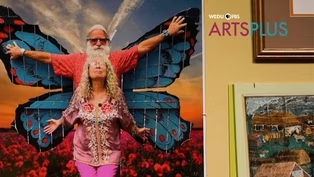
1218 | Mosaic House of Dunedin
Video has Closed Captions
Clip: S12 Ep18 | 6m 43s | Explore the arts and artists living in the Mosaic House of Dunedin, Florida (6m 43s)
Providing Support for PBS.org
Learn Moreabout PBS online sponsorship

- Arts and Music
The Best of the Joy of Painting with Bob Ross
A pop icon, Bob Ross offers soothing words of wisdom as he paints captivating landscapes.













Support for PBS provided by:
WEDU Arts Plus is a local public television program presented by WEDU
Major funding for WEDU Arts Plus is provided through the generosity of Charles Rosenblum, The State of Florida and Division of Arts and Culture and the National Endowment for the Arts, and the Hillsborough County Board of County Commissioners.