WEDU Arts Plus
1221 | Episode
Season 12 Episode 21 | 26m 32sVideo has Closed Captions
Florida Orchestra | Kaleidoscopic Images | Stereotank | Cowboy Arts & Gear Museum
Go Inside the Music with Florida Orchestra Music Director Michael Frances as he shares the story behind "The Planets". Dayton, Ohio, artist Marsha Monroe Pippenger creates kaleidoscopic collages from paper. Meet Stereotank, a Florida design studio focused on the relationship between sound, art, and architecture. The Cowboy Arts & Gear Museum in Nevada to explores the life of the American cowboy.
Problems playing video? | Closed Captioning Feedback
Problems playing video? | Closed Captioning Feedback
WEDU Arts Plus is a local public television program presented by WEDU
Major funding for WEDU Arts Plus is provided through the generosity of Charles Rosenblum, The State of Florida and Division of Arts and Culture and the National Endowment for the Arts, and the Hillsborough County Board of County Commissioners.
WEDU Arts Plus
1221 | Episode
Season 12 Episode 21 | 26m 32sVideo has Closed Captions
Go Inside the Music with Florida Orchestra Music Director Michael Frances as he shares the story behind "The Planets". Dayton, Ohio, artist Marsha Monroe Pippenger creates kaleidoscopic collages from paper. Meet Stereotank, a Florida design studio focused on the relationship between sound, art, and architecture. The Cowboy Arts & Gear Museum in Nevada to explores the life of the American cowboy.
Problems playing video? | Closed Captioning Feedback
How to Watch WEDU Arts Plus
WEDU Arts Plus is available to stream on pbs.org and the free PBS App, available on iPhone, Apple TV, Android TV, Android smartphones, Amazon Fire TV, Amazon Fire Tablet, Roku, Samsung Smart TV, and Vizio.
Providing Support for PBS.org
Learn Moreabout PBS online sponsorship- [Announcer] This is a production of WEDU PBS.
Tampa, St. Petersburg, Sarasota.
(bright music) - [Narrator] Funding for WEDU Arts Plus is provided by the Community Foundation Tampa Bay.
- [Gabe] In this edition of WEDU Arts Plus, the Florida Orchestra takes us Inside the Music.
- It gives us a chance to really break down any fear of the songs.
We want to make sure that there's no limit to, to appreciation and understanding.
- [Gabe] Multicolored collages.
- You can mix papers, you know.
I layer them and mix them.
So it's a little bit like mixing paint.
I have a huge collection of paper, huge.
- [Gabe] Exploring the many layers of sound.
- [Marcelo] We start with one idea, (steady drumming) but we never really know how it will sound until we finish it.
- [Gabe] And the Cowboy Arts Museum.
- Cowboys like their bling.
Bling is nothing new in the cowboy world.
- It's all coming up next on WEDU Arts Plus.
(exciting theme music) Hello, I'm Gabe Ortiz and this is WEDU Arts Plus.
Ever wondered what goes on in the minds of composers like Beethoven, Mozart, or Tchaikovsky?
Florida Orchestra Music director Michael Francis has answers.
He created a concert experience that explains the life and times of great composers.
Listen closely as the maestro takes us Inside the Music.
(classical orchestra music) - The Inside the Music series is really something that we feel very passionate about at the Florid Orchestra because it gives us a chance to really break down any fear of this music.
We want to make sure that there's no limit to, to appreciation and understanding.
(orchestral music continues) What I try to do is just provide a gateway so that people can have this personal, proactive listening experience, because the composers went through all the same things we went through.
Danger and love and life and loss, and all these qualities.
And suddenly then this music erupts.
And it's a march like you've never heard before.
This is a march in five, four.
That's left, right, right, left, right.
(audience laughing) I'm not a military man, but I know that's awkward.
Gustav Holst, the English composer, wrote The Planets in 1914 and he finished it in 1919.
So it really spanned World War I.
It was a tumultuous period in European history.
(orchestra music continues) So he represents seven of the planets in this large suite for a very large orchestra.
I think there's 130 musicians and singers involved in this epic saga.
Within this suite of music, each planet has his own individual character.
(exciting orchestral music) Mars is the bringer of war.
This idea of what we are all capable of, the danger within us for destruction.
(steady orchestral music) Venus is the bringer of peace, and this is much more sensuous music.
It's much more about the higher instruments.
It's a real antidote to this shocking brutality of Mars.
(hurried classical music) Well, Mercury is the winged messenger, and this was really Holst's personal star sign.
It's more about being nimble and fleeting and fast moving and this idea of information flying around.
It's much more skittish and much more playful.
(light orchestral music) Jupiter, the bringer of jollity.
To me, this music feels much more about England.
You feel this national style, you feel the folk music, it has a a feeling of celebration.
(steady orchestral music) Saturn is the bringer of old age, and this was Holst's favorite movement.
He had a lot of physical health conditions and I think for him, fear of death was a, was something that he lived with on a daily basis.
Uranus the Magician, well this is based upon Holst's own name that he wrote into the fabric of the music.
So he is almost imagining himself as the puppet master.
Taps into this idea of the populous style of music.
(dramatic orchestral music) And finally, Neptune the Mystic.
If we began with the physical, now we end with the metaphysical, this cold distant music that seems to call us into another realm.
And at the end of it, you hear the sirens calling you distantly into space.
These voices that appear off stage that cannot be seen, but can be heard, and above all, can be felt.
(haunting vocalizing) Because ultimately it's about the seven planets helping us to live on the one planet that's not mentioned, planet Earth, and how we interact with each other and how each of the characters which he represents in an astrological way represent the different aspects of our psyche.
(orchestral music continues) - The Inside the Music concert model is really an interesting one.
It draws in many different types of audience members, purely because of its format.
To have, you know, Michael Francis be your tour guide during a piece like The Planets, you are able to sit as an audience member and you're able to meet Michael and the orchestra halfway.
- And in this moment you hear an awful lot of Dukas, Sorcerer's Apprentice as well, which was written about 20 years before this.
- I think the model and the format and the way that engages our community members and creates these access points for everyone, that's really what brings in folks from all corners of our community.
It's beautiful.
(dramatic orchestral music concludes) - He helps put the music into context, so you're kind of understanding where it, where it's coming from and the history and everything, so you feel more connected.
- I was sitting there and I was thinking, I love this better than probably what the show is gonna be, just 'cause he brings so much to it.
With his story, the way he, his humor, everything, it was phenomenal.
- These Inside the Music concerts are magical.
I'm a huge classical music fan, but hearing Michael Francis talk about the layers, the context, everything going on, and with his impish sense of humor, it's a real treat.
- A lot of the work that we do in education and community outreach at the Florida Orchestra is directly related to the fundamental philosophy of what happens on stage.
So some of the programs that facilitate that in the early stages, we have Strings for Kids, which is a free afterschool program for a lot of our communities that wouldn't, that wouldn't have access.
In the middle school, we have a teaching artist program where we send out musicians who perform with the orchestra, but they also split half their time going into schools and working directly with hundreds and hundreds of kids every week.
And then we have our youth concerts.
So we see upwards of 6,000 kids a week who come and experience a mini version of Inside the Music.
The idea is to meet the community where they are and to provide programming to them that will only enhance the depth of what it is music has to offer everyone.
- Inside the Music allows us to open this gateway of understanding so that when you come to the music, you have an intellectual appreciation, an emotional understanding of the narrative, and perhaps you learn something new about this masterful art form or orchestral, classical music.
(hurried classical music) This orchestra is the perfect example of human interaction.
So to celebrate that with music, which brings people together, which helps you understand your own life.
I have the most wonderful job.
And the word 'maestro' means teacher.
So anything I can do to share that with people is the great privilege of my life.
(dramatic orchestral conclusion) (bright music) - For more information, visit FloridaOrchestra.org.
Artist Marsha Monroe Pippenger's kaleidoscopic collages are paintings made out of paper.
Travel to Dayton, Ohio to see firsthand how she brainstorms ideas, gathers her materials, and puts together a remarkable finished product.
(bright string music) - When I teach about collage, I always talk about the fact that Picasso and Braque are credited with inventing collage in 1912, and I beg to differ with that always because as far as I'm concerned, any kind of piecework throughout the centuries, taking all kinds of ephemera and discarded materials and fabrics and paper scraps and creating things out of them.
For me, that's collage.
I'm Marsha Monroe Pippenger, and I'm an artist.
I'm a teacher, and I'm a teaching artist.
I'm kind of the artist in residence here at the Requarth Company.
We have seven acres here at Requarth.
The building, of course, is old.
It dates from the 1880s or 1890s.
The Requarth Company moved down here in 1895.
There's a kitchen showroom here now.
We have six kitchen designers plus the lumber yard and the lumber staff, and everyone who works here will bring clients up to meet me and see the studio and they enjoy that.
I think customers enjoy that, too.
I have lots of room, I have really good lighting.
It's all North life.
There's great storage.
It's just a really good space.
The building, the people, the surroundings are wonderful.
(bright music continues) What's my favorite?
My favorite part of art making.
The first favorite part is the idea, which often comes from my reading.
Reading books, articles, or a phrase that I hear that will capture me.
And from there it's gotta roll around in my head a little bit.
I'll make sketches and drawings and I put the drawing on canvas.
Sometimes it's to scale, sometimes not.
And then the second favorite part is getting in there with the paper.
I start pulling the papers that I think will work and sort of creating a little pile, and start moving things around.
I don't commit right away.
And I use thousands of glue sticks because the nice thing about a glue stick is I can put a dab of glue down, I can put the paper down, I can remove it if I want to, if I change my mind or I wanna move it or whatever.
You can mix papers, you know, I layer them and mix them.
So it's a little bit like mixing paint.
I have a huge collection of paper, huge.
In the beginning I used tissue paper and cheap magazine papers and they fade.
They don't last.
So I use mostly handmade papers today, and I do use paper from magazines, but it's gotta be a high quality magazine with high quality inks.
And then sometimes I incorporate other things, bits and pieces of rock or tile or rust.
Yellow's my favorite color.
I'm pretty sure there's a touch of yellow in probably every single piece I've made.
I really like to work big, like 36 by 48.
That's three by four feet.
That's a nice size.
I like that size.
I've got these collage tapestries that I've been making and they're bigger.
They're four by six, five by seven, five by eight.
But I have leftover collage pieces that have innate nice little compositions.
I've been making pendants from those, so they're about two by three inches, so two by three inches up.
You know, as big as I can manage.
The most challenging part about creating a collage might be knowing when it's finished.
I think it's really easy to overdo, and there are times when I felt like I need somebody standing behind me to tell me when to stop.
You should leave a little mystery.
When you put in all the information, you end up boring people, and you need to let the viewer do a little work.
And so I try to keep that in mind.
That's one of my mantras, so to speak, for art making, is to try and stop just a little bit short of finished.
And I think that works.
About five, six years ago, I was asked to design a prayer wall for my church, which is Westminster Presbyterian Church here in Dayton, downtown.
And I designed it to fit with the architecture of our sanctuary and it's made out of wood.
And I had designed it so it looked like it had grown kind of organically, so it had sort of a random pattern.
And so you could tuck your prayer into the cracks among the wooden bricks.
And the pastors remove all the prayers about once a month, I think.
And nobody reads them.
It's between you and whoever you believe in, and they're burned.
Our senior pastor invited people to come up and put their first prayer in the prayer wall, which I did, like everyone else.
And I turned around and I looked down the center aisle of the church and people were lined up all the way down the entire length of the sanctuary out into the narthex.
And I started to cry.
And as you can tell, it still affects me.
And I started thinking about walls, and how walls can be positive.
They don't have to be negative in connotation, that walls can protect and surround.
And so I started a series called Redefining Walls, of collages that are abstractions of walls.
And I've been making them ever since.
I've made literally hundreds of collages relating to that idea of redefining walls.
And it was all because of this serendipity, this blessing that I had that I certainly didn't expect.
There's a quote that I really like.
"Fine art is that in which the hand, the head, and the heart come together."
And so if you can incorporate those three into your work, I think you've done a good thing.
(bright music continues) - See more at pippengerart.com.
Stereotank is a design studio focused on the relationship between sound, art, and architecture.
Meet the studio's co-founders, and see some of their experimental projects.
(water dripping, reverberating) - [Sara] It's a sound installation that creates music or rhythms with water.
(water rumbling) My name is Sara Valente.
- [Marcelo] And my name is Marcelo Ertorteguy.
- And we are Stereotank.
(ambient music) Stereotank was born in 2009.
- Our goal was to use space as an instrument, so sort of like you can inhabit the musical instrument.
Of course that evolved into many other iterations.
(bells dinging) - We've been trained as architects.
- We moved to New York and then while we were working in architectural offices, we on our side, we started to do art projects in the city, public art, temporary installations and so on.
And that was also like a perfect territory to experiment.
This idea of combining public art and sound or architecture and sound into immersive installations.
(bells jingling) - We found several opportunities, grants and awards to be able to propose quick installations that could be done in the city just to targeting some areas that were underdeveloped or underused that needed activation.
(drums beating) - We tried to experiment with sound, always sort of in a very primitive way.
The first sound installation we did was actually called Stereotank, and that's where our name came from.
We took these huge plastic water tanks side by side and then connecting them.
- So the actual string that was creating the sound was also part of the structure of the installation because it was keeping it together.
So we like that idea of kind of joining architecture and sound even through structure of a project.
(drums reverberating) So we were invited to propose a project for Times Square.
We won luckily this competition, and we had to design a heart shape installation.
That was the premise of the proposal.
- It had to be related to love, and we never saw ourselves doing anything like that.
So we took it really sort of our way and looking at the heart more from a acoustical point of view.
(drums beating) The heart had some drums embedded, so people could stop and play.
There were actually like six different acoustical percussion instruments.
- Very low frequency sound, beating with a light.
All of this was pulsating while the heart was not being played by people.
We had to figure something out that was sturdy enough and we went back again to the plastic tanks.
Thinking about the afterlife of a project.
We designed the HeartBeat project for being able to be transformed after it's used in Times Square as another project that is called HeartSeat.
(instrument sounding) We're gonna show a sample of the CargoGuitar.
The CargoGuitar was a project that we did in Japan.
This extra long string, it's within a shipping container.
So that's how we came up with the name.
This string is amplified, but it doesn't have any kind of effect, (string reverberating) so the string becomes smaller and the tone higher.
(string reverberating) (traffic ambiance) - When we arrived in Miami, we couldn't really treat public space as the same because it's completely different.
So what we start doing is actually going first inside of galleries where we could experiment with space and also people.
So the first one we did is called Generative Drop Sequencer.
(water droplets rumbling) - To engage more with public space here in Miami as well.
We've been working with some students at FIU on a seminar that has to do with a public space and art.
(upbeat music) - [Marcelo] I think we have to mention about the little free library project.
- [Sara] It's basically turning the standard little free library format into an inhabitable little free library.
We've also been working on our own project, our own house and studio.
(drums beating) - [Marcelo] We start with one idea, but we never really know how it will sound until we finish it.
- [Sara] That applies to sound, but also applies to working with given materials in general, because when you have to work with an object that already exists that has its own properties, then you really need to adapt to it.
(bells dinging) So that's, we think the beauty of working with materials and with systems that have been designed for other purposes.
(bright tone) - Discover more at stereotank.com.
Up next, get a look inside the Cowboy Arts and Gear Museum.
Located in Elko, Nevada, the museum examines the life and times of the American Cowboy in their exhibitions.
(bright string music) - The Cowboy Arts and Gear Museum is dedicated to preserving the legacy, the arts, the crafts, the craftsmanship of the American cowboy.
From the early days of settlement here in northeastern Nevada.
(string music continues) (oxen calling in distance) We want to display and share these stories, the archives, the materials that were used, the saddles, the bridles, bits and spurs, and the different aspects of the way a family ranch would've been through the early part of the 1900s.
(bright music continues) - It really holds true to the legacy of the pioneer spirit of the west, of the people who created the gear that they needed.
But at the same time, the artistry that it required.
And living in Nevada and especially here in rural Nevada, we have a lot of great artists.
We have writers and poets, painters, sculptors, dancers, and this wide open landscape really inspires that kind of work and that you can see on display here that represents decades of tradition in rural Nevada.
(bright music continues) - When visitors come into our museum, which is housed in G.S.
Garcia's historic saddle shop from 19 seven, they will see a brand wall, which is a project to show the contemporary and the historical use of brands, how cattle owners designated whose cow belonged to what.
We have saddles that were working saddles.
So some of them show a lot of wear and tear.
They were the pickup truck of their time.
Cowboys spent a lot of time in them, so they spent their money wisely selecting a saddle.
- It just reminds me of the significance of handing down that kind of quality craft of the gorgeous leather work here in the saddles and just the smell of the leather.
I mean, this is such a rich museum, not only in history, but in texture and, and the feeling that you get when you walk in.
(upbeat country music) - Cowboys like their bling.
Bling is nothing new in the cowboy world.
And these pieces have a lot of very intricate engraved markings to them, and they just show the high quality of work that was produced and sought after by cowboys.
An item that was made maybe in 1898 or 1915 is still the same style and craftsmanship that it is in contemporary times of today.
- What I love about this Cowboy Arts and Gear Museum in the heart of downtown Elko is it's really also signaling this renaissance of celebrating the traditions of the community, but at the same time, revitalizing these buildings.
We're not in this habit of knocking them down.
That used to be what was happening.
And now we're bringing these buildings back to life and we're filling them full of the things that are important to us.
(country music continues) - Elko is right in the heart of the Golden West.
We still embrace those cultures and traditions, yet we meld into the new ways.
And the Cowboy Arts and Gear Museum is a great way of keeping those old traditions, but presenting them to new audiences and new generations.
(country music concludes) (bright tone) - Plan your visit at CowboyArtsAndGearMuseum.org.
And that wraps it up for this edition of WEDU Arts Plus.
For more arts and culture, visit wedu.org/artsplus.
Until next time, I'm Gabe Ortiz.
Thanks for watching.
(dramatic music) - [Narrator] Funding for WEDU Arts Plus is provided by the Community Foundation, Tampa Bay.
(bright crescendo)
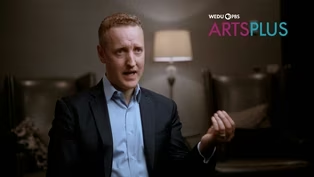
Video has Closed Captions
Clip: S12 Ep21 | 7m 8s | Get a glipse inside the minds of great composers with the Florida Orchestra. (7m 8s)
Providing Support for PBS.org
Learn Moreabout PBS online sponsorship

- Arts and Music
The Best of the Joy of Painting with Bob Ross
A pop icon, Bob Ross offers soothing words of wisdom as he paints captivating landscapes.













Support for PBS provided by:
WEDU Arts Plus is a local public television program presented by WEDU
Major funding for WEDU Arts Plus is provided through the generosity of Charles Rosenblum, The State of Florida and Division of Arts and Culture and the National Endowment for the Arts, and the Hillsborough County Board of County Commissioners.