
1/24/23 | Life Lessons
Season 14 Episode 8 | 27m 41sVideo has Closed Captions
An episode about life’s lessons.
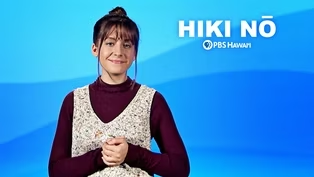
On this episode of HIKI NŌ on PBS Hawaiʻi, Cadence Wisniewski, a junior at Kalāheo High School on Oʻahu, returns to the PBS Hawaiʻi studio to host an episode about life’s lessons – shared by both HIKI NŌ student correspondents and the people they spotlight in their community. EPISODE #1408
Problems playing video? | Closed Captioning Feedback
Problems playing video? | Closed Captioning Feedback
HIKI NŌ is a local public television program presented by PBS Hawai'i
1/24/23 | Life Lessons
Season 14 Episode 8 | 27m 41sVideo has Closed Captions
On this episode of HIKI NŌ on PBS Hawaiʻi, Cadence Wisniewski, a junior at Kalāheo High School on Oʻahu, returns to the PBS Hawaiʻi studio to host an episode about life’s lessons – shared by both HIKI NŌ student correspondents and the people they spotlight in their community. EPISODE #1408
Problems playing video? | Closed Captioning Feedback
How to Watch HIKI NŌ
HIKI NŌ is available to stream on pbs.org and the free PBS App, available on iPhone, Apple TV, Android TV, Android smartphones, Amazon Fire TV, Amazon Fire Tablet, Roku, Samsung Smart TV, and Vizio.
Providing Support for PBS.org
Learn Moreabout PBS online sponsorship[intro music] HIKI NÕ, Hawai‘i's New Wave of Storytellers.
Aloha and welcome to this week's episode of HIKI NŌ on PBS Hawai‘i.
I'm Cadence Wisniewski, a junior at Kalāheo High School on O‘ahu.
Mahalo for tuning in.
I'm so happy to be back here in the PBS Hawai‘i studio to host another great show highlighting the best work from Hawai‘i's New Wave of Storytellers.
On this episode of HIKI NŌ, we’ll take you from O‘ahu to Hawai‘i Island to Maui and Kaua‘i, where you'll meet students as young as in the sixth grade.
This show is full of life's lessons – shared by both HIKI NŌ student reporters and the people they spotlight in their community.
We’ll meet a Buddhist Bishop with a rich history and a teacher with a green thumb on O‘ahu.
We’ll also witness stories of perseverance, whether it be a school band keeping the music alive for the pandemic, or a student learning to cope with the loss of a friend.
I know you'll feel just as inspired as I do by these stories.
To start things off, let's watch this profile produced by the students of Hongwanji Mission School on O‘ahu that introduces us to one of the island's most important Buddhist dignitaries.
I didn't aspire to be a minister, um, until much later in my life.
[ocean wave] For myself, uh, I often have the thought, and I'm still in awe of how fortunate can one person be?
Because so many opportunities have come my way.
Eric Matsumoto, Bishop of the Honpa Hongwanji Mission of Hawai‘i started his journey in a way you may not expect.
I didn't aspire to be a minister, um, until much later in my life.
After entering college, uh, I did have the aspiration to become a foreign language instructor.
My motivation for learning Japanese, uh, came from my wanting to speak to my paternal grandmother more.
With this decision, Bishop Matsumoto left Hōnaunau on Hawai‘i Island and went to Japan to study Japanese.
It wasn't enough to only learn the words or the grammar of a language.
But if you truly wanted to master the language, you also have to learn about the culture, the mannerisms, the thinking, uh, of the people.
During his studies, some students invited him to study Buddhism, though during this time, he was dealing with personal challenges involving his family.
At that point in my life, uh, I began asking many questions, uh, you know, that, uh, I was searching for answers.
In the final analysis, Buddhism provided me with some answers which brought understanding and awareness into my life which changed the way I looked at life and many things.
While Buddhism helped him through his personal challenges, the Bishop's gratitude for Buddhism inspired him to continue it professionally.
After becoming Bishop of Hawai‘i in 2011, he had the chance to meet many distinguished individuals.
Today, you know, to have been able to meet individuals like the former Emperor Akihito and Empress Michiko of Japan, and Aung San Suu Kyi of Burma, uh, the late, uh, Archbishop Desmond Tutu, you know, have been such precious and priceless opportunities which I treasure.
After meeting many important leaders, the Bishop continues to be grateful for the opportunity to share Buddhism with all people.
At heart, I’m still simply a minister.
And so for me, it's, uh, seeing a, a sparkle or a smile, uh, a twinkle in someone's eye that perhaps through talking with me or some kind of interaction through me, that, uh, they've come to understand a little bit more about, uh, the meaning and significance of the Buddha's teaching.
Bishop Matsumoto continues to practice gratitude and inspires others to do the same.
This is Mia Schatz from Hongwanji Mission School for HIKI NŌ.
[ocean wave] This next student reflection comes from Kolten Sewake, a sixth grader at E.B.
de Silva Elementary School on Hawai‘i Island, who has a message for his past self.
[ocean wave] Dear Third Grade Kolten, things are gonna get tough for you in fourth grade.
There's gonna be a new sickness.
All schools will shut down.
You'll have all your classes at home on the computer.
You'll stay at home all day.
It will actually be kind of fun.
Then we'll find out mom has cancer, but she'll get better after a few months.
But then the cancer will come back, and she'll get even worse.
Auntie Kathy will move to E.B.
deSilva Elementary School.
I have no idea where that place was, but Dad will think it will be easier if you and Kreighton go there, too.
So, you'll change schools but find out the teachers are very nice.
You'll even eat breakfast at school, and Grandma will help around the house.
You will also learn how to take care of Kreighton.
Bummer, right?
But Mom will get better every day.
Just to remember to go through every day with a good attitude and everything will be okay.
Sincerely, sixth grade Kolten.
[ocean wave] Dear sixth grade Kolten, I'm sorry that you faced some tough times but I'm happy things are better for you and your family.
Great job stepping up and taking care of your younger brother.
Always know that you're not alone and that someone is always there to help.
This next piece is from the HIKI NŌ archives and it's also from the Big Island.
It's a story from the students of Waiākea High School who profile a man with a message to share to students who are going through rough patches.
[insects and birds] The first time I wrote, as you can see, some of the words say breathe, breathe, breathe.
I couldn't write.
But all that I could write were things that would help me push forward and to be centered and to stay grounded, to stay alive.
Breathing is a natural process providing us with oxygen to survive.
For 25-year-old Hilo resident Easton Tanimoto, breathing was more than simple respiration.
So, I left Hawai‘i to go to California for film school.
I was looking forward to creating music videos and, you know, I was slightly confident that I could create a life that reflected my dreams.
I was in California for two years.
I had a phone call.
My brother told me we just got robbed.
The robber stole all these things that I've saved up so much money to, to follow my passion.
A week later after getting robbed, my friend offered me mushrooms.
Mushrooms, also known as psilocybin, or magic mushrooms, are used for their hallucinogenic effects to produce a trip.
Easton thought it would relieve his depression, but when he took it at it the reverse.
I ended up becoming so overwhelmed with fear and anxiety that I ran out the house at midnight.
Tanimoto felt lost but then found himself where he least expected.
Falling off a telephone pole 35 feet, burning all the skin, breaking bones on the way down.
After eight days in a coma, I woke up in a hospital.
I was so fortunate to be alive and to see how much people cared for me at a time where I didn't care about myself.
It was so eye opening.
I know there's a lot of good people out in the world, and I hope I can join that group.
I travel with people who want to make a difference in the world, who want to build relationships with the future and share hope.
Easton decided to start speaking at schools with the intent that students won't make the same mistakes he did.
This group includes Kyle Quilausing and Sam Sampago, both of whom have had their share of experiences, good and bad, to share with students.
Together we touch upon the lives of depression, drugs, bullying, with a common goal to inspire us to make better life choices.
I wear this shirt and this hat, and it's kind of like a conversation starter, too.
Reach out to a positive.
Reach out to a family member or friend.
Express it, don't depress it.
That's how it happens.
I can connect with other people who are also going through their own battles or have gone through, and I can relate to them, and I can see the appreciation they have for life.
I'm alive.
I’m alive!
I’m strong.
I’m strong!
I’m confident.
I’m confident!
I’m free.
I’m free!
[Hawaiian] Hi this is Cassidy Denault from Waiākea High School for HIKI NŌ.
[ocean wave] Inspiring, right?
These are the tough conversations that need to be had so that people don't find themselves in these kinds of situations.
This next story is from the students of Hawai‘i Technology Academy on O‘ahu.
They profile a teacher at Moanalua High School who's dedicating her time to teach her students about growing food sustainably.
Having that connection to the earth is definitely important if we're going to try to be more sustainable.
I think every little bit helps.
[ocean wave] It's pretty amazing that you put some seeds in some soil and you water it and then something grows.
I wanted to incorporate, um, some local like, place-based lessons and projects for my class.
And so, one of the issues that I wanted them to cover – where does Hawai‘i get its food from and the food security?
And so that's kind of how the garden sprang up.
According to the U.S. Department of Agriculture, food insecurity is the lack of consistent access to enough food for an active, healthy life.
As my students were doing their research, they learned that most of the food that's, um, that Hawai‘i consumes is shipped in.
In 2021, a UH study found that 48% of Hawai‘i families with children are experiencing food insecurity.
One way in which people in Hawai‘i could try to have more food security is growing their own food.
They didn’t think it was possible.
When the produce was ready to harvest it was passed out for students to take home to their families.
It was really good to get them outside, too, and have them build community.
My hope is that it'll become like a school-wide garden where a lot of different classes will be able to utilize the space.
Having that connection to the earth is definitely important if we're going to try to be more sustainable.
I think every little bit helps.
This is Tamar Wachi from Hawai‘i Technology Academy for HIKI NŌ on PBS Hawai‘i.
[ocean wave] We all need to take care of the island even if that means doing something small, because like she said, every little bit helps.
Okay, now let's dive into the HIKI NŌ archives to watch this story from Nānākuli High and Intermediate School on the O‘ahu, where students there share the story of a boy with a passion for singing and dancing, and his number one fan: his mom.
[laughter] For Nānākuli High and Intermediate School sophomore Malachi Keohuloa has a life like most students.
He goes to class, interacts with friends, and does homework.
But his passion is the performing arts, where he spends 10 hours after school a week with the Nānākuli High and Intermediate School Performing Arts Center.
However, Malachi cannot share that passion with his biggest supporter, his mother, as his mother, Yvette Ibarra, is deaf.
I was born deaf.
While my mom was pregnant with me, she had German measles, rubella.
And so, when I grew up, I was very positive about being deaf.
It wasn't a hardship.
For Malachi, joining the performing arts was a natural thing for him to do.
I realized that my son had a passion.
He really loves to dance.
He really loves music.
[singing] I'm just really fond of music and I thought that maybe joining a performing arts center would probably help me go more in depth with my passion for music and, um, dancing, singing and now I guess um, I, I like acting.
Some psychiatrists say that people who eat peanut butter sandwiches are lonely.
I guess they’re right.
I guess sometimes it's, it's a little disheartening when your deaf mother is in a crowd at your show, and she can't hear a word you're saying or singing.
So, I guess you have to like, really bring your emotions out when you're onstage.
So, I just enjoy watching his performances.
Most of the time, I do understand because it's all based on expression, body language, or the feeling, and so it's beautiful and it touches my heart.
Their relationship is no different because of her disability.
I feel like you shouldn't treat your parent any different from other parents just because they have a disability.
So, I don't see my mom any different, but I do sometimes keep in mind that she's deaf.
But being deaf is like you can feel the world without hearing sound, and I feel the world with my heart.
[singing] This is Desiree Kanui from Nānākuli High and Intermediate School for HIKI NŌ.
[singing] [ocean wave] Now let's learn some Sign Language from the students of H.P.
Baldwin High School on Maui.
About 15% of people in America are born deaf or have suffered from some level of hearing loss that affects communication.
People with severe hearing loss communicate using a series of standardized hand signals known as American Sign Language, or ASL.
Reaching out to these members of the community by using sign language is one way to show kindness and compassion.
Here is one easy conversation starter in ASL.
To say ‘how are you,’ place both fists together with thumbs up and rolled outwards to say ‘how’.
Next, point at the person you're addressing to say ‘you.’ Remember that facial expressions are crucial when talking to a person who is hearing impaired.
Now that you've started a conversation, here are some possible responses.
To say ‘good’, place the fingers of your right hand to your mouth and bring them down face up on your left hand.
To say ‘bad’, begin with the same but end with your right hand facing down on your left hand.
Now that we have shown you the basics, get out there and connect with the deaf community in your area.
And if you're interested in learning more about ASL, visit www.nad.org.
This is Kristen Takamiya from H.P.
Baldwin High School for HIKI NŌ.
[ocean wave] Let's travel now to Pearl City High School on O‘ahu to watch a story about how its school band kept us or them through the pandemic.
[band music] Now more than ever, it feels like music is really worth, worth doing, because it brings people together.
[ocean wave] In April 2022, the Pearl City High School concert band returned to the stage.
It was the first concert since the Coronavirus pandemic caused an unexpected intermission.
We stopped playing for a little while and the numbers were really high.
Um, but we really, we really wanted to continue playing.
So, um, our number one goal was, you know, to get the kids back together, the students back together and making music.
So really the, the protocols that we put in place, we were outside, we masked the students, and we distanced them.
In the spring semester we were separated by our full instrument group, so we were separated by clarinets, flutes, uh, saxes, trumpet.
[metronome] It makes it a little bit harder to kind of vibe with everybody, you know.
It's hard to like, really, uh, have the music kind of go together if, if we're so far apart.
Band members wore special masks that fit around the mouthpieces of their instruments.
Even though these changes made playing difficult, students were determined to keep the music alive.
We're just not as together as we used to be, but at least we're still progressing, uh, at least a little forward.
Restrictions eventually eased, allowing band members to rehearse and perform together.
It’s, it's exciting, and now I’m getting really hyped up for it.
Now more than ever, it feels like music is really worth, worth doing, so, because it brings people together, and it lets people, um, um, work, work together.
Um, no matter what the difficulty is we're going to try to do it as best we can, um, with keeping our, our families and our students safe.
This is Andrew Tokita from Pearl City High School for HIKI NŌ.
[ocean wave] Covid really loved to cause trouble, didn't it?
But no matter how hard COVID tried to knock us down, we always came back persevering.
Our HIKI NŌ students are strong.
This next piece is about losing a friend, one of the hardest things in life, and especially losing someone to suicide when you're left with so many unanswered questions and guilt, it's hard to ever fully bounce back from something like that.
This student reflection comes from Emi Nishimura, a student at Kailua Intermediate School on O‘ahu, who reminds us that the best you can do is be there for your friends and to remind them that they matter more than they will ever know.
I never thought something like that would happen to someone I knew, but it did.
[ocean wave] Hello, my name is Emi Nishimura and I'm an eighth grader at Kailua Intermediate School on the Island of O‘ahu.
I once knew someone.
They were around my age and had their whole life ahead of them.
They died by suicide.
They were the type of person who I would have never even suspected to be hurting inside.
I thought that they're the very definition of okay because they always seemed so happy and were social and would tell jokes to make people laugh.
But it turned out that they were not alright.
And I never knew that until it was too late.
I saw them every single day, until suddenly, just like that, they were gone.
Knowing someone my age and then losing them was shocking.
It was painful and it hurt.
I never thought something like that would happen to someone I knew, but it did.
What happened has made me more aware of how much mental health matters and how it can affect everyone, even people you might not think it would.
It's made me realize how important it is to check up on your friends, make sure that they're doing okay.
And if they're not, being there for them and letting them know that you care.
So, if you are feeling depressed or even considering self-harm or suicide, or know someone who is, please reach out for help, by talking to someone you trust, like your friends, teachers, coaches, or anyone you feel comfortable talking to.
You can even call a suicide prevention line, which is anonymous and confidential.
It can be difficult to be honest about how you're feeling.
But in the end, it will be worth it.
Every situation and person is different, but always know that there is hope and there are people who are here to help.
Most of all, know that you matter, and you are worth so much more than you think.
[ocean wave] If you or someone you know is contemplating suicide, please call 988.
Thank you, Emi, for being so brave and sharing your story.
Now we have a story from the HIKI NŌ archives from Kapa‘a High School on Kaua‘i which showcases a local program that is dedicated to suicide prevention.
[scuffling] It's very uplifting to be able to see the community gather around the needs of our youth.
The Kaua‘i Resilience Project is a bold community initiative to enhance our young people's ability to successfully navigate through life's challenges.
We wanted to find out how kids were feeling, how are they doing, and we were surprised to find out, unfortunately, that some of our students are feeling sad and they're feeling worthless, um, and they're giving up hope.
And we knew then that we wanted to get together as a community to find out how we could help and what we could do.
The project aims to understand the key factors that lead to stress and feelings of helplessness by listening to Kaua‘i’s youth.
What we did is we talked to our kids, and we found out that they, they felt that there wasn't enough things to do on the island, that the island of Kaua‘i is no longer for them, um, that it, it caters more towards tourists.
And they requested that we add more programs, um, to have accessibility to more activities after school.
Using this input, the Kaua‘i Resilience Project helps reinforce local youth programs with necessary support for increased success.
There are other sources of, of structure too.
It could be a team or a club at school, or just making sure they remain engaged in school and continue to advance in their classes.
But we find that engagement of all different kinds is associated with resilience.
Rolling out their community action plan, the project strives to help our young people thrive.
There was a, an important study that was done on Kaua‘i, uh, many years ago that discovered that no matter how hard and how challenging a life that a child may have, if they have one caring adult, it makes all the difference, and they can be resilient.
So, our goal is to ask everybody on Kaua‘i to help listen to our young people, to help do things with them, to include them in their life so that everyone can feel connected and feel happier and more resilient.
Through consistent effort, the project is making an impact.
Finding a mentor would be like joining a group and seeing if you like the group leader, joining a, uh, sports team and seeing if you like the coach, uh, joining like a faith-based organization, a church group, a youth group, something like that.
And, uh, those kinds of folks, the adults that are in those kinds of positions are very frequently open to mentorship.
So, all of us are working hard to bring resources into the community for youth.
We're bringing after school programs; we're bringing things to do on evenings and weekends.
Um, we're helping kids learn how to be resilient.
As their island's youth grows, so will the support from the Kaua‘i Resilience Project.
This is Michael Amoyo from Kapa‘a High School for HIKI NŌ.
[ocean wave] That concludes our show.
We hope you've enjoyed the work of Hawai‘i's New Wave of Storytellers.
Don't forget to subscribe to PBS Hawai‘i on YouTube and follow HIKI NŌ on Instagram and TikTok to enjoy that best stories from Hawai‘i.
We'll see you next week for more proof that Hawai‘i students HIKI NŌ: can do.
[outro music]
Preview: S14 Ep8 | 30s | Life’s lessons shared by student correspondents and the people they spotlight. (30s)
Providing Support for PBS.org
Learn Moreabout PBS online sponsorship
- News and Public Affairs

Top journalists deliver compelling original analysis of the hour's headlines.

- News and Public Affairs

FRONTLINE is investigative journalism that questions, explains and changes our world.












Support for PBS provided by:
HIKI NŌ is a local public television program presented by PBS Hawai'i