WEDU Arts Plus
1301 | Episode
Season 13 Episode 1 | 26m 34sVideo has Closed Captions
Underground electronic entertainment | Art and science | Design studio | Robert Frank
Jason Kitchen of L8 Night Flights and his “Flight Crew” introduce us to underground electronic entertainment. Artist and chemist Paula Gracey creates works that connect art and science. Meet the artistic team behind Such + Such, a fabrication and design studio in Cincinnati. An exhibition at the Addison Gallery of American Art in MA showcases the work of documentary photographer Robert Frank.
Problems playing video? | Closed Captioning Feedback
Problems playing video? | Closed Captioning Feedback
WEDU Arts Plus is a local public television program presented by WEDU
Major funding for WEDU Arts Plus is provided through the generosity of Charles Rosenblum, The State of Florida and Division of Arts and Culture and the National Endowment for the Arts, and the Hillsborough County Board of County Commissioners.
WEDU Arts Plus
1301 | Episode
Season 13 Episode 1 | 26m 34sVideo has Closed Captions
Jason Kitchen of L8 Night Flights and his “Flight Crew” introduce us to underground electronic entertainment. Artist and chemist Paula Gracey creates works that connect art and science. Meet the artistic team behind Such + Such, a fabrication and design studio in Cincinnati. An exhibition at the Addison Gallery of American Art in MA showcases the work of documentary photographer Robert Frank.
Problems playing video? | Closed Captioning Feedback
How to Watch WEDU Arts Plus
WEDU Arts Plus is available to stream on pbs.org and the free PBS App, available on iPhone, Apple TV, Android TV, Android smartphones, Amazon Fire TV, Amazon Fire Tablet, Roku, Samsung Smart TV, and Vizio.
Providing Support for PBS.org
Learn Moreabout PBS online sponsorship- [Announcer] This is a production of WEDU PBS.
Tampa, St. Petersburg, Sarasota.
(uplifting music) - [Dalia] In this Season 13 premiere of "WEDU Arts Plus," meet a team of St. Petersburg-based DJs.
- The coolest part about DJing, I think, is just being able to tell a story, and set a vibe, and connect with people without actually having to speak to them.
- [Dalia] Chemistry and art.
- [Paola] That's like an experiment for me.
I started working with this technique of painting back in 2004.
I've noticed over the years it's gotten better, and a lot of it has to do with my documentation.
- [Dalia] One-of-a-kind design and fabrication.
- [Alex] We go really fast from idea to reality.
I think that's one of our strong points.
Our aesthetics, definitely modern, and it's deeply influenced by production - [Dalia] And documentary photography.
- There was no prescribed, "I am going to do this."
It's more, "I am going to travel.
Look, see, feel, and see what I learn."
- It's all coming up next on "WEDU Arts Plus."
(jazz music) Hello, I'm Dalia Colon, and this is "WEDU Arts Plus."
Jason Kitchen, co-founder of L8 Night Flights, began his DJ career in 2009.
Since then, he has created his Flight Crew, an impressive team of DJs who have had many club residencies around the Tampa Bay area.
(DJ stand clicks) (phonograph record scratching) (upbeat music) - My favorite part of DJing is that moment when you're just totally in the flow, you're not thinking about anything else.
Everyone in the room is vibing and smiling at each other.
And it doesn't matter if there's 1,000 people or 10 people.
It's just that connection between you and people that are in the room.
Hello, I'm Jason Kitchen.
I'm the creator and co-founder of The House Music Collective L8 Night Flights.
- Hi, my name is Alex, I'm a partner in L8 Night Flights, and I go by Taetro as a DJ.
- HI am Alen, I go by Alen P. I'm the member of the L8 Night Flights crew, and I'm originally from Croatia.
- My name's JB Nicotera, and I'm a part of the L8 Night Flights crew here in St. Petersburg, Florida.
- My name is Curtis Viscome, AKA Curtis James, and I'm a disc jockey for L8 Night Flights.
- L8 Night Flights, in our group of DJs, it was always about people that honestly, were just people we loved, were our friends.
That's always been the most important to us is that you're good people first, and that we want to... You wanna be around these people.
- The coolest part about DJing, I think, is just being able to tell a story, and set a vibe, and connect with people without actually having to speak to them.
- For me, DJing is all about the energy exchange, the vibration between myself as a DJ, selector of the music, and the dance floor, and the people on dance floor receiving that energy through music.
- DJing, to me, is the art of collecting and curating music for a group of people that are all like-minded, and tapping into the ether and energy of those people all at once, and letting them decide where the night's gonna go.
And doing all of that without a single verbal exchange.
- One of my favorite stories as a DJ was out at The Edge, rain started, there was no cover, it's an outdoor venue, and we just throw tarps out into the crowd.
And these 40, 60-foot long tarps get spread out, and everybody in the crowd's holding it.
Feels like you're back in middle school with the parachute.
Everybody's under it dancing, all the way connected to the DJ, and it was just...
It was ball, it was kids at play again, it was amazing.
(upbeat music) - Ichicoro was definitely a special place for L8 Night Flights because it was the founding venue where we started playing.
We had a special set up.
It was very low-ceiling, very small, very dark.
People get very intimate there.
DJ booth was very close to the dance floor in a sense that you can actually touch people in front of you.
- My favorite place that we've done events at is gonna absolutely gonna be the St. Petersburg Pier.
The fact that it's open to all ages, it's a free event that we community funded and just be able to see these, my friends and people we've known for a long time, bringing their young children with them and seeing everybody dance together.
It's really special.
I met my business partner, Lyndon Uy.
It was about 2009.
I had just gotten my first public gig out in the world, and I was playing at this place called Orbit 19 in Holiday, Florida.
Lyndon had moved down here from New York City, just had a quadruple bypass.
And so he came down here to live in with his mother and father.
He was actually, even though he was coming down here 'cause of the quadruple bypass, he was also coming down here to take care of them.
That was something really special about Lyndon that he, all the way until when he passed, he was taking care of his mother and father.
- He was a mentor, for sure, when it came to music.
He was someone who would always tell it like it is.
He would tell you, "Your set sucked, and this is the reason why."
He would help you get better.
- As always, a smile on his face.
I never saw him grumpy, like very rarely.
He always was very direct and transparent.
- He held all of us together.
He was a calming presence when he needed to be.
He was a chaotic energy pusher when he needed to be.
- But more than that, he was a role model.
He was a teacher, he was a phenomenal DJ.
- Lyndon was always the type of person that would listen to everybody.
He made people feel special and always was an ear.
- He would do things that would just blow your mind and like you would learn every time you saw him play.
- Even when he passed, that was something that everybody always said was that he was there and just a really good friend to everybody.
(mellow music) DJing and music really is where it started for me and the many 20 plus years that I've put into this now.
There's a lot of different paths that I've sacrificed going down those different roads because of the L8 Nights, because the economics of being a DJ versus having a career, the just gig work versus steady career money is definitely... Those are the things that people don't always see or think about.
And there's just tons of those kinds of sacrifices, I think, to be an artist of any type.
And so, yeah, I think I feel any artist could relate.
And at the end of the day, I wouldn't take any of it back.
There's definitely struggles that could come along with it, but the memories and the moments that we've all shared, it makes it worth it.
♪ You who make the worlds collide ♪ ♪ I knew you'd come knocking one day ♪ ♪ Unannounced, like a thief ♪ (mellow music) - For more information, check out l8nightflights.com.
Paola Gracey is both an artist and a practicing chemist.
When she creates, she demonstrates the connections between art and science.
Each of her paintings becomes an experiment, rich with texture, color, and energy.
(machinery whirring) - So I think as an artist, it's nice to have the artist touch from the beginning to end.
(tool clattering) Instead of using a canvas to wrap it, I use a wooden panel just because of the resin.
I have to keep it nice and level so that it doesn't pull towards the center.
This one is for a 36x36 piece.
(machinery whirring) Got my four sides, now I'm gonna go frame it.
(pensive music) I'm Paola Gracey.
I'm an artist and chemist.
Practicing chemist during the day, and then at night is when I start to paint and become alive.
(pensive music) The thicker the border, I love the way that the paint looks when it's dripped over it.
(pensive music) (tool clicking) And so I place these to make sure I have a nice 45-degree angle before I add the nails to it to reinforce it.
(tool clinking) So now, I'm gonna add the plywood to the top, and this, of course, will be my background.
(wood clattering) And let me switch out to the staple gun.
(staple gun clicking) So I'll paint the background and then I'll apply the glitter, and then I'll do several layers of resin.
And then this is what the pieces actually look like before I apply the acrylics.
(gentle upbeat music) I don't use the typical easel, my easel's the ground.
- [Interviewer] Are you mixing chemicals into some of the paint?
- Yeah, so I'll add like a pouring medium to it.
It's like an experiment for me.
I started working with this technique of painting back in 2004.
I've noticed over the years it's gotten better, and a lot of it has to do with my documentation.
So I, just like I would in the laboratory, I documented my lab notebook, all my materials, all my observations, and then I use that information to work on the next piece.
The colors I use mostly are like jewel tones and blues.
And then I guess a lot of it, the colors that I use are influenced by science and growing up in South Florida, the colorful atmosphere.
And so I like to throw in a shrill orange or a yellow, a neon yellow, into the piece.
(upbeat music) They just speak to me in different ways, and I don't know that people understand it.
It is just... How they speak to me is how I choose what color will go next to the other.
I don't ever let the canvas kind of stop.
(upbeat music) This is where I lift it up and let gravity do its thing.
(uplifting music) There we go.
(electronic music) What do you think?
(Paola laughing) You see how some start to really take off and then others are, it's kind of like the race of the drips.
So I try to control it, but at the same time, it's more of an organic flow to it.
And so I'll just assist them and kind of give a momentum.
(upbeat music) All right, Gino, we can bring it down now.
All right, and that's the end.
If I like the way it is, I bring it back down, I have to leave it to dry for a couple days, and that's it.
(pensive music) Both my grandmothers were artists, and so I was always exposed to that.
When I was studying, doing my undergraduate in chemistry, I always took a painting class to help destress.
And there is when I started to merge the science and the art.
When I was taking a biochemistry class, whatever I was studying, I would incorporate into the paintings.
And the piece that I just did live today was the "Kinetic Energy Series."
I love looking at images from the Hubble Telescope, the amount of kinetic energy out there in outer space.
We don't know much, but the way that I like to exhibit it is where it looks like it's going against gravity.
So it kind of confuses people and they think I throw it, and so I kinda like that unknown and that mystical aspect of: How did she get the paint to do what it did?
So this piece is from the "Spectra Series."
When you look at certain chemicals under the microscope, a lot of them have that holographic effect, and it's just beautiful.
I wanted to try to find a glitter that would represent that.
When I'm in the laboratory analyzing different substances, we use liquor chromatography, and so these are what my results look like at the end of the day.
(pensive music) I've had several people ask me, "Well, why don't you cover the acrylic on the top with the resin?"
And my answer to them is, "Well, I like the texture because if I were to cover it with the resin, you lose that effect of the matte against the high sheen."
It just adds like this depth to it, and then just the glitter, when you walk past it, the piece becomes alive.
Especially when you have the right lighting, it really demands your attention.
It's so much fun to work with.
(pensive music) (mellow music) - To see more of Gracey's work, go to paolastudios.com and instagram.com/paolastudios.
Founded in 2010, Such + Such is a design and fabrication studio based in Cincinnati, Ohio.
Up next, meet the artistic team and see how they work together to create something fresh, modern, and inventive.
(welding tool crackling) - Such + Such is a design and fabrication studio, and we specialize in furniture, interiors, and signage.
(upbeat music) (welding tool crackling) (upbeat music) Me and Alex met at DAAP.
We were actually freshman-year roommates, randomly assigned.
We gained a decent amount of professional experience, and we realized that we didn't really wanna work for other people, we wanted to work for ourselves.
And that was kind of like the ethos or the inspiration behind Such + Such.
(upbeat electronic music) - [Alex] We go really fast from idea to reality.
I think that's one of our strong points.
Our aesthetics, definitely modern, and it's deeply influenced by production.
(tool whirring) - [Zach] The guy that's been with us the longest is Adam Brock.
He has a degree in sculpture from Cincinnati Art Academy.
Dan Dickersheet who works for us who also has a degree in sculpture from DAAP.
Both of those guys I just mentioned are... specialize in metal work and have a background in working with metal in their own sculptural pieces.
The third guy we have working for us is Nolan Schultz.
He has the same training and background as me and Alex.
So he has a degree in industrial design from DAAP.
- We're all dirt bags, man.
It is what it is, I think.
(Alex laughing) I mean, everybody works hard.
They care about what they do a lot and we definitely try and have fun.
But as far as like the crew and stuff, we will go grab a beer at Queen City Radio.
(bright music) - [Zach] We are in a situation where most of our employees are pretty close to our own age.
We all live in the neighborhood, so we see each other and we definitely spend time at the bars.
- As a manager, I think it's important to keep things loose and keep things fun.
And I think that it's really hard to produce good work in a, like a real rigid environment.
I mean, we're all kind of into the same stuff, so it's pretty easy for us to just go grab a beer and complain about politics; or talk about something that's not work; or talk about something that's really close to work, but maybe not quite; or what we want to do in five years or what's the future like.
'Cause it's important for us to make sure, like... To make sure everybody knows that we, like, care about them beyond just the commercial transaction of money for work.
Like, we care about what happens to them.
- I think that's really cool.
There's a bond outside of work, and important to having a good work environment here, too, because these guys respect each other not just on the job in general, you know?
(upbeat music) One of my favorite projects was Corporate OTR, which is a street wear and shoe store that went in on a Vine Street Downtown.
We worked with the owner, Matt Tomamichel, who's a great guy, and let us have a lot of creative freedom to kind of push the boundaries in the space and do something kind of weird.
And that's what we love to do is not make what you expect us to make.
We worked with the owners of Fusion to develop their own custom furniture for their fast casual sushi restaurant.
So we designed their own chairs, tables, menu boards, stools, various other accessories for the restaurant.
And I think at this point, we've done like six or seven Fusions, all with custom furniture that we produce.
- We are doing a few different outdoor-game tables for the new Ziegler Park renovation.
It's through 3CDC sponsored by go Vibrant.
They're sweet.
I don't really know.
They have ping-pong tables.
- On a project like the ping-pong tables, it started with our client, 3CDC, reaching out to us.
We go online and we pull inspiration, and that can be anything, from other people's ping-pong tables to a set of stairs.
Like, we really try to pull...
It's more about for us, like color, form, emotion, in that stage.
And then once we have a final design locked in, we move into shop drawings, which is getting all the little details figured out for the guys in the shop, splitting up the work from the Metal Department to the Woodworking Department, and then fabrication, and that includes sending some things to our vendors, doing some things in house.
- And then usually, then, the fabricators sit down and they kind of think through the drawings, come back with a few more questions.
That phase is super collaborative, and that's really where our fabricators are just beyond a welder or beyond a woodworker.
And they kind of have to have that creative problem-solving mind state.
That's definitely something, like for me personally, experimentation, making new things, trying new things is like core.
If we weren't doing that, this wouldn't be any fun at all.
(bright music) We are super involved in like the OTR community.
Our focus is on the built environment, and I think that for us to be able to put these unique and novel things into the world, and have all these different people from all walks of life rub up against them, I think, is pretty, pretty powerful.
- When Ziegler Park came to be, we got together with our board and decided to support the go Vibrant gaming grove and have permanent structures so that people can play at any time of the year with the equipment just always there.
Such + Such was brought in to create the tables, which were quite a project, and they're very, very sturdy and very bright, and we love them.
- One thing that I really like about what we do is that I think we take a very... Like a high design or a more artistic approach to pieces that are just in the world around you.
But we'd get it done, and that's kind of how we came up, and we haven't let that go 'cause it's what, I think, sets us apart.
We're not a metal shop, we're not a mill shop, we're Such + Such.
(mellow music) - Check out more at suchandsuchsite.com.
Robert Frank was a documentary photographer who captured 1950s America with his camera lens.
Entitled "The Americans," his pivotal photo book contained 83 photos that showed what society was like at that time.
Visit the Addison Gallery of American Art in Massachusetts to learn more.
- [Reporter] This is the America of the 1950s.
Champagne chatter, warm nights at the drive-in, and Hollywood poise and glamor.
This is also 1950s America.
A divide on the streets of South Carolina, political fervor, and labor traced beneath fingernails.
This is photographer Robert Frank's America.
- He wanted to document a civilization.
- [Reporter] Armed with a Guggenheim Fellowship, the Swiss photographer drove 10,000 miles throughout his adopted country in 1955 and '56, taking some 27,000 photographs and whittling them down to a series of 83.
He considered it a poem, says curator Allison Kemmerer.
- It's not documentary photography, it's not a declaration of, "America is this," or, "America is that."
It's this idea of this kind of rhythm stanza.
You hit a flag, you kind of pause, reset, think about where you've been, and then continue the journey.
- [Reporter] Frank published the series titled "The Americans" as a photo book.
First in France and then in the United States in 1959.
The Addison Gallery of American Art is one of only four museums to own the entire series.
It's presented in the same sequence here as in the book.
- This is a 4th of July picnic in New York.
Equality, freedom, opportunity, children in white dresses, that sort of innocent, buoyant energy.
- [Reporter] However... - However- - [Reporter] There's a big butt looping here.
- Yes, and I would say there's a clue, too.
The flag itself is transparent.
It's kind of like we're seeing through that symbol to see something a little deeper, perhaps, what is behind the veil.
So the next image takes us to New Orleans, a trolley car, the racism, the segregation.
- [Reporter] A little bit later on, the series grows seemingly menacing in the intent faces of two hitchhikers Frank picked up in Idaho.
Then, we're back on the street as a car, in all its energy, races past a group whose racing days are over.
Maybe the same for the car in the following photograph, and then life itself in the next.
- In the early '50s, things had changed.
So there's escalating Cold War, the dawn of the civil rights movement, McCarthyism, the Korean War.
There was just an underlying anxiety, suspicion, and negativity.
- [Reporter] Which Frank toyed with.
And this photograph of a young Kim Novak were not actually drawn to the Hollywood actress.
- And it's less about the starlet than it is about all the gawkers surrounding her.
And it's a very subtle but powerful comment on our celebrity worship and the value we place on fame and glamor.
- [Reporter] Frank developed a mistrust, even an anger, toward the ruling class, especially as he made his way through the segregated South.
- He was arrested several times on the trip.
He was not yet a citizen, so he was a foreigner, he was Jewish, he was held overnight in jail.
He wants to validate the people who were on the margins.
- [Reporter] The photographer returned again and again to symbols of America: lunch counters, cowboys, and jukeboxes.
But as you've likely figured out by now, he captures them all with twinges of Hopperesque loneliness.
In fact, the painter, Edward Hopper, was an influence.
- There was no prescribed, "I am going to do this."
It's more, "I am going to travel.
Look, see, feel, and see what I learn."
- [Reporter] And did he stay an observer or did he interact?
- He did not interact.
There's actually a great image that he cites as one of his favorite of an African American couple in San Francisco.
And they're lying down having a picnic, and they're turning around because they noticed him, and it's obviously expressions of suspicion.
He loved the way the Black couple contrasted against the very white city.
- [Reporter] When "The Americans" was published here, critics pounced.
At a time when Ansel Adams defined photography with well-lit crisp images, Frank tended toward the blurred, the grainy, and the provocative.
- People did not like that.
(Allison and Reporter laughing) But at the same time, that style and that exposure of truth influenced a generation of photographers, writers, artists, and viewers.
- [Reporter] Who can still look at "The Americans" and sometimes see them stare right back.
(mellow music) - For more information, go to addison.andover.edu.
And that wraps it up for this episode of "WEDU Arts Plus."
To view more, visit wedu.org/artsplus or follow us on social.
I'm Dalia Colon, thanks for watching.
(pensive music) (uplifting music)
Video has Closed Captions
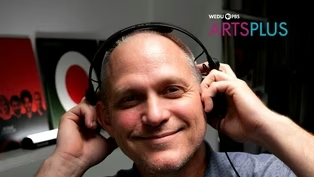
Clip: S13 Ep1 | 6m 48s | Disc Jockeys based in St. Petersburg share the art of mixing music and connecting. (6m 48s)
Providing Support for PBS.org
Learn Moreabout PBS online sponsorship

- Arts and Music
The Best of the Joy of Painting with Bob Ross
A pop icon, Bob Ross offers soothing words of wisdom as he paints captivating landscapes.











Support for PBS provided by:
WEDU Arts Plus is a local public television program presented by WEDU
Major funding for WEDU Arts Plus is provided through the generosity of Charles Rosenblum, The State of Florida and Division of Arts and Culture and the National Endowment for the Arts, and the Hillsborough County Board of County Commissioners.