WEDU Arts Plus
1304 | Episode
Season 13 Episode 4 | 26m 46sVideo has Closed Captions
Archbold at Wild Space Gallery | Ruth Gilmore Langs | Milwaukee Rep | Mahkwuhoo Meditation
Art, science, and nature are combined and exhibited at the Wild Gallery Space (St. Petersburg). See the works of abstract expressionist artist Ruth Gilmore Langs. The Milwaukee Repertory Theater's Professional Training Institute prepares the next generation of stage performers. Learn the art of meditation through an indigenous guided meditation philosophy created by Paiute person Brian Melendez.
Problems playing video? | Closed Captioning Feedback
Problems playing video? | Closed Captioning Feedback
WEDU Arts Plus is a local public television program presented by WEDU
Major funding for WEDU Arts Plus is provided through the generosity of Charles Rosenblum, The State of Florida and Division of Arts and Culture and the National Endowment for the Arts, and the Hillsborough County Board of County Commissioners.
WEDU Arts Plus
1304 | Episode
Season 13 Episode 4 | 26m 46sVideo has Closed Captions
Art, science, and nature are combined and exhibited at the Wild Gallery Space (St. Petersburg). See the works of abstract expressionist artist Ruth Gilmore Langs. The Milwaukee Repertory Theater's Professional Training Institute prepares the next generation of stage performers. Learn the art of meditation through an indigenous guided meditation philosophy created by Paiute person Brian Melendez.
Problems playing video? | Closed Captioning Feedback
How to Watch WEDU Arts Plus
WEDU Arts Plus is available to stream on pbs.org and the free PBS App, available on iPhone, Apple TV, Android TV, Android smartphones, Amazon Fire TV, Amazon Fire Tablet, Roku, Samsung Smart TV, and Vizio.
Providing Support for PBS.org
Learn Moreabout PBS online sponsorship- [Announcer] This is a production of WEDU PBS, Tampa, St. Petersburg, Sarasota.
- [Gabe] In this edition of "WEDU Arts Plus," an exhibition where art, science and nature collide.
- It gives a perspective of how many levels that nature can give us, and how much we are connected to nature.
So, scientists are artists in themselves, and what they produce, and we put that on display here.
- [Gabe] The energy of abstract expressionism.
- [Ruth] It's not unnatural for an artist to burst out into abstract painting because what you're doing is you're losing an image, and it becomes all about shapes and colors.
- [Gabe] A Theater's Professional Training Institute.
- [Chad] It's really great to watch these kids come together, and they come from a wide range of diversity in all aspects.
And over the course of months, you see them gel as a group.
- [Gabe] And the spiritual art of meditation.
- [Brian] The basis of the meditation is community, family, and their engagement with the land that they're on.
- It's all coming up next on "WEDU Arts Plus."
(bright upbeat music) Hello, I'm Gabe Ortiz, and this is "WEDU Arts Plus."
Located in the Warehouse Arts District of St. Petersburg, the Wild Space Gallery aims to raise awareness about conservation issues in Florida.
The gallery's latest exhibit explores the relationship between nature and humanity in "Timeless: Art, Science and Nature' at Archbold Biological Station."
(sonic music) - The best part of my job is being able to see the things that would otherwise be mysterious.
The natural world is cryptic, it's right under our noses, but we often don't understand what we're seeing.
And I love trying to understand what we're seeing, and I love to try to be close to the things that are mysterious to us.
Archbold Biological Station is an independent science organization.
It's a field station that is based in Highlands County, Florida.
It's designed to host long-term ecological research.
So, by long-term, I mean decades long.
Artists, scientists, educators, come from all over the world to Archbold to try and understand and get a glimpse of the very unique, highly biodiverse ecosystems that Archbold hosts and understands and collects data on.
(soft orchestral music) - The Wild Space Gallery is opened by the Florida Wildlife Corridor Foundation.
The foundation is a collaborative mission to save the Florida Wildlife Corridor.
So the corridor is 18 million acres of connected landscape and waterways that support wildlife and us people here in the state of Florida.
- Wild Space Gallery is established to really, I guess to bolster and get out the message of the Florida Wildlife Corridor.
- From our beginnings, we have incorporated storytelling and also artwork.
Our founder, Carlton Ward Jr. is a National Geographic photographer.
And through his images, he has and continues to raise awareness of the Wildlife Corridor.
And so, here at the Wild Space Gallery, we hope to bring that piece of art and storytelling that has been the true vein of our values and our mission from the beginning, and spread it to the people to bring more awareness of the corridor.
- There's a strong relationship between science and art.
And so, in some ways that's the inextricable link between science and art, that creative mindset is what fuels both scientists and artists.
And often you find those skill sets and those sensitivities in the same person.
And Archbold's very lucky that we attract those types.
(bright orchestral music) - The title of this exhibit is "Timeless: Art, Science and Nature' at Archbold Biological Station," and each piece connects to that in some way.
- I'd have to say that my favorite piece is the "Ant Lab," which it sort of reproduces the workspace of Dr. Mark Deyrup, who is a entomologist and has been studying ants in Florida since 1982.
And so his area is, I could never decide if it was an artist studio or a scientist laboratory.
- We have microscopes and you can see the little hairs on the ant, so it brings in the science down to really small level.
And then you have the wood cut prints that show the landscape, and it pulls you back, it pulls you in and it pulls you back.
And the farther you stand away from it, the more 3D it looks.
Then we have the people in the field too, that do the art, science, and are in nature.
So, it combines all three, and it gives a perspective of how many levels that nature can give us, and how much we are connected to nature.
So, scientists are artists in themselves and what they produce, and we put that on display here.
(bright orchestral music) - A lot of different kind of artists and scientists have worked at Archbold over the years.
When I think of the most unusual would be Evelyn Gaiser.
And Evelyn is a professor, she's a limnologist.
Limnologist means one who studies fresh water.
There's a lake at Archbold called "Lake Annie."
And so, over a year's time, she studied the temperatures in Lake Annie, and she is also a classically trained musician.
So, she looked at those data points and she said, "Huh, that looks kind of like a musical score."
So basically, she created a musical score from using the data points.
It's curiosity, it's passion for figuring out what's going on.
It's a leap of imagination.
So, I think that scientists and artists have that very much in common.
Evelyn's work sort of exemplifies what happened there.
- Archbold is embedded in the corridor, and the values of that landscape and the values of the people in that landscape are sort of distilled in the art that you see here.
- [Liz] What we do here at the gallery is, is try to connect people through arts to nature, no matter where they're from.
- [Joe] But our hope is that you can get that little boost of inspiration and curiosity to take you out to the field to try to experience it.
(bright epic music) Ruth Gilmore Langs is an abstract expressionist.
In her vivid artworks, she favors texture, color, and shapes.
We visit the artist in her studio gallery to find out more.
(brush scratching) - I love color, it seems to talk to me when I work.
My name is Ruth Gilmore Langs, I'm an abstract painter.
And my studio gallery is in Islamorada, Florida.
I think that the keys are unique in their light.
The light is very different here.
It's very ultraviolet light, and that's an inspiration.
As an abstract expressionist, I love painting large scale.
I love thick paint all the way.
Thicker the better.
I use a lot of texture, definitely.
I used to be a weaver when I was younger, and I loved the texture in fibers, and I think it's translated into the painting.
(bright orchestral music) It's not unnatural for an artist to burst out into abstract painting because what you're doing is you're losing an image, and it becomes all about shapes and colors.
And for me, I see it as a very high form of expression and extremely challenging because you're losing the trees and the ocean and trying to emote and communicate through brushstroke, color, paint, energy.
In my heart and in my soul, I'm a storyteller.
And however I, whatever medium you land on as an artist, it's storytelling.
(bright downbeat music) If we're lucky, we get to show.
And showing is a completely different thing than painting and working.
So, suddenly you've been working alone and working alone and focusing on your topic, and then you move it into a studio, and hopefully have a really big fun party.
I pick themes and then I follow them, and that's true for the USA series, I've been following it for 20 years.
And one of the things about following a story is it started with 9/11 and the shock of that, the shock the whole country had, the whole world had with that.
And then to follow that series into what America is today, there's a story there.
And I'm telling it through shapes and color.
And what it's saying is gonna be everybody's eyes and ears to figure that out.
For me, that painting is a victory because I'm, was trying really hard to express the beauty of America, the rivers, the sunshine, the land, the expansiveness, all the while with the limitation, which isn't that big of a limitation, but I was on a 10-and-a-half foot canvas trying to express our huge nation.
(bright downbeat music) The second piece to the USA series, which I started after 9/11, is probably the darkest piece in the series, mostly because it's black and white.
It's a repetition of USA and the numbers 11.
And as I began repeating the numbers 11, it became obvious to me that that represented the Twin Towers.
(soft orchestral music) I, myself, have come to see the paintings as mirrors, and they're a reflection, and I think they'll offer whatever needs to be offered to each individual person.
Because we bring ourselves as much as anything to these paintings.
They will give out, but you bring yourself.
And everybody's gonna bring their own history and their own story, and their own feelings about America, no matter where you're from in the world.
And I think these paintings are an attempt to express it through abstract expressionism.
How lucky is that, that that's my tool?
(soft orchestral music ending) In Wisconsin, the Milwaukee Repertory Theater's Professional Training Institute prepares the next generation of performers.
The program gives local high school students the chance to work on their craft, pursue their interests, and express themselves.
- You guys got it?
- [Person 1] Yes.
- [Person 2] Yeah.
- Yes, yes, yes!
- [Chad] Theater is a collaborative art form.
(eerie music) Milwaukee Repertory Theater is the state's largest theater.
We serve 200,000 people annually, including 20,000 students to create positive change, using world class theater experiences that entertain, provoke, and inspire an audience representative of Milwaukee's rich diversity.
- Of course, I know how to recruit!
And I'll prove it with my first recruit, Hank Raymonds!
And I don't ever worry about the other team, all I care about is what my guys are gonna do to them.
- The Professional Training Institute was launched last year mostly because as we were looking at our new strategic plan, we knew that we had a responsibility as the state's largest theater to create and develop talent within the state.
Wisconsin has some of the most talented teenagers I've ever seen in the country.
And so, they come in and they train with our artist for nine months out of the year for free.
And then at the end of that program, we hire them as paid professional actors, and they produce their own show with the highest production standards that we would have for any other production that we have here at The Rep.
So, they get to interact with some of the best artists in the world that are Broadway, on the West End, and touring, and they get the best of instruction all for free.
And then they work as paid professional.
- My name is May Adrales, and I'm the associate artistic director at The Rep.
I'm working with the students today to work with them on devising theater.
We're gonna start first with what makes a play?
What makes dramatic action?
What is dramatic action?
What does it mean to have an event in a play?
And also, what is character?
For character, think about like, their circumstance, right?
We'll be working straight up on our feet.
I wanna work with them as an ensemble.
A lot of company-driven devised work really begins with no script in the room, not a table.
But with the interactions with one another, and people's imaginations just bouncing off of each other.
We will do a set amount of improvs, and I'll be able to give critical feedback, and also help students also articulate their thoughts about the work in front of them.
- [Chad] It's really great to watch these kids come together and they come from a wide range of diversity in all aspects.
And over the course of months, you see them gel as a group.
- How are we doing?
- I got this, I got this, okay!
- [Chad] We're looking for geographic diversity, we're looking for ethnic diversity, we're looking for talent diversity.
- [Dominic] My name is Dominic Schiro, I'm a senior and I go to Pius XI High School.
- [Mainyia] My name is Mainyia Xiong, and I am a senior and I go to Menomonee Falls High School.
- To have a program like this that focuses on kids, this is really good for those that are looking to improve their craft without it either seem childish or like way outta their league, yet like college graduate kind of stuff.
- The first time we all met each other, it just clicked right away.
So, it was really nice to work with a group of kids that are willing to put themselves out there and all equally unique in talent.
- Oh my gosh, there's no water left!
- So, we take the best of the artists that are in our productions, and we have them teach classes based upon their specific skillset.
- By the end of this class, we're gonna actually devise our own piece of theater, okay?
But first, what I wanna do is just talk to you about what makes a play.
- So, over the course of nine months, the idea is, is that they get a breadth of experience from our different professionals from all over the country that come from different backgrounds and they train in different areas.
- Well, the workshops, they're very touch and go on a lot of different subjects.
So like, we did a whole thing on movement while just the, for the hour before, we did a whole thing on songwriting.
And a few weeks ago, we did one about auditioning, like how do you audition with songs, and like what to do and what not to do.
And it was really, it was really useful.
- Do you get real experience from the outside world and from the career that you wanna be in?
It gives you like a great insight of what your future may look like.
- I'm gonna give you a scenario, I'm gonna give you a play, and you guys are gonna create.
I'm gonna give you the script, and you guys are gonna give me a play.
- It was remarkable how like they, we were seen as essentially equals.
And I was like, but this is just such a welcoming space and it's amazing.
- I'm usually like a really shy person and just closed off.
But this has really helped me boost my confidence and made me realize that it's such a great thing to work with other people.
And that bouncing ideas off of one another, and just depending on one another is a great thing to have.
- Anytime you can teach a young person how to more freely express themselves, the healthier the society will be.
So I feel like it's of critical importance to actually introduce theater at a young age.
(indistinct) - We're relying upon her expertise as an artist, and that's what she's bringing to the table, particularly with these young kids and the shows that she's directing.
And she's got an infectious passion for the art, which is hard to deny.
- Because at the beginning, also, you get a whirl, you establish character.
And middle, there is an event, there is action.
And then the third is a resolution, okay?
So there, we've dissected what a play is.
They may not know what a director does, a lot of people don't.
And so, I think it's important to show them this other aspect of the theater that's not just performance on stage.
That there are writers and designers and directors that are shaping the story.
So I think that my role is to show them a little bit about the creation side of theater, not just the performance.
In this dystopian world, the earth fights back, right?
(May laughing) Because there were some sinister, look, there was a sinister hill, right?
They came and they were basically chuckled, they laughed at Jack and Jill's demise.
- Whatever we can do to develop the state's talent is gonna be great because we want these students to go out into the world to get their training and hopefully come back to Wisconsin and continue the great tradition of Wisconsin-based actors.
- I want them to come away with a feeling of accomplishment.
I want them to be able to push themselves and be able to try out new ideas and in front of a lot of people and take some risks.
- What happens in a lot of training programs is theater is seen as a very subjective, like this is how theater is done.
And this program, there's a bit of that in there, but then they just let you go, and they take everything you learned and it becomes more of an art.
- Having something really close to home is really nice because you don't have to travel that far.
And it's nice to have like a local community that you can go to and express this art form with other kids.
- So they develop together as a cohort, and then that skill as a group is shown through in their performance together at the end of the program.
So, I love seeing how the group gels, and then how they push each other to grow, and they get better as a group and they leave better at the end.
- [Mainyia] I love it, it's such a good opportunity to work with other kids just like me.
- [Person] Too harsh and precise.
So much destruction caused by one fight.
(bright orchestral music) - Discover more at milwaukeerep.com.
Brian Melendez is the creator of Mahkwuhoo, an indigenous guided meditation philosophy.
Travel to Nevada to learn more about the spiritual art of meditation and its ability to reconnect us to the earth.
(sonic music) - The meditation that we're gonna do today is called Mahkwuhoo.
And Mahkwuhoo in my language, which is the Paiute language, it's pretty a literal translation that means something which is already done.
We're gonna come together as family and community, sit on the ground, we're going to focus and we're going to ask the spirits of our ancestors to guide us and teach us lots of things and connect back to the earth.
And then I'm going to share with you some really old ancient songs from my people, just to give you a little bit more of a boost to walk into the world and feel good.
That's a...
I, myself, am a Paiute person from this valley.
So the belief systems that I have, and my culture and my language and my understanding is connected to the great basins connected to this valley.
So this is the most localized indigenous practice that we can have in our valley, 'cause it doesn't, it's not imported from other places, it is very much us here.
What I do, and as far as Mahkwuhoo meditation, is I take my understanding of my community and then compile all of that, like the essence of who we are as far as what our spirituality might be, and then create something and then provide it to all people in the form of meditation.
(bright sonic music) I'm able to crosswalk every single thing that is something that maybe a person of the great basin may have, and take it from like the tribal space, from the reservation, and bring it out into non-tribal spaces.
And when I'm in non-tribal spaces, I'm able to share it in a way with all people of the world because the basis of the meditation is community, family, and their engagement with the land that they're on.
A lot of the people that come here, they come by themselves, and they don't know anybody.
So, when they get to be here, and when they get that experience at the end where they get to hold hands and they get to hug, and they get to have this experience.
And I've seen so many people leave here making a friend, and then they come back, and all of a sudden those circles get bigger and stronger.
And then there's more cohesive experiences for people.
- Brian reminds us that we don't have to do this alone.
We can pray and bring it to ceremony and meditate, and be reminded that we're here all doing this together.
(Brian chanting) (percussive music) - And the singing and the drumming is, it's really beautiful because they have so much meaning to us.
There's songs of about people being born or there's songs about the water, they're stories.
So, it's our oral tradition and story coming out in song form.
And so, there's different rhythms and different harmonies and different words and different purpose and intention.
And so, when we're doing this, that's what we're doing it for, is to raise the energy even more.
So for us to have the drums and the noise and the loudness and kind of shake you a little bit, that's what we're after.
We want you to be just a little unsettled, and just kind of remember that there's a lot of energy and a lot of power in the world, and we're just a little part of it.
(Brian chanting) (percussive music) There are tribal people who still very much live here.
And so, I use the opportunity to have meditation to educate people as to the tribal belief systems that are already existing on the land.
The people that are here venturing in the city, they should understand and know that there are 27 federally recognized tribes in the state of Nevada.
And that we still very much have language and culture and tradition, and we have our connections back into these areas, and that we're very much here and we're not going anywhere.
So that's why I use meditation because it's a really neutral vessel for me to take something and share something of my identity and culture with people from other different cultures in the world.
And they will be able to extract in, absorb a lot of what I'm saying in their own way, in their own understanding.
(Brian chanting) (percussive music) - It's an art of how both the guide is an artist.
But I think I also become an artist.
I'm creating myself in the course of this ceremony or the course of this ritual, where I feel I'm an artist of my own consciousness.
And that's a powerful thing.
(Brian chanting) (percussive music) - I try to invoke the spirit of my ancestors, my connection to the land, who I am, to give me insight and to give me direction as to what I'm to create next.
Because I very much believe that my job in this earth is to be a person of service.
So, I don't think about the things in which I create solely just so I can have it and I can feel a certain way.
I feel that what I'm here to do is to provide a service back to the world.
My art has to be a reflection of the message in which I'm trying to leave this world, because I have no desire to create art that doesn't help people.
I wanna be the kind of artist that, that if I did something, it's because it took all of the momentum of my community and family to help me to do that.
The art that I created came from a really beautiful, sacred place, and that's what I'm trying to do.
- Visit lucentree.com to learn more.
And that wraps it up for this episode of "WEDU Arts Plus."
To view more, visit wedu.org/artsplus, or follow us on social.
I'm Gabe Ortiz, thanks for watching.
(bright upbeat music) (bright revealing music)
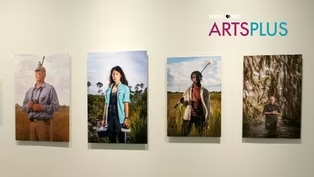
1304 | Archbold at Wild Space Gallery
Video has Closed Captions
Clip: S13 Ep4 | 6m 22s | The Wild Space Gallery highlights the interconnection between science, art, and nature. (6m 22s)
Providing Support for PBS.org
Learn Moreabout PBS online sponsorship

- Arts and Music
The Best of the Joy of Painting with Bob Ross
A pop icon, Bob Ross offers soothing words of wisdom as he paints captivating landscapes.











Support for PBS provided by:
WEDU Arts Plus is a local public television program presented by WEDU
Major funding for WEDU Arts Plus is provided through the generosity of Charles Rosenblum, The State of Florida and Division of Arts and Culture and the National Endowment for the Arts, and the Hillsborough County Board of County Commissioners.