WEDU Arts Plus
1306 | Episode
Season 13 Episode 6 | 26m 34sVideo has Closed Captions
Emily Tan | Bach Society of Dayton | Industrial Aesthetic | Roadside Art
Painter and performance artist Emily Tan of Tampa uses the arts to express her subconscious and explore her Asian-American identity. The Bach Society of Dayton honors seven centuries of classical and contemporary music. An exhibition in Pembroke Pines, FL, explores the industrial aesthetic. A program through the Nevada Department of Transportation works to decorate the state's highways with art.
Problems playing video? | Closed Captioning Feedback
Problems playing video? | Closed Captioning Feedback
WEDU Arts Plus is a local public television program presented by WEDU
Major funding for WEDU Arts Plus is provided through the generosity of Charles Rosenblum, The State of Florida and Division of Arts and Culture and the National Endowment for the Arts, and the Hillsborough County Board of County Commissioners.
WEDU Arts Plus
1306 | Episode
Season 13 Episode 6 | 26m 34sVideo has Closed Captions
Painter and performance artist Emily Tan of Tampa uses the arts to express her subconscious and explore her Asian-American identity. The Bach Society of Dayton honors seven centuries of classical and contemporary music. An exhibition in Pembroke Pines, FL, explores the industrial aesthetic. A program through the Nevada Department of Transportation works to decorate the state's highways with art.
Problems playing video? | Closed Captioning Feedback
How to Watch WEDU Arts Plus
WEDU Arts Plus is available to stream on pbs.org and the free PBS App, available on iPhone, Apple TV, Android TV, Android smartphones, Amazon Fire TV, Amazon Fire Tablet, Roku, Samsung Smart TV, and Vizio.
Providing Support for PBS.org
Learn Moreabout PBS online sponsorship- [Announcer] This is a production of WEDU PBS, Tampa, St Petersburg, Sarasota.
(cheerful music) - [Dalia] In this edition of "WEDU Arts Plus," a local artist expresses herself through multiple disciplines.
- So I think my art, it's not really the Asian part, it's more of the mixture.
- [Dalia] An accomplished musical ensemble.
- The Bach Society of Dayton is really all about choral excellence and bringing that to the local community.
And I also think it's about being able to create collaborations with other groups within the community.
- [Dalia] The industrial aesthetic.
- [Taryn] This is a very sculpture-centric show.
And each of these pieces will likely look very different according to the differing context that they're presented in.
- [Dalia] And art on the roadside.
- [Meg] It's really a beautiful thing to see our community's culture and history represented right there as you're driving.
- It's all coming up next on "WEDU Arts Plus."
(cheerful music) Hello, I'm Dalia Colon and this is "WEDU Arts Plus."
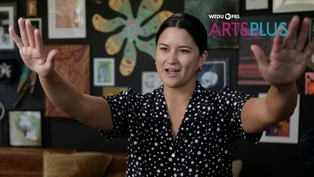
For painter and performance artist, Emily Tan of Tampa, the arts are a way to express her subconscious and explore her Asian American identity.
(soft music) - Before I even knew what mental health was growing up, I used art as a therapeutic medium.
My name is Emily Tan.
I am an abstract painter, art teacher, paint performer, and I also DJ.
(soft music) Growing up on Long Island, I was a child of a Slovakian woman and a Chinese and Filipino man.
And my mom had two children before I was born, so they were white and I was the little mixed baby.
And I don't know if that was an identity crisis right away, but I think it's what started the search.
I started painting, and drawing, and chalk on my entire driveway, like on every Sunday and Saturday.
I think now the work I've been doing is more childlike.
I was able to tap into that inner child and I'm using different symbols and things that I used to draw on my planner growing up, but now I'm putting them on a canvas.
So it feels like a full circle type of reclaimed power in my art.
(cultural music) The daisy and the mandala symbols are huge in my new work.
I recently did a mural for Cocoon, which is a yoga studio in Tampa.
- So a mandala is something that you can gaze at and it becomes a way to quiet the mind and invoke certain energy.
And this mandala, specifically, is a mandala for abundance in all of its most positive ways.
In peace, in spiritual attainment and wealth, all the good things.
And what's essentially a yoga practice, in and of itself, to gaze at a mandala in meditation.
- Every summer, I teach summer art camp at the Tampa Museum of Art.
- Emily as an art instructor, is super enthusiastic, and warm, and encouraging.
When you walk into that space, you're just hit with all of this creative, positive energy.
It's like a whirlwind in there.
(laughing) If you've seen her process, you know she's not the neatest artist.
You will always find like some bit of paint somewhere around her from a project.
So that's the same vibe you get in her classroom, but the students really, really respond to it.
(upbeat music) - The other part of my art that I love doing so much now is the paint performances.
- I love that Emily approaches her art like a yoga practice.
And that she is devoted to it.
And we've been watching her work.
Her working is an art form.
It's beautiful to see.
(upbeat music) - So I go by DJ Emmy.
My boyfriend Skyler, he DJs, and he taught me, you know, the basics.
(upbeat music) But it is interesting because music has always inspired my art.
And now I feel like the art is getting to influence DJing.
So it's kind of like a energetic push and pull back and forth.
(inspiring music) - It is really exciting to have started to work with Emily when she was an undergraduate at University of Tampa.
To get to know a young artist at that age and see them grow, it's just been really great to have almost like a front row seat to see to her growth.
And I'm really, really excited for what happens next with her and what more she could bring to the Tampa Bay art community.
(inspiring music) - So I think the way I bring my identity in, which I just recently started doing, but I like to call myself like the whitest Asian.
Because growing up in New York, I really didn't have any, any cultural background.
So my dad was raised in New York, my mom raised in Harlem.
And we were just a very like basic, we're not gonna do any of the cultural, maybe Chinese New Year, but besides that, that was it.
So my grandma gave me my cultural background, the little bits of it that I'm so grateful for.
And my grandma speaks Tagalog, she's from the Philippines.
She's awesome.
I love her.
She'd bring me to Chinatown, like we had the best times, but that was really it.
(upbeat music) So I think my art, it's not really the Asian part, it's more of the mixture.
So like blending two worlds and being in this world as someone that I didn't really have a example of growing up, I never really saw a mixed person growing up.
So I think that is my identity going through and that is what I try to convey in my art.
(cheerful music) What would I say to little Emily?
I would say, don't worry, you're gonna be okay.
There will be people that you can look up to and there are people that exist now.
You just have to find them.
So, I think I found them.
I think I am her now.
(laughing) (cheerful music) - See more at emilytan.art.
In Ohio, the Bach Society of Dayton honors seven centuries of classical and contemporary music.
This group of volunteer singers join together and embrace the power of song in their performances.
(orchestral music) - [Marc] And I think a lot of people will tell you, Bach's not my thing, or classical music isn't really my thing.
- Okay, here we go, begin.
- We wanna challenge those assumptions.
(orchestral music) This is music that was written for kings, for royalty.
Come and listen to some of the greatest music ever written and maybe what you find is something that really you needed that you didn't know you were missing.
The Bach Society is kind of a unique organization.
It is made up of entirely volunteer singers, but we pride ourselves on singing at a professional level.
We come from, literally, from all walks of life.
And I like to think that we're filling a niche in the Dayton area that isn't already filled in terms of classical music.
- The Bach Society of Dayton is really all about choral excellence and bringing that to the local community.
And I also think it's about being able to create collaborations with other groups within the community.
- The mission of the Bach Society of Dayton is to perform and promote the appreciation of choral music, both sacred and secular, and to nurture the next generation of choral singers.
- I think no matter what age you are, we all love music.
The main criteria for anybody is just if you wanna sing.
I didn't ever feel any sort of pressure or any sort of constraint because I was younger.
It was just, I wanted to sing just like the person next to me who might've been older than me or not.
All sorts of people are members of the choir.
(orchestral music) - It is not only Bach, we perform a lot of Bach, but we also perform music of Mozart, and Haydn, and Handel, folk songs, spirituals, some acapella.
We also want to provide variety in our concerts and so we do collaborations.
We bring in dancers, we bring in choirs of young singers, brass groups.
- Other cities and countries do have their own Bach societies and they're all just a little bit different.
But we're all, again, a little bit alike.
We all kind of have a common thread about choral excellence and this beautiful music and keeping it alive through the generations.
- Johann Sebastian Bach is probably the greatest composer.
Now I'm gonna get a lot of pushback on that, but his music is timeless.
- His music is so compelling and he was so inventive.
Sure you can say, okay, Mozart was the next generation and he looked to Bach as an inspiration.
But every musician since then has drawn on Bach's techniques, his instrumentation, his use of harmonies and counterpoint.
Those are all found in Western music ever since.
You'll find those influences through jazz, hip hop, heavy metal music.
If you talk to real musicians in those genres, a lot of them have actually been inspired by Bach's works because they're so methodical and reliable and so very vital.
(orchestral music) (audience clapping) Four times a year we'll have concerts at the Kettering Adventist Church.
Not everybody can make it to a concert, so we try to do a little bit of outreach.
- [Host] Tonight's anthem is being performed by the Bach Society of Dayton.
♪ Oh say can you see by the dawn's early light ♪ - One of the projects that we started a couple years ago is called Sing Dayton.
(bell tolls) We'll go to a small venue.
The idea is to bring people from the community to come and enjoy socializing and singing.
There's zero requirement that you know how to sing, that you know how to read music.
♪ What would I do without your smart mouth ♪ - [Marc] And we're not doing lofty music.
We'll do pop songs and we'll sing for a little bit and then we'll take a break and have a beer together.
I think it's really special and I think it really taps into a need.
And not everybody can be a Beyonce and not everybody can sing the high notes with Aerosmith, but certainly not everybody's accustomed to singing Bach either.
We just want people singing, a joyful, soulful activity.
(solemn music) - I was in Bach Society during my gap year.
I loved getting to experience all sorts of new music.
I don't think "St Matthew's Passion" was necessarily on my Spotify playlist, but singing it made me love it all the more.
(orchestral music) - I love music that I've never sung before and struggling with it, and learning it, and rehearsing it, and then, all of a sudden, this amazing thing happens.
I don't know how it happens in your brain, but then your brain just figures it out.
Especially stuff where we're singing in a different language and it's really challenging pitch and really challenging with rhythm.
And then it, all of a sudden, it just comes together into this beautiful masterpiece.
And when that happens, that moment, that is, that's the thing I love the best.
(orchestral music) It is amazing.
It's thrilling, it's satisfying.
I don't know that you can really get that anywhere else.
You know, coming together as a group.
All of us from different walks of life, different occupations, and we work really hard and then there we are.
And then you create this beautiful thing and the audience is just, you can tell we're moving them.
There's just nothing like it.
It's just indescribably wonderful.
And you may not know Latin, you may not know German, you may not know the piece, but I said, you are just really gonna be blown away by this.
- [John] Just give us a try.
Just come, come one time, and you'll be hooked.
You'll wanna come back.
- For more information visit bachsocietyofdayton.org.
The exhibit, New Industry, Contemporary Visions of the Industrial, explores the industrial aesthetic.
Located at the Frank Gallery in Pembroke Pines, the show features artwork that reflects on mechanics and the urban scape.
(digital music) - [Taryn] New Industry is really inspired by urban architecture, industrial engineering.
We're really looking to a lot of very exciting South Florida artists to utilize these everyday construction materials in new and innovative ways.
- I was exploring the human figure.
I was trying to simplify it in a way where I use three simple lines of different thicknesses to embody the human figure.
My name is Norman Silva and I'm an artist.
This is by far my largest exhibition.
(digital music) This piece is called Alone.
These pieces of steel came from my backyard.
So I cut them up, I added a little bit of a neck in here and I created a person, a human figure in the simplest way.
Three lines, different thicknesses, different textures.
The reason why it's called Alone is coming from that saying, being alone in a crowd.
This particular person, within the piece, if you notice it has a little shinier head than the others.
So it kinda stands out a little bit.
Even though it is within all of the rest of the people in there, it feels alone.
If you look around, you could start seeing different personalities in the other people within the piece.
Like this couple, there's an older lady, I like to say.
There's another couple over here gossiping.
So there's a crowd, a scene is happening within this particular little piece.
My current series of sculptures are basically an outlet from my inner architect.
I love the materials that I'm using right now, the wood, the concrete, the steel.
- There's definitely a tradition from Modernism onwards of being very, very conscientious about the materials that we use in fine art.
So the show really does that in a very beautiful and lyrical way.
I am Taryn Moller Nicoll, and I'm the Chief Curator here at the Frank Sea Ortis Art Gallery and Exhibit Hall in Pembroke Pines.
More rugged materials, such as weathered wood, have been placed in beautiful symmetrical formations, such as Norman Silva's.
And then we have everyday materials, like concrete being used for bases.
It definitely challenges what people expect to see from a contemporary fine art piece.
(magical music) - I love admiring buildings and I see them as giant sculptures.
I see them as pieces of artwork.
You could look at some of the buildings downtown Miami that are incredible.
And you look at them and they could be, in a smaller sense, could be put as sculptures in a gallery.
- The most exciting elements of the show is the heavy emphasis on three-dimensional pieces.
This is a very sculpture-centric show, and each of these pieces will likely look very different according to the differing context that they're presented in.
So in this gallery space, in particular, we really emphasize lighting.
So there are many different shadows that are cast, there are changes in depth, as we view the works from differing angles.
It's also a way that the artist releases control.
It can form the work up to a point, but after the work leaves their studio, they're really placing a lot of trust in the curatorial team to showcase their work and tie it to an overarching idea in a very provocative way.
The Frank is about two years old.
We have a year round open call to artists.
We really do invite every single cultural producer to submit their work here to the Frank.
We want to see what people are making.
So regardless of their level of professionalism, whether they're just starting out, or they're seasoned, lifelong artists who really have honed their practice, we encourage everyone to submit their portfolio to us and keep us abreast of what it is that they're working on.
- [Norman] The way in which I create, either comes from an idea at first that I sketch down, or from something that I pick up and see something in it that inspires me to create something out of it.
- Walking down the street, we're on a sidewalk and we see cracks and imperfections in the concrete.
Maybe after seeing an exhibition like this, we have more of an appreciation for these little details in our lives and we're able to see things slightly differently.
- Discover more at thefrankgallery.org.
The Nevada Department of Transportation's Landscape and Aesthetics Program strives to decorate the state's highways with creative public art.
Working with architects and designers, the team renders roadside sculptures that connect with the surroundings.
(digital music) - Imagine driving through the Nevada desert and you reach an area where you see beautiful cultural symbols rising from the roadside.
You see a windmill representing the ranching history in this area of South Reno.
Perhaps you're on the Carson City Freeway and you see symbols that are symbolic of the Native American culture there.
It's really a beautiful thing to see our community's culture and history represent right there as you're driving.
You can find these landscape and aesthetics features on many of the highways, at many of the on and off ramps maintained by NDOT across Nevada.
Our NDOT mission is ultimately to keep Nevadans safe and connected.
And landscaping aesthetics is a vital part of that.
(upbeat music) NDOT Landscape and Aesthetics Program is a longstanding program to bring both the aesthetic, and environmental, and cultural benefits of landscape and aesthetics to our highways.
- We'll start with analysis of the site.
Where are we designing and what are we designing for?
We look at the environment.
There might be some environmental challenges, like a lot of storm water runoff, erosion.
So we'll look at all these things, as well as the culture and the history.
And that's what we're really after, is to develop this theme that is suitable for the area.
And looking for that inspiration through culture and history and the stories that we hear from people in the community.
The next steps are getting help from landscape architects.
That takes the theme and the idea that's in our heads, and then can translate that into a drawing and a plan.
(upbeat music) - When it comes to the Department of Transportation and the public art that we do for them, we'll get some CAD files from the DOT.
We really look at the drawings, we have to manipulate it and make it constructable.
And then we submit that back to them and go, hey, does this work for you?
(upbeat music) I really like to work with my hands.
I like to make things.
I enjoy taking something as rudimentary as a piece of steel and creating something really refined out of it.
The things that we build, they're big.
They are fun to build.
And, oftentimes, when we're here in the shop and we're building it, and I don't have that sense of place, if you will, 'cause we're here on Fourth Street.
But when you stand it up and you set it there and you look at what's really happening around, you go, that's nice, man.
You know, like you can see that from a bunch of different angles.
It has a lot of depth.
It's good.
I think the most exciting moment for all of us here at the shop is getting it on a crane and getting it in the hole.
- I really like this spot here at Damonte We wanted to express the ranching heritage and the Reno rodeo that we all enjoy.
And coming up with a sculptural piece that represents that with a female roper and the calf and the ranch style fencing.
This theme was really well communicated in a very exciting sculpture here that we are fortunate to have artist and fabricator Paolo Cividino take these unyielding heavy materials like steel and really bring life to them and movement.
- Besides the aesthetic value of highway landscaping, there's also really tangible benefits, including economic benefits.
The landscaping can help peak interest of visitors, driving them to stay longer or to visit our communities, helping enhance our community's tourism value.
But also highway landscaping can help employ those who might otherwise not be employed on public works projects, such as highway projects.
That includes landscape architects, landscape fabricators, and so many more who really come together to, not only provide this valuable artwork, but help produce an economic value from that as well.
(cheerful music) - We built five state monuments that are at the intersections of all the interstates.
Those were so, so fun to make.
I was just driving down 395 a couple weeks ago with my wife, and every time I do, there's a car or two, minimum, pulled over and people taking photos of themselves or their family in front of the monument that we made at Topaz.
And it feels good, you know?
And that monument is really well designed.
Seth Johnson from the DOT designed it.
He did a great job.
I think that public art, at the end of the day, I think it grounds people.
I think it gives people a sense of place.
I think it also just, you know, man, like we're going through some pretty rough stuff.
Just being able to look at something, it just sort of gives you the ability to take a breath, right?
I mean, maybe the wagon doesn't resonate with you, but maybe it resonates with the other guy.
And I think that there's something about that.
I think inherently, art, music, it is crucial to the wellbeing of our soul.
- Learn more at nevadadot.gov/projects-programs.
And that wraps it up for this episode of "WEDU Arts Plus."
To view more, visit wedu.org/artsplus, or follow us on social.
I'm Delia Colon, thanks for watching.
(dramatic music)
Video has Closed Captions
Clip: S13 Ep6 | 6m 21s | Tampa artist Emily Tan explores her Asian-American identity through multidisciplinary art. (6m 21s)
Providing Support for PBS.org
Learn Moreabout PBS online sponsorship

- Arts and Music
The Best of the Joy of Painting with Bob Ross
A pop icon, Bob Ross offers soothing words of wisdom as he paints captivating landscapes.











Support for PBS provided by:
WEDU Arts Plus is a local public television program presented by WEDU
Major funding for WEDU Arts Plus is provided through the generosity of Charles Rosenblum, The State of Florida and Division of Arts and Culture and the National Endowment for the Arts, and the Hillsborough County Board of County Commissioners.