WEDU Arts Plus
1308 | Episode
Season 13 Episode 8 | 26m 33sVideo has Closed Captions
Imperfect Harmony | Fashion Illustration | Representation in Reno | Vintage Ski Lift Art
Discover the Henry B. Plant Museum's exhibit, "Imperfect Harmony: Man, Machine, and Music at the Tampa Bay Hotel." A Detroit fashion illustrator shares her passion through skilled drawings. Painter Kelsey Rolling focuses on representation and reinterpretation in the works she creates in Reno, Nevada. Three Peak Designs in California restores vintage ski lift chairs into original works of art.
Problems playing video? | Closed Captioning Feedback
Problems playing video? | Closed Captioning Feedback
WEDU Arts Plus is a local public television program presented by WEDU
Major funding for WEDU Arts Plus is provided through the generosity of Charles Rosenblum, The State of Florida and Division of Arts and Culture and the National Endowment for the Arts, and the Hillsborough County Board of County Commissioners.
WEDU Arts Plus
1308 | Episode
Season 13 Episode 8 | 26m 33sVideo has Closed Captions
Discover the Henry B. Plant Museum's exhibit, "Imperfect Harmony: Man, Machine, and Music at the Tampa Bay Hotel." A Detroit fashion illustrator shares her passion through skilled drawings. Painter Kelsey Rolling focuses on representation and reinterpretation in the works she creates in Reno, Nevada. Three Peak Designs in California restores vintage ski lift chairs into original works of art.
Problems playing video? | Closed Captioning Feedback
How to Watch WEDU Arts Plus
WEDU Arts Plus is available to stream on pbs.org and the free PBS App, available on iPhone, Apple TV, Android TV, Android smartphones, Amazon Fire TV, Amazon Fire Tablet, Roku, Samsung Smart TV, and Vizio.
Providing Support for PBS.org
Learn Moreabout PBS online sponsorship(bright music) - [Announcer] This is a production of WEDU PBS, Tampa, St. Petersburg, Sarasota.
(bright music) - [Gabe] In this edition of "WEDU Arts Plus," an exhibition highlights the power and limitations of technology.
- We had the opportunity to borrow an Orchestrion, which is an elaborate self-playing musical instrument that replicates or was supposed to replicate an entire band of orchestra.
- [Gabe] Fashion illustration.
- [Nicole] With an illustration, you're taking an idea and recreating it into something new, something more magical.
- [Gabe] Representation through painting, - [Kelsey] I got to a point where I was like, I can just paint my representation that I want.
It kind of serves as filling gaps in places where I think they need to be filled.
- [Gabe] And handcrafted ski lift chairs.
- If they can have something that represents that sport for them year round and at their house, I think it's something that is pretty powerful.
- It's all coming up next on "WEDU Arts Plus."
(upbeat music) Hello, I'm Gabe Ortiz and this is "WEDU Arts Plus."
Music technology is constantly evolving, but as an exhibition at Tampa's Henry B.
Plant Museum demonstrates, the effects of this progress can be unpredictable.
(bright instrumental music) - The Plant Museum is this incredible space.
We're housed in, what was the Tampa Bay Hotel, that operated from 1891 till 1932.
Henry Plant built up this transportation empire that spanned the entire eastern seaboard.
It was railroads and steamships and hotels.
The building that we're in today, the Tampa Bay Hotel was the crown jewel of his empire.
All of the wealthy and famous people of the time period would've been coming here, so without Henry Plant, Tampa doesn't exist the way we think of it today.
- He very much saw that the hotel would serve the community, and so not only was there a hotel, but in the middle of the 1890s, he also established what he called a casino, which at the time was an entertainment venue, not a site for gambling, but it would have, you know, live performances, concerts, things like that and then there was an orchestra that performed daily, both in the hotel and around the community.
- If you think about it, music really was a communal activity, because there wasn't much recorded music to listen to, so you were listening to people performing it live.
So some of the well-known performers of the casino would've been people like John Philip Sousa, who brought his military band here.
Booker T. Washington spoke here in 1912, Dame Nellie Melba, who was a world famous Australian opera singer.
These are like the Beyonces of the 1890s.
We are so excited for our new exhibit.
It's titled "Imperfect Harmony: Man Machine and Music at the Tampa Bay Hotel."
This exhibit really looks at the intersection of music, technology and how that creates community, or in some cases disrupts community in Tampa.
It's a really fascinating exhibit, because at this time period we have these mechanical instruments that were brand new, that would've been very much novelties to the people who were staying at the hotel and the people in Tampa and it led to all of these sorts of questions, things like, do we still need musicians now that we have mechanical instruments that can take the place of them?
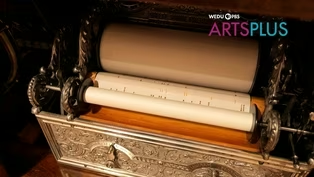
(orchestrion clicking) - The genesis of the exhibit was we had the opportunity to borrow an orchestrion, which is an elaborate self playing musical instrument that replicates or was supposed to replicate an entire band of orchestra.
(upbeat orchestrion music) Henry B Plant purchased an Orchestrion for his home at a cost of $5,000, which in today's dollars would be more than my home cost, right?
So this was the kind of thing that was really reserved for industrial elites, royalty.
Henry B.
Plant decided to actually put an orchestrion in the hotel, which meant that if you were a resident of Tampa, unlike 99.9% of the population, you could actually see one in person, but I think one of the things that is also really so significant is to recognize its limitations.
So if you were thinking about artificial intelligence now, you know, we all know those things that are tells that, oh, this photograph is fake because it's so hard to, you know, replicate hands.
An orchestrion couldn't play that long, so it would actually be, because it plays basically for the length of the roll.
So it's not as if it's suddenly going to be giving entire concerts, but I think when we look at all of the really significant ways that the Tampa Bay Hotel Orchestra served the community, which again required mobility, they would give concerts in Plant Park, a 2000 pound machine is not going to do that.
We have a variety of things that people can take a look at and they really should, because it is almost impossible to see one of these instruments much less the range that we have available.
- The mechanical violin, I believe it's called a Violin Virtuoso.
It's just amazing that they've taken an instrument and built a machine around it to play the instrument.
I would never think about that today.
(somber music) - These instruments, although technologically fascinating, did nothing to really take away from the experience of live music, because they did not sound like an orchestra.
(poignant music) - I love that we are able to tell the stories of individuals in this exhibit.
My favorite is a man named Giovanni Tallarico.
He was the orchestra leader at the Tampa Bay Hotel in 1909, and some of his family still lives in the area, but one of his grandchildren, you have probably heard of a gentleman named Steven Tyler, the front man for Aerosmith.
- The music box was definitely something that was designed for the home, certainly the well to do home, and then eventually it was replaced by the phonograph.
(upbeat music) That was revolutionary in a very different way, because by the time that you get to the 1920s, anybody can purchase a phonograph on credit and so it really changes or kind of democratizes music in a way that hadn't occurred before.
♪ That's where the people smile ♪ ♪ Smile at you all the while ♪ - So when I think about this exhibit, my big takeaway is that a lot of the questions that we are wrestling with today are similar to things that our ancestors asked about.
We're thinking about how does AI fit into music?
Well, how did technology fit into music 130 years ago?
That was a very common question and it led to this cultural moment of really thinking about and examining what is the role of a musician?
What is a role of art in our society?
And we're still asking those questions today.
(thrilling music) (gentle music) - "Imperfect Harmony: Man Machine and Music at the Tampa Bay Hotel" is on exhibit at the Henry B.
Plant Museum through December 23rd, 2024.
Get more information at plantmuseum.com.
Nicole Jarecz is a fashion illustrator based in Detroit, Michigan.
In her skill drawings, she reveals the vibrancy, beauty and spirit of fashion design.
(bright music) - I think it was really the fashion industry that inspired me to do this.
It's all about the clothes for me.
Fashion illustration is, it's like a different form of expression than photography.
You have a lot of fashion photography out there, but not a lot of fashion illustration.
So it's just a different expression of the figure, a different expression of the wardrobe, the way the wardrobe moves, it's different than design.
I'm not like designing the clothes, I'm just taking the photo or taking the person and transforming it into something new.
Before photography, there was only illustrators illustrating these ideas for magazines and then helping designers out as well.
Illustrating the figure, which was a very important part of like seeing the dress before the design was made and then, yeah, you had the illustrators who were working for Vogue or WWD.
There was a guy named Rene Gruau and he was one of my favorite illustrators and he, you know, kind of dominated that field, but unfortunately, like once photography came, it was like a quick way to seize the moment and it kind of took over illustration at the time.
I think an illustration is more special than a photograph.
I know a lot of talented photographers, but it's very like straightforward.
This is the image.
With an illustration, you're taking an idea and recreating it into something new, something more magical.
I really wanna express a gesture with my fashion illustrations.
It's more mesmerizing.
It captures like color and light and movement.
That's what really what I want to capture with my illustrations.
So sometimes I'll take a photo and I'll stylize it more.
Everything's always changed up.
It's never exactly the same as a photograph.
I focus more on the clothing when I do the illustration.
I really like couture gowns.
Couture is like a high design, a way of sewing and intricate patterns.
I like that it's telling a story in a way and I just like the whole movement of the couture compared to a street style that you might see.
(bright music) For the mediums that I use, I play around with a lot of different things.
I use colored pencil, ink, watercolor, gouache, acrylic, anything that I can find, I really like to mix it up and try different techniques.
The type of clothing definitely makes a big impact on what I use for the medium.
If I see a flowy dress, I might wanna use watercolor, because watercolor is very graceful and elegant.
So I combine a lot of digital and traditional methods together, especially when I'm working for a client for a magazine.
So I'll start the illustration off, traditionally.
I'll do like a pencil drawing and I'll do my watercolor and ink, then I scan it in and I finish it up in Photoshop and I might like do this several times to get the exact essence of what I'm trying to represent.
I've worked for a lot of different companies in fashion.
I've worked for Roger Vivier he's like a couture shoe company in Paris.
I've worked for El Magazine and Glamour Magazine, a lot of fashion magazines.
My favorite project that I worked on was for Rose Vivier.
I designed a bunch of greeting cards for him and his company and that was a lot of fun.
It was like a very luxurious brand to work for and I'd really liked to work for different brands like that.
The daily struggle that I have is to be playful and precise at the same time.
In my personal pieces, those are always the most fun for me.
So I just try to be a little bit more free.
I try to be a little bit more fluid in what I'm doing.
I think people really respond well to my personal pieces, maybe because I'm not overthinking them as much.
I think that they really like the gesture that I put into my personal pieces and the color and just the overall feeling is just more creating something that's beautiful for someone to put in their home or you know, to show to their friends and family.
I just wanna share my work with people.
Interacting with the community here is really important to me.
I started seeing illustrators doing these sketching events a few years ago, you know, in bigger cities like New York and Paris and I thought, I really wanna bring that to Detroit.
I wanna do the same thing and nobody else is doing it.
So I contacted Neiman Marcus and Saks and they were both on board and they started having me a regularly sketching.
I bring all of my supplies with me, some paper and then people just start coming up to my booth and they see me sketching.
I usually like take a photo of them or they'll stand in front of me and pose and I'll do my sketch and it's kind of like a takeaway gift for them, for the evening.
I sketch a little bit of everything.
I sketch people dressed to the nines in gowns and then I dress people in street wear.
My favorite is when people are really dressed up, it makes it a lot of fun.
I like when people are dressed, you know, bold and lots of color.
It really gives me an opportunity to get out there, talk to people, interact with them, and just, you know, see what they respond to.
It helps me to improve upon myself when I see if they react to one sketch compared to another sketch.
Well, when I started doing these events I realized that I had to be very quick.
I only have a certain amount of time to sketch somebody and I realized that I don't need to spend, you know, hours and hours and hours on one single illustration.
People really like it when it's simple and fluid and I try to bring that into my work at home to remember to keep it simple, keep it playful and don't overthink it too much.
The community loves it.
They're excited about it.
I've had a ton of support from people here in Detroit, so it's been really great.
I think that the illustration just brings a different outlook on fashion.
I think people sometimes respond more to the fashion illustration than if they were to see it in person or even on their computer screen with photography, it just brings more of a special feeling.
I don't think fashion illustration ever gets boring.
I think it's something that evolves over time.
I think my style could change again like it has in the past.
It just depends on, you know, the trends, what's going on and what I think people are responding to at that time.
(bright music) - Discover more at Nicole-jarris.com.
Up next, visit Reno, Nevada to meet Painter Kelsey Rolling.
In her visual work, she focuses on representation and reinterpretation and explores art history and pop culture.
(bright mid-tempo music) - My name's Kelsey Rolling.
I'm a painter full-time right now.
I do a lot of work that focuses on like intersectional feminism, 'cause of lack of representation.
Basically just like figurative works of women of color, I would describe my work as, with varying influences depending on what's going on in my life.
- Kelsey's a portrait artist so when we approach portraiture that third wall is completely broken, so we get to stare at the subject, spend time with the subject, which is the really impactful thing about portraiture work and the ability that Kelsey is able to have on her audience.
It's just this profound sense of like who is the subject, how can I get to know them, how can I do a little more research to understand them, especially in regards to the pop cultural references and there are history references that she has throughout her work.
- I get a lot of my ideas from looking at a bunch of things.
I'm really fascinated by, like how saturated our visual world is.
So I like look a lot at social media things, like Instagram and like see cool photos or paintings.
So it starts with getting reference images.
I use kind of mixed media.
I paint with a lot of acrylic paint as base layers and then I use oil paints to do my figures mainly so I can get like really good detail on them.
I'll pick just like a solid color that I think is like really beautiful and just kind of base the whole painting energetically around that and that's where I like start with the acrylics and then I'll do a rough sketch of the figure and then I'll paint it in with oils from there.
A lot of what makes something look real is focusing on things that you wouldn't wanna include on a face almost if you're drawing it.
I remember when I was younger, I would draw things and I wouldn't include certain shadows or certain blemishes or certain marks under the eyes that like really make something look realistic.
So I try to just focus on little highlights and different colors and shading, 'cause there's just so much variation that goes into a face and like skin tones.
I look at a lot of references, but like painting it as it's seen and not how your brain wants to see it.
I think that's made me like expand my idea of beauty in a lot of ways too, which was nice.
I just more accepting of a lot of different things, 'cause it's all just looks so beautiful to me.
(lively music) (bright lively music) - The type of response that we typically get from Kelsey's work comes from a audience that's more connected with social media.
So we get a little bit, of mostly consisting of young people, just really vibing her work, really into the subject matter she's pursuing.
- I know my art isn't necessarily geared towards a younger audience, but I think having people who look like me or can relate to me and like see me as like an artist who's just painting people that look something like them would be really nice, 'cause like that's what I wanted when I was younger so I like hope to kind of have that for people who need that as well, like regardless of how old they are.
I grew up in like a different time than it is now.
We all grew up in a time where there wasn't really like a lot of places where you'd see black people or brown people and things.
That really influenced me a lot as a kid, because I know like a lot of other people of color can relate to like wanting to look different or act different.
Growing up, it's hard when you're just like, where am I in these places?
I got to a point where I was like I can just paint my representation that I want.
It kind of serves as filling gaps in places where I think they need to be filled.
People gain an understanding and can relate to people if they like see them.
If you grew up with a bunch of people who look really different, you don't think that's weird.
If you grow up in like Reno and there's not a lot of brown people, like you don't really know how to like interact with them sometimes and like I experienced that growing up.
There's just people being like confused by my hair, confused about my parents, 'cause they're like a biracial couple.
So they didn't know, they didn't understand.
More exposure to different types of people just creates more tolerance in a way, or accepting in a way or just normalization at least.
I want people to stop for a moment, I want it to have enough detail, enough confusion in it that people like take a moment to look at it.
I'm intrigued by like personal understanding of it, 'cause I think everybody responds to everything differently given their background and given their opinions on art.
I would like them to just like question like where we see people and like how we see them and like how we interact with them and like recognize beauty in different forms, in different ways.
- Based in Truckee, California, Three Peak Designs is a company that restores vintage ski lift chairs into works of art.
Designed for homes, offices and more, these custom chairs are full of history and appeal.
(bright country music) - Three Peak Designs is a company where we source and refurbish vintage ski lift chairs.
So we source chairs most of 'em from the 1970s and kind of bring 'em back to life for people's homes.
I think repurposing things in general is a nice way to reduce waste, but also give life to something that might seem like it's run its course and so I think it's just a unique way to kind of bring a product back to life and also use it in a different way.
The ski chairs, as everybody knows, are connected to skiing and people in the Tahoe community and outside of the Tahoe community and other ski towns are obsessed with skiing and so if they can have something that represents that sport for them year round and at their house, I think it's something that was pretty powerful.
We had seen some people doing this in Colorado and my business partner, Ben, had thought, maybe his woodwork would lend itself to a project like this.
I had just moved to the Tahoe area, wasn't working yet, and he asked me if I had access to any ski chairs, so I just started emailing around town, got a hold of a couple, turned out they looked pretty cool and we finished 'em up and so we turned it into a business.
The business is mainly set up here in Truckee, Tahoe.
We do a lot of the fabrication and installation here in Truckee, Tahoe, but the woodwork is done in San Francisco where my business partner lives.
(bright country music) (sander buzzing) Ben does all of the woodwork, the new slats and the wood designs in his shop and then we bring all of those up to Tahoe and I then install them here on location and then deliver them to the customer's house, which has mainly been in the Tahoe area, but it's been as far as those in Montana.
When we get these chairs, they are what we like to call in their raw form.
So they have definitely been weathered over three to four decades.
So all of the paint is chipped off.
There is a decent amount of on these and there's a lot of work to be done if they want to be brought into the home as a statement piece.
So what we do is we strip it down to the raw metal in its original form and then powder coat it and so what they're doing there is spraying a powder onto the chair and then baking it in a massive oven essentially to get that paint powder to stick and the powder coating, the color you see on the chairs is all done in Reno at a powder coating shop.
(bright music) Our ski chairs have lived on the mountain for over three decades and they aren't really just an object.
They have a lot of memories tied to them.
They're kind of a unique place, you can meet new people.
I have no doubt that people have met their husband or wife on a ski chair.
Just being outside, being refreshed by the outdoors is something that you can kind of associate with these ski chairs and it also brings some of that nostalgia for people that have been skiing their entire lives or introducing it to their families.
I mean, all of that is happening on a ski chair and after so many years these chairs are now moving into their, we'll call it their retirement.
So they're getting cleaned up, we're bringing them into people's homes for functional art is kind of what we like to call it.
It is kind of amazing to watch these chairs end up on the front porches of people's homes.
This sport is that important to people that they wanna show that this is something they care about and that this is a skier's home.
I've been skiing and snowboarding since I was in eighth grade, so working on something like this and tying my passion with the small business that I'm running has been really, really great.
(bright music) - For more information, go to facebook.com/threepeakdesigns and that wraps it up for this episode of "WEDU Arts Plus."
To view more, visit wedu.org/artsplus, or follow us on social.
I'm Gabe Ortiz.
Thanks for watching.
(upbeat music)
Video has Closed Captions
Clip: S13 Ep8 | 6m 41s | Tech meets art with "Imperfect Harmony" at Henry B. Plant Museum. (6m 41s)
Providing Support for PBS.org
Learn Moreabout PBS online sponsorship

- Arts and Music
The Best of the Joy of Painting with Bob Ross
A pop icon, Bob Ross offers soothing words of wisdom as he paints captivating landscapes.











Support for PBS provided by:
WEDU Arts Plus is a local public television program presented by WEDU
Major funding for WEDU Arts Plus is provided through the generosity of Charles Rosenblum, The State of Florida and Division of Arts and Culture and the National Endowment for the Arts, and the Hillsborough County Board of County Commissioners.