WEDU Arts Plus
1309 | Episode
Season 13 Episode 9 | 26m 18sVideo has Closed Captions
Natural material furniture | Reflecting on rest | Mixed-media construction | Portraiture
Produced by St. Petersburg College students with WEDU, craftsmen in Tarpon Springs reveal a project with natural materials. Michigan artist Mario Moore's "Recovery" reflects on African American men's rest. The Fuller Craft Museum in Massachusetts features Stephanie Cole's mixed media constructions exploring her life. An exhibition offers a brief history of photography through portraiture.
Problems playing video? | Closed Captioning Feedback
Problems playing video? | Closed Captioning Feedback
WEDU Arts Plus is a local public television program presented by WEDU
Major funding for WEDU Arts Plus is provided through the generosity of Charles Rosenblum, The State of Florida and Division of Arts and Culture and the National Endowment for the Arts, and the Hillsborough County Board of County Commissioners.
WEDU Arts Plus
1309 | Episode
Season 13 Episode 9 | 26m 18sVideo has Closed Captions
Produced by St. Petersburg College students with WEDU, craftsmen in Tarpon Springs reveal a project with natural materials. Michigan artist Mario Moore's "Recovery" reflects on African American men's rest. The Fuller Craft Museum in Massachusetts features Stephanie Cole's mixed media constructions exploring her life. An exhibition offers a brief history of photography through portraiture.
Problems playing video? | Closed Captioning Feedback
How to Watch WEDU Arts Plus
WEDU Arts Plus is available to stream on pbs.org and the free PBS App, available on iPhone, Apple TV, Android TV, Android smartphones, Amazon Fire TV, Amazon Fire Tablet, Roku, Samsung Smart TV, and Vizio.
Providing Support for PBS.org
Learn Moreabout PBS online sponsorship- [Narrator] This is a production of WEDU PBS, Tampa, St. Petersburg, Sarasota.
(gentle music) - [Dalia] In this edition of WEDU "Arts Plus," furniture craftsmen in Tarpon Springs combine natural materials.
- [Chris] All the wood is saved from Florida, all over Florida.
We have about 15 to 20 different types of wood in stock year round, all professionally kiln dried, no bugs, no moisture, ready to work with.
- [Dalia] An artistic reflection.
- [Mario] The show is called "Recovery" and the show is about considering how Black men rest and relax and take time for themselves.
- [Dalia] Mixed media assemblages.
- [Beth] She has this very deep understanding of objects and this very intuitive connection to material culture.
- [Dalia] And exhibiting photographic portraits.
- [Tim] As a curator, one of the things I always look to is how do my objects relate to the rest of the museum.
You wanna have the collections speak to one another.
- It's all coming up next on WEDU "Arts Plus."
(light jazzy music) Hello, I'm Dalia Colon, and this is WEDU "Arts Plus."
This first segment was produced by students at St. Petersburg College in partnership with WEDU.
Craftsmen in Tarpon Springs are bringing a new aesthetic to their handmade tables.
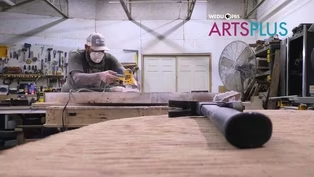
Owner Chris Mauer shares the process of combining natural stone and epoxy resin to locally sourced wood at The Furniture Place.
(router whirring) - [Chris] Hey, my name is Chris Mauer at The Furniture Place Tarpon Springs.
We specialize in custom reclaimed and live edge furniture, and we save all of our wood from Florida.
Absolutely, yes, it is an art.
Woodworking is an art.
Epoxy resin is an art.
We do a lot of both.
So I got into furniture making about, let's say 15 years ago.
I started making tables.
One thing led to another.
We started with the Home Depot wood in the beginning, did the fixer upper farm tables, and then it evolved to the live edge, which then slowly evolved to the epoxy, which that's probably the most fun we get to have in the shop with all the different designs and colors we get to do for everybody with the river tables and the big wall art pieces and countertops, kitchen islands, all that fun stuff.
(warm acoustic music) So that was all US turquoise from a US mine in Arizona, that one of my buddies saved all that stone, and he makes jewelry.
And we decided a couple years back to start a small little wood meets rock collection, which we're about to launch here soon.
That's the table you guys saw with me picking the stones.
One big and upcoming thing here, we're getting ready to finally be finished up with the first table.
So that'll be exciting for everybody to see the end result.
Everybody's been looking at the stones and the table in the mold for the last year, so it's finally ready to go.
So that one particular piece is kind of rare.
Usually there is people that do a clear epoxy.
This one has the bright blue, the greens, the turquoise in it that normally we make out of a pigment powder or a paste or a liquid.
In this case, it's natural stone that comes from the earth.
So here we are, we have the trees, we have the rocks, we're putting them together and we have another awesome piece of art.
So for the epoxy takes usually anywhere from 24 to 72 hours to full cure.
A hundred percent cure is 30 days.
So once we pour that thing, really it has to sit for 30 days before we do anything with it 'cause there is a waiting and, of course, a drying and curing process that we have to hold to standard.
After we complete every piece, it makes you feel really good because the people that are about to receive their custom order, that they've been waiting months to get from us, they've already approved it, they've seen pictures, but they don't really get to appreciate it till it gets into their house and they really get to see it in person.
- So I've been searching for a gift for my friend who's getting married, and I said that I think they would like the charcuterie board 'cause they like to entertain.
He took me in the back where they were making one, and somebody had already purchased it, they ordered it.
It was just very beautiful.
The price was right, I believe, for something that is handmade and that nobody else makes, and it's very difficult, I'm sure to make at home.
It's absolutely art, something that you would stare at just like you were going into a museum to see art.
This is something that it's in your home, and you would sit there and stare at it if it was your coffee table or your kitchen table.
Absolutely beautiful art comes out of there.
- Yeah, so we actually don't have too much big heavy equipment here.
We do almost everything by hand.
Yes, we have powered hand tools, stuff like that.
But the biggest machine that we use every single day is a three and a quarter horsepower router that we run literally every day in the shop.
That's how we flatten everything.
And then of course, from there we sand and finish.
All the wood is saved from Florida, all over Florida.
We have about 15 to 20 different types of wood in stock year round, all professionally kiln dried, no bugs, no moisture, ready to work with.
Everything here is done the right way.
And of course, we ship all over the US.
So all different types, custom furniture from tables to countertops to bedroom dressers, office furniture.
You name it, we pretty much do it all in-house of course.
So we don't source anything out.
It's all right here local.
Keeping it right in Tarpon Springs.
- [Dalia] To learn more, visit reclaimedfurniturefl.com or follow on Instagram @thefurnitureplacetarponsprings.
Head to Detroit, Michigan to learn about artist Mario Moore's thought provoking exhibit "Recovery."
In his paintings and silverpoint drawings, he reflects on how African American men rest, relax, and recover in our society.
(soft thoughtful music) - [Mario] I'm interested in creating the stage that the audience can come into.
Art to me has always been involved in my life.
I grew up around the DIA.
I used to go visit the museum when I was a kid.
I would walk through the galleries.
But as far as inspiration, that came from my mom Sabrina Nelson because she...
I would see her do these large paintings.
Just the idea to look at a canvas that's blank or a piece of paper and her just make something was always interesting to me.
The way that I begin my work is usually through sketches and ideas.
It's usually that I have a thought and I have a process and I sketch out or I think about that thought, and then I say, "What is the best way to portray this thought or to talk about this idea?"
So that can go to sculpture, that can go to drawing, that can go to video, that can go to painting.
But the majority of the time, I'm interested in a massive narrative.
We're in the David Klein Gallery, and the show is called "Recovery" and the show is about considering how Black men rest and relax and take time for themselves.
What happened was I was working on a body of work where I was thinking about myself personally and how I move my body through the world and how the world considers me as a Black man.
And then I had brain surgery.
I had brain surgery and literally I was forced to rest.
So that made me think about things historically, like how did historic Black men that we know and the world knows like a Martin Luther King or a Malcolm X or a W.E.B.
Du Bois... And when we look up their names, they're always speaking really loud.
They're on the podium, they're always active.
In times of turmoil, like what we're dealing with today as far as everything politically and socioeconomically, how do I rest?
'Cause we're kind of in a, we're in a similar state.
And in some ways, in some senses as far as education and other things like that, it's worse.
It's gone backwards instead of forwards.
But at the same time, we're human.
So these men took vacations.
They took time with their family, they took naps.
So I started to think about that.
And the work presents a question, because I don't have the answer.
So how do Black men rest, how do they relax, and what does that look like?
It has to do with just the history of America in that Black men and Black people just in general were in the process of constantly having to stay ahead just to catch up economically.
Since we got to the country of the Americas, we were slaves.
It was things that the country were built on the labor that we put in.
So that is passed down.
As far as trying to catch up, you have to work extremely hard.
So the idea of resting and relaxing is not a part of the process when you're always thinking about what do I need to do next.
Silverpoint is a technique that was used in the 16th and 15th century, and it's literally a piece of silver and drawing with a piece of silver.
Most of the silverpoint drawings that have the historical, the larger ones that have the historical figures in the background, it's a concept and idea, is that can a Black man look relaxed and calm and present himself in that way, but also at the same time be powerful.
I'm letting the background, the historical figures do all the work for me while I relax.
And I think that's a part of the importance and a part of the process.
I like the amount of texture and detail that went into the silverpoint, but there's a limited number of values that you can reach.
So no matter what I draw, no matter how hard the subject matter is, it's always gonna be this softness to it.
And I really like that.
The other thing I really like about silverpoint is that you can't erase.
So it's almost like drawing with a pen.
Whatever you put down is permanent, right?
So everything that goes into that drawing, you have to deal with it, right?
It's there to exist forever.
Another thing I like is that in dealing with silverpoint, you're literally leaving behind silver on paper.
So you're creating something that has initial value.
And with the work that I was working on, I'm dealing with a subject matter that people don't see as valuable.
America often sees as invaluable, as far as Black men, and also this idea of rest and this idea of relaxing.
So I think that material has worked for me really well in thinking about these ideas and concepts.
There's one piece in particular in the show.
I read this book called "Medical Apartheid."
It has to do with the experimentation on Black people from slavery to contemporary times.
And I also got this huge photography book called "Stiff Skulls and Skeletons."
Through that book you can see how they experimented and practiced on cadavers.
And most of the cadavers you will see are Black or African American cadavers.
And the way that that happened is they were like, "Well, we don't really care about this community so we can dig up these graves and use these bodies."
So those bodies became objects.
They weren't even people anymore.
So it was like, well the thing that just happened to me with my brain surgery, what would that look like back in these times?
And I wanted to show opposition to that, that shined the light on me as a person, as a human being instead of an object, and mute the light on the figures that are above me.
The American bulldog, for me it's a literal representation of the history of America, and I use it as a symbol for America itself.
And often you'll find the dog is sleeping or relaxing as it's ignoring really big issues that are happening right above it.
I include history in my work because as far as social issues, we kind of roll around all the time back to similar issues over and over again.
So I look at the past and I consider it and I'm saying, "Well, what was happening then kind of looks like now.
What did they do then?
What can we do now?
What can we do to change it?
And what does that look like?"
I think there's a ton of stuff to take away from this show.
I think about a lot of different narratives that go into one piece, but there's a lot of stuff that I don't think about.
And I think those are the important things that people that come and see the show, that they can pull out for themselves.
I think it's important for the people to answer.
Well, these are the things that I've noticed.
These are some ideas that I'm thinking about.
This is a question that I have.
And I think it becomes more participatory that the people that come and see the show, they provide the answers.
I think hearing their perspective and hearing their ideas about resting and what that looked like for them was extremely important.
I think hearing my dad talk about how he's worked since he was 16 years old and talking about his perspective was important.
But I think the most important thing that happened after the show was I went into the barbershop, and one of the barbers that was in there, he told me after seeing my show, he literally took a week off of work.
And then also hearing that several men after seeing the show were going outside and crying, which is like...
They honestly never thought in this way.
So I think those were probably the most important things that happened.
- [Dalia] See more at mariomoorestudio.com.
As artist Stephanie Cole puts it, she quote "paints with stuff."
Glass, wood, fiber, her mixed media constructions explore different aspects of her life.
Visit the Fuller Craft Museum in Brockton, Massachusetts to see an exhibit of her work.
- [Reporter] When it comes to the artwork of Stephanie Cole, here you will find her life in pieces.
- [Stephanie] I found that building things and making things was what was really I was meant to do.
- [Reporter] Within these wooden frames are bits of everything the artist has been collecting for more than 70 years, shards and shells, windows and words.
Even Cole's DNA is embedded within these assemblages.
- Yes.
(laughs) Are you thinking of the "Royal Reliquary Window?"
Probably in other places too.
I think there's some of my hair in "The Getting There."
- [Reporter] Temples to the artist's tenacity, these sculptures, now on view at the Fuller Craft Museum, represent how Cole has looked at herself, her grief and the world, from the pain of losing a beloved cat to the euphoria of turning 60.
- [Stephanie] The one thing that is more joy than anything else is my self-portrait "Domestic Goddess."
It was supposed to be self-portrait at age 60, but there were so many things going on, it wasn't done until age 63.
But it's called "Domestic Goddess" because I was really happy with everything that I had accomplished.
- [Reporter] An artist for as long as she can recall, and well-documented here when she was four, Cole first learned from her artist father, then at art school.
She later became an art teacher, raised a family, and with her husband, restored an antique home where she's excavated many an artifact, now found in her work.
And it's here where she's had the luxury of working in a filled to the brim studio, only since she was in her sixties.
- [Stephanie] You just get deep into it, and I've had to learn to be able to portion it out because I still, I'm a grandma, I'm a mom, I'm a wife.
There are still responsibilities.
That's my first priority.
But I'm able to do it in bits and pieces, and I'll tell them I'm going out in the studio, and they're pretty good about letting me be.
- [Beth] To hear about an artist that was only creating for herself to make sense of the world around her, to chart her own history was really compelling to me.
- [Reporter] Elements of the show bring us deep into Cole's life and emotions.
We find a radiant rendering of her husband Jim, or my golden man, as she crowns him, and a frank assessment of her own aging.
The work is so personal, Cole never intended to sell or even really share it until curators like Beth McLaughlin took notice.
- [Beth] She has this very deep understanding of objects and this very intuitive connection to material culture.
And she has a respect for the histories of these objects and for the embedded stories that come with them to her.
- [Reporter] It was Cole's daughters who urged her to put the work out in the world.
Art is the family business by the way.
♪ I don't want to wait ♪ ♪ For our lives to be over ♪ - [Reporter] Her daughter Paula Cole is the Grammy winning singer and achieved champion.
Seeing her work in a museum leaves Stephanie Cole both delighted and slightly perplexed.
- [Stephanie] How do you go from being private to a museum?
That takes chutzpah, doesn't it?
So it was my daughters' chutzpah, not mine.
(laughs) - [Reporter] And how do you feel about them being out now?
- I love it, I love it.
And what I love especially is people's reaction to it.
That's what I love.
- [Reporter] Both Cole and McLaughlin say women in particular are drawn to her work, finding pieces of themselves among hers.
- [Beth] I see an artist who is juggling the demands of family.
She also has very overtly feminist work, such as "Don't Wake the Tiger," which is a gorgeous mosaic piece that was created after the 2016 election that is speaking directly to the oppression of women and how we do need to rise up and to fight for equality.
- [Stephanie] It's mostly women that talk to me about their feelings about it.
They've said things like I feel brave now.
I think I'm going to do things that I have not allowed myself to do.
Or they identify with moments, moments of grief or joy, or materials lying around, 'cause a lot of people collect things.
- [Reporter] Because we are the sum of our parts or pieces.
- [Dalia] To find out more, go to fullercraft.org.
The Norton Museum of Art in West Palm Beach showcases the exhibit "Who," a brief history of photography through portraiture.
Curator Tim B. Wride tells us about the portraits that make up the show.
(jaunty jazz music) - [Tim] This is the first gallery at the Norton Museum of Art that is dedicated to the permanent collection.
As a curator, one of the things I always look to is how do my objects relate to the rest of the museum.
You wanna have the collections speak to one another.
In this case it speaks across centuries.
I decided that for the first six years, I would follow the great questions of journalism.
So this year there will be three rotations of "Who," a short history of photography through portraiture, each one in this case, addressing how we look at them as a contemporary audience with contemporary eyes.
And that's important.
We start with the very beginnings of photography.
We start with daguerreotype, 1839, and we end with 21st century.
We really do brush against the major artistic currents of both America and Europe.
The funny thing about early photography is that it went through so many incarnations.
The real big deal was to figure out how am I gonna make this negative so that it's as crisp and clear an image as it was when it was a daguerreotype.
Somebody comes up with the idea that they are going to use glass plates, so that once it's set, it's clear, and you get, as in this portrait of Lincoln by Hesler, you get incredible detail.
You see the wrinkles, you see the moles, you see everything, how the hair lays, which was something that prior to this, was difficult to do because they were using paper negatives.
We always see him with a beard.
He's supposed to have a beard, but here it is pre beard, which I really like.
The other thing that's on this wall, and the reason I put these two together, this is an image by Julia Margaret Cameron.
And I have to tell you that Julia Margaret Cameron was an anomaly in the whole photo world.
And I say that because A, she's a woman, and it was a guy's world.
This is Sir John Herschel.
And Herschel is important not only for being a polymath, but being incredibly brilliant, but he's also the one that coins the term photography.
And the reason I put them together, as you can see, they're so different.
She's really looking at it as an art.
This is really a political statement.
We think they're so simple, and yet they're really, really complex little objects.
(soft house music) From the 19th century to the '30s, cameras change.
They get more sophisticated, and more than that, they get smaller.
Photographers can roam the streets, and nobody really knows they're taking pictures.
So they're not reacting as if they're having their photograph taken.
In the 19th century, there was this, when people had leisure time, people would walk around the streets of primarily Paris, the metropolitan areas, just looking at other people.
They were called flaneurs.
Cartier-Bresson was probably the mid-century's most important photographic flaneur.
He was that amazing talent that was able to anticipate when all of the stars would align, and then take the picture just as everything was coalescing into what he called the decisive moment.
He really is the godfather of street photography.
The really great thing about this piece is that A, it is a joyful piece.
It is post-war.
So here you have, you're in the streets of Paris post-war, post occupation, and Cartier-Bresson is playing with his camera with the depth of field.
So you can see that he's completely in focus.
He's really vignetted that one moment of pride of place, pride of adulthood for this little kid.
Arne Svenson found a collector, and the collector was really amazing in so far as he had hundreds and hundreds of sock monkeys.
And yet each sock monkey had its own personality.
And so Arne goes through and takes these very formal portraits of sock monkeys.
It would never happen in the 19th century, wouldn't have happened in the middle of the 20th century, but by the time you get to the end of the 20th century, all of these ideas are playing through, and all the photographers are thinking about not only what kind of pictures do I take, but what happens when I take them.
And that's a key for the end of the 20th century, moving into the 21st.
If you are looking at contemporary art right now, you'll see, oh my God, everything's really big and really colorful.
That's the period we're in.
And if we have anyone to blame for that, it is the German photographer.
In this case, Thomas Ruff, but also Thomas Struth, Andreas Gursky.
It's completely neutralized.
There's no expression, there's no emotion.
It's really about this head as an object, as a thing that we have unlimited access to.
Avedon once said that portraits are just the surface.
You can get nothing more and nothing less.
It's only the surface.
Whereas we are led to believe from the time we're tiny, that oh, through a great photograph, you can see into the person's soul.
Take your pick.
The Germans don't think so.
- [Dalia] Discover more at norton.org.
And that wraps it up for this episode of WEDU "Arts Plus."
To view more, visit wedu.org/artsplus, or follow us on social.
I'm Dalia Colon.
Thanks for watching.
(low tense music) (flourishing music)
Video has Closed Captions
Clip: S13 Ep9 | 4m 54s | The Furniture Place transforms local materials into beautifully crafted tables. (4m 54s)
Providing Support for PBS.org
Learn Moreabout PBS online sponsorship

- Arts and Music
The Best of the Joy of Painting with Bob Ross
A pop icon, Bob Ross offers soothing words of wisdom as he paints captivating landscapes.













Support for PBS provided by:
WEDU Arts Plus is a local public television program presented by WEDU
Major funding for WEDU Arts Plus is provided through the generosity of Charles Rosenblum, The State of Florida and Division of Arts and Culture and the National Endowment for the Arts, and the Hillsborough County Board of County Commissioners.