WEDU Arts Plus
1312 | Episode
Season 13 Episode 12 | 25m 37sVideo has Closed Captions
Nadiyah Mahmood's henna art | Hyman Bloom | Quilt making | Fire art
Pakistani artist Nadiyah Mahmood shares her skills as a henna artist with the residents of Tampa. An exhibition at the Museum of Fine Arts in Boston features the works of artist Hyman Bloom. Judy Holley practices the art of quilt making in Louisiana. Reno, Nevada, artist Cooper Bayt combines fire spinning, juggling and dancing in his energetic performances.
Problems playing video? | Closed Captioning Feedback
Problems playing video? | Closed Captioning Feedback
WEDU Arts Plus is a local public television program presented by WEDU
Major funding for WEDU Arts Plus is provided through the generosity of Charles Rosenblum, The State of Florida and Division of Arts and Culture and the National Endowment for the Arts, and the Hillsborough County Board of County Commissioners.
WEDU Arts Plus
1312 | Episode
Season 13 Episode 12 | 25m 37sVideo has Closed Captions
Pakistani artist Nadiyah Mahmood shares her skills as a henna artist with the residents of Tampa. An exhibition at the Museum of Fine Arts in Boston features the works of artist Hyman Bloom. Judy Holley practices the art of quilt making in Louisiana. Reno, Nevada, artist Cooper Bayt combines fire spinning, juggling and dancing in his energetic performances.
Problems playing video? | Closed Captioning Feedback
How to Watch WEDU Arts Plus
WEDU Arts Plus is available to stream on pbs.org and the free PBS App, available on iPhone, Apple TV, Android TV, Android smartphones, Amazon Fire TV, Amazon Fire Tablet, Roku, Samsung Smart TV, and Vizio.
Providing Support for PBS.org
Learn Moreabout PBS online sponsorship- [Narrator] This is a production of WEDU PBS, Tampa, St. Petersburg, Sarasota.
(upbeat music) - [Dalia] In this edition of "WEDU Arts Plus," a Tampa henna artist adorns clients at a local art hub.
- My style is very eclectic.
It's all over the place.
I would say though I always end up going back towards like Indian Pakistani style 'cause that's what I'm comfortable with, that's what I grew up with.
- [Dalia] Paintings of the human body.
- Bloom was an artist who found beauty in all kinds of things that other people wouldn't look at twice, for the color, for the shape, for the luminescence, - [Dalia] Patterned quilts.
- [Judy] Quilting is compulsive.
And once you start it's something like you need to do or you have to do.
And I probably saw some every day.
- [Dalia] And performing with fire.
- I would describe flow arts fire spinning as a visual art and you're able to tell a story and create shapes that you wouldn't be able to otherwise with just your body.
- It's all coming up next on "WEDU Arts Plus."
(bright music) Hello, I'm Dalia Colon and this is "WEDU Arts Plus."
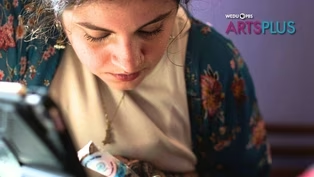
Her body art may be temporary, but local henna artist, Nadiyah Mahmood, leaves a lasting impression with her unique mix of traditional and modern designs.
- Henna typically lasts about seven to 14 days on the skin.
My name is Nadiyah and I'm a professional henna artist.
I've been a henna artist with 15 years experience, but professionally about eight, nine years.
I'm a second generation Pakistani American.
Me and my sisters grew up getting henna done, and I just kind of took to that form of art.
When I was about, you know, like 13 or 14 years old, I was just going to the local mosque in Atlanta where I'm from and just adorning little kids, and friends and family members and, you know, having fun with it.
Then I decided, you know what?
This is something I wanna take seriously.
So I just dedicated little by little my time to practicing.
It got better as I went on and here I am.
- [Client] Who's the fun part?
- Coloring.
(chuckles) The scientific name for henna is lawsonia inermis.
Lawson is the actual dye that is released from the plant.
I make the paste myself.
It's a 24 hour process to make the henna paste.
Henna typically lasts about seven to 14 days.
It's typically done on the hands and the arms, and then second to that, the feet and the legs.
More and more people are getting it done on various other locations of the body.
(upbeat music) Henna itself has dated back thousands and thousands of years.
A historical figurehead that made it even more popular was Cleopatra of Egypt.
Each culture has their own specific style, how they, you know, adopted the form of art.
I would say Moroccans have like their fessia style, which is very detailed, more line work; Arabic style, very dainty floral, chainy look; east African, very bold, thick lines.
So it varies from different cultures.
My style is very eclectic.
It's all over the place.
(upbeat music) I would say though I always end up going back towards like Indian Pakistani style 'cause that's what I'm comfortable with, that's what I grew up with.
Like the paisleys, the florals, maybe a little bit of structure.
I am also known for adding various modern elements to my designs.
I've done a sleeve where it was all "Harry Potter" dedicated.
I also did an alien themed henna sleeve as well.
One of the most common things I like to do is bridal henna.
Back in the day, this is how they would show off their lineage, their heritage.
Culturally, it means significance to them to adorn themselves as feminine as possible.
(upbeat music) I also sell some of my artwork as well.
I paint henna artistry style canvases and so on.
(upbeat music) When someone like to book with me, we will talk about locations, and nine times outta 10, I'll suggest Felicitous.
- Can I get the teacher pet?
- Yeah.
- Felicitous is this awesome coffee shop.
It feels like it's home, right on 51st Street.
- My wife and I, we had always had this vision of what we wanted our coffee shop to be.
And the number one thing was we wanted to be a place where people in the community could come together over art, over music, over making connections.
Nadiyah has started out as a customer, just like most of our vendors.
- I first started going there just to study a little bit, and then I just started having clients meet me there.
- As soon as we learned a little bit about what she was about and her talents, we were all about having her come and set up a tent and attending our day markets.
I really like that one, like the tattoo guy.
- The markets are monthly get together type of thing, where a bunch of vendors and artists showcase their artwork, their product.
(vocalist singing in foreign language) - This is the kind of thing that we live for really, is just to try and support local artists, local artisans to make a living really out of their passion.
Coming into the coffee shops and having something as culturally rich, as Nadiyah's henna, it just ticks every box.
We're able to connect people in the community to a a new perspective.
Ultimately what that does for us as a society is brings us closer.
- Hi.
- What I love the most about being a henna artist is I get to look at my work, my finished product and see how happy it makes my client.
That is probably the biggest gift, is just watching someone you know go from, "Hey, I need this," to, "Oh my gosh, I can't believe I got this done."
It's so vibrant.
It brings joy to people's hearts.
You don't have to necessarily be part of the culture or any culture that henna is dominant in.
You just have to, you know, just love the form of art honestly.
(bright music) (gentle music) - For bookings and more, visit hennabynadinam.square.site or follow Nadiyah @nadi_nam.
Artist, Hyman Bloom, was interested in the human figure and the complexities of the human condition.
Visit the Museum of Fine Arts, Boston and Massachusetts to see an exhibition of the artist's work and discover more about his life.
- [Narrator] From his earliest days artist, Hyman Bloom was fascinated by the human body.
- She is what an old woman's body is, and to celebrate that in paint is an unusual thing.
- [Narrator] From the moment his career began in earnest in the 1930s until his death in 2009, Bloom rendered the figure from classical idealized forms in chalk to the unrelentingly visceral in paint.
But Bloom's work, Museum of Fine Arts curator, Erica Hirshler, tells us routinely went below the surface.
For many, uncomfortably so.
- These are paintings that are violent.
They're bodies that are wrenched open.
In this particular one, you see the hands of the doctor and the knife that he's holding up.
And so the subject matter is horrible, and the painting is beautiful.
And it's that paradox that I find really interesting.
- Hirshler is the curator of "Matters of Life and Death," and exhibition of some 70 paintings and drawings, works in which she looks beyond age, death and autopsies to find what Bloom saw.
- Bloom was an artist who found beauty in all kinds of things that other people wouldn't look at twice, for the color, for the shape, for the luminescence.
And he also was an artist who believed that life is cyclical.
And he saw these bodies as also generators of new life.
- [Narrator] Bloom and his family immigrated to the United States from Latvia in 1920.
They settled in Boston.
And as a teenager, Bloom took art classes at the MFA.
He was an early exceptional talent.
- He makes drawings of wrestlers and boxers.
Those were sports his brothers were interested in.
When Bloom died, "The Boston Globe" obituary said that the drawings were like a combination of Blake and Michelangelo.
- [Narrator] Following in the tradition of those artists, and famously, Leonardo da Vinci, Bloom visited a morgue early in his career.
It would inform his life's work.
- [Erica] They all go to the morgue because that was the place where you could study human anatomy.
Doctors and artists went at the same time to see how the body is formed, to see how the muscles work, to see what's underneath so that you can portray it properly.
And Bloom was well aware of that tradition.
- It's becoming evident that he's probably one of the great American painters since the 20th century.
And people are starting to mention him in the same, it's sort of at the same level as people like Jackson Pollock and de Kooning.
- [Narrator] Art historian Henry Adams says Bloom was indeed on the same track as the 20th century greats.
In 1942, a number of Bloom works were featured in a game changing exhibition at the Museum of Modern Art in New York.
There was an other worldly quality to the work, which Adams documents in the new Bloom catalog, "Modern Mystic."
- He sort of a curious painter.
I think there are certain painters like Rembrandt who looked very closely at the material world, but then there's a spiritual quality that comes through from the material fact.
- [Narrator] But Bloom never achieved the lasting fame of fellow painters like Pollock, in part because he despised promotion.
- It's the tradition of the artist recluse, and it's going back to figures like Goya at the end of his life, or Winslow Homer.
These people who have withdrawn from the public fray.
- People will write about him and he say, "So?
They wrote about me.
What's the big deal?"
- [Narrator] Stella Bloom is Hyman's widow.
We spoke in their New Hampshire home in the studio he used in the last years of his life when his canvases grew larger and larger, where he surrounded himself with shelves filled with art books, colorful pottery and musical instruments.
In all likelihood, Bloom wouldn't have wanted us here.
On the few occasions, guests were allowed into either of his two studios, they'd find all his paintings turned away from prying eyes.
- [Stella] He just didn't want the influence of somebody saying, oh, you know, that's finished.
- [Interviewer] How would you assess when he decided a piece was finished?
- His pieces, as far as he was concerned, they were never finished.
He would sell a picture or the gallery would sell a picture, and then he would go back to a home that owned the painting and he would sit there and do this, and then he say, "I can change that left corner or the right corner."
And of course, the owners that knew him said, "No, no, no, no, you're not bringing oil and brushes here to change it."
And that's why he never signed them.
- [Narrator] Stella says her husband lived to work, a canvas always on his easel, a sketchbook almost always at his side.
And virtually all of his work was created from memory, bodies, forests and Christmas trees that he would contemplate, sometimes for years.
- It's pretty extraordinary.
And I think the essence of Bloom has to do with the fact that he's pulling things out of his imagination.
So he is not just copying reality.
Every pencil stroke, every brushstroke is a thought.
- [Narrator] This may be the beginning of Bloom's, well, re-bloom as the art world reacquaint itself with one of its once rising stars.
For Stella Bloom, it's a promise come true.
- The day he die, I promised him that somehow there will be a show and a book.
And when they were hanging the work, I asked to go there and see the work being hanging.
So now I believe it and I'm happy.
I'm very happy.
(gentle music) - For more information, go to mfa.org.
Since she was a teenager, artist, Judy Holly, has been practicing the art of quilt making.
With skill and concentration, she renders colorful quilts rich with pattern and design in Baton Rouge, Louisiana.
(bright music) - In 1998, I had a quilt that won first places in every show that it was in, including the one in New Orleans and then the Mid-Atlantic Quilt Festival in Williamsburg, Virginia, and then it also won something in Houston at the International Quilt Festival that year.
Raspberry Parfait is a New York Beauty block and it's something I always wanted to try.
And I was at a fabric store and I saw some '30s prints on sale.
That's always a good excuse to buy something, but one of the prints on sale looked exactly like the fabric that was in my mother's kitchen when she bought this old '30s house in central Mississippi.
It looked like the curtains we took down.
And so I bought that and I bought some friends, and they were on sale.
And for about a year, I kind of gathered up all this fabric that was depression era '30 type prints.
And so I made her a New York Beauty quilt outta those depression era prints for her '30s house.
When you look at the New York Beauty blocks and you see all the points, I actually cut strips and their paper piece so I'm not cutting out any little pieces.
I'm making them from strips and I just cut as I go.
That is what's called an offset log cabin.
I'm attracted to curve designs, and when you do an offset log cabin, you can actually do circles with it if you choose to.
I chose to do a clamshell pattern with it.
And at the time, my son was living in Japan, so I was collecting Japanese prints.
It was just a good excuse to buy fabric.
And since he lived in Japan, I bought Japanese prints and made that quilt.
The Railroad Through the Rockies pattern is another way that I could use a New York Beauty block.
And it was traditionally gave you a broad open space that represented the plains as the railroad went across the country.
Nice place to hand quilt or to showcase your quilting.
So I decided to use my New York Beauty block in that kind of setting.
And I had bought a Australian print for the border.
I taught a lot of quilt classes for probably 25 years throughout the Gulf Coast area mostly.
I started sewing at 16.
I was in a girl's trio for several years, and we had all of our dresses alike.
And I liked my trio clothes.
I didn't like the ones that were store bought and I liked going to the store and picking the pattern and picking out the fabric.
My mother made my trio clothes, but she didn't like it.
My grandmother was a depression era quilter and her quilts were all over her houses, but she was old by the time I came along and I never actually saw her quilting.
She talked about it.
We slept under the quilts and at one point when we lived in her house, her quilting frame hung over my bed, suspended from the ceiling.
I never saw a quilt in it and I never saw anybody using it.
I knew what it it was for and I always said one day I'm gonna make a quilt.
When I was 16, I took my money I got from my birthday, and I lived in Connecticut at the time, right in the middle of the textile industry, and I went to the one of the local mills and bought fabric and everything I needed and I shut myself up in my bedroom with a sewing machine, and when I came out, I had a dress.
I've been sewing ever since.
I made my first quilt right after my son was born.
Then I just kind of played around at it.
I didn't actually follow directions.
I just kind of did my own thing.
And I did that for about 15 years.
And finally I just decided I wasn't progressing.
I was gonna pick a pattern, actually read the directions and start very traditionally and do a traditional block and something like that.
The first book I bought I bought in 1970.
It was the only book that was still in print on quilting.
It was published in 1949.
It's by Marguerite Ickis.
It's over there on the shelf.
I work with a lot of traditional patterns and I have a quilt program that's electric quilt.
A lot of traditional in there.
You can also draft your own patterns in there, and then you can print out any block in any size that you need.
I work on the computer a lot.
I don't really design that much on the computer.
I do some a little bit, but I like designing at the design wall.
I like the fabric to tell me what to do.
Originally, I pieced by machine and I quilted by hand, and I did quilt by hand for quite a few years.
And you finally get to the point, you're not gonna be able to finish all these quilts.
Hand quilting takes a while.
I decided to learn to quilt on a domestic machine.
And a lot of people now use a big, professional long arm.
I didn't even know what that was when I was learning how to quilt.
So by the time I was aware of what long arms were and what they could do, I had already mastered quilting on a domestic machine, so I have no desire to change.
The Juki actually is an industrial strength machine, but the batting doesn't really cause much of an issue.
Sometimes there's a lot of bulk in the seam allowances that you have to sew over, but it's not an issue with the Juki.
I had one machine that if you weren't using the exact needle specific for that technique or that fabric, it wouldn't sew.
Most machines aren't that persnickety.
I do use predominantly cotton.
Ben's shirts are great.
Do make quilts from dead people's clothes often.
Usually that's for family members.
When I made the quilt for the family and he had beautiful shirts, a hundred percent cotton, high quality, they wanted their quilt and I got to keep the rest of it.
And I like using woven fabric.
I'm adventuresome.
I will still use other fabrics.
I collect ties, and people just give those to me.
They're predominantly silk, but they can be acetate, they can be polyester, they can be wool and silk blends, they can be cotton.
So you're putting them all together.
You have to wash it in cold water and not put it in a dryer.
I have a quilt in the front made from Japanese brocades.
If your work is nonstop on a project, I made a quilt from my boss in about two weeks, four to eight hours a day.
That was maybe twin size or a large lap or twin.
Quilting is compulsive, and once you start, it's something like you need to do or you have to do.
And I probably sew some every day.
(bright music) - Head to Reno, Nevada to meet artist Cooper Bayt.
Combining fire spinning, juggling and dance, he creates dynamic performances that leave the viewer amazed.
(upbeat music) - I would describe flow arts as a visual art, much like dance, but you're combining modern dance with prop manipulation.
So it's adding that extra element where it's kind of an extension of your body and you're able to tell a story and create shapes.
(upbeat music) My name's Cooper Bayt and I'm from Reno, Nevada.
I am a flow artist and professional fire spinner.
I was gifted a pair of juggling sticks when I was really young and I spent countless hours at the park training this thing that I had no idea would really kinda take over my life later on.
Controlled Burn, which is a local fire spinning group, had a workshop when I was only 13 years old.
And so I was able to fire spin for the first time when I was 13.
And my grandma, she was a professional photographer, she actually captured that first time.
She instilled a lot of that fine arts background in me that to be dynamic.
The first step to creating a fire show, make sure that the area is safe in case anything happens, any drops, nothing's gonna spark up.
Secondary, set the space with candles, with torches on the ground in order to create the stage effect.
Third, almost most importantly, is that I'm gonna have a duvetyn blanket, it's a fire safe blanket, and a spotter that's gonna be right there for me to help me put out my props in order for me to start the next one and keep everything in a calm, collected manner, tell me if I catch on fire or if anything goes wrong.
(upbeat music) (fire whooshing) There are specialized tools.
Take a juggling club.
And the way you would do it is you would have, let's say a jar or a ammo container full of white gas, kerosene or lamp oil, and you actually dip it in and this wick will absorb like a sponge.
When you dip the prop into the gas, that's like a moment of mindfulness, like you're counting, you're measuring the amount of field that you soak and you hold it there and you let the excess drip out.
And in that moment, you know you're collecting yourself, you're getting ready.
And when you're ignited that poof, that initial rush is like, okay, here we go.
Everything just starts to fade away.
You just get that internal rush of the fire around your body, the sound of it, whooshing past your head.
It's an amazing feeling.
I love to interpret like hip hop dance with creating shapes that are extensions of my bodies with the props.
So it's kind of that mix of dance and prop manipulation.
Very much inspired by hip hop and modern dance.
A lot of it is improvisational when it's just a solo flow performance.
I do also choreograph and write shows with multiple fire artists.
So it becomes a choreographed dance that is very structured, that we all have to hit the certain notes on the certain eight counts, and in order to create the illusion, create the shape that we want the audience to see.
What I get out of flow arts juggling, fire spinning is the fact that it's good.
It's good for my mental health.
It's not so easy to talk about mental health and people's anxiety and fear.
And I think this has been a means that has really, really saved me in a way to be able to dance like nobody's watching.
And you really can get into a meditative state.
It's the flow state that we refer to and it's mindfulness because you're able to move your body in a certain way that you're able to release, you're able to let go of everything else and train relentlessly to give some kind of purpose in this crazy world, like even if it's just as silly as learning a new trick that night, it's doing the problem solving, the going through the motions and the failure in order to pick it back up and and start again.
And so that translates into my life tenfold.
(upbeat music) (gentle music) - Discover more at instagram.com/cooperbayt.
And that wraps it up for this episode of "WEDU Arts Plus."
To view more, visit wedu.org/artsplus or follow us on social.
I'm Dalia Colon.
Thanks for watching.
(upbeat music) (gentle music)
Video has Closed Captions
Clip: S13 Ep12 | 5m 38s | Henna artist Nadiyah Mahmood adorns clients with her unique mix of traditional and modern designs. (5m 38s)
Providing Support for PBS.org
Learn Moreabout PBS online sponsorship

- Arts and Music
The Best of the Joy of Painting with Bob Ross
A pop icon, Bob Ross offers soothing words of wisdom as he paints captivating landscapes.










Support for PBS provided by:
WEDU Arts Plus is a local public television program presented by WEDU
Major funding for WEDU Arts Plus is provided through the generosity of Charles Rosenblum, The State of Florida and Division of Arts and Culture and the National Endowment for the Arts, and the Hillsborough County Board of County Commissioners.