WEDU Arts Plus
1314 | Episode
Season 13 Episode 14 | 26m 15sVideo has Closed Captions
Noland Anderson's organic images | David Felberg | Women's influence on fashion | Fire & wood prints
Tampa Bay artist Noland Anderson paints organic images celebrating people of color and scenes of people in everyday urban life. New Mexico-based violinist David Felberg connects with his audiences through his instrument. The Peabody Essex Museum (Massachusetts) features an exhibition of women's influence on fashion and design. Artist Ben Rogers uses fire and wood to create prints in Nevada.
Problems playing video? | Closed Captioning Feedback
Problems playing video? | Closed Captioning Feedback
WEDU Arts Plus is a local public television program presented by WEDU
Major funding for WEDU Arts Plus is provided through the generosity of Charles Rosenblum, The State of Florida and Division of Arts and Culture and the National Endowment for the Arts, and the Hillsborough County Board of County Commissioners.
WEDU Arts Plus
1314 | Episode
Season 13 Episode 14 | 26m 15sVideo has Closed Captions
Tampa Bay artist Noland Anderson paints organic images celebrating people of color and scenes of people in everyday urban life. New Mexico-based violinist David Felberg connects with his audiences through his instrument. The Peabody Essex Museum (Massachusetts) features an exhibition of women's influence on fashion and design. Artist Ben Rogers uses fire and wood to create prints in Nevada.
Problems playing video? | Closed Captioning Feedback
How to Watch WEDU Arts Plus
WEDU Arts Plus is available to stream on pbs.org and the free PBS App, available on iPhone, Apple TV, Android TV, Android smartphones, Amazon Fire TV, Amazon Fire Tablet, Roku, Samsung Smart TV, and Vizio.
Providing Support for PBS.org
Learn Moreabout PBS online sponsorship- [Announcer] This is a production of WEDU PBS: Tampa, St. Petersburg, Sarasota.
- [Dalia] In this edition of "WEDU Arts Plus," scenes of people in everyday life through paint.
- With a lot of pieces that I paint, I put them in different settings.
And I try to do things in a way that you couldn't quite pick up what era it is.
And I sort of give a story to this in my head.
- [Dalia] A violinist performs.
- For me, it's one of the only things that I can be truly in the moment with and share that in the moment-ness with other people.
(violin music) - [Dalia] Women designers who changed fashion.
- One of the things that I think is very frequently sort of taken for granted is how innovative many of these women designers were and are.
- [Dalia] And burned wood prints.
- It's pretty amazing to watch fire and water and electricity and wood, kind of all the natural elements come together to create something that's readily available in nature, such as trees and lightning and fractal shapes.
- It's all coming up next on "WEDU Arts Plus."
(upbeat jazz music) Hello, I'm Dalia Colon, and this is "WEDU Arts Plus."
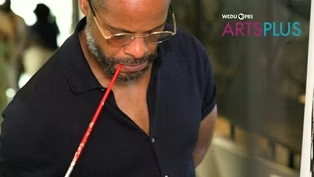
Tampa Bay artist Noland Anderson's work is inspired by the simple and subtle makeup of the world around us.
He creates organic, detailed works of art, celebrating people of color and the simple beauty of everyday urban life.
(soothing music) - I started painting probably around four or five years old.
It started with comic books.
You know, superheroes.
The human figure was always my first interest when it came to drawing and painting.
(soothing music) After finishing high school, I took up advertising at The Art Institute of Fort Lauderdale.
After graduating from there, most of my work was always as a freelance illustrator.
During those years, I would design Judaic greeting cards.
They used a lot of gold and a lot of silver film that I began to use in my personal art.
And that's how it's been for me as an artist.
Doing so much work for different people, I sort of, like, picked a little from this and that, and it has influenced the work that I do now.
For about 10 years, I worked as a restoration artist in the yacht industry down in South Florida.
We did a lot of faux painting in the interior part of the yachts and sailboats.
I applied the techniques from that in the work that I do now.
You know, it's the certain look of wood I know from doing the restoration work.
I eventually moved to Tampa, Florida and began to focus on my personal art and painting the things that I enjoyed doing.
Working as a freelance illustrator, it wasn't that often that I got a chance to paint people of color.
As I started doing my own personal work, I wanted to paint images that look like me, that reflect who I am.
I wanted to show that, you know, we are everywhere.
And with a lot of pieces that I paint, I put them in different settings.
And I try to do things in a way that you couldn't quite pick up what era it is.
And I sort of give a story to this in my head.
There's one called "The Pimp of Charlemagne Duvier," but it's really, it's two old men playing chess and a old mingy little dog beside him.
The main character is wearing this purple fedora.
And I use the term the pimp of Charlemagne, not pimp as in someone who's taking advantage of women or anything like that, but someone who's, like, taking advantage of life.
They're pimping life, so to speak.
That character, I've painted several times in different paintings.
(soothing music) I think the subtle things are more true, genuine.
I would use nature, I would involve flowers or birds or butterflies that's moving around, because I want that to be a part of that subtle moment that's just caught.
A lot of times I'm just painting.
I'm not really giving any thought to what I'm doing.
I just start throwing things around and see what happens.
I try not to overthink when I'm creating a piece.
I guess it's like musicians when they playing music, they have a jam session.
You just playing.
And I think that some of the best stuff that comes out when you're not overthinking, you're not trying to think about it, you're just jamming away.
- I had the opportunity to connect with Noland Anderson while I was the operations leader for the Renaissance International Plaza Hotel.
We were partnering and working with another local artist by the name of Meclina Priestley.
She said, "You know what?
I have the perfect brother that you gotta meet.
Not only is he the foundation of what Tampa is as an artist, his art is second to none."
I said, "I gotta meet this guy, Noland, and see what Noland's all about."
So we set up a meeting.
Noland came in, and honestly he had us at, "Hello."
- I was invited to hang some work at the Renaissance Hotel.
Talib transitioned over here as the general manager of the AC hotel, and we wanted to do something a little different with the artwork.
- Antonio Catalan was the founder of the AC brand in Spain.
Our objective was really to, you know, pay homage to Antonio Catalan and everything that he built.
- At the same time, while yet telling that story, also show a little bit about my background as an artist who liked to paint black art.
After doing a little research, I found a woman by the name of Yinka Esi Graves from out of Spain who does flamenco dancing.
- She was the blender of, you know, this flamenco dance, infusing the African dance.
So we said, "All right, we're in."
It's beautiful.
They wear these wonderful dresses.
They have so much that you can do in that piece.
And then the texture that would come out of that would be outstanding.
The only ask was that it takes up a whole wall.
- If you look closely at the artwork there, there's that mixed medium.
There's the concrete, and there's some sculpture going on.
There's the gold leafing in there.
The gold leafing was the influence from years of doing the Judaic artwork.
I knew a rough idea of what I want it to look like.
And as it began to take shape, then I knew the direction to go in.
(latin music) - [Talib] Every first Saturday of every month, we host an event called Elegant Saturdays.
- [Noland] That event for me as an artist, I'm there to do live paintings, to connect with the community, to let them see the process.
- They're getting a chance to meet the actual artist that is our resident artist in the space.
He's given an opportunity as well.
So when we do curate our next art show, now the people that have been coming every month to Elegant Saturday, now they feel part of what Noland's doing, right?
So now they're gonna show up and they're gonna support Noland as well.
- A lot of times when I'm creating in a studio, not so much that I'm creating for someone else, I'm creating for me.
But I don't get that feedback until after the piece is done.
But when I'm doing live painting, you know, I get the interaction with people.
I get to hear what people are thinking about.
- [Talib] When you meet an artist like Noland, he gives off this aura of patience, of sophistication, of luxury.
Where I see the future for Noland, and I see him across the United States in multiple different brands and really showcasing his work.
But not just showcasing his work, giving the hotel an opportunity to display something worth displaying, and inviting the community in to their hotel to make it vibrant.
- What I would say to other artists, just keep painting.
Even if you don't feel like it, paint.
Even if you don't know what you want to do, just paint.
You know, don't try to overthink anything.
Just keep doing it.
Try to do something every day.
And don't worry about what the final piece is going to look like.
Just go with it.
Don't overthink anything.
- See more at nolandandersonart.com.
David Felberg is a violinist.
Based in New Mexico, he's able to connect with audiences across the state with his instrument.
Up next, listen in on one of his performances.
(violin music) - You know, I get excited personally about all the inner workings of music and how music is put together, and how clever it is, and trying to always figure out what the composer's trying to say.
(violin music) That's a lifelong challenge.
But then to be able to share that with people on an intimate level is really cool.
(violin music) There's harmony, but there's so much more to music.
There's- it's sound, it's texture, it's color, it's emotion.
And it's such a reflection of the world around us.
(violin music) - How would you express your sense, or your interpretation, of Joseph Kasinskus's "Flight of Birds" piece?
- It's an incredible musical flight.
It's an extremely emotional piece.
(violin music) All the timing is so important.
The space between the notes is equally important as the notes themselves, and it's all about timing.
There was a place in the piece also that I had to sing, and that was pretty new for me.
♪ I know you ♪ ♪ I know you ♪ Just coordinating all those things is very untraditional things that I would do, but it's a magnificent effect that he has with the looping.
Just like you would do on pop albums.
And so it requires, you know, knowing some technology.
And it really feels like you're looking at birds overhead in the sky and then singing with them or at them or something.
- Is that what you thought about when you were singing?
- I thought about singing with them, with the birds themselves.
♪ I know you ♪ ♪ I know you very, very well ♪ ♪ Well I know you ♪ ♪ I know you ♪ - Why is it important for you to bring people together?
- Creating a community, it's of, you know, creating a small community is part of creating a large community.
And so to do it at the very ground level is so important.
And it's a reflection of creating a community in a large city.
- [Megan] What do you want to bring to the audience?
- I want to bring a sense of shared experience, which I think is the most important thing, is that we're all sharing this together.
And also to give them an appreciation for something maybe that they don't know they like yet.
- [Megan] How does it become an experience?
- You know, as a instrumentalist, you spend a lot of time by yourself in a small room.
Oh, hopefully away from other people so they don't have to hear all your little experiments that you're doing.
And you have to work out a performance of a piece.
But it's a really cool experience when you finally get in front of people.
And you have to feel like you let go.
When you're super prepared, really, ultra prepared, the audience can feel a sense of confidence, and there's a relaxed-ness about that.
And that when the audience can relax, then they can take in more.
- What does it feel like when you make that connection?
- It's a great, it's like nothing else, yeah.
And that's why you do it.
That's why you spend many, many hours in a room by yourself working.
So that when you go out there and make the connection, it's really an incredible feeling.
(violin music) - Sometimes I feel like when I go to Chatter that it's all rehearsed, of course, but there's a thing being created right there in front of me.
- Definitely, yeah.
- In that room.
- If you're really well prepared, then you can be a little more improvisatory, and you can take chances that you would not have planned out.
And what's exciting is when, as a performer, when you're feeling the audience is with you, you can really have a conversation with your audience.
(violin music) I think the intimacy, you feel the vibrations, you actually feel the vibrations of the notes.
And there's something about the actual feeling of it, which is a different experience as opposed to just hearing it.
You really feel the wood in the string instruments moving, or a reed vibrating, or you hear breath.
You know, the breath is part of the music.
And the way the musicians move together is really exciting.
It's exciting to see how people react to one another to try to bring off something.
- Why do you love that connection?
- I love that connection because I love the music that I'm playing, and I wanna share that.
And I wanna share it in the most profound way that I possibly can.
(violin music) (audience applauding) - For more information, visit nmphil.org.
Visit the Peabody Essex Museum in Massachusetts to see an exhibit focused on women's groundbreaking influence on fashion and design called "Made It: The Women Who Revolutionized Fashion."
The exhibit displays more than 100 distinct works.
- [Reporter] It's the strange thing about women's fashion that for most of its history, it's men who've been the designers, deciding not only what women might wear, but how they wear it.
- Yeah.
Yeah, it doesn't make sense, - [Reporter] But this exhibition is the exception.
It's a winding tour through 250 years of the women as the Peabody Essex Museum proclaims who've revolutionized fashion.
Petra Slinkard is a co-curator.
- You know, one of the things that I think is very frequently sort of taken for granted is how innovative many of these women designers were and are.
Putting pockets in skirts, the kinds of examples of improvement to a system that women are building on for themselves.
- [Reporter] Starting as we find here in the 1700s, when Marie Antoinette was the queen atop the fashion scene.
- In regard to silhouette, you know, here, a woman's silhouette, even if she's of a diminutive stature, is still taking up almost three times the size of her male counterpart.
- [Reporter] For well over a century, European women were part of a guild system, where they made the clothes men told them to until in the 1800s they began to push back.
In the U.S., Elizabeth Keckley was an enslaved woman who purchased her freedom and ultimately fashioned her own success, dressing the upper crust and one very famous figure.
- She became the in-house dressmaker for Mary Todd Lincoln.
She became her confidant and, you know, lived and worked very close with her for many years.
It's her sense of scale and proportion and fit that makes an ensemble like that work on someone of such a short stature, in which, you know, I think just speaks to her artistic ability.
- [Reporter] But for all the stitches and strides, it would take years for the story to change.
- Morning, Biddy.
- Morning, Mr. Woodcock.
- If you've ever seen the movie "Phantom Thread," you know, here's this powerful figure, right?
He's sort of larger than life.
But he's almost sort of like the conductor.
But if you really look at that film again, you start to see the army of women behind the closed doors who are actually doing the making.
And then you start to see this narrative, you know, play out that it has for, you know, hundreds of years.
- [Reporter] But when the alterations came, we saw them, like hemlines rising with the tides of change, especially in the 1960s.
- Women were experiencing a new sense of independence that I think, in some way, was also experienced earlier in the 1920s when you saw another moment where hemlines rose and waistlines went away.
But that there's this sort of democratization that is taking place in the fashion of the 1960s.
- [Reporter] And where men had put women in constricting corsets and couture, women like Elsa Schiaparelli and Gabrielle "Coco" Chanel let the seams out.
- It upset Chanel so much that she came out of retirement.
And that's where we start to see that boxy Chanel suit really gain in prominence.
And it was in part because I think it was easier to wear.
- [Reporter] Barreling through the 20th century, Vivian Westwood turned punk, Ray Kawakubo deconstructed dress, and Catherine Hamnett literally made fashion statements on t-shirts.
- She's using them as a billboard.
So even if you say nothing, you say so much, you know, with what you've chosen to wear.
- I do think that it has been one of our great goals to, you know, make very beautiful things that also, you know, you can drive your car and pick up your child.
- [Reporter] Natalie Chanin is the founder of Alabama Chanin, a fashion and lifestyle company based in Florence, Alabama, where she joined us by Zoom.
Until Chanin came along, Florence was a former textile town time forgot.
- And how many people worked for you?
- All together, a little over 50.
50 people all together.
So small business.
- [Interviewer] And how many of the 50 people do you know?
- [Natalie] All of them.
- [Interviewer] Which is important to you.
- [Natalie] Yes, yes it is.
- [Reporter] Chanin's design is fully considered, from her local employees to her use of organic materials, to the garments she hopes will still be worn decades from now.
- I really do have this philosophy about what we wear being utilitarian, but also, you know, made with beauty and this care for the environment in mind.
- [Reporter] Moving fashion forward to today, the runway still traffics in gowns, but also now in burkinis and all body types because, Slinkard says, "Women have fashion all zipped up."
- What makes women and men different in their designs that, you know, women are designing from that standpoint of hand, heart, and head, and that it is emotional and that it is powerful.
But it's powerful because of what it represents.
- Find out more at pem.org.
Nevada-based artist Ben Rodgers is the creator of Burned Wood Prints.
With wood as his canvas, he uses fire, water, electricity, and ink to render something truly unique.
(upbeat classical music) - I would describe my work as taking a piece of wood with the natural wood grain, the natural feel, the smell of the wood, and burning it with fire.
Then taking imagery and applying it right over the top of the wood, like painting onto a wooden canvas.
My name is Ben Rodgers, and I create burned wood prints.
I'll choose maple plywood because it's very strong and it's very flat.
And take that piece, cut it down in my workshop.
(tool buzzing) And then I'll router the edges.
(tool buzzing) And then I'll flame the edges.
So I take a torch and actually burn around the piece.
(torch hissing) And then I'll take a bit of water and baking soda solution and spread that over the top to help the electricity conduct.
And it also helps it stay on the surface of the wood rather than going through the middle.
The next stage is to burn it with electricity.
The process of electrocuting the wood is pretty amazing.
So I have a machine that I created in my workshop.
And I'll take that and run an electric current through the wood, which travels along the surface of the wood, burning natural shapes into it.
People call it fractals or tree limbs or lightning, all reminiscent of what these burn marks in the wood look like.
No two are alike on those fractal shapes.
They're totally unique, just like nature, just like a tree branch or lightning.
It can never be reproduced.
Sand everything down so it's nice and smooth and looks really crisp.
And then run it through a big flatbed printer.
And that puts ink directly onto the wood, creating the imagery that is the final piece.
During the printing process, I'll take an image into Photoshop, and I'll take a photograph of the wood and overlay it in Photoshop so that I can see that tan canvas.
Because basically I'm starting with wood instead of white like you would on paper.
In recent years, what's also helped is a printer that has the capability to lay down white ink.
And so as the prints move through, a layer of white goes down first before the color is applied over the top.
And this allows the colors to really explode on the wood canvas.
(relaxing upbeat music) Growing up in Lake Tahoe, I've got a ton of Tahoe imagery.
And I use combination of my own imagery, but a lot of stock imagery, a lot of trees, bears, Tahoe mountains, and chair lifts, ski resorts, stuff like that.
(relaxing upbeat music) I love creating custom ones.
People love to have their own unique picture, you know, that family photo, and have it in a unique canvas that I can create.
(upbeat electronic music) One thing that stands out that surprises people is when they pick up a piece of my art, oftentimes they'll smell it.
And it smells like burned wood.
It smells like if they've ever been in Tahoe in the wintertime and they've had a fire in the fireplace.
It smells like home, or it smells, you know, like a campfire from their childhood or something.
And so that's kind of a unique side effect.
My favorite part of the whole process is giving pieces to people and watching their eyes light up when you show them, you hold it up, and they go, "Wow."
The uniqueness of the art drives me.
And I get positive reactions wherever I go, and it really fuels my desire to keep going, all the positivity that surrounds it.
(upbeat electronic music) - Check out more at instagram.com/burnedwoodprints.
And that wraps it up for this episode of "WEDU Arts Plus."
To view more, visit wedu.org/artsplus or follow us on social.
I'm Dalia Colon.
Thanks for watching.
(dramatic music) (orchestral music)
Video has Closed Captions
Clip: S13 Ep14 | 7m 7s | Noland Anderson paints organic images celebrating people of color and scenes of everyday people. (7m 7s)
Providing Support for PBS.org
Learn Moreabout PBS online sponsorship

- Arts and Music
The Best of the Joy of Painting with Bob Ross
A pop icon, Bob Ross offers soothing words of wisdom as he paints captivating landscapes.











Support for PBS provided by:
WEDU Arts Plus is a local public television program presented by WEDU
Major funding for WEDU Arts Plus is provided through the generosity of Charles Rosenblum, The State of Florida and Division of Arts and Culture and the National Endowment for the Arts, and the Hillsborough County Board of County Commissioners.